The ignition cut out first. It was such a small change that Tom Brant almost mistook it for the engine settling under load, the kind of brief hesitation a farmer learns to register without consciously hearing.
Then the rented tractor gave a hard, uneven shudder that traveled through the seat, up his spine, and into his teeth.
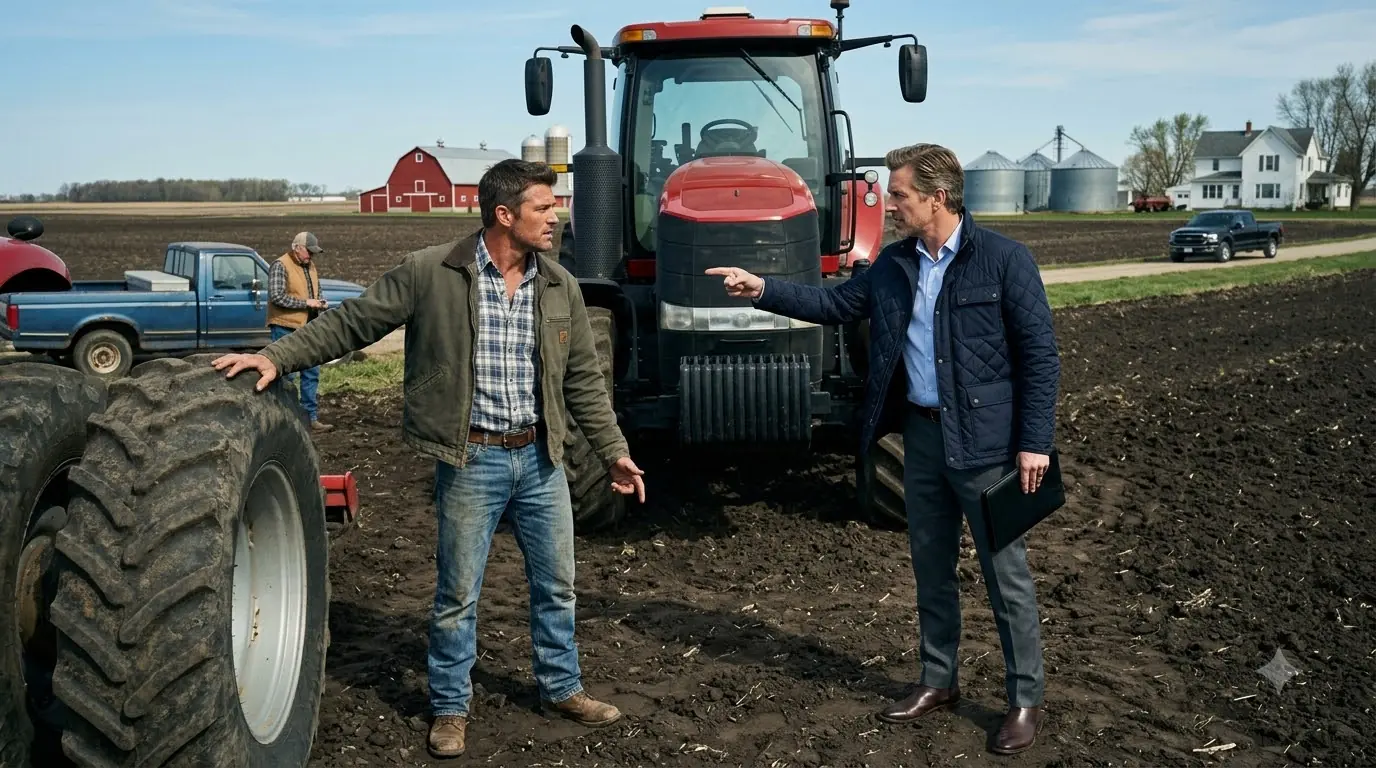
The steering wheel twisted against his palms, the cab dropped to the left, and a metallic slam sounded somewhere below the floor. Before Tom could get his foot properly off the throttle, the machine lurched once more and died.
For a long moment he sat with both hands on the wheel, staring through a windshield coated in spring dust. Ahead lay rows of dark Iowa soil, the boundary fence, a stand of cottonwoods along the creek, and a pale strip crossing his path at an angle that made no sense among the straight planting rows. He did not have to check the display or climb down to know what had happened to his morning. He recognized the spot. The first tractor had broken there, the second had failed a few yards away, and now the third sat motionless in the same narrow band of ground.
The silence after a powerful diesel stops suddenly is a silence a farmer never forgets. Tom could hear his own breathing, a meadowlark somewhere near the fence, and the faint clink of metal cooling under the hood. He tried the ignition once, then caught himself and stopped before doing more damage. An orange warning symbol remained on the dash. He looked at it without understanding the warning, because all his mind would allow him to understand was that another machine was gone.
He was fifty-one years old, and he had worked the Brant farm nearly every spring he could remember. He had endured late snow, blistering summers, low corn prices, hail, fuel bills, and years when the bank's patience seemed shorter than the growing season. He knew that the land could punish a person without ever appearing to change. But he had never seen it pick three machines in a row and break each one in a different way. That was what frightened him, more than the money and more than the possibility of missing the planting window.
When he finally climbed down, his boots landed on ground that looked perfectly ordinary. The rental tractor was an expensive machine, almost eighty-five thousand dollars of used but carefully maintained glass and steel that the dealership had made him promise to return without damage. Its rear tire had settled several inches lower than the other, although the tread itself appeared intact. A shallow crease disturbed the soil immediately behind it. Tom crouched to touch the crease, then stood because he could feel anger rising and did not trust himself to make a sensible decision with it.