One man grabbed Jack Whitmore by the throat while the other locked his arms behind his back and shoved a folded deed against his chest. Sign it or by morning everything turns to ash. One of Derrick Lawson’s men snarled Lawson was the developer who had spent a year trying to force him off this land. Jack said nothing. They dragged him to the South Field doused it in gasoline and set it burning while he stood pinned forced to watch 35 years of work with Emily turn to smoke.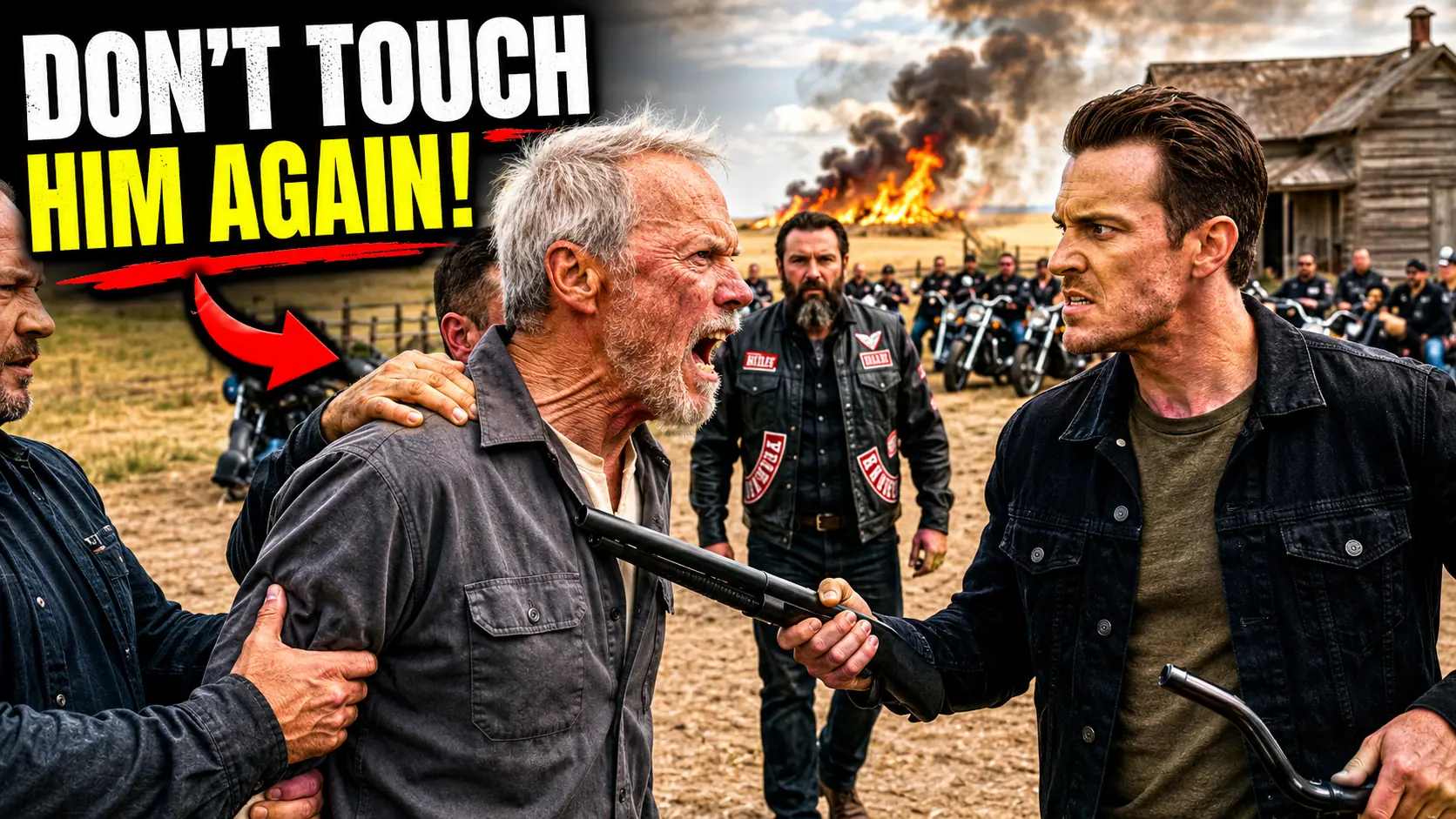
They weren’t finished. One spat at his boots. Another pressed a shotgun barrel under his chin. Old men who won’t quit end up buried here. Jack looked him dead in the eye. You don’t know whose land this is. What none of them knew that quiet farmer had once ridden as national road captain for the Hell’s Angels a man they called Talon whose name once emptied bars in six states before he hung up his colors for a woman named Emily.
Within six hours 62 Hell’s Angels rode into Larkspur County and did something that left the entire county speechless. This is Heart Tales. Now let’s go back and find out exactly how it happened.
The man’s fingers stayed locked around Jack’s throat for 11 full seconds before he let go. And in those seconds Jack counted the trucks parked at the edge of his own driveway counted the men leaning against them counted the single dirt road out. Diesel hung thick in the air mixing with the sweetness of burning wheat. Gravel bit into his knees where they’d forced him down.
That same man was Cole Ashford the one who’d shoved the deed against Jack’s chest minutes earlier and now carried a shotgun. He hadn’t bothered showing until now. He was younger than the others maybe 30 with a jaw that never stopped working even when his mouth was closed. He walked the barrel up from Jack’s chest to his chin slow like he wanted Jack to feel every inch of it. Mr Lawson said to give you one more chance.
He tilted his head toward the field where flames had already swallowed the fence line and were climbing the old oak post. Emily used to lean her bicycle against it. Consider this the polite version. Jack’s palm was still bleeding from the gravel. He let it hang open at his side. Blood tracking a slow line toward his wrist. And he watched the fire the way a man watches weather something to be outlasted not fought. You’ve got until sunrise.
Cole said he backed toward the truck shotgun still raised eyes never leaving Jack’s face. Sign the papers or the house is next. The trucks pulled out one after another. Headlights sweeping across the barn across the mailbox Emily had painted with sunflowers across the man standing alone in the middle of his own scorched yard. The sound of engines faded down Route 14 until there was nothing left but the crackle of the fire and the tick of a fence post cooling in the dark.
Jack didn’t move for a long moment. Then he walked to the stand pipe by the barn dragged the hose across the yard and put out what he could of the fence line by hand one section at a time while the south field burned itself down to black behind him. Smoke stung his eyes. His shoulders ached in a way they hadn’t ached in three and a half decades. When there was nothing left to save he went inside ran his torn hand under the kitchen tap wincing as cold water found the raw edges of the cut and wrapped it in a dish towel that still smelled faintly of Emily’s lavender soap.
He stood at the window for a while looking out at what used to be a field. Then he opened the drawer beneath the phone the one he hadn’t opened since the funeral and took out a small leather address book with a cracked spine. There was one number written inside the back cover in handwriting that wasn’t his. He dialed it from memory before he’d even finished opening the book. It rang four times on the 5th. A voice answered rough with sleep and cigarettes.
Yeah it’s Whitmore. Jack said. The silence on the other end lasted three full seconds. Then Jack Whitmore I need you. Jack said he kept his voice level offering no explanation of the fire the deed or the shotgun. He said only what needed saying tonight. If you can another silence shorter this time where Jack gave the address. He didn’t need to give directions. Some men never forget a road once they’ve bled on it.
Six hours the voice said. Maybe less. The line went dead. Jack set the phone back in its cradle and sat down at the kitchen table across from Emily’s empty chair. The dish towel darkening slowly around his hand. Outside what remained of the south field glowed faint orange against the dark like something still breathing. He had told himself 35 years ago that he would never make that call. He had told himself a great many things back then.
This story doesn’t begin with the fire. It begins two years before it on a gray October morning when Jack Whitmore buried his wife of 46 years in the small cemetery behind Larkspur Methodist and came home to a farmhouse that suddenly felt three sizes too large. Emily had been the one who talked to people. Jack had been the one who fixed fences and rotated the wheat and let her do the talking without her.
The farmhouse settled into a silence so complete that Jack sometimes caught himself speaking to the dog just to hear a human voice answer back even if it was only his own. He kept the place running out of habit more than ambition. 400 acres of wheat and hay along Route 14 a barn his grandfather built with cedar he’d hauled down from the Bitter Roots a farmhouse kitchen that still smelled of Emily’s canning jars lined up on the window sill. He rose before dawn most mornings now fed the two horses that were all that remained of a once larger herd and worked steadily until his aching knees told him to stop.
It was not a hard life. It was a quiet one. And after 46 years of noise quiet had started to feel like its own kind of company. Neighbors along Route 14 knew him as a man who waved from his truck but rarely stopped to talk who paid his feed bill in full and on time every month at Kesslers Supply in Ridgeland who showed up to help pull a stranger’s tractor out of a ditch without ever mentioning it afterward and who could fix nearly anything mechanical on the property without once consulting a manual.
Nobody in three decades had heard him raise his voice. Nobody had ever seen him lose a fight. Mostly because nobody in three decades had ever seen him get into one. The wheat rows he planted every spring ran straighter than any other farm along that stretch of highway. A habit some old part of him had carried over from a different kind of discipline though he never spoke of where the habit came from.
The farmhouse itself sat a quarter mile back from the road. White paint gone soft gray at the edges. A porch that creaked in exactly the same three spots it had creaked in for 40 years. Inside little had changed since Emily’s last winter. Her reading chair still angled toward the wood stove. Her sewing basket still tucked beside it. Half-finished mending inside that Jack had never been able to bring himself to either finish or throw away.
Derek Lawson found him in April one year and two months after the funeral standing at the edge of the south field in a suit that cost more than Jack’s truck. Mr Whitmore he offered a handshake. Jack didn’t take it. I represent a group looking to develop this corridor. We’d like to make you an offer. A generous one. He named a number. It was three times what the land had ever been worth on paper and Jack still said no.
The man kept offering more money more promises more pressure until one evening in late June when Jack finally said yes. He took the check cash and the next morning drove out to the county courthouse to sign the papers. The deal was done. The land was gone. Emily’s garden photographs were still in the drawer beneath the phone right beside the cracked leather address book. Jack drove home alone that night feeling nothing but the quiet that had settled over him for two years.
He had told himself 35 years ago that he would never make that call. He had told himself a great many things back then. This story doesn’t begin with the fire. It begins two years before it on a gray October morning when Jack Whitmore buried his wife of 46 years in the small cemetery behind Larkspur Methodist and came home to a farmhouse that suddenly felt three sizes too large.
Emily had been the one who talked to people. Jack had been the one who fixed fences and rotated the wheat and let her do the talking without her. The farmhouse settled into a silence so complete that Jack sometimes caught himself speaking to the dog just to hear a human voice answer back even if it was only his own. He kept the place running out of habit more than ambition. 400 acres of wheat and hay along Route 14 a barn his grandfather built with cedar he’d hauled down from the Bitter Roots a farmhouse kitchen that still smelled of Emily’s canning jars lined up on the window sill.
He rose before dawn most mornings now fed the two horses that were all that remained of a once larger herd and worked steadily until his aching knees told him to stop. It was not a hard life. It was a quiet one. And after 46 years of noise quiet had started to feel like its own kind of company. Neighbors along Route 14 knew him as a man who waved from his truck but rarely stopped to talk who paid his feed bill in full and on time every month at Kesslers Supply in Ridgeland who showed up to help pull a stranger’s tractor out of a ditch without ever mentioning it afterward and who could fix nearly anything mechanical on the property without once consulting a manual.
Nobody in three decades had heard him raise his voice. Nobody had ever seen him lose a fight. Mostly because nobody in three decades had ever seen him get into one. The wheat rows he planted every spring ran straighter than any other farm along that stretch of highway. A habit some old part of him had carried over from a different kind of discipline though he never spoke of where the habit came from.
The farmhouse itself sat a quarter mile back from the road. White paint gone soft gray at the edges. A porch that creaked in exactly the same three spots it had creaked in for 40 years. Inside little had changed since Emily’s last winter. Her reading chair still angled toward the wood stove. Her sewing basket still tucked beside it. Half-finished mending inside that Jack had never been able to bring himself to either finish or throw away.
Derek Lawson found him in April one year and two months after the funeral standing at the edge of the south field in a suit that cost more than Jack’s truck. Mr Whitmore he offered a handshake. Jack didn’t take it. I represent a group looking to develop this corridor. We’d like to make you an offer. A generous one. He named a number. It was three times what the land had ever been worth on paper and Jack still said no.
The man kept offering more money more promises more pressure until one evening in late June when Jack finally said yes. He took the check cash and the next morning drove out to the county courthouse to sign the papers. The deal was done. The land was gone. Emily’s garden photographs were still in the drawer beneath the phone right beside the cracked leather address book. Jack drove home alone that night feeling nothing but the quiet that had settled over him for two years.
He had told himself 35 years ago that he would never make that call. He had told himself a great many things back then. This story doesn’t begin with the fire. It begins two years before it on a gray October morning when Jack Whitmore buried his wife of 46 years in the small cemetery behind Larkspur Methodist and came home to a farmhouse that suddenly felt three sizes too large. Emily had been the one who talked to people. Jack had been the one who fixed fences and rotated the wheat and let her do the talking without her.
The farmhouse settled into a silence so complete that Jack sometimes caught himself speaking to the dog just to hear a human voice answer back even if it was only his own. He kept the place running out of habit more than ambition. 400 acres of wheat and hay along Route 14 a barn his grandfather built with cedar he’d hauled down from the Bitter Roots a farmhouse kitchen that still smelled of Emily’s canning jars lined up on the window sill. He rose before dawn most mornings now fed the two horses that were all that remained of a once larger herd and worked steadily until his aching knees told him to stop.
It was not a hard life. It was a quiet one. And after 46 years of noise quiet had started to feel like its own kind of company. Neighbors along Route 14 knew him as a man who waved from his truck but rarely stopped to talk who paid his feed bill in full and on time every month at Kesslers Supply in Ridgeland who showed up to help pull a stranger’s tractor out of a ditch without ever mentioning it afterward and who could fix nearly anything mechanical on the property without once consulting a manual. Nobody in three decades had heard him raise his voice. Nobody had ever seen him lose a fight. Mostly because nobody in three decades had ever seen him get into one.
The wheat rows he planted every spring ran straighter than any other farm along that stretch of highway. A habit some old part of him had carried over from a different kind of discipline though he never spoke of where the habit came from. The farmhouse itself sat a quarter mile back from the road. White paint gone soft gray at the edges. A porch that creaked in exactly the same three spots it had creaked in for 40 years. Inside little had changed since Emily’s last winter. Her reading chair still angled toward the wood stove. Her sewing basket still tucked beside it. Half-finished mending inside that Jack had never been able to bring himself to either finish or throw away.
Derek Lawson found him in April one year and two months after the funeral standing at the edge of the south field in a suit that cost more than Jack’s truck. Mr Whitmore he offered a handshake. Jack didn’t take it. I represent a group looking to develop this corridor. We’d like to make you an offer. A generous one. He named a number. It was three times what the land had ever been worth on paper and Jack still said no. The man kept offering more money more promises more pressure until one evening in late June when Jack finally said yes. He took the check cash and the next morning drove out to the county courthouse to sign the papers. The deal was done. The land was gone. Emily’s garden photographs were still in the drawer beneath the phone right beside the cracked leather address book. Jack drove home alone that night feeling nothing but the quiet that had settled over him for two years.
He had told himself 35 years ago that he would never make that call. He had told himself a great many things back then. This story doesn’t begin with the fire. It begins two years before it on a gray October morning when Jack Whitmore buried his wife of 46 years in the small cemetery behind Larkspur Methodist and came home to a farmhouse that suddenly felt three sizes too large. Emily had been the one who talked to people. Jack had been the one who fixed fences and rotated the wheat and let her do the talking without her. The farmhouse settled into a silence so complete that Jack sometimes caught himself speaking to the dog just to hear a human voice answer back even if it was only his own. He kept the place running out of habit more than ambition. 400 acres of wheat and hay along Route 14 a barn his grandfather built with cedar he’d hauled down from the Bitter Roots a farmhouse kitchen that still smelled of Emily’s canning jars lined up on the window sill. He rose before dawn most mornings now fed the two horses that were all that remained of a once larger herd and worked steadily until his aching knees told him to stop.
It was not a hard life. It was a quiet one. And after 46 years of noise quiet had started to feel like its own kind of company. Neighbors along Route 14 knew him as a man who waved from his truck but rarely stopped to talk who paid his feed bill in full and on time every month at Kesslers Supply in Ridgeland who showed up to help pull a stranger’s tractor out of a ditch without ever mentioning it afterward and who could fix nearly anything mechanical on the property without once consulting a manual. Nobody in three decades had heard him raise his voice. Nobody had ever seen him lose a fight. Mostly because nobody in three decades had ever seen him get into one.
The wheat rows he planted every spring ran straighter than any other farm along that stretch of highway. A habit some old part of him had carried over from a different kind of discipline though he never spoke of where the habit came from. The farmhouse itself sat a quarter mile back from the road. White paint gone soft gray at the edges. A porch that creaked in exactly the same three spots it had creaked in for 40 years. Inside little had changed since Emily’s last winter. Her reading chair still angled toward the wood stove. Her sewing basket still tucked beside it. Half-finished mending inside that Jack had never been able to bring himself to either finish or throw away.
Derek Lawson found him in April one year and two months after the funeral standing at the edge of the south field in a suit that cost more than Jack’s truck. Mr Whitmore he offered a handshake. Jack didn’t take it. I represent a group looking to develop this corridor. We’d like to make you an offer. A generous one. He named a number. It was three times what the land had ever been worth on paper and Jack still said no. The man kept offering more money more promises more pressure until one evening in late June when Jack finally said yes. He took the check cash and the next morning drove out to the county courthouse to sign the papers. The deal was done. The land was gone. Emily’s garden photographs were still in the drawer beneath the phone right beside the cracked leather address book. Jack drove home alone that night feeling nothing but the quiet that had settled over him for two years.
He had told himself 35 years ago that he would never make that call. He had told himself a great many things back then. This story doesn’t begin with the fire. It begins two years before it on a gray October morning when Jack Whitmore buried his wife of 46 years in the small cemetery behind Larkspur Methodist and came home to a farmhouse that suddenly felt three sizes too large. Emily had been the one who talked to people. Jack had been the one who fixed fences and rotated the wheat and let her do the talking without her. The farmhouse settled into a silence so complete that Jack sometimes caught himself speaking to the dog just to hear a human voice answer back even if it was only his own. He kept the place running out of habit more than ambition. 400 acres of wheat and hay along Route 14 a barn his grandfather built with cedar he’d hauled down from the Bitter Roots a farmhouse kitchen that still smelled of Emily’s canning jars lined up on the window sill. He rose before dawn most mornings now fed the two horses that were all that remained of a once larger herd and worked steadily until his aching knees told him to stop.
It was not a hard life. It was a quiet one. And after 46 years of noise quiet had started to feel like its own kind of company. Neighbors along Route 14 knew him as a man who waved from his truck but rarely stopped to talk who paid his feed bill in full and on time every month at Kesslers Supply in Ridgeland who showed up to help pull a stranger’s tractor out of a ditch without ever mentioning it afterward and who could fix nearly anything mechanical on the property without once consulting a manual. Nobody in three decades had heard him raise his voice. Nobody had ever seen him lose a fight. Mostly because nobody in three decades had ever seen him get into one.
The wheat rows he planted every spring ran straighter than any other farm along that stretch of highway. A habit some old part of him had carried over from a different kind of discipline though he never spoke of where the habit came from. The farmhouse itself sat a quarter mile back from the road. White paint gone soft gray at the edges. A porch that creaked in exactly the same three spots it had creaked in for 40 years. Inside little had changed since Emily’s last winter. Her reading chair still angled toward the wood stove. Her sewing basket still tucked beside it. Half-finished mending inside that Jack had never been able to bring himself to either finish or throw away.
Derek Lawson found him in April one year and two months after the funeral standing at the edge of the south field in a suit that cost more than Jack’s truck. Mr Whitmore he offered a handshake. Jack didn’t take it. I represent a group looking to develop this corridor. We’d like to make you an offer. A generous one. He named a number. It was three times what the land had ever been worth on paper and Jack still said no. The man kept offering more money more promises more pressure until one evening in late June when Jack finally said yes. He took the check cash and the next morning drove out to the county courthouse to sign the papers. The deal was done. The land was gone. Emily’s garden photographs were still in the drawer beneath the phone right beside the cracked leather address book. Jack drove home alone that night feeling nothing but the quiet that had settled over him for two years.
He had told himself 35 years ago that he would never make that call. He had told himself a great many things back then. This story doesn’t begin with the fire. It begins two years before it on a gray October morning when Jack Whitmore buried his wife of 46 years in the small cemetery behind Larkspur Methodist and came home to a farmhouse that suddenly felt three sizes too large. Emily had been the one who talked to people. Jack had been the one who fixed fences and rotated the wheat and let her do the talking without her. The farmhouse settled into a silence so complete that Jack sometimes caught himself speaking to the dog just to hear a human voice answer back even if it was only his own. He kept the place running out of habit more than ambition. 400 acres of wheat and hay along Route 14 a barn his grandfather built with cedar he’d hauled down from the Bitter Roots a farmhouse kitchen that still smelled of Emily’s canning jars lined up on the window sill. He rose before dawn most mornings now fed the two horses that were all that remained of a once larger herd and worked steadily until his aching knees told him to stop.
It was not a hard life. It was a quiet one. And after 46 years of noise quiet had started to feel like its own kind of company. Neighbors along Route 14 knew him as a man who waved from his truck but rarely stopped to talk who paid hisOne man grabbed Jack Whitmore by the throat.
The other locked his arms behind his back and shoved a folded deed against his chest.
Sign it or by morning everything turns to ash.
One of Derrick Lawson’s men snarled.
Lawson was the developer who had spent a year trying to force him off this land.
Jack said nothing.
They dragged him to the South Field.
Doused it in gasoline and set it burning while he stood pinned.
Forced to watch 35 years of work with Emily turn to smoke.
They weren’t finished.
One spat at his boots.
Another pressed a shotgun barrel under his chin.
Old men who won’t quit end up buried here.
Jack looked him dead in the eye.
You don’t know whose land this is.
What none of them knew was that quiet farmer.
Had once ridden as national road captain for the Hell’s Angels.
A man they called Talon.
Whose name once emptied bars in six states.
Before he hung up his colors for a woman named Emily.
Within six hours.
62 Hell’s Angels rode into Larkspur County.
And did something that left the entire county speechless.
This is heart tales.
Now let’s go back and find out exactly how it happened.
The man’s fingers stayed locked around Jack’s throat.
For 11 full seconds before he let go.
And in those seconds Jack counted the trucks.
Parked at the edge of his own driveway.
Counted the men leaning against them.
Counted the single dirt road out.
Diesel hung thick in the air.
Mixing with the sweetness of burning wheat.
Gravel bit into his knees where they’d forced him down.
That same man was Cole Ashford.
The one who’d shoved the deed against Jack’s chest.
Minutes earlier and now carried a shotgun.
He hadn’t bothered showing until now.
He was younger than the others.
Maybe 30 with a jaw that never stopped working.
Even when his mouth was closed.
He walked the barrel up from Jack’s chest to his chin.
Slow like he wanted Jack to feel every inch of it.
Mr Lawson said to give you one more chance.
He tilted his head toward the field.
Where flames had already swallowed the fence line.
And were climbing the old oak post.
Emily used to lean her bicycle against.
Consider this the polite version.
Jack’s palm was still bleeding from the gravel.
He let it hang open at his side.
Blood tracking a slow line toward his wrist.
And he watched the fire the way a man watches weather.
Something to be outlasted.
Not fought.
You’ve got until sunrise.
Cole said he backed toward the truck.
Shotgun still raised eyes never leaving Jack’s face.
Sign the papers or the house is next.
The trucks pulled out one after another.
Headlights sweeping across the barn.
Across the mailbox Emily had painted with sunflowers.
Across the man.
Standing alone in the middle of his own scorched yard.
The sound of engines faded down Route 14.
Until there was nothing left.
But the crackle of the fire.
And the tick of a fence post cooling in the dark.
Jack didn’t move for a long moment.
Then he walked to the stand pipe by the barn.
Dragged the hose across the yard.
And put out what he could of the fence line by hand.
One section at a time.
While the south field burned itself down to black.
Behind him smoke stung his eyes.
His shoulders ached.
In a way they hadn’t ached in three and a half decades.
When there was nothing left to save.
He went inside ran his torn hand under the kitchen tap.
Wincing as cold water found the raw edges of the cut.
And wrapped it in a dish towel.
That still smelled faintly of Emily’s lavender soap.
He stood at the window for a while.
Looking out at what used to be a field.
Then he opened the drawer beneath the phone.
The one he hadn’t opened since the funeral.
And took out a small leather address book with a cracked spine.
There was one number written inside the back cover in handwriting that wasn’t his.
He dialed it from memory.
Before he’d even finished opening the book.
It rang four times on the 5th.
A voice answered rough with sleep and cigarettes.
Yeah it’s Whitmore.
Jack said.
The silence on the other end lasted three full seconds.
Then Jack Whitmore I need you.
Jack said he kept his voice level.
Offering no explanation of the fire.
The deed or the shotgun he said.
Only what needed saying tonight.
If you can another silence.
Shorter this time where Jack gave the address.
He didn’t need to give directions.
Some men never forget a road once they’ve bled on it.
Six hours the voice said.
Maybe less the line went dead.
Jack set the phone back in its cradle.
And sat down at the kitchen table.
Across from Emily’s empty chair.
The dish towel darkening slowly around his hand.
Outside what remained of the south field.
Glowed faint orange against the dark.
Like something still breathing.
He had told himself 35 years ago.
That he would never make that call.
He had told himself a great many things back then.
This story doesn’t begin with the fire.
It begins two years before it.
On a gray October morning.
When Jack Whitmore buried his wife of 46 years.
In the small cemetery behind Larkspur Methodist.
And came home to a farmhouse that suddenly felt.
Three sizes too large.
Emily had been the one who talked to people.
Jack had been the one who fixed.
Fences and rotated the wheat and let her do the talking.
Without her.
The farmhouse settled into a silence so complete.
That Jack sometimes caught himself speaking to the dog.
Just to hear a human voice answer back.
Even if it was only his own.
He kept the place running.
Out of habit more than ambition.
400 acres of wheat and hay along Route 14.
A barn his grandfather built with cedar.
He’d hauled down from the Bitter roots.
A farmhouse kitchen that still smelled of Emily’s.
Canning jars lined up on the window sill.
He rose before dawn most mornings now.
Fed the two horses.
That were all that remained of a once larger herd.
And worked steadily.
Until his aching knees told him to stop.
It was not a hard life it was a quiet one.
And after 46 years of noise.
Quiet had started to feel like its own kind of company.
Neighbors along Route 14.
Knew him as a man who waved from his truck.
But rarely stopped to talk.
Who paid his feed Bill in full and on time.
Every month at Kesslers Supply in Ridgeland.
Who showed up to help pull a stranger’s tractor.
Out of a ditch without ever mentioning it afterward.
And who could fix nearly anything.
Mechanical on the property.
Without once consulting a manual.
Nobody in three decades had heard him raise his voice.
Nobody had ever seen him lose a fight.
Mostly because nobody in three decades had ever.
Seen him get into one.
The wheat rows he planted every spring.
Ran straighter than any other farm.
Along that stretch of highway.
A habit some old part of him.
Had carried over from a different kind of discipline.
Though he never spoke of where the habit came from.
The farmhouse.
Itself sat a quarter mile back from the road.
White paint gone soft gray at the edges.
A porch that creaked in exactly the same three spots.
It had creaked in for 40 years.
Inside little had changed since Emily’s last winter.
Her reading chair still angled toward the wood stove.
Her sewing basket still tucked beside it.
Half finished mending inside.
That Jack had never been able to bring himself.
To either finish or throw away.
Derek Lawson found him in April.
One year and two months after the funeral.
Standing at the edge of the south Field.
In a suit that cost more than Jack’s truck.
Mr Whitmore he offered a handshake Jack didn’t take.
I represent a group looking to develop this corridor.
We’d like to make you an offer.
A generous one he named a number.
It was three times what the land had ever been worth.
On paper and Jack still said no.
Jack refused the offer and told him to leave his land alone.
Lawson warned that if Jack didn’t sign by the deadline the whole county would pay for the cleanup.
Jack stood his ground and said he’d rather watch his land burn than sell it.
The next day Derek Lawson sent men to Jack’s field.
They came at night and burned down the fence line.
Jack tried to put it out but the flames spread fast.
The men left a burned marker in the field to remind him of their warning.
Jack went home and sat alone at the kitchen table.
The men who had burned the field were proud of themselves.
They thought they had scared Jack into submission.
But they had no idea what they had just done.
Jack kept their burned marker in the field.
He knew it would never be removed.
Bear and the other Hell’s Angels arrived the next morning.
They saw the burned fence and the marker.
Bear asked Jack what happened.
Jack told them everything from the beginning.
Bear and the others listened without interrupting.
They decided to rebuild the fence line.
They replaced the burned marker with a new one.
The new marker was carved by a member’s daughter.
It had the letters of Emily’s name cut deep.
Bear stayed three days after that first morning.
He slept on Jack’s living room couch.
While half a dozen riders from Ridgeline rebuilt the fence line.
They replaced the burned marker with a new one.
Carved this time by a member’s daughter.
Who did woodwork on the side.
The letters of Emily’s name.
Cut deep enough to outlast another 35 years.
Jack never asked them to he found the finished marker.
Standing at the edge of the south field.
On the fourth morning.
And stood looking at it for a long time.
Before he went inside to make coffee for six.
Unexpected house guests on the third night.
Sitting on the porch with two beers between them.
Bear finally asked the question.
He’d been carrying since the warehouse in Butte.
Why’d you stop all those years back.
You could have kept the patch and had Emily too.
Plenty of men do.
Jack turned the bottle slowly between his palms.
Before he answered she never asked me to choose.
That was the thing about her.
She just started setting two plates instead of one.
Every single night.
Whether I was home to eat off the second one or not.
He looked out at the dark shape of the barn.
After about a year of empty plates.
A man starts doing the math himself.
Bear didn’t say anything to that.
He didn’t need to.
He understood plate math better than most men his age.
Having eaten alone at a kitchen table of his own.
For the better part of two decades.
Bear rode out on the fourth morning.
The rest of the chapter following behind him.
In a column.
That took almost four minutes to clear the driveway.
Jack stood on the porch and watched.
Until the last tail light disappeared.
Around the bend on Route 14.
Then went inside and for the first time in two years.
Left both of Emily’s canning jars on the windowsill.
Exactly where she’d always kept them.
Rather than moving them to make room for anything else.
Six months later.
The Larksburg County Fair held its Harvest Festival.
On the same weekend as always.
And Jack Whitmore entered his wheat.
In the county competition.
For the first time in three years.
Taking second place.
Behind a younger farmer two towns over.
He didn’t mind losing he minded a little.
That Emily wasn’t there to gloat about it.
Since she’d always been the better gardener.
Between them and had never once let him forget it.
The fairground smelled the way it always had.
Every September of his life.
Fried dough and diesel from the tractor pulls.
And the particular.
Dust that only rises off a livestock ring.
In late summer.
Jack walked the grounds slowly that afternoon.
Stopping at the quilting tent.
Where Emily used to enter a piece.
Most years more out of habit than any real hope.
Of placing and found himself.
Standing there longer than he’d planned.
Running his thumb along the edge of a stranger’s.
Stitching the way another man might touch a photograph.
Priscilla Donnelly found him there.
And walked with him for a while.
Without saying much of anything.
Which suited them both.
Near the fence line by the horse ring.
A boy of about 9 asked Jack.
With the blunt honesty only children manage.
Whether it was true he used to be a real Hell’s Angel.
Jack considered the question seriously.
The way he considered most things.
And told the boy that a long time ago.
He’d been part of something.
And that the something had mattered less in the end.
Than who a man chose to come home to every night.
The boy didn’t fully understand the answer.
Jack hadn’t expected him to.
Some answers are planted for later.
Not for the asking.
He kept one photograph from that whole ordeal.
Taken by a neighbor’s daughter on her phone.
The morning the riders arrived.
62 motorcycles.
Parked at strange angles across a scorched field.
Dawn light catching on chrome.
One old man standing at the center of it all.
With his hands still wrapped in a dish towel.
He had it printed at the drugstore in Ridgeline.
The same drugstore.
Where Emily used to develop her garden photographs.
Every autumn.
And kept it in the kitchen drawer beneath the phone.
Next to the leather address book with the cracked spine.
In case anyone in Larkspur County ever needed reminding.
What a promise looked like.
When it finally came due.
Bear still calls every few months now.
Mostly to talk about nothing in particular.
Weather harvest.
The price of diesel whichever county fair results.
Jack feels like arguing about that week.
Neither man has ever said the word friendship out loud.
They haven’t needed to some things.
Once a debt has been settled clean.
Simply become what they were always meant to be.
There is a particular kind of quiet that surrounds men.
Like Jack Whitmore.
Men who spend a lifetime being underestimated.
By the very stillness that makes them dangerous.
It isn’t a performance.
It’s a habit built one difficult choice at a time.
The choice to walk away from power.
In favor of something smaller and harder.
To protect a woman a kitchen table.
35 ordinary mornings in a row.
That kind of quiet.
Doesn’t come from having nothing left to prove.
It comes from having already proven it once.
When no one was watching.
And deciding that was enough for one lifetime.
What Derek Lawson never understood.
Standing in that field with a folded deed.
And a man he mistook for an easy target.
Is that debts of a certain kind don’t disappear.
Just because they go unspoken.
For 35 years they wait.
Patient as soil for exactly the season they’re needed.