“Touch it and I’ll put your hand in next,” the arrogant gang leader sneered, grabbing a fistful of Clara’s hair and driving her to her knees beside the fire. Right in front of her he struck a match. Two years of hand-tooled leather, the last connection to her late grandfather, went up in flames. Clara sobbed, utterly helpless and humiliated by a billionaire’s hired thug who thought his money gave him the right to destroy her life. But as the flames climbed, Clara’s shaking hand reached across the workbench. She grabbed a bone-handled awl and a pair of shears, crossing them into a clean X, blades out. It was a secret distress signal her grandfather taught her the year before he died. The thug was too busy watching the fire to notice, but Silas, the quiet old man behind the counter, did.
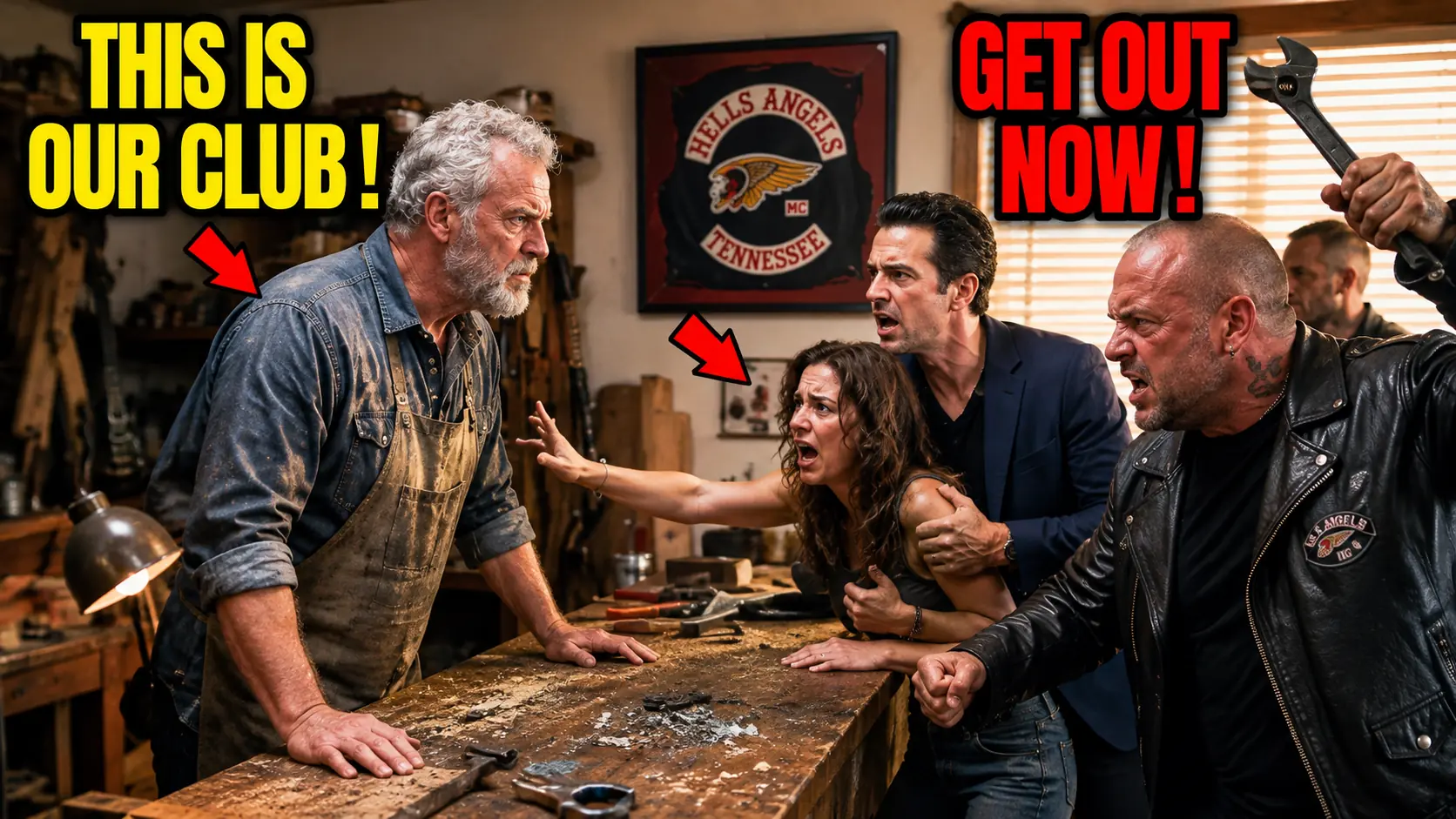
The saddle collapsed into embers. Clara screamed and lunged for it, and the gang leader—Julian Ashford, twenty-six, hair combed too carefully for a man doing arson—grabbed a fistful of her hair and drove her to her knees beside the fire. “Touch it and I’ll put your hand in next,” he said. Behind the cutting counter, sixty-five-year-old Silas Calaway did not move. He had learned a long time ago that stillness read as surrender to men who had never needed to be still themselves. Clara’s eyes found him across the smoke. He was the only person in the room not looking at the fire. She thought of the signal one heartbeat before she made it, her grandfather’s voice six years gone still in her ear: If it’s ever real trouble, Clara, the kind that doesn’t leave when you ask it to, you cross the awl over the shears where the window can see it. You don’t wait to be sure. You do it the second you’re not.
Her hand found the workbench behind her, hidden by her own shoulder from the three men flanking Julian. Two seconds—that was all it took. The awl’s bone handle came down across the shears in a clean X, blades out facing Warren Avenue and the plate-glass window beyond it. She had done it a hundred times in practice with her grandfather years ago in an empty shop after closing, until her hands knew the motion without her mind. None of the four men saw it. They were watching two years of hand-tooled leather turn to ash. Silas saw it. Something in his face changed for exactly one second—not fear, not surprise, something older and colder that had been asleep for eighteen years and had just opened one eye. Then it was gone and he was the quiet old man again.
“What do you think you’re doing, old man?” Julian said, releasing Clara’s hair and turning toward the register, already bored with her. He would not get the chance to be bored with anything else that day. Silas crossed the shop floor faster than a sixty-five-year-old man should be able to move, flipped the heavy brass deadbolt on the front door, and let the click echo through the room like a verdict. Julian turned. “I said, what are you doing?” Silas answered him with a rawhide mallet pulled from beneath the counter in the same motion that threw the bolt. He stepped into the narrow aisle between the workbenches—a choke point he had chosen the day he built those benches eighteen years ago without knowing why he wanted one—and let the first man come to him one at a time because the aisle made sure of it.
The mallet’s wooden head found the man’s kneecap with a sound like a dropped melon, and the man folded sideways into a rack of stretching frames without a word. The second man pulled a switchblade more out of panic than plan. Silas caught his wrist mid-swing, twisted until the tendons gave, and drove the blunt steel handle of a heavy leather shears into his ribs with a single economical motion—no wasted movement, no wasted breath—until the knife clattered against the floorboards and the man folded, gasping, into the spilled dye pooling near the counter. The third, Julian himself, swung a steel wrench in a wide, panicked arc that would have opened Silas’s skull if it had landed. It never came close. Silas ducked under it in a motion so unhurried it looked almost lazy, caught the extended arm at the wrist, planted his boots, and broke it at the elbow with the flat efficiency of a man closing a door he’d closed a thousand times before. Julian went down screaming. The fourth man slipped in the spilled dye and did not get up at all. Nineteen seconds. Clara would count them later, replaying the scene in her mind for months and always arrive at nineteen.
For a moment nobody in the shop moved at all. Smoke drifted sideways through a shaft of afternoon light. A single ember lifted off the ruined saddle, floated the length of the room, and settled unnoticed on the toe of Julian’s boot. Clara knelt exactly where she’d been thrown, glass in her palms, watching an old man she thought she knew rearrange her entire understanding of him in the space of nineteen seconds. You’ve spent your whole life being told that danger announces itself, that it’s loud before it’s dangerous. Ask yourself honestly: if you’d worked beside this man for three years, refilling his coffee, listening to him hum off-key while he cut leather, would you have seen this coming? Most people never do. That’s the whole point of a man like Silas Calaway.
Silas set the mallet on the counter, stepped past the groaning men, and knelt at a rusted iron trunk in the corner of the shop. He had not opened it in eighteen years. She didn’t know who he was, and to understand why that mattered the story has to start eighteen years earlier with a promise made in a hospital room and a debt that had waited nine years before that to be repaid. Cheyenne Leatherworks had stood on Warren Avenue since 1964, when Clara’s grandfather Walt Whitfield hung a hand-lettered sign in the window and started stitching harness leather for ranchers who paid him in beef and firewood as often as cash. Clara grew up in the smell of that shop—neatsfoot oil, tanned hide, the particular scorched-sugar smell of a hot stamping iron—and by the time she was twenty-two she could cut a pattern freehand that a machine would have needed a template for.
Her mornings had a shape she could have described with her eyes closed. She unlocked the front door at 6:45. She ground coffee beans loud enough to cover the quiet, because the quiet in that shop was the kind that took getting used to. She ran her palm along the edge of the workbench on her way to the back room, an old habit inherited from watching her grandfather do the same thing for twenty years, checking the wood the way another person might check their own pulse. She loved the quiet of the work, the way a good piece of leather told you what it wanted to become if you paid attention, the grain rising up under a stamping tool like something remembering its own shape. She loved that Silas never explained anything twice because he trusted her to remember the first time. And she loved—though she would not have used this word for it—the particular safety of working beside a man who never once in three years raised his voice.