Three men kicked in the door of Earl Dawson’s Diner and started trashing the place. They broke chairs, smashed the counter glass, and threw an old man’s life’s work onto the floor. They grabbed his waitress and slammed her into the wall. The old man behind the counter just stood there—sixty-seven years old, grey hair, hands that hadn’t been in a fight in forty years. He had one choice in that moment: stand down and let them wreck everything he’d built, or do something he swore he’d never do again. What those three men didn’t know was who they had just walked in on. Forty years ago, men twice their size used to go quiet when Earl Dawson’s name came up. Nobody in this diner that morning had any idea what was about to happen, or why a kid named Curtis Lane should never have sent his crew through that door.
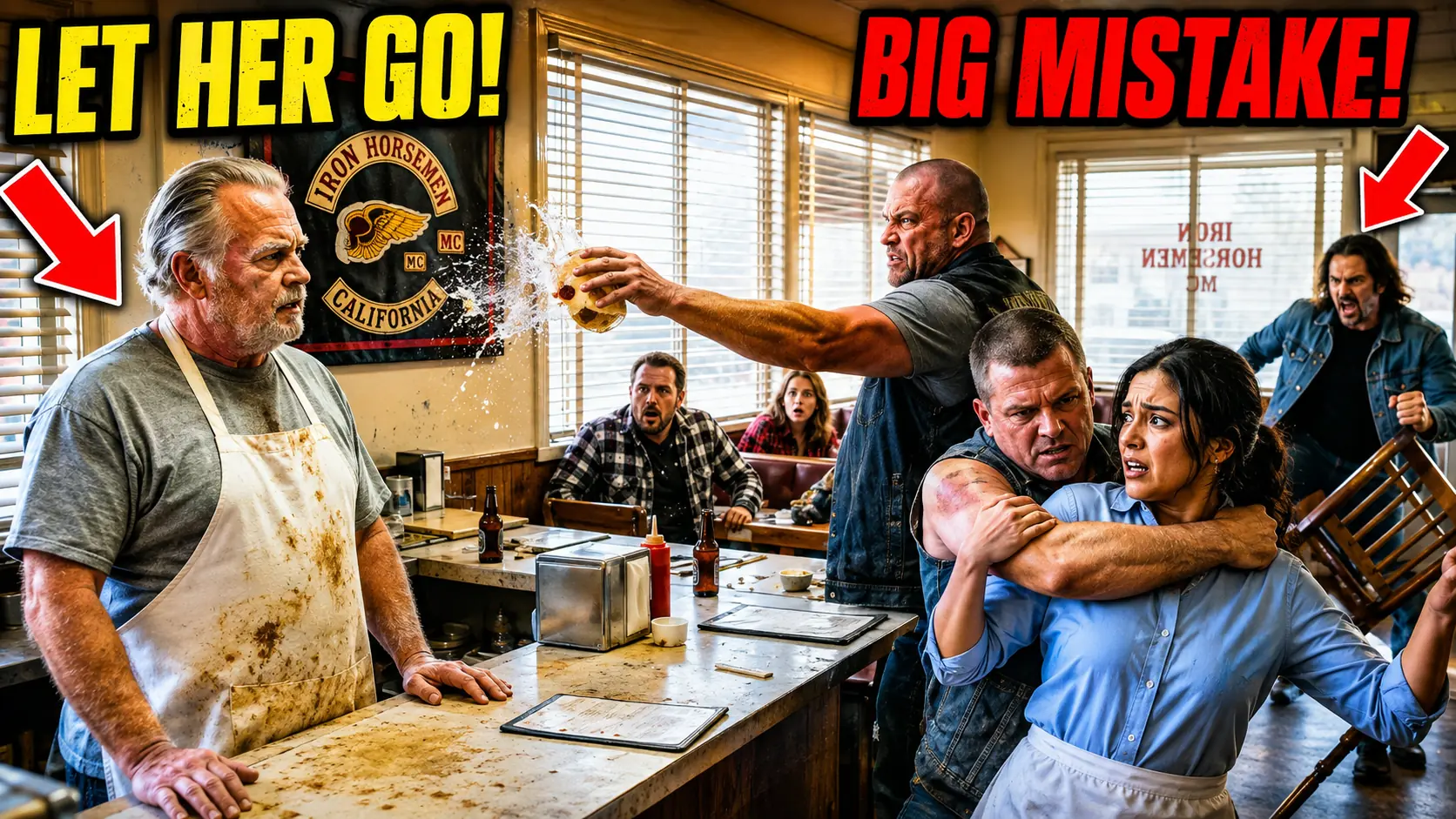
It started thirty seconds earlier than that. The door hadn’t even finished swinging when the first one—a thick-necked guy with a shaved head—put his boot through a chair just to announce they’d arrived. The second one walked straight down the counter, knocking over the ketchup bottles, the napkin holders, the little vase with the plastic flower Sarah had put there herself. Pure noise. Pure mess. The kind of thing that’s not about damage—it’s about making sure everyone in the room understands who’s in charge for the next few minutes. The third one was the one who grabbed Sarah. He didn’t ask her to move. He just took her arm and threw her, and she hit the edge of the counter hard enough that her knees went out from under her. That’s when Earl set the spatula down. He came around the end of the counter the way he did everything—slow, unhurried, like a man who had all the time in the world.
The shaved-head one saw him coming and laughed. An old man in an apron walking toward three of them like he had any business doing that. He stopped laughing about four seconds later. Earl gave him a chance first. He stood there a half-second longer than he needed to and said one thing quiet: “Walk out now and we forget this happened.” The kid swung instead. Earl let the punch come to him, watched the fist travel, and at the last possible second tilted his head three inches to the left. The punch went past his ear into nothing. Before that kid even understood he’d missed, Earl’s hand was already closing around the back of his neck. One motion. The kid’s face met the edge of a table, and he didn’t get back up. The other two stopped moving for one full second. The only sound in that diner was a coffee pot still hissing on the burner. Then the second one picked up a chair because somebody had to do something. And Earl Dawson, sixty-seven years old, shifted his weight the way a man does right before he stops waiting.
Earl Dawson had opened that diner at five o’clock every morning for nineteen years running—same time every single day. By the time the first trucker walked through the door, the place already smelled like bacon, grease, and coffee strong enough to strip paint. In a town like Millbrook, Ohio, that smell was about the closest thing to church most men ever got. He was not a big man. He was the kind of big that comes from forty years of hard living settling into a man’s bones and never quite leaving. Grey hair cut short. Beard trimmed close. Quiet, mostly—but when Earl Dawson talked, people leaned in. Sarah Mills had walked into that diner eight months earlier looking for work. Earl hadn’t asked her many questions. Twenty-four years old. Sharp. The type who’d learned the hard way not to trust people too fast. He gave her an apron, a key to the back door, and not once in eight months did he raise his voice at her.
Millbrook had been a quiet town for a long time. Then about six months before that morning, the quiet started cracking at the edges. A new outfit moved in. They called themselves the Black Vipers. Young. Mean in the particular way young men get mean when they’ve found a shortcut to feeling powerful. Their operation wasn’t complicated. Walk into a small business, explain that the neighborhood had gotten dangerous, and offer protection for a modest weekly fee. The hardware store paid first. The laundromat went next. The tire shop held out almost a month until a brick went through their window. Within a season, every business on that stretch of road was leaving an envelope on a counter every Friday. Nobody fought it. Fighting it got your windows broken—or worse. Their leader called himself Curtis Lane. Twenty-seven years old. Tattoos climbing both sides of his neck. A smile that never once made it as far as his eyes. He’d built the whole operation up from nothing and was visibly proud of it. People who’d known him longer said he’d grown up watching his father get pushed around by every landlord in three counties, never once pushing back. And Curtis had decided early on that nobody would ever look at him that way. He’d built fear instead of respect, because fear was faster.