Thugs Trashed Old Veteran's Diner, Didn't Know He Was the Most Lethal Hells Angel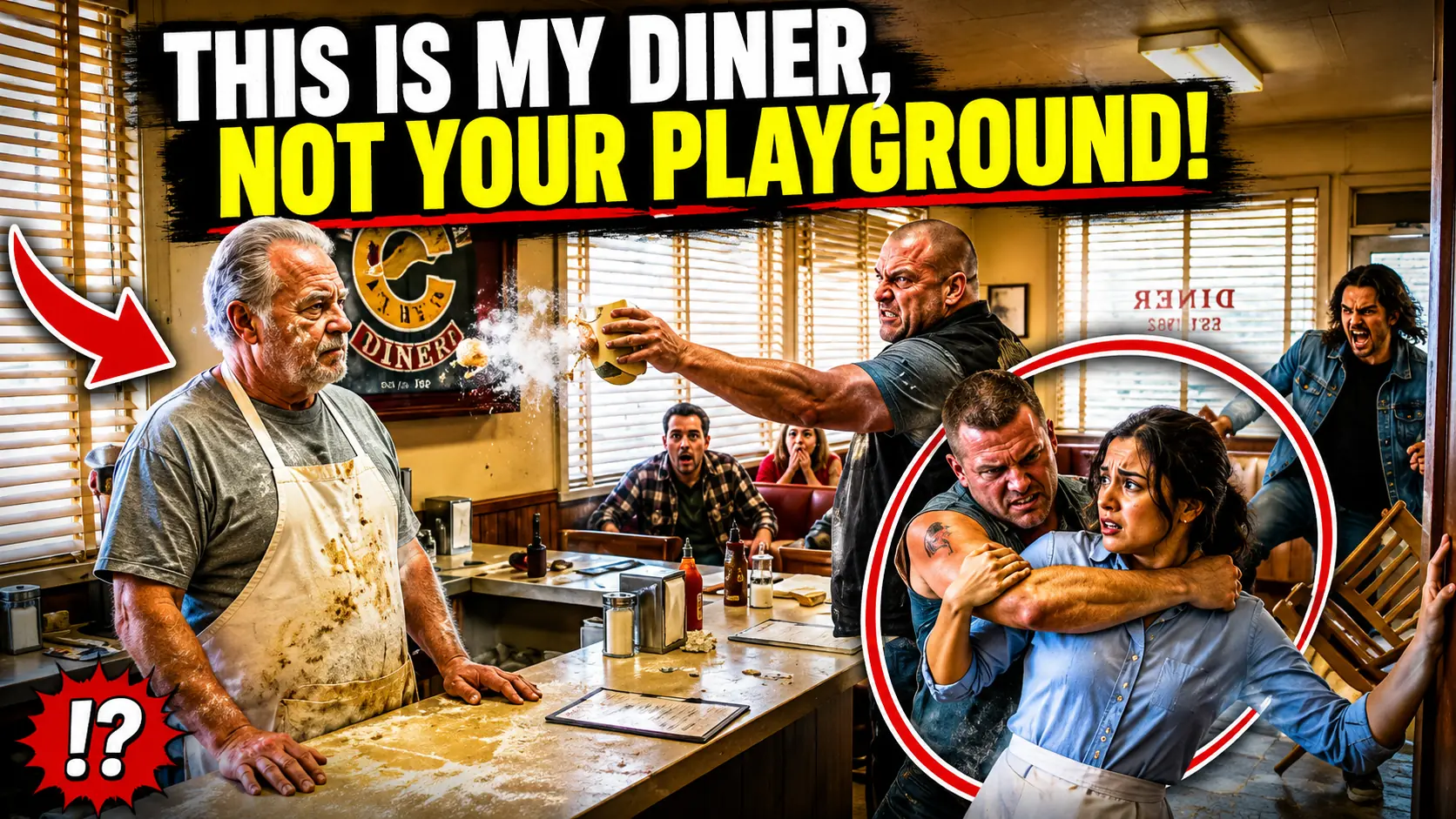
Three men kicked in the door of Earl Dawson's Diner and started trashing the place, breaking chairs, smashing the counter glass, throwing an old man's life's work onto the floor. They grabbed his waitress and slammed her into the wall. The old man behind the counter just stood there, sixty-seven years old, grey hair, hands that hadn't been in a fight in forty years. He had one choice in that moment: stand down and let them wreck everything he'd built, or do something he swore he'd never do again. What those three men didn't know was who they just walked in on.
Forty years ago men twice their size used to go quiet when Earl Dawson's name came up. Nobody in this diner that morning had any idea what was about to happen, or why a kid named Curtis Lane should never have sent his crew through that door. Stick around. This one gets a lot more dangerous before it's done. It started thirty seconds earlier than that. The door hadn't even finished swinging when the first one, a thick-necked guy with a shaved head, put his boot through a chair just to announce they'd arrived.
The second one walked straight down the counter, knocking over the ketchup bottles, the napkin holders, the little vase with the plastic flower Sarah had put there herself. Pure noise, pure mess, the kind of thing that's not about damage. It's about making sure everyone in the room understands who's in charge for the next few minutes. The third one was the one who grabbed Sarah. He didn't ask her to move. He just took her arm and threw her, and she hit the edge of the counter hard enough that her knees went out from under her.
That's when Earl set the spatula down. He came around the end of the counter the way he did everything: slow, unhurried, like a man who had all the time in the world. The shaved-head one saw him coming and laughed, an old man in an apron walking toward three of them like he had any business doing that. He stopped laughing about four seconds later. Earl gave him a chance first, stood there a half second longer than he needed to, and said one thing quiet: walk out now and we forget this happened.
The kid swung instead. Earl let the punch come to him, watched the fist travel, and at the last possible second tilted his head three inches to the left. The punch went past his ear into nothing. Before that kid even understood he'd missed, Earl's hand was already closing around the back of his neck. One motion, the kid's face met the edge of a table, and he didn't get back up. The other two stopped moving for one full second. The only sound in that diner was a coffee pot still hissing on the burner.
Then the second one picked up a chair because somebody had to do something, and Earl Dawson, sixty-seven years old, shifted his weight the way a man does right before he stops waiting. That's the part everybody wants to skip straight to, so let's slow down for one second, because you need to understand exactly who that old man used to be before you watch what he does to the rest of them. Earl Dawson had opened that diner at five o'clock every morning for nineteen years running, same time every single day. By the time the first trucker walked through the door, the place already smelled like bacon grease and coffee strong enough to strip paint.
In a town like Millbrook, Ohio, that smell was about the closest thing to church most men ever got. He was not gym-big, the kind of big that comes from forty years of hard living settling into a man's bones and never quite leaving. Grey hair cut short, beard trimmed close, quiet mostly, but when Earl Dawson talked, people leaned in. Sarah Mills had walked into that diner eight months earlier looking for work. Earl hadn't asked her many questions. Twenty-four years old, sharp, the type who'd learned the hard way not to trust people too fast. He gave her an apron, a key to the back door, and not once in eight months did he raise his voice at her.
Millbrook had been a quiet town for a long time. Then about six months before that morning, the quiet started cracking at the edges. A new outfit moved in, called themselves the Black Vipers. Young, mean in the particular way young men get mean when they've found a shortcut to feeling powerful. Their operation wasn't complicated: walk into a small business, explain that the neighborhood had gotten dangerous, and offer protection for a modest weekly fee. The hardware store paid first. The laundromat went next. The tire shop held out almost a month until a brick went through their window.
Within a season every business on that stretch of road was leaving an envelope on a counter every Friday. Nobody fought it. Fighting it got your windows broken or worse. Their leader called himself Curtis Lane, twenty-seven years old, tattoos climbing both sides of his neck, a smile that never once made it as far as his eyes. He'd built the whole operation up from nothing and was visibly proud of it. People who'd known him longer said he'd grown up watching his father get pushed around by every landlord in three counties, never once pushing back, and Curtis had decided early on that nobody would ever look at him that way. He'd built fear instead of respect, because fear was faster.
Three days before that morning, Curtis Lane came through Earl's front door for the first time, two of his guys trailing behind. They sat at the counter, spun the stools, put their boots up where the coffee cups belonged. Curtis looked around the old photographs, the regulars gone quiet, and then he looked at Earl and smiled. He told Earl the neighborhood had gotten dangerous, said for two hundred dollars a week he'd personally make sure nothing happened to such a nice old place. Earl poured three cups of coffee, slid them across the counter, didn't charge a cent. Then he said exactly one word: no.
The whole diner went still. Curtis's smile flickered like a candle catching a draft it didn't see coming. He wasn't used to that word. Most men telling Curtis Lane no said it with their voice shaking. Earl's didn't shake at all. Curtis laughed it off, said he'd swing back by in a few days. Then he and his boys walked out, and the whole diner let out a breath it had been holding. Sarah came over once they'd gone, scared and not hiding it, told Earl maybe they should just pay. Two hundred dollars wasn't worth somebody getting hurt over.
Earl wiped down the counter and told her not to worry, said men like that talked a lot bigger than they hit. He believed that, mostly. But Earl Dawson also understood, with a clarity that scared even him a little, exactly what kind of storm was in. He let Sarah keep believing it would blow over, because that's the small mercy you offer somebody who's already carrying enough fear for one lifetime. What he didn't tell her was that he'd made his decision the moment Curtis Lane walked back out that door. He just hoped it wouldn't actually come to that. It came to that.
Above the register hung a single photograph, a much younger Earl standing next to a row of motorcycles with men whose names nobody in town had ever heard him say. Sarah had asked about it once. He'd told her those were men he used to know, brothers in the way that word means something different once you've bled next to somebody. I miss who I was around them, he'd said, not what we did. Respect built on fear always collects its bill eventually, with interest. She hadn't fully understood what he meant, not then. She would, before that week was out.
Three quiet days passed. Earl almost let himself believe Curtis had moved on. Then that morning arrived: the boot through the glass, the chairs, Sarah hitting the floor. Curtis hadn't come himself, too smart for that. He'd sent three of his crew instead, the ones who liked the work a little too much, and they'd come in loud, because loud had worked on every other business on that strip. They had no idea they just walked into the one place where loud wasn't going to be enough. The one with the chair swung first, a wide overhead arc built to put Earl on the ground.
Earl stepped inside the swing instead, close enough that the chair came down across his back instead of his skull. While the man was still finishing a swing that had already failed, Earl drove a fist up under his ribs, and the chair clattered off fingers that had forgotten how to hold anything. The last one threw a punch built entirely out of panic. Earl leaned away, caught him by the collar, and walked him straight through what remained of the front door. The glass that hadn't already come down came down. Then nine seconds, maybe ten. Three grown men on the floor or on the sidewalk, and one old man in a flour-dusted apron who wasn't even breathing hard.
Someone laughed, the nervous kind, the kind that escapes a body the second it believes it's safe again. Earl helped Sarah up first, checked the cut above her elbow. Then he looked down at the three of them and told them quiet to crawl back to Curtis Lane and let him know the diner wasn't paying, not this week, not ever. They went limping, none of them looking back once. Earl swept the glass himself, told the regulars breakfast was on the house, sat Sarah at the counter, poured her a coffee she hadn't asked for. The room filled back up with low talk, everybody already turning nine seconds of violence into a story they'd tell for years.
Earl finally poured himself a coffee, sat down, rolled a shoulder that still carried an old ache, and let out a breath that had clearly been waiting its turn. He looked exactly like what he was supposed to be most days: a tired man who'd handled a little trouble and was ready to put it behind him. Sarah asked him low where a man learns to move like that. Earl smiled just barely and said it was a long time ago, said it didn't matter anymore. He believed every word of that when he said it. He was wrong. The worst of that morning hadn't even introduced itself yet.
The phone behind the counter rang. Earl let it go twice before picking it up, listened, said nothing, and whatever easy look had been resting on his face packed up and left for good. A voice on the other end said his full name, Earl Dawson. Then it said something that made him set his coffee cup down slower than he'd set anything down in years. We know who you are now. Here's what had happened. In the twenty minutes since those three men limped out, they'd made it back to Curtis Lane, and Curtis had been furious.
Somewhere in the middle of that fury, one of the older guys on the crew, a man who'd ridden with rougher company long before Curtis was old enough to shave, heard the description of the diner and went the color of old paper, because that older man remembered a name from a long way back. Back when the real clubs ran those highways, back when the wrong patch on a man's back could clear out a bar in under ten seconds. There had been exactly one name people said quiet, like saying it too loud might summon him: Dawson. And just like that, the whole shape of the morning changed.
This stopped being about two hundred dollars a week the instant that crew understood who Earl Dawson actually was. The job turned into something a great deal colder. A name like that, alive and breathing where half the town could watch him drop three of their men, wasn't a problem they could leave standing. If word got out the Black Vipers got humiliated by one old man and did nothing about it, the whole operation was finished by Friday. So it stopped being a shakedown. It became a cleanup. The voice told Earl they were coming back, all of them this time, told him there'd be no witnesses left standing to talk about it afterward. Then it hung up.