Top 10 Scariest Creatures Living in the Deep Ocean
Thousands of feet beneath the ocean’s surface, sunlight disappears completely.
The water becomes bitterly cold. Pressure rises to levels that would crush an unprotected human body. Food may not appear for days, weeks, or even months. Yet this seemingly impossible world is filled with life.
The creatures living there do not resemble the familiar animals found near beaches or coral reefs. Many have transparent bodies, expandable stomachs, needle-like teeth, glowing organs, oversized mouths, or eyes designed to detect the faintest movement in total darkness.
These features may look terrifying to us, but they are not accidents of nature. Every fang, glowing lure, flexible jaw, and ghostly body is an adaptation that helps an animal survive in one of the harshest environments on Earth.
Scientists are still discovering new deep-sea species, and some known animals have only been observed alive a handful of times. NOAA estimates that humanity has identified only a fraction of the species living in the ocean, partly because deep habitats are difficult and expensive to explore.
From a shark whose jaws launch out of its face to a fish capable of swallowing prey larger than itself, here are ten of the scariest creatures living in the deep ocean.
What Makes the Deep Ocean So Terrifying?
The deep ocean generally begins where sunlight becomes extremely weak, roughly 200 meters below the surface. Below about 1,000 meters, the ocean enters permanent darkness. No sunrise reaches this world, regardless of the time of day.
Without sunlight, plants cannot grow through photosynthesis. Animals must hunt one another, filter tiny organisms from the water, feed around hydrothermal vents, or survive on organic material falling from above.
This drifting material is sometimes called marine snow. It includes dead plankton, mucus, waste, and fragments of organisms slowly sinking from brighter waters. It may not sound appealing, but it supports enormous deep-sea communities.
Food scarcity has shaped almost everything about deep-ocean predators.
Some species have evolved enormous mouths because they cannot afford to let a potential meal escape. Others have flexible stomachs that allow them to consume more food than their bodies appear capable of holding. Many produce their own light through bioluminescence, using it to communicate, hide, confuse attackers, or lure prey closer.
Pressure presents another challenge. At extreme depths, it can reach hundreds or thousands of times the pressure experienced at sea level. Deep-sea animals often lack large gas-filled spaces and possess flexible tissues that function under crushing conditions.
Their frightening appearance is therefore not evidence that the deep sea creates monsters. It is evidence that evolution can produce astonishing solutions when survival becomes difficult.
10. Giant Isopod
Imagine a pill bug from your garden growing nearly as large as a household cat.
That is essentially what a giant isopod looks like.
Giant isopods belong to the genus Bathynomus and are close relatives of the woodlice and roly-polies found on land. Their armored bodies are divided into overlapping segments, while numerous legs move beneath a hard shell. Two pairs of antennae extend from the head, helping the animal detect its surroundings in darkness.
Some giant isopod species can grow beyond 30 centimeters, while the largest individuals may approach half a meter in length. NOAA has documented Bathynomus giganteus reaching roughly a foot and a half long.
Their unusual size is commonly associated with deep-sea gigantism, a pattern in which some deep-ocean species grow significantly larger than their shallow-water relatives.
Giant isopods generally inhabit the seafloor hundreds of meters below the surface. At those depths, they endure immense pressure and receive less than one-millionth of the sunlight available near the surface.
They are primarily scavengers.
When fish, squid, whales, or other animals die and sink, giant isopods may gather around the remains. A large carcass represents a rare feast in an environment where food is unpredictable.
Their powerful mouthparts can tear through flesh, while their expandable digestive systems allow them to eat heavily whenever food becomes available. This ability is essential because the next substantial meal might not appear for a very long time.
Despite their intimidating appearance, giant isopods are not aggressive monsters hunting humans through the darkness. They usually conserve energy by moving slowly across the bottom and waiting for opportunities.
When threatened, some species can curl their armored bodies into a protective shape, much like smaller terrestrial isopods.
What makes them frightening is their familiarity. The human brain recognizes their form as something that should be tiny. Seeing the same design enlarged into a heavily armored deep-sea scavenger creates an immediate feeling that something is wrong.
Yet in the deep ocean, the giant isopod fits perfectly.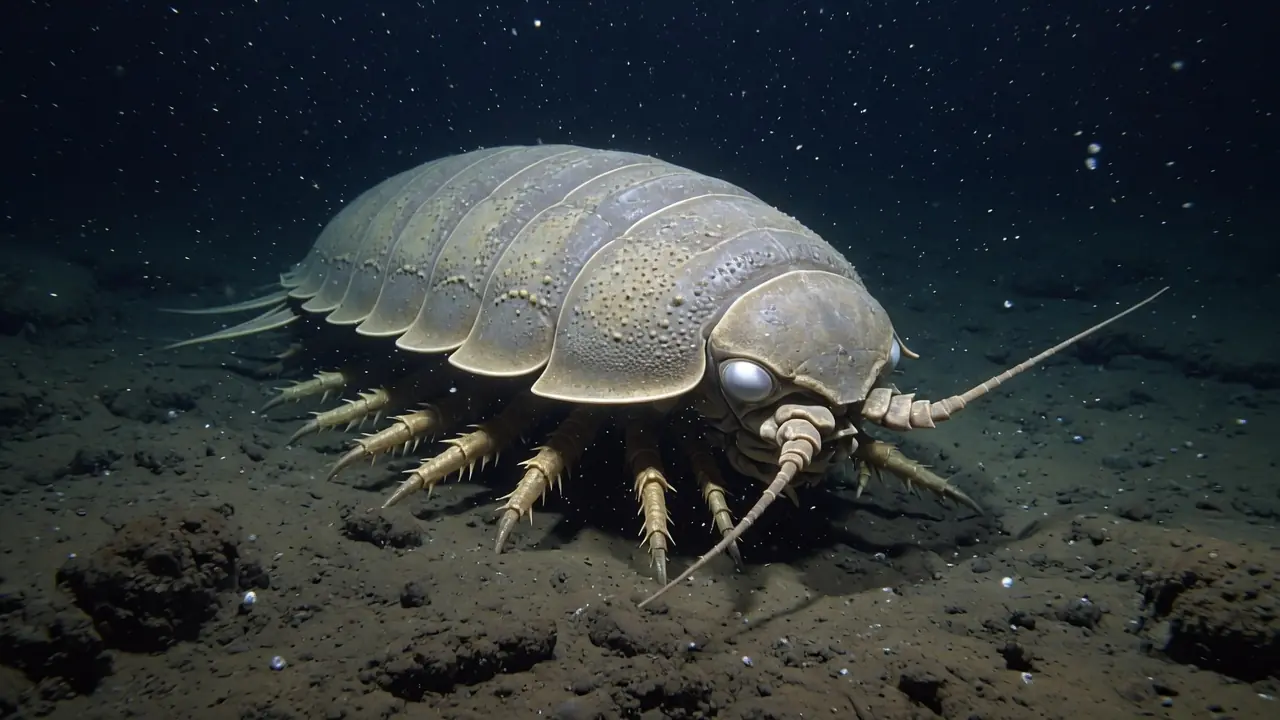
9. Vampire Squid
Its scientific name means “vampire squid from hell.”
With dark red skin, glowing eyes, webbed arms, and rows of fleshy projections resembling spikes, the vampire squid appears to deserve that dramatic title.
The truth is far stranger.
The vampire squid, Vampyroteuthis infernalis, is not a blood-drinking predator. It is not even considered a true squid. It represents the only surviving member of an ancient cephalopod lineage positioned between squids and octopuses.
Most individuals are relatively small, with a mantle reaching approximately 30 centimeters. They inhabit deep waters throughout temperate and tropical oceans, including low-oxygen zones that many predators cannot tolerate.
Its eight arms are connected by a cloak-like membrane. When alarmed, the animal can turn this webbing outward and wrap it over the body, creating a defensive posture known as the pineapple position.
From the outside, the animal suddenly appears larger, darker, and covered with threatening-looking projections called cirri.
Those projections are not dangerous teeth or claws. They are soft structures.
The vampire squid also lacks the ink sac used by many shallow-water cephalopods. Ink would be less useful in a world already surrounded by darkness. Instead, it can release a cloud of glowing mucus containing bioluminescent particles.
The luminous cloud may confuse a predator while the vampire squid escapes.
Its large eyes are among the most striking parts of its appearance. Depending on the lighting, they can look blue, red, or almost transparent. Relative to its body size, the vampire squid possesses some of the largest eyes found in the animal kingdom.
But perhaps the greatest surprise is its diet.
Rather than attacking large prey, the vampire squid uses two thin retractable filaments to collect marine snow. This material includes drifting plankton remains, mucus, waste, and other organic debris. MBARI researchers describe it as a deep-sea scavenger that helps move carbon toward the seafloor.
The vampire squid looks like a creature designed for a horror film, yet its lifestyle is remarkably peaceful.
It survives not by becoming the strongest predator in the darkness, but by living where many predators cannot follow and feeding on material almost everyone else ignores.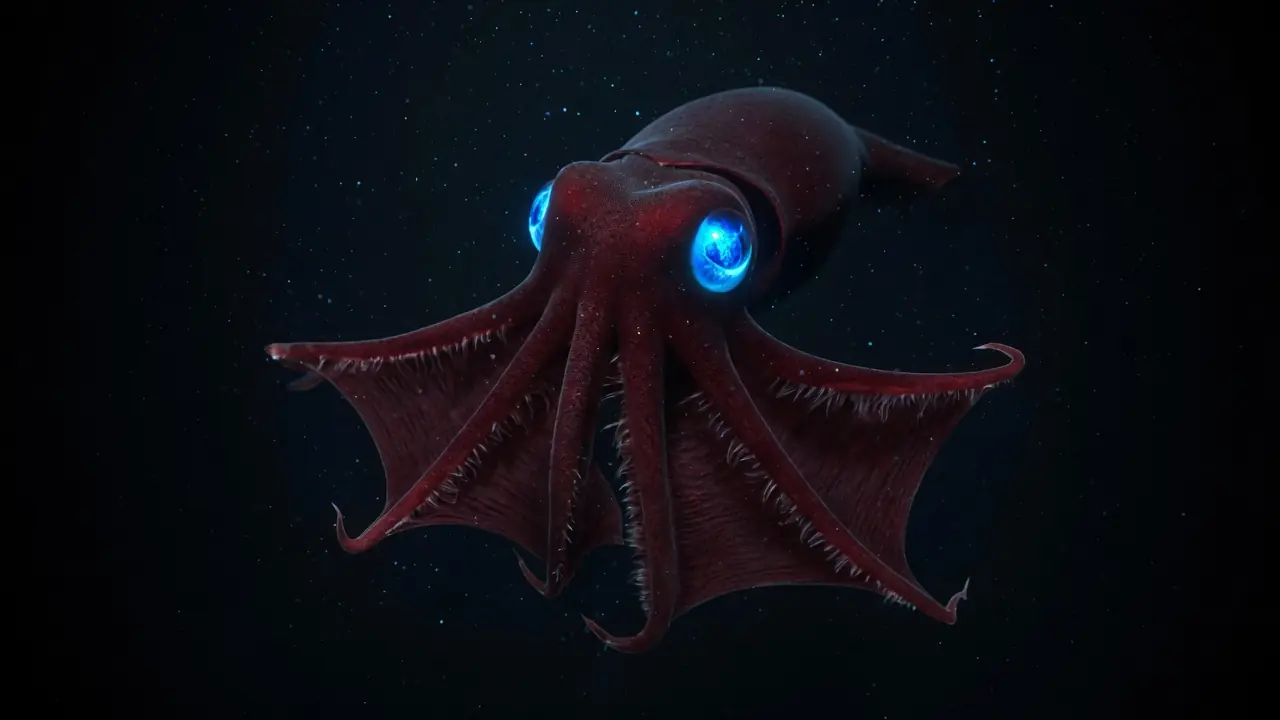
8. Fangtooth Fish
The fangtooth fish possesses teeth so large that they barely seem capable of fitting inside its mouth.
Its head is enormous compared with the rest of its body. Its skin is rough and dark. Deep grooves in its skull provide space for its lower fangs when the jaws close.
Without those grooves, the teeth could potentially pierce the fish’s own head.
The common fangtooth, Anoplogaster cornuta, lives in deep tropical and temperate waters around the world. Adults are usually much smaller than photographs make them appear, generally reaching only around 15 to 18 centimeters.
That means one of the ocean’s most frightening faces belongs to an animal shorter than many school rulers.
Its appearance still makes sense in its environment.
In the deep sea, a predator may only have a brief opportunity to capture food. Long, inward-pointing teeth help prevent slippery fish and crustaceans from escaping once the jaws close.
Adult fangtooths are dark brown or black, giving them camouflage in low-light conditions. Their bodies are built for ambush rather than long, high-speed pursuits.
Younger fangtooths look so different from adults that scientists once classified them as separate species. Juveniles are lighter, possess longer head spines, and have proportionally smaller teeth. As they mature, their heads become heavier and their jaws transform into the intimidating structure seen in adults.
Fangtooth fish may travel upward in the water column at night and descend during the day, following the movement of potential prey. This behavior is connected to diel vertical migration, a vast daily movement in which countless ocean animals rise toward surface waters after sunset and retreat deeper before daylight.
Although its fangs appear capable of causing serious injury, the common fangtooth is not considered a threat to swimmers. Its habitat is far below normal human activity, and its body is surprisingly small.
The fangtooth is frightening because it demonstrates that a predator does not need to be enormous to look perfectly adapted for capturing anything that approaches too closely.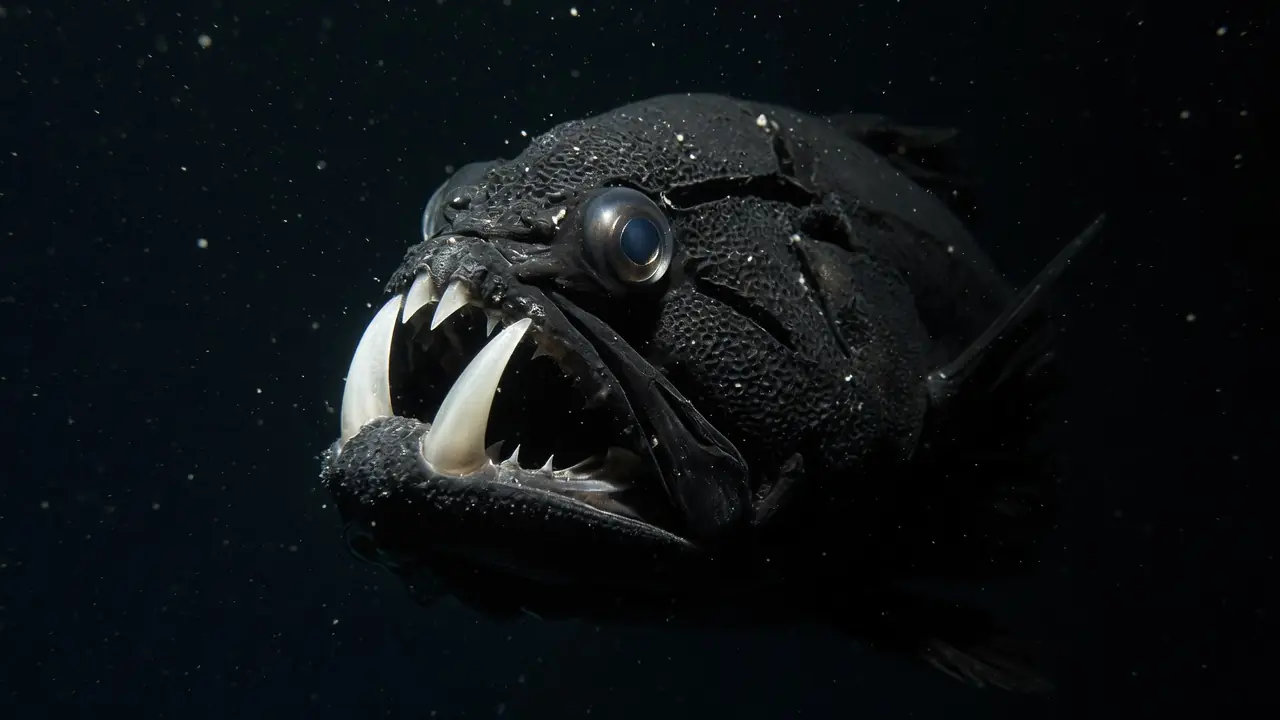
7. Pacific Viperfish
The Pacific viperfish seems to have been built almost entirely from teeth.
Its lower fangs curve upward beyond the mouth. Its jaw opens unusually wide, and its long body is covered with dark, reflective skin. Rows of glowing organs line its sides, producing light in an environment where sunlight cannot reach.
Pacific viperfish, Chauliodus macouni, inhabit deep waters of the North Pacific. They are mesopelagic predators, often occupying the region sometimes called the twilight zone.
NOAA has observed viperfish drifting almost completely motionless before launching lightning-fast strikes at nearby prey.
Remaining still serves two purposes.
It conserves energy, and it makes the fish difficult to detect. Instead of wasting valuable calories chasing every movement, the viperfish waits for the right moment.
A modified fin ray extends from its back and ends in a light-producing organ. Scientists believe this bioluminescent structure may help attract prey or communicate with other members of its species.
Along the body, additional photophores may help create counterillumination. By producing light that matches the faint glow from above, an animal can reduce its silhouette when viewed from below.
The viperfish’s teeth are not designed for chewing. They form a cage around captured prey, reducing the chance that a struggling fish or shrimp can escape.
Its hinged skull and flexible jaws allow it to open its mouth widely relative to its body size. This is another common deep-sea strategy: consume whatever becomes available, even when the meal appears too large.
Pacific viperfish may approach shallower water during the night before descending again during daylight hours. However, they remain far beyond the range of ordinary swimmers.
Their greatest threat comes not from their size but from their efficiency. In the darkness, a smaller animal may not see the viperfish until the strike has already begun.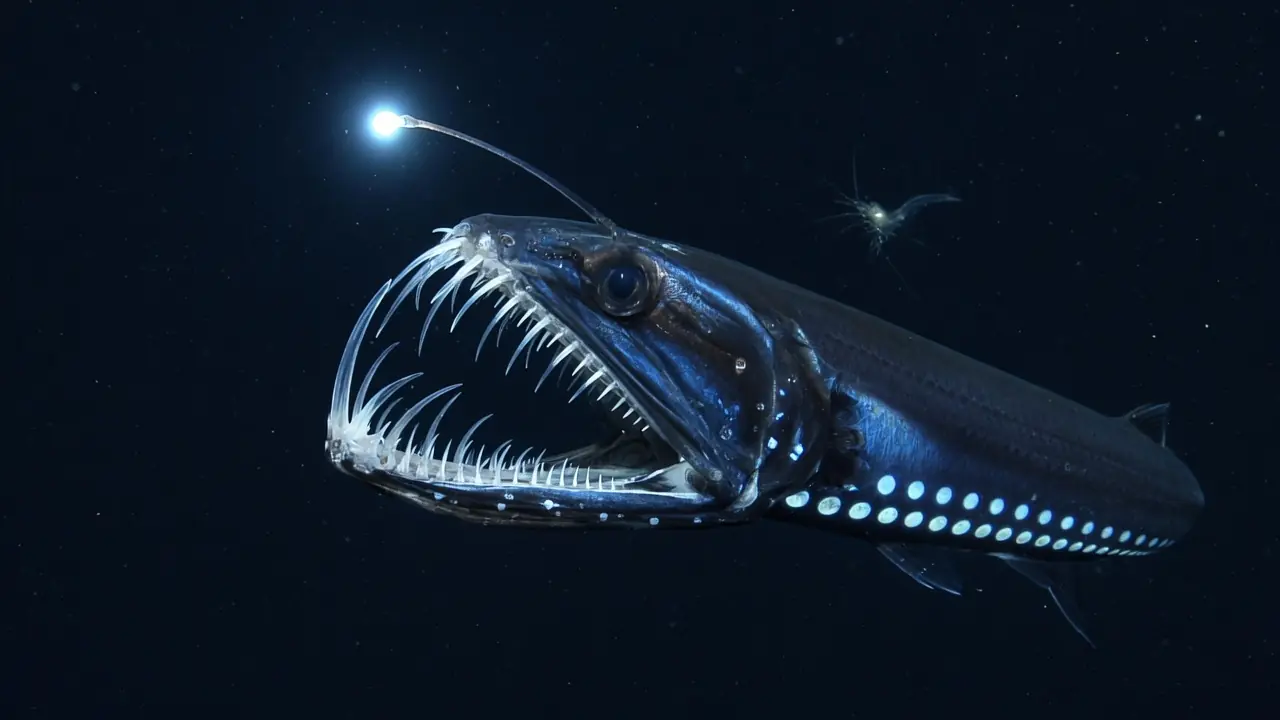
6. Black Swallower
The black swallower does not look especially terrifying when its stomach is empty.
It is a slender, dark fish with a narrow body and a relatively ordinary-looking head. Yet its appearance changes dramatically after it captures a large meal.
The black swallower, Chiasmodon niger, has an extremely expandable stomach and flexible jaws. It can consume prey far larger than its own body, sometimes swallowing fish more than twice its length and many times its mass.
Its jaw bones connect in ways that allow the mouth to open widely. Sharp, backward-curving teeth hold onto prey as the swallower gradually works the victim into its stomach.
Once the meal has been consumed, the stomach stretches outward like an inflated transparent bag. The outline of the swallowed fish may remain visible through the thin tissue.
This extraordinary adaptation solves one of the deep sea’s greatest problems: meals are unpredictable.
A predator that waits for perfectly sized food may starve. A predator capable of swallowing almost anything it encounters gains a major advantage.
However, the black swallower’s strategy carries a risk.
When it consumes extremely large prey, digestion may take a long time. In some cases, decomposition can produce gases inside the stomach before the meal has been fully broken down. The expanding gases may make the black swallower buoyant, causing it to rise toward the surface.
This is one reason specimens are occasionally discovered floating above their normal habitat with enormous fish still visible inside them.
The black swallower generally lives in deep tropical and subtropical waters. It spends its life far below ordinary human observation, which means much of its behavior remains difficult to study.
Unlike an active shark or squid, it does not frighten people through size or speed. Its horror comes from the impossible transformation of its body.
A fish that appears narrow and unremarkable can suddenly stretch into a living container around an animal larger than itself.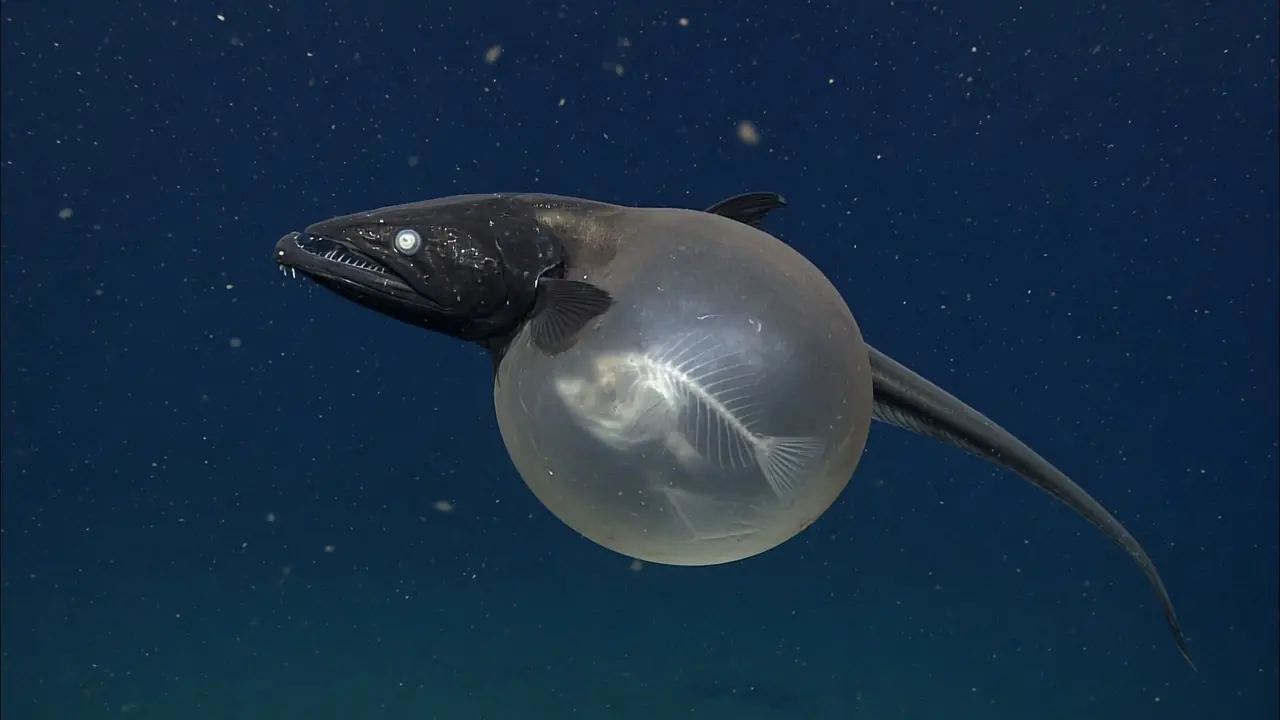
5. Deep-Sea Anglerfish
In a world without sunlight, one small point of light can become impossible to ignore.
That is exactly what the deep-sea anglerfish depends upon.
Female anglerfish possess a modified fin spine extending from the head like a fishing rod. At its tip is a glowing lure called an esca. In some species, the light is produced with help from bioluminescent bacteria.
A curious fish sees the glow moving in the darkness and approaches.
It may believe the light represents food. By the time it recognizes the shape waiting behind the lure, escape may already be impossible.
The anglerfish opens a mouth filled with long, transparent teeth. Its jaws and stomach can expand, enabling it to consume surprisingly large prey. NOAA notes that some anglerfish can swallow fish up to twice their size.
Its round body is not designed for sustained pursuit. Instead, the fish conserves energy and allows prey to come to it.
This hunting method is exceptionally effective in the deep sea. Producing light requires energy, but it may cost far less than swimming long distances in search of food.
Anglerfish reproduction is even stranger than their hunting method.
In several deep-sea species, males are tiny compared with females. A male’s main task is to locate a mate in an enormous, dark environment.
Once he finds a female, he bites into her body. In some species, his tissue eventually fuses with hers, connecting the circulatory systems. The male loses much of his independent body and becomes a permanent source of sperm.
A female may carry one or several attached males.
Not all anglerfish reproduce in exactly this way, but sexual parasitism is one of the most extraordinary adaptations known among vertebrates.
Deep-sea anglerfish rarely encounter humans alive. Many are relatively small, despite their monstrous appearance in magnified photographs.
Nevertheless, their combination of a glowing lure, expandable jaws, needle-like teeth, and permanently attached mates makes them some of the most alien-looking animals known to science.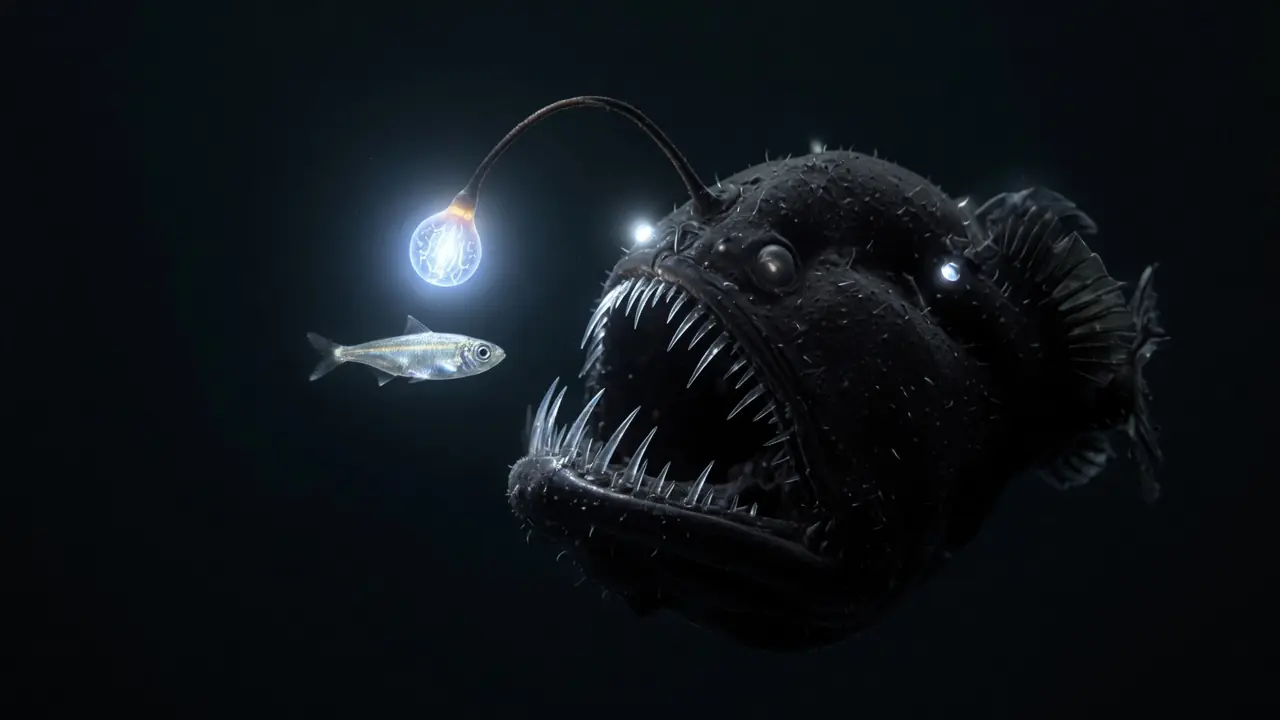
4. Gulper Eel
At first glance, the gulper eel appears to be almost entirely mouth.
Its jaws form a loose, expandable pouch much larger than the rest of its head. Behind them extends a thin, whip-like body that seems too delicate to support such an enormous feeding structure.
Gulper eels are sometimes called pelican eels because their mouths resemble the throat pouch of a pelican. The best-known species is Eurypharynx pelecanoides, although other related deep-sea eels share similar adaptations.
Despite its fearsome appearance, a gulper eel’s mouth is not built to crush large animals with powerful teeth. Its jaws are loosely connected, allowing the mouth to expand and engulf prey.
When feeding, the eel may open its jaws like a net, taking in fish, shrimp, plankton, and large quantities of water. The water is then expelled while food is retained.
The stomach can also expand to accommodate large meals.
Near the tip of its long tail is a light-producing organ. This structure may help attract prey, although much of the animal’s natural behavior remains poorly understood because living gulper eels are difficult to observe.
Their bodies are fragile, and specimens brought rapidly to the surface may be damaged by pressure changes. Modern remotely operated vehicles have therefore provided researchers with a much clearer view of how these animals appear in their natural habitat.
One famous deep-sea recording showed a gulper eel dramatically inflating its mouth when approached by an underwater vehicle. For a moment, its head expanded into a huge balloon-like form, making the animal appear many times larger.
This may have been a defensive display intended to startle a potential threat.
The eel then closed its mouth and continued swimming, revealing a much smaller and thinner profile.
The gulper eel is frightening because its body seems to violate ordinary proportions. Its mouth belongs to an enormous predator, while its body resembles a ribbon floating through space.
In the deep ocean, however, that oversized mouth may be the difference between catching a rare meal and starving.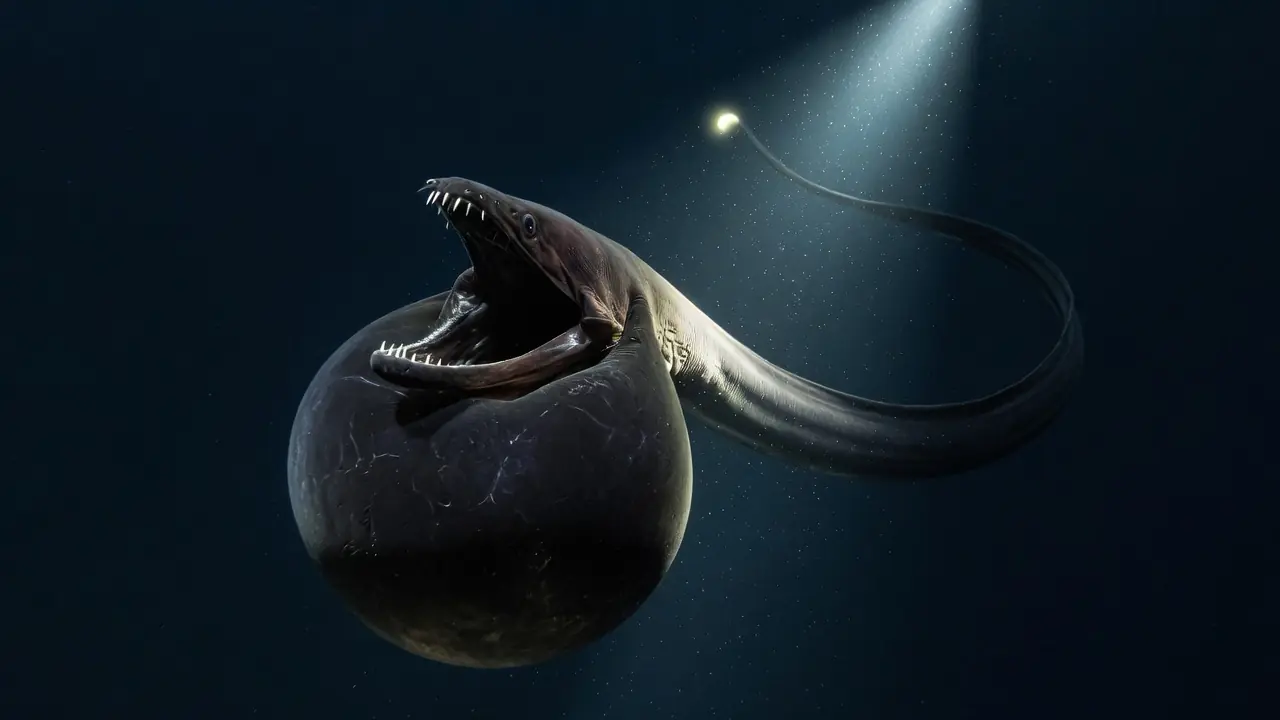
3. Goblin Shark
The goblin shark already looks unsettling before it begins feeding.
Its soft, pale body appears almost pink because blood vessels can be visible through the skin. A long, flattened snout extends over a mouth lined with narrow teeth.
Then the jaws launch forward.
Unlike the jaws of most familiar sharks, the goblin shark’s jaws can rapidly extend away from the skull. Ligaments and specialized joints store energy before releasing the jaw structure toward prey.
The movement is so sudden that it resembles a trap springing open.
The goblin shark, Mitsukurina owstoni, is the only living representative of the family Mitsukurinidae, an ancient lineage sometimes described as dating back more than 100 million years.
Its long snout contains sensory organs called ampullae of Lorenzini. These structures detect weak electrical signals produced by other animals, helping the shark locate prey in dark or muddy environments.
Once the shark senses a fish, squid, or crustacean, it can project its jaws forward and capture the animal with its pointed teeth.
Goblin sharks are found in deep waters around the world, though they are rarely observed alive. Most knowledge historically came from animals accidentally captured by deep-water fishing operations.
In 2026, scientists reported rare footage of goblin sharks swimming in their natural deep-sea habitat. These observations expanded scientific knowledge of their geographic and depth ranges.
Despite their frightening appearance, goblin sharks are not known to pose a significant danger to humans. They normally live at depths far beyond recreational diving, and encounters are exceptionally rare.
Many specimens are also smaller than the enormous sharks imagined in popular culture, although some individuals may grow several meters long.
The goblin shark’s terror comes from movement rather than size.
When its mouth is closed, the shark looks strange but relatively slow. When it strikes, its entire face appears to transform, launching a hidden set of jaws into the darkness.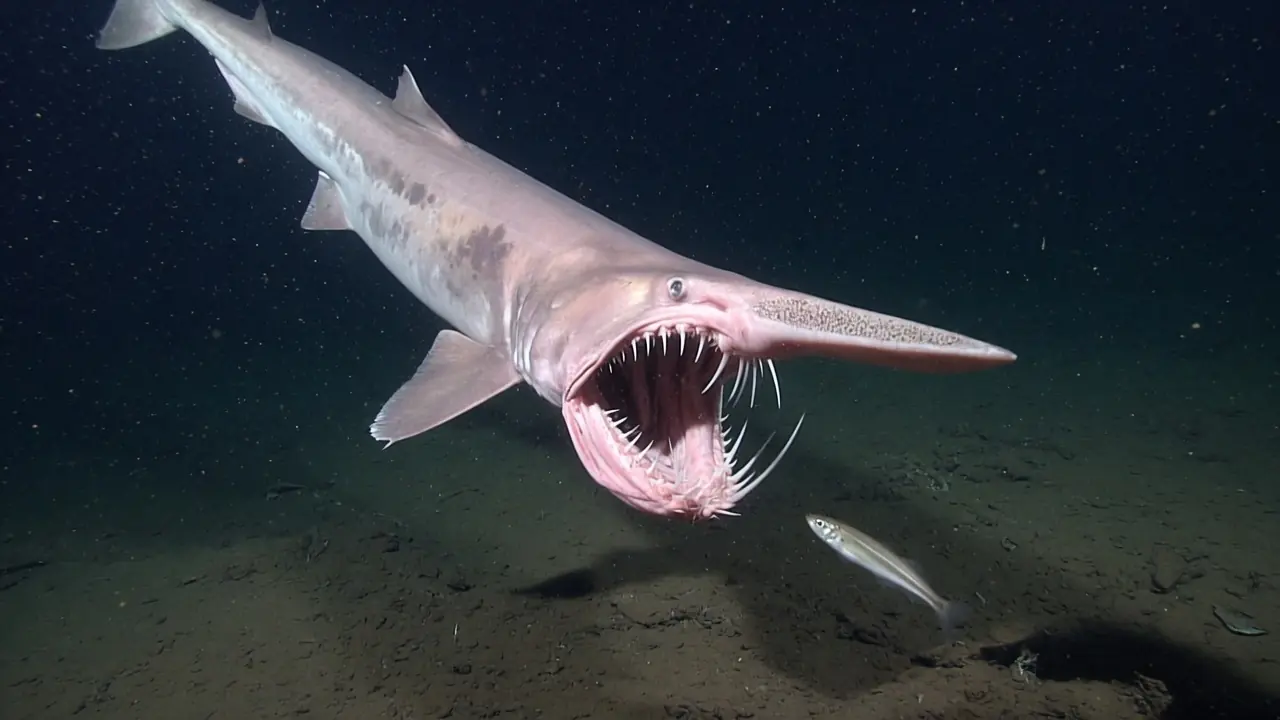
2. Giant Squid
For centuries, sailors told stories about enormous tentacled creatures capable of rising from the ocean and dragging ships beneath the waves.
Most of those stories were exaggerated.
But the animal behind some of the legends was real.
The giant squid, Architeuthis dux, is one of the largest invertebrates on Earth. Large females may reach approximately 13 meters in total length, although reliable maximum measurements remain difficult because the long feeding tentacles can stretch or become damaged.
The squid has eight shorter arms and two much longer feeding tentacles. Clubs at the ends of the feeding tentacles are lined with suckers surrounded by hard, toothed rings.
These structures help the squid seize fish and other squid before pulling them toward a sharp beak hidden at the center of its arms.
Its eyes can grow to the size of dinner plates, ranking among the largest eyes in the animal kingdom. Enormous eyes may help the squid detect faint shapes, bioluminescent flashes, or the movement of large predators in the darkness.
One of those predators is the sperm whale.
Scientists have found giant squid beaks inside sperm whale stomachs, while circular sucker scars can appear on the whales’ skin. These clues reveal encounters occurring far beyond human observation.
Giant squid spend much of their lives in deep ocean environments and have rarely been recorded alive. For generations, nearly everything scientists knew came from dead or dying individuals found at the surface, washed onto beaches, or recovered from whale stomachs.
The first widely recognized photographs of a living giant squid in its natural habitat were captured in the early 2000s. Later video revealed the squid moving and feeding in deep water.
Even now, scientists know relatively little about its reproduction, population size, migration, and daily behavior. Smithsonian researchers note that despite improved observations, major mysteries remain about the depths where giant squid live.
Recent environmental DNA studies have also detected giant squid without directly seeing them. Water samples can contain genetic traces left by animals that passed through an area, offering a new way to identify elusive species.
A giant squid is not believed to stalk boats or search for human prey. Its long body is also far less muscular than the indestructible krakens of legend.
Yet the reality remains astonishing.
An animal as long as a bus can live in the darkness beneath major shipping routes, fighting sperm whales and disappearing again without anyone at the surface knowing it was there.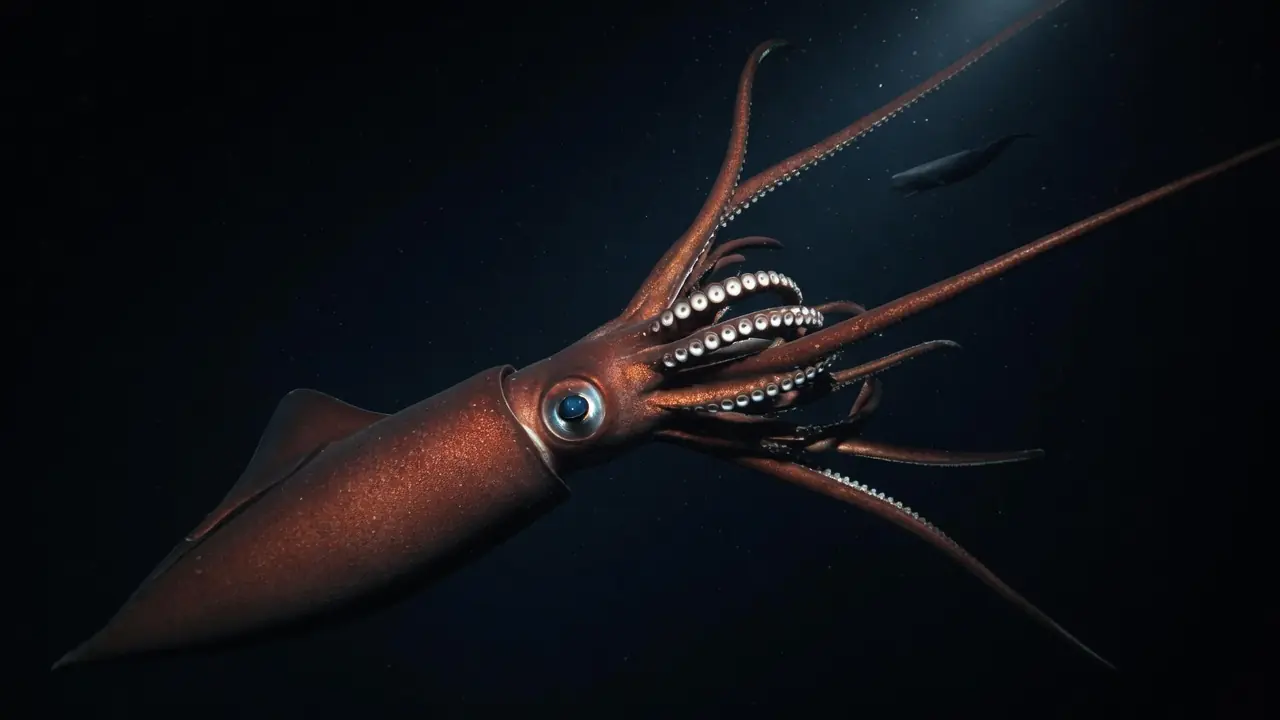
1. Sloane’s Viperfish and the Blackdragon
Choosing a single scariest deep-sea creature is nearly impossible, but few animals capture the horror of the deep better than the blackdragon.
Female blackdragons possess elongated bodies, enormous teeth, and nearly invisible skin. Males may look so different that they were once mistaken for entirely separate animals.
The Pacific blackdragon, Idiacanthus antrostomus, and related dragonfish species inhabit the dark midwater zone. Females are the primary hunters, while males are much smaller and may have reduced digestive systems.
One of the blackdragon’s most remarkable adaptations is its ability to produce red bioluminescence.
Most deep-sea animals cannot see red light because red wavelengths disappear quickly in ocean water. At depth, red-colored animals often appear black.
The blackdragon can produce and detect red light, effectively giving it a private flashlight. It may illuminate prey without revealing its position to animals unable to see those wavelengths.
Its teeth are also adapted for invisibility.
Research into some dragonfish has shown that their teeth possess structures that reduce light reflection. Instead of flashing when struck by bioluminescent light, the teeth remain difficult to detect.
This is particularly useful for a predator whose mouth may remain open while approaching prey.
A blackdragon may therefore swim through the darkness with its body hidden, its teeth nearly transparent, and a beam of red light visible only to itself.
The related Sloane’s viperfish, Chauliodus sloani, adds another nightmare to the same region of the ocean. Its fangs are so long that the fish cannot close its jaws in the normal way. Instead, the teeth curve around the outside of the head.
Like other viperfish, it can wait motionless before striking with extraordinary speed.
These predators are not enormous. Many would be easier to hold than a large household pet.
But size is not what makes them terrifying.
They live in permanent darkness, see wavelengths invisible to much of their prey, conceal their own bodies, and carry teeth that function like an escape-proof cage.
The blackdragon is frightening not because it resembles an imaginary monster.
It is frightening because every seemingly monstrous feature has a practical purpose.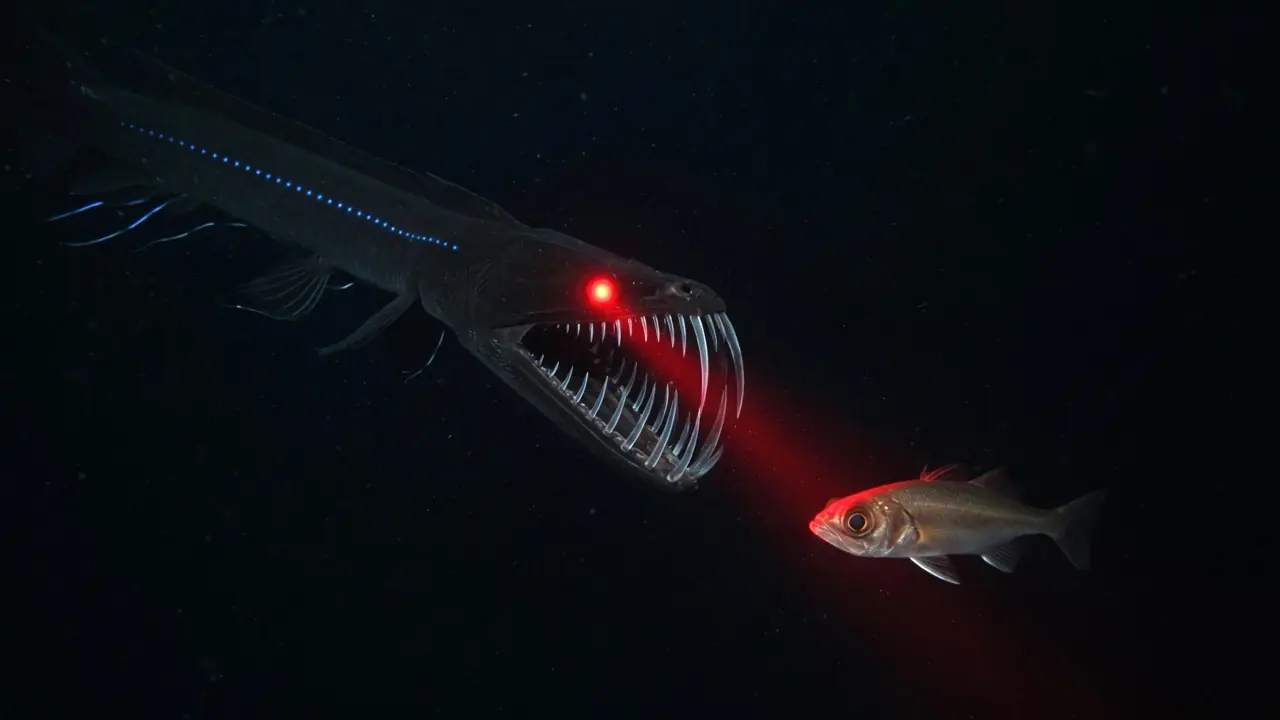
Are These Deep-Sea Creatures Dangerous to Humans?
Almost none of the animals on this list represent a realistic threat to the average person.
They usually live hundreds or thousands of meters beneath the surface, far beyond normal swimming and recreational diving depths. Several are also much smaller than close-up photographs suggest.
The pressure at their normal depths is a far greater danger to humans than the animals themselves.
Even species capable of causing injury, such as the goblin shark or giant squid, have little reason or opportunity to encounter people. There is no evidence that they regularly hunt humans.
Calling them scary refers primarily to their appearance, hunting adaptations, and the environment they inhabit.
In many cases, humans pose a greater danger to deep-sea life than deep-sea life poses to us.
Deep-water fishing, plastic pollution, climate change, oxygen loss, mineral extraction, and ocean acidification can affect habitats once considered protected by their remoteness. Monterey Bay Aquarium researchers warn that changes in deep-sea biodiversity could influence fisheries, marine mammals, and even broader ocean systems.
The animals may look indestructible, but many grow slowly, reproduce infrequently, or depend on extremely stable conditions. Damage to their populations could take decades or centuries to reverse.
Why Do So Many Deep-Sea Animals Have Large Teeth?
Large teeth are useful when food is scarce.
A predator near the surface may have many opportunities to hunt. A deep-sea predator might go for long periods without encountering suitable prey.
When an animal finally approaches, losing it could mean losing the only meal available for days.
Long, backward-facing teeth form a trap. Once prey enters the mouth, struggling may push it farther inward rather than allowing it to escape.
Many deep-sea predators also possess hinged skulls, flexible jaws, and expandable stomachs. These adaptations allow them to capture meals that appear too large for their bodies.
The strategy is simple: do not reject food merely because it is inconveniently sized.
Why Do Deep-Sea Creatures Glow?
Bioluminescence is one of the most important survival tools in the deep ocean.
Animals can produce light through chemical reactions inside their bodies or through relationships with light-producing bacteria.
They use this light for several purposes:
-
Attracting prey
-
Finding mates
-
Confusing predators
-
Communicating
-
Hiding their silhouettes
-
Illuminating nearby animals
-
Releasing glowing defensive clouds
Anglerfish use luminous lures to attract curious prey. Vampire squid release glowing mucus when threatened. Some dragonfish use red light to hunt animals that cannot detect it.
Other species use counterillumination. Light-producing organs on the underside of the body match the weak illumination coming from above, making the animal harder to see from below.
In an environment defined by darkness, the ability to control light can be as useful as speed, strength, or armor.
How Much of the Deep Ocean Have We Explored?
Humanity has mapped the seafloor with increasing accuracy, but visually observing and biologically sampling the deep ocean remain enormous challenges.
The deep sea covers most of the planet’s habitable space. It includes underwater canyons, abyssal plains, seamounts, trenches, hydrothermal vents, whale falls, and vast regions of open water.
ROVs and autonomous underwater vehicles allow scientists to record animals without exposing humans to extreme pressure. High-definition cameras have revealed delicate species that were previously damaged or destroyed when collected with nets.
Environmental DNA can detect animals from genetic traces in water. Acoustic tools can reveal the movement of organisms through different depths. Specialized landers can remain on the seafloor and record activity over long periods.
Even with these technologies, new species continue to appear.
MBARI has documented hundreds of unusual animals during more than three decades of deep-sea exploration, including newly described siphonophores and other organisms.
Every expedition raises the same unsettling possibility.
The strangest creature in the deep ocean may not be one we have already discovered.
It may be one that has never entered the beam of a camera.
Final Thoughts
The deep ocean is not empty.
It is a vast world filled with predators, scavengers, drifting colonies, glowing hunters, transparent animals, and creatures that appear almost impossible.
The giant isopod survives by waiting for rare feasts on the seafloor. The vampire squid transforms itself into a defensive cloak while feeding on falling debris. The anglerfish turns light into a trap. The black swallower stretches around prey larger than its own body. The goblin shark launches its jaws forward like a hidden weapon.
None of these animals evolved to frighten humans.
Their strange bodies were shaped by darkness, pressure, cold, and hunger. What looks monstrous near the surface may be perfectly efficient thousands of feet below it.
Perhaps that is the most unsettling fact of all.
The deep sea does not need imaginary monsters.
Its real inhabitants are already stranger than almost anything humans could invent.