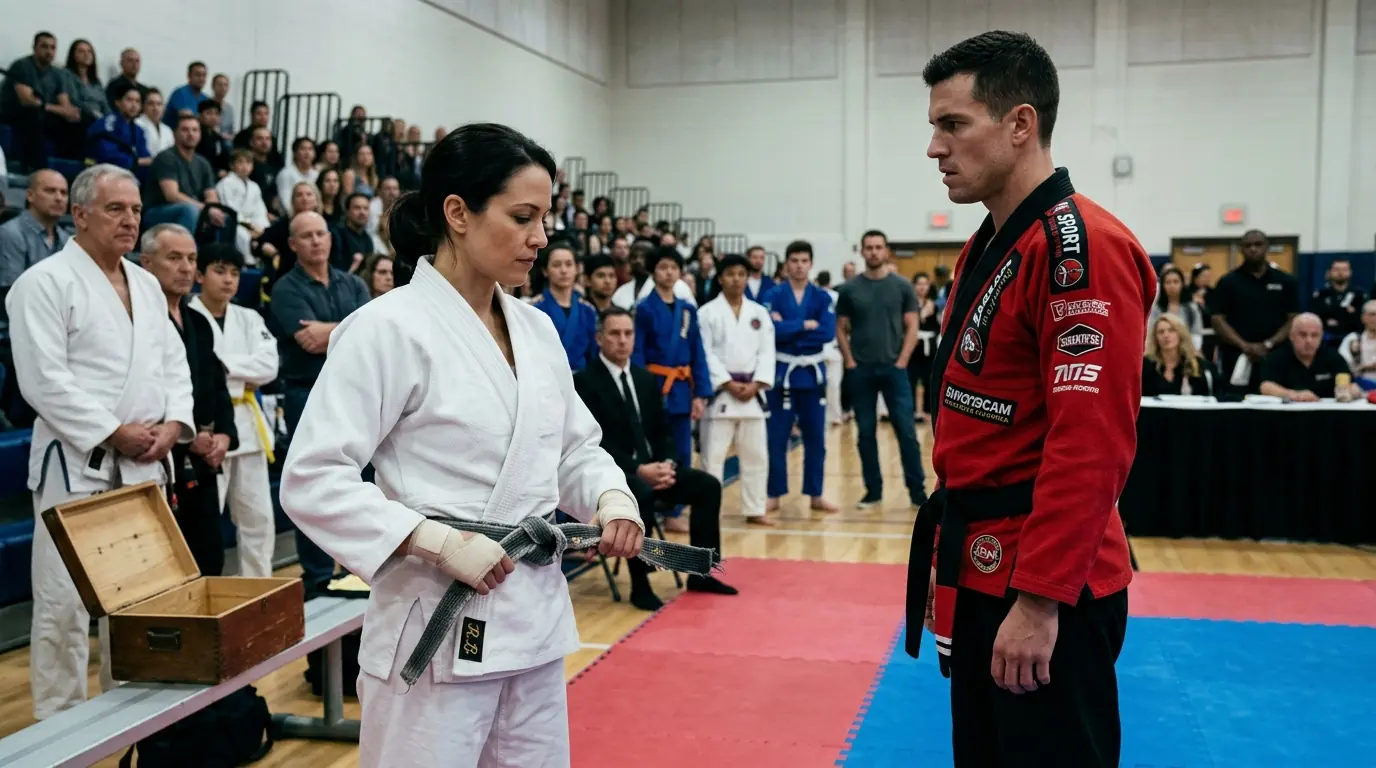
“Try Not to Cry, Princess,” the Champion Laughed — Then the 5-Foot-3 Woman Slowly Tied Her Father’s Black Belt
The first laugh came from the champion.
The second came from three men standing near the mirrors.
The third never happened.
Because by then, Claire Bennett had opened the old wooden box.
The room went quiet as she lifted the black belt from inside.
It was faded almost gray.
The edges were frayed.
One end had been repaired by hand with black thread.
Near the knot line, two small initials were stitched in gold.
R.B.
Claire ran her thumb over them.
Then she wrapped the belt around her waist.
Once.
Twice.
Slowly.
The champion’s smile disappeared.
He knew those initials.
So did the head instructor.
So did the oldest man sitting beside the trophy case.
And suddenly the woman everyone had been calling “princess” did not look small anymore.
She was still five feet three.
Still one hundred twenty-five pounds.
Still wearing a plain white gi with no team patch and no sponsor logo.
But the belt changed the room because the belt belonged to Richard Bennett.
And twenty-four years earlier, Richard Bennett had been the man who taught half the serious fighters in that county how to stand.
His daughter had been watching.
That mattered more.
The whole thing started an hour earlier at the North County Martial Arts Invitational, a Saturday exhibition held inside the Ridgeline Athletic Pavilion outside Cincinnati.
The event was supposed to be easy.
Local schools.
Demonstrations.
Youth matches.
Charity fundraiser.
A few celebrity appearances.
Then the main attraction.
Derek Voss.
Thirty-two years old.
Six feet tall.
Two-time national full-contact karate champion.
Fast hands.
Heavy kicks.
Good enough to have turned regional competition into a career.
Confident enough to have turned confidence into a performance.
Derek knew how to work a crowd.
He laughed easily.
Talked loudly.
Treated interviews like sparring.
People liked him.
Mostly.
Even people who disliked him watched.
That was useful.
The pavilion held nearly nine hundred spectators that afternoon.
Families filled the bleachers.
Children in uniforms moved between mats.
Coaches shouted over whistles.
Announcements echoed through bad speakers.
Claire had come because of her mother.
Not because of Derek.
Not because of competition.
Not because she missed the noise.
Her mother, Helen Bennett, had called three nights earlier.
“You’re coming Saturday.”
Claire said no.
“You didn’t let me finish.”
“You were going to ask me to come to Ridgeline.”
“Yes.”
“No.”
“Your father’s memorial presentation is at three.”
Claire became quiet.
“I know.”
“They’re putting his photograph on the legacy wall.”
“I know.”
“You should be there.”
“I don’t need to watch strangers describe Dad.”
Helen sighed.
“They aren’t strangers.”
“Some are.”
“Claire.”
She hated when her mother used that tone.
Not angry.
Tired.
Claire was thirty-eight years old.
Successful physical therapist.
Divorced.
No children.
Owned a small house.
Paid taxes.
Scheduled medical appointments.
Argued with insurance companies for a living.
And yet one word from her mother could make her feel fifteen.
Helen continued.
“Your father spent thirty years in that community.”
“I know.”
“Then show up for thirty minutes.”
Claire stared at the ceiling.
“Thirty.”
“Forty-five.”
“Thirty.”
“Fine.”
Helen lied.
They both knew it.
The memorial was not the real reason she wanted Claire there.
The real reason was the belt.
Richard Bennett’s belt.
After he died, Helen kept it in a cedar box in the hall closet.
Nobody touched it.
Not because it was sacred.
Richard would have hated that.
Because nobody knew what to do with it.
He had worn it for nearly twenty-six years.
It carried sweat stains.
Thread repairs.
A burn mark from a heater in the old dojo.
The gold initials were added by one of his first students.
He wore it long after newer belts were available.
“Still holds my jacket,” he always said.
Richard Bennett had never been famous.
Not nationally.
He did not compete after thirty-five.
He did not chase titles.
He ran a neighborhood dojo called Bennett Karate and Movement.
The name was intentionally boring.
His students were not.
Police officers.
Teachers.
Teenagers.
Factory workers.
Competitive fighters.
Women who wanted self-defense.
Older adults trying to move without pain.
Richard taught all of them.
His gift was not producing champions.
His gift was seeing what a person needed before they could explain it.
Derek Voss had been one of those people.
At fourteen, Derek was angry, talented, and almost impossible to coach.
His father had gone to prison.
His mother worked two jobs.
Derek fought at school.
Got suspended twice.
Then a counselor sent him to Richard.
Derek expected another adult who wanted obedience.
Richard gave him a broom.
“Floor first.”
Derek stared.
“I came to train.”
“Floor first.”
“Why?”
“Because you walked on it.”
That became the relationship.
Derek trained there for eight years.
Richard taught him stance.
Distance.
Patience.
How not to use speed as a substitute for timing.
How to breathe after getting hit.
How to lose.
At least he tried to teach that part.
Then Derek became good.
Very good.
He moved to a larger competition team.
Started winning nationally.
Sponsors came.
Media came.
He still visited Richard at first.
Then less.
Then almost never.
No fight.
No betrayal.
Just distance.
The kind that happens gradually enough nobody can point to the day it began.
Claire remembered all of it.
Because she had grown up in the dojo.
Not as Derek’s training partner.
She was four years younger.
When Derek arrived at fourteen, Claire was ten.
She sat near the office doing homework while her father taught.
At twelve, she started training seriously.
At sixteen, she was better than most boys her age.
At eighteen, she won a state title.
At nineteen, she quit competition.
That part almost nobody remembered.
Richard did.
He never argued.
Claire went to college.
Studied physical therapy.
Kept training privately with her father whenever she came home.
No tournaments.
No ranking events.
No photographs.
No interest in proving anything.
For twenty years, martial arts became something personal.
Movement.
Balance.
Rehabilitation.
Sometimes self-defense.
Sometimes just an hour with her father.
Then Richard died.
Pancreatic cancer.
Eight months from diagnosis to funeral.
Claire trained with him until he could no longer stand.
Then they trained sitting.
Then they stopped calling it training.
He corrected her grip from a hospital recliner once.
She told him to shut up.
He smiled.
“Too late.”
After he died, Claire did not put on a gi for two years.
Until Saturday.
Ridgeline Pavilion.
The memorial presentation.
Thirty minutes.
That was the plan.
She arrived at 2:26.
Helen was already there.
Of course.
She wore navy slacks and a white blouse.
Claire wore jeans and a black sweater.
Helen hugged her.
“You’re late.”
“It’s 2:26.”
“Exactly.”
Claire smiled.
Then saw the wooden box in her mother’s hands.
Her smile disappeared.
“No.”
Helen looked innocent.
“What?”
“You brought it.”
“Yes.”
“Why?”
“Because they asked.”
“Who?”
“Master Alvarez.”
Claire closed her eyes.
Samuel Alvarez.
Seventy-three.
One of Richard’s oldest friends.
Retired instructor.
Chairman of the memorial committee.
Dangerous combination of age and confidence.
Helen continued.
“He wants it displayed beside the photograph.”
“No.”
“He asked nicely.”
“No.”
“Claire.”
“That belt is not decoration.”
Helen nodded.
“I agree.”
Claire stared.
“Then why is it here?”
“Because your father wanted it used.”
Claire became still.
“What?”
Helen looked down at the box.
“He told me before he died.”
Claire’s throat tightened.
“What did he say?”
“That if you ever trained again, it was yours.”
Silence.
Claire stared at her mother.
Helen continued.
“I never told you because you were grieving.”
“You decided that?”
“Yes.”
“That was not your decision.”
“I know.”
Claire looked away.
Anger and pain arrived together.
Helen whispered,
“I’m sorry.”
Claire did not answer.
Too much.
Too suddenly.
She looked at the box.
“You kept that for two years.”