"Get out of my event. Now."
Byron Palmer looked at Margo Sullivan. Calm. Unmoved. "I'm an invited guest. I'm not leaving."
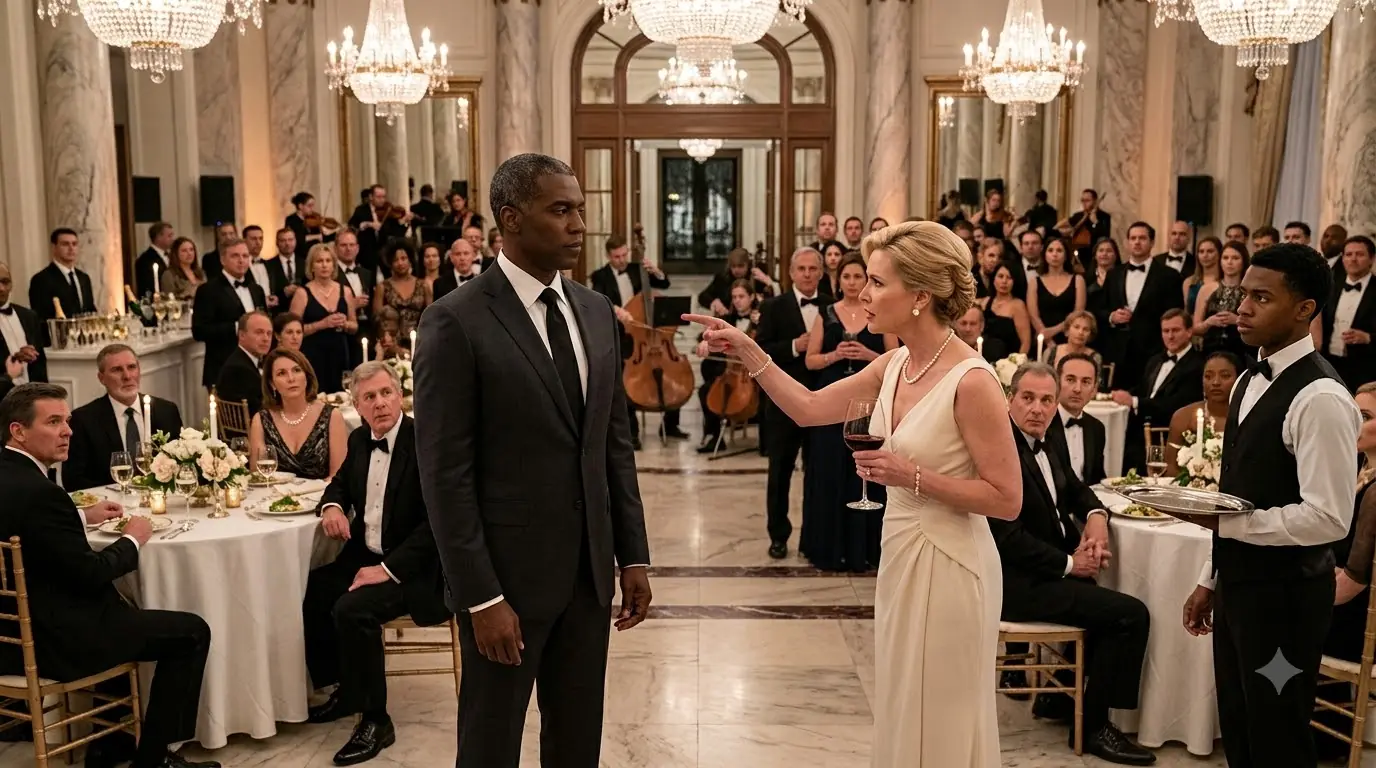
Margo's face twisted. She snatched a wine glass from a nearby table and poured it down his chest. Red wine soaked through his white shirt while the ballroom fell silent around them.
"This is how I deal with people like you when you don't know your place," she said loudly enough for everyone to hear.
Two hundred guests froze. Byron pulled a handkerchief from his pocket, wiped once, and looked her directly in the eyes. "I hope you'll remember this moment."
"Oh, I will," Margo answered with a cold smile. "I'll remember the moment I threw you out of my gala."
"It's your biggest mistake."
She truly believed she was right to humiliate a Black man in a simple suit. She had no idea that, within hours, the man standing in front of her would make her regret every word and destroy the only deal capable of saving her husband's company.
Byron Palmer had grown up in Southeast Baltimore, far from the polished harbor district tourists saw in brochures. His neighborhood was the kind of place where corner stores kept thick protective glass between customers and cashiers, where rent was always due before there was enough money to cover it, and where a parent working two jobs was considered ordinary.
His mother, Dorothy Palmer, worked night shifts in a hospital laundry room and weekends at a grocery store. She came home exhausted, slept in short stretches, and still never missed a parent-teacher conference. Byron remembered her hands more clearly than almost anything from childhood, dry from detergent, stiff from work, but always steady when she helped him with schoolwork at the kitchen table.
He became the first person in his family to finish college. Scholarships covered part of the cost, part-time work covered the rest, and four hours of sleep became his normal routine for years. After graduation, he did not chase Wall Street or search for the fastest path into someone else's fortune.
He went back to Baltimore and started a small investment firm in a rented office above a barber shop. The carpet smelled faintly of hair tonic from downstairs, the air conditioner failed every July, and for the first two years Byron answered his own phone because there was nobody else to do it. He built relationships slowly and invested even more slowly.
That was twenty years earlier.
The firm had become Meridian Capital Holdings, valued at approximately $3.2 billion. Byron had built it without inherited money, family connections, or a famous surname. His advantage was discipline, patience, and the quiet intelligence that people often mistook for passivity.
Yet almost none of that was obvious when someone met him. He did not wear obvious designer labels, did not collect exotic cars, and rarely allowed his photograph to appear in the financial press. He moved through the world the same way he always had, watching closely and saying less than people expected.
That habit was exactly why Margo Sullivan made the worst mistake of her life.
On the morning of the conference, Byron sat at his kitchen table in Baltimore with a cup of black coffee going cold beside a thick confidential folder. Across the cover were the words: SULLIVAN INDUSTRIES ACQUISITION PROPOSAL.
The transaction was simple in structure and enormous in consequence. Meridian Capital would acquire sixty percent of Sullivan Industries for $1 billion. The investment would recapitalize the company, satisfy critical debt obligations, and preserve operations that were otherwise approaching collapse.
Without the deal, Sullivan Industries was projected to fail within roughly six months.
Every negotiation had been conducted through lawyers, advisers, encrypted email, conference calls, and carefully controlled documents. Six months of negotiations had gone into the proposal. Leonard Sullivan, the company's chief executive, had never met Byron face to face.
In fact, Leonard had barely seen a current photograph of him. Byron's few public photographs were years old, and he avoided social media, publicity events, and the business-celebrity circuit. That privacy was deliberate.
But Byron was not prepared to sign a billion-dollar agreement without seeing the people behind the numbers. Financial statements could show him debt ratios, revenue decline, debt maturities, and operating margins. They could not show him how a company treated someone who appeared to have no influence.
So he made a decision that morning.
He would attend the Sullivan Industries investment conference alone. No assistant. No security detail. No visible Meridian badge. No introduction arranged in advance. He would arrive as a man in a simple dark suit and observe the room before anyone knew who he was.
He wanted to know how they treated a person who looked unimportant.
Two hundred miles away, the grand ballroom of the Kensington Hotel was being transformed for the Sullivan Industries annual investment conference. White tablecloths stretched over large round tables. Crystal centerpieces caught the light from the chandeliers. A string quartet tuned instruments near the far wall while hotel staff arranged champagne and fresh-cut lilies.
The guest list included two hundred people, senators, hedge fund managers, corporate executives, major creditors, old-money families, attorneys, and donors. At the center of the activity was Margo Sullivan, Leonard's wife, moving through the room as if every square foot belonged personally to her.
Margo had built a reputation in Washington social circles for hosting events where nothing looked accidental. She knew which donor preferred Bordeaux, which senator's wife refused shellfish, which tables should be closest to photographers, and which guests needed to be seated where other people could see them.
Appearance was not simply important to Margo. It was a system of value.
She believed she could identify influence by clothing, education by accent, wealth by posture, and social worth by the way someone entered a room. Those judgments had served her often enough that she no longer considered them judgments. To her, they were facts.
Shortly before the reception began, Leonard's phone rang.