What Max’s Family Learned Before Taking Him Home
PART 2 — CURRENT CONDITION UPDATE
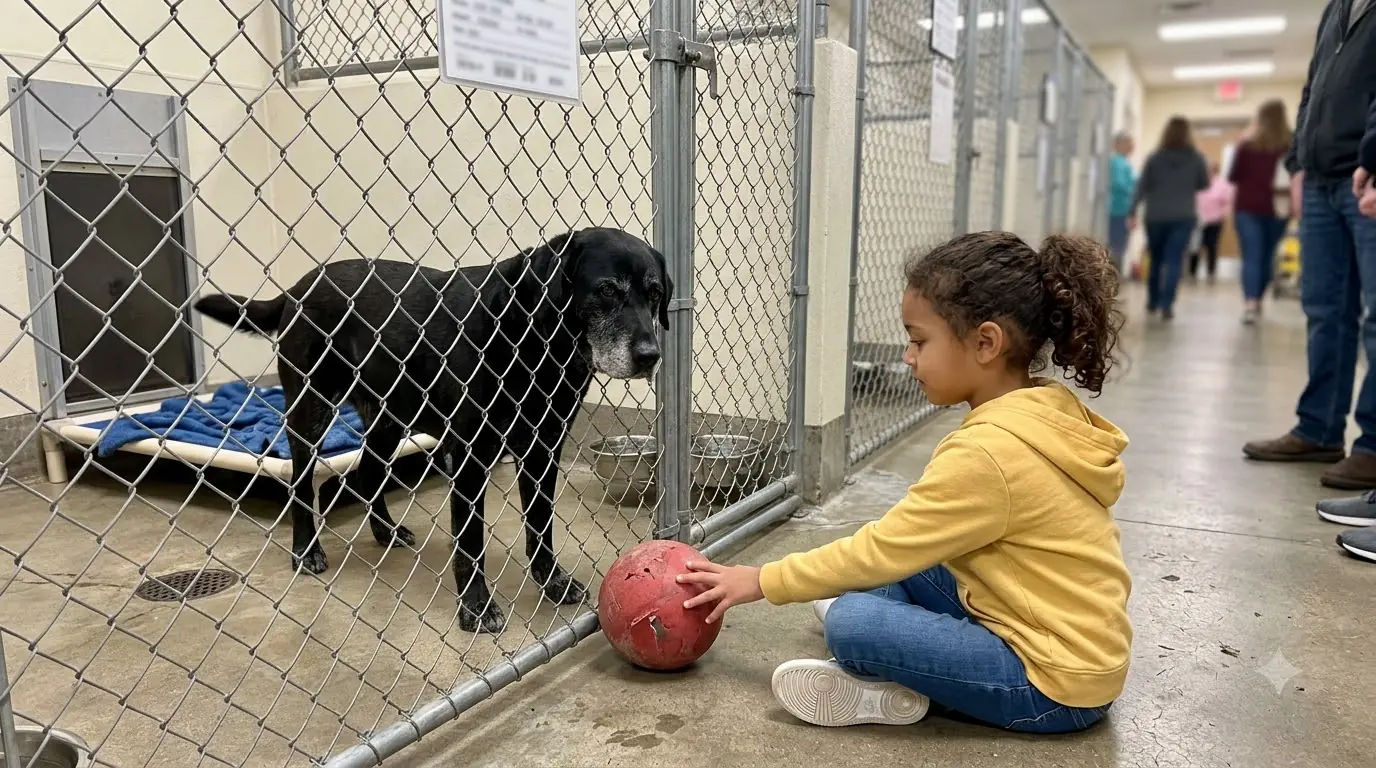
Max is now living with Sophie and her family under a foster-to-adopt agreement while our veterinary team continues managing his health. He is no longer sleeping in the shelter kennel where he waited for nearly four months, and the faded red ball that introduced him to Sophie now rests beside a large orthopedic bed in the family’s living room.
His transition has been encouraging, but it has also required patience, medical planning, and several changes to the family’s original expectations.
When Sophie’s parents first returned with a leash, they believed Max would complete a routine examination and leave with them that afternoon. Shelter staff had already explained that he was an older dog with some stiffness, but Max rarely cried, refused a walk, or reacted when people touched his legs.
Like many Labrador Retrievers, he remained friendly even when he was uncomfortable.
During the examination, the veterinarian noticed that Max placed less weight on his right front leg. The difference was subtle when he walked slowly, but it became more obvious when he turned or tried to rise from a lying position.
He shifted much of his weight toward his left side and used his hindquarters to push himself upright. Once standing, he took several short steps before his stride became smoother.
The veterinarian gently moved each of his joints. Max showed reduced flexibility in both hips and both elbows. When the right shoulder was extended, he tightened his muscles, lowered his head, and stopped wagging his tail.
He did not growl or attempt to pull away. That quiet response made the discomfort easy to underestimate, but the examination showed that his pain needed to be taken seriously.
X-rays confirmed chronic arthritis in several joints. The cartilage in Max’s hips had worn down, and the surrounding bone had changed over time. Similar degenerative changes were visible in both elbows.
The image of his right shoulder raised a separate concern. One area of bone appeared irregular and less dense than expected. Changes like this can have several causes, including an old injury, inflammation, infection, or a tumor affecting the bone.
Because Max’s history before entering the shelter was incomplete, no one knew whether he had injured the shoulder years earlier. His previous owner had provided basic records, but there were gaps during the period when the owner’s health declined.
The veterinary team recommended additional imaging and laboratory testing before making assumptions.
Max received bloodwork, urine testing, chest X-rays, and a more detailed series of images of the shoulder. His blood panel showed mild anemia, but his kidney and liver measurements were within acceptable ranges for his age.
The urine test did not show evidence of a serious infection or major protein loss. His chest X-rays revealed mild age-related changes but no obvious masses in the lungs.
The additional shoulder images suggested that the irregular area was more likely connected to an old traumatic injury and chronic joint disease than an aggressive bone tumor. However, ordinary X-rays could not provide complete certainty.
The team discussed advanced imaging and a bone sample with the family. Those procedures could offer more information, but they would require sedation or anesthesia and would need to be weighed against Max’s current condition, stress level, and the likelihood that the result would change treatment.
A veterinary orthopedic specialist reviewed the images. The specialist found evidence that Max may have damaged the shoulder joint or nearby bone earlier in life. The area had healed unevenly, leading to chronic inflammation and altered movement.
There was no aggressive pattern of bone destruction at that time. The edges appeared more consistent with a long-standing process than a rapidly advancing disease.
That assessment was reassuring, but the team did not dismiss the finding. Max will receive repeat imaging after a planned monitoring interval. If the area changes, if the pain suddenly becomes more severe, or if swelling develops, a biopsy may still be recommended.
For now, Max’s condition is being treated as significant chronic arthritis complicated by an older shoulder injury.
His pain-management plan was designed carefully. Max began a veterinarian-prescribed anti-inflammatory medication after his kidney and liver values were checked. Because long-term medications can sometimes affect the digestive system, kidneys, or liver, his family received instructions to watch for vomiting, diarrhea, dark stool, appetite loss, unusual thirst, or sudden lethargy.
He also receives an additional medication that targets chronic discomfort through a different pathway. The combination allows the team to use conservative doses while addressing more than one source of pain.
No human pain medicine is given to Max. Several common medications used by people can be dangerous or fatal to dogs, especially when combined with veterinary prescriptions.
His family keeps every medication in a labeled container and records each dose on a chart attached inside a kitchen cabinet. This prevents accidental double dosing when more than one adult is helping with his care.
Max accepts tablets easily when they are hidden inside a small portion of his regular food. Sophie is allowed to place the prepared bite in his bowl, but an adult handles the medication itself and confirms that he swallowed it.
The family initially wanted to buy several joint supplements at once. The veterinarian advised them to introduce only products with appropriate safety information and to avoid starting many new treatments simultaneously.
If several supplements and medications are added on the same day, it becomes difficult to know which one caused a side effect or which one provided a benefit.
Max now receives one veterinarian-approved joint supplement. His response will be assessed over time rather than judged after only a few days.
Weight management is another important part of his treatment. Max arrived at the shelter slightly heavier than ideal, even though he lost some muscle during his stay.
Extra body fat increases pressure on painful joints, while muscle loss makes it harder for a dog to stabilize those joints. The goal is not simply to make the number on the scale drop. Max needs a slow reduction in excess fat while preserving and rebuilding useful muscle.
His meals are measured carefully. Treats are counted as part of his daily intake rather than added without limit.
Sophie initially wanted to reward him every time he returned the red ball. The family now reserves a portion of his regular food for training and play. Max is equally pleased to receive praise, gentle petting, or another roll of the ball.
The veterinarian selected a complete diet appropriate for an older dog with mobility problems. The transition happened gradually because sudden food changes can cause digestive upset.
Max ate well at the shelter, but his appetite decreased during his first evening in the new home. He accepted a few bites from Sophie, then walked toward the front door and stood there quietly.
The family worried that he wanted to return to the shelter. His behavior was more likely part of the uncertainty that follows a major environmental change.
For four months, Max had lived according to the shelter’s schedule. Meals arrived with the same sounds, doors opened at predictable times, and he slept surrounded by barking, footsteps, and cleaning equipment.
A quiet house may seem comforting to people, but to a dog accustomed to constant shelter noise, the sudden silence can also feel unfamiliar.
His foster family placed his bowl near the living room rather than in an isolated laundry area. They sat nearby without watching him closely.
After several minutes, Max returned and finished most of the meal. By the third day, he was eating both daily servings without hesitation.
Fresh water is available in the kitchen and beside his bed. His family never restricts his water, even if increased drinking would be inconvenient.
Because certain medications and age-related illnesses can change thirst or urination, the adults monitor how often the bowls need refilling. So far, Max’s drinking has remained consistent.
His mobility plan began with rest and controlled movement rather than complete inactivity. Dogs with arthritis need protection from excessive stress, but prolonged confinement can cause additional muscle loss and stiffness.
Max takes several short walks each day on level ground. The first outings lasted only a few minutes. His family watched his posture, pace, breathing, and willingness to continue.
He was eager to explore the neighborhood, but his enthusiasm could have carried him farther than his joints could comfortably manage. Sophie’s father learned to turn toward home before Max began slowing down.
A dog may appear comfortable during activity and become significantly sore several hours later. For this reason, the family also records how Max rises after naps and how he moves the morning after a longer walk.
During his first week, one evening walk lasted almost twice as long as planned because Max seemed happy and continued smelling trees along the sidewalk. That night, he shifted repeatedly on his bed and struggled more than usual when standing.
The family shortened the next day’s walks and contacted the veterinary team. Max improved with rest and his regular medication, but the episode demonstrated why gradual increases matter.
His current walks follow a predictable route with smooth pavement and several grassy areas. He does not climb steep hills or run beside a bicycle.
The family uses a well-fitted harness rather than placing pressure on his neck. A leash remains attached outdoors, even though Max usually stays close.
His movement can become less stable when he turns suddenly, and chasing a squirrel across wet grass could cause a painful fall.
Inside the home, nonslip runners create secure paths between Max’s bed, bowls, and the back door. The family’s hardwood floors were difficult for him during his first day.
When his paws slid outward, he froze rather than risk another step. Sophie sat several feet away and rolled the red ball onto the nearest rug.
Max followed it carefully, moving from one secure surface to the next. The family then added more runners before asking him to cross the room again.
A low ramp now covers the steps leading into the backyard. Max initially tried to step beside it because ramps were unfamiliar to him.
His family used treats and slow guidance to teach him. No one pulled him up by the collar or pushed him from behind.
Within several days, he began using the ramp with only a little hesitation. A textured surface provides traction, and an adult remains nearby in wet weather.
Max is not allowed to jump into the family’s vehicle. A second ramp helps him enter through the rear door, and a secure restraint prevents him from moving around while the car is traveling.
The first time the ramp appeared beside the vehicle, Max became excited and attempted to climb too quickly. His front feet reached the surface while his hind legs remained on the ground, leaving him briefly unbalanced.
The family stopped, allowed him to step away, and tried again at a slower pace. He now waits until the ramp is stable and an adult gives him a familiar cue.
His orthopedic bed has a firm supportive base with enough padding to protect his elbows and hips. The edges are low so he does not have to climb.
At first, Max slept beside the bed rather than on it. Shelter staff had sent home a blanket carrying familiar smells, and the family placed it across the mattress.
That night, Max rested his head on the blanket while his body remained on the floor. By morning, he had moved entirely onto the bed.
He now changes position more comfortably and sleeps for longer periods without repeatedly standing. The family watches for excessive panting, restlessness, licking at a joint, or an inability to settle, because these may indicate pain even when he does not cry.
Max has started working with a veterinary rehabilitation professional. His initial assessment measured muscle size, range of motion, posture, balance, and how he distributes weight across his legs.
As expected, he carried less weight on the right front leg. He also had reduced muscle through his hindquarters after months of limited activity.
The rehabilitation plan began with gentle exercises on nonslip surfaces. Max practices controlled weight shifts while standing, slow transitions between sitting and standing, and careful steps over very low obstacles.
Each session is short. Quality matters more than the number of repetitions.
If Max becomes tired, begins leaning heavily, or changes his movement to protect the shoulder, the exercise stops. Pushing through visible fatigue would strengthen poor movement patterns and increase discomfort.
Sophie sometimes participates by standing in front of him and offering a piece of measured food while an adult supervises. This keeps the sessions positive without allowing her to pull on his body or reposition his legs.
Massage and gentle movement are used only as demonstrated by the rehabilitation team. The family does not force a painful joint through a greater range.
Additional therapies may be considered depending on Max’s progress. The veterinary team has discussed options that could support comfort and mobility, but no treatment is presented as a guaranteed cure.
Arthritis is a chronic condition. The goal is to reduce pain, preserve movement, and allow Max to participate in family life safely.
After several weeks, the family noticed that he was standing more easily in the morning. He still pushes forward before rising, but he rarely needs a second attempt.
His stride remains shorter on the right side, especially after rest. Once he has walked slowly for several minutes, his movement becomes smoother.
Max’s faded red ball remains his favorite possession, but play has been modified to protect his joints.
At the shelter, visitors sometimes threw balls down a narrow concrete corridor. Max would accelerate, stop sharply, and turn quickly to retrieve them. Repeated high-impact movement is not appropriate for his shoulder and hips.
In his new home, the ball is rolled gently across a rug or short section of grass. Max walks after it instead of sprinting.
Sophie has learned not to snatch the ball from his mouth. She waits until he releases it or asks him to place it in her open hands.
Max does not appear possessive. He brings the ball willingly and waits for the next roll, just as he did at the kennel gate.
The family also introduced scent games that provide enrichment without requiring fast movement. Pieces of his measured food are hidden in folded towels or placed beneath lightweight cups.
Max learned quickly. His tail moves steadily while he searches, and he often checks Sophie’s hands to see whether she is preparing another round.
The red ball is inspected frequently. Its surface is faded and marked by teeth, but it is still intact.
Because damaged rubber can break into pieces and become a swallowing hazard, play remains supervised. The family purchased a similar ball as a backup, but Max continues to choose the old one.
The original ball may have belonged to him before he entered the shelter. It was found among the few belongings delivered with him, though the records do not explain when he received it.
Shelter caregivers believed that carrying it became a coping routine. It gave Max something familiar to do whenever visitors entered the hallway.
We cannot know whether he understood that presenting the ball might help him find a home. It would be easy to give human meaning to every repetition.
What staff could observe was simple: Max became more engaged when someone played with him, and he became quieter when people passed without stopping.
His behavior around Sophie changed almost immediately because she responded to the invitation he had been making.
The family’s adoption decision was not based only on that emotional moment. Shelter counselors discussed the long-term responsibilities of caring for a senior dog with chronic pain.
Sophie’s parents reviewed expected veterinary costs, medication schedules, transportation needs, exercise limitations, and the possibility that Max’s shoulder condition could become more serious.
They were also asked to consider whether their home environment suited him. The family has no steep interior staircase, and the primary living spaces are on one floor.
Sophie is old enough to follow safety instructions. She understands that Max may not want to be hugged, climbed on, awakened suddenly, or disturbed while eating.
During their first meeting outside the kennel, staff showed her how to pet his shoulder and chest without leaning over him. Max moved closer on his own and rested beside her.
The shelter never described him as “perfect with all children” based on a single interaction. Dogs can behave differently when tired, frightened, painful, or placed in new situations.
Every meeting between Max and Sophie was supervised. His body language remained relaxed, and Sophie consistently respected instructions.
At home, an adult still supervises their play. Sophie does not administer medication, walk him alone, or attempt to lift him.
She helps in safe ways. She fills his puzzle toy with measured food, straightens his blanket, reads beside his bed, and rolls the ball a short distance.
Max has begun waiting near the window when her school bus arrives. The first time he heard the bus stop, he stood and looked toward the door.
When Sophie entered, he carried the red ball to her and wagged so hard that his entire body moved. She sat on the rug before greeting him so he would not attempt to jump.
Max’s emotional adjustment has been gentler than the family expected, though there have been uncertain moments.
During his first several nights, he woke when the house became silent and walked from room to room. He checked the front door, kitchen, and hallway before returning to his bed.
The family kept a low light on and maintained a consistent bedtime routine. His final bathroom trip occurred at the same time, followed by medication, fresh water, and quiet settling.
No one repeatedly called him or followed him through the house. He was allowed to investigate and return when ready.
By the end of the first week, his nighttime wandering had decreased. He now sleeps for several hours at a time and usually remains on his bed until morning.
Max initially became alert whenever keys jingled. He would stand at the door and position his body as though determined not to be left behind.
His previous owner’s move into assisted living likely involved sudden changes, unfamiliar people, and the removal of household belongings. Max could not understand why the person he had lived with was gone.
At the shelter, the sound of keys often meant that someone was opening a kennel or taking a dog into the hallway. His response may have developed from several experiences rather than one clear memory.
The family practiced short, predictable departures. One adult remained with Max while another left and returned.
Later, everyone stepped outside for only a few seconds. A camera allowed them to observe his behavior without extending the absence beyond what he could tolerate.
At first, Max stood at the door and listened. He did not destroy objects, scratch frantically, or bark continuously, but he remained tense until the family returned.
The departures increased gradually. Max can now remain calm for moderate periods, usually sleeping after checking the front window.
The family does not leave him alone for a full workday. Their schedules are arranged so that he receives bathroom breaks, medication, and company.
A trusted neighbor has met Max several times and can help if plans change. Introductions happened while the family was present so the neighbor would not appear unexpectedly.
Max greeted her with the red ball during the second visit.
His behavior with unfamiliar adults is friendly but not demanding. He approaches, smells their clothing, and often brings a toy.
Visitors are told not to encourage jumping or rough play. They also avoid touching his painful shoulder suddenly.
Max has not shown aggression around food, toys, beds, or people. However, his caregivers continue observing body language rather than assuming that a gentle dog has no boundaries.
Turning his head away, closing his mouth, stiffening, lowering his tail, licking his lips, or moving away can all indicate discomfort.
Respecting these smaller signals prevents a dog from needing to communicate more strongly.
Max’s hearing appears mildly reduced. He does not always respond when called from another room, especially if background noise is present.
He responds more reliably when the speaker stands within view or uses a clear hand signal. The family avoids startling him while he sleeps.
His eyes show common age-related cloudiness in the lenses, but his functional vision remains good. He follows moving objects, navigates the home, and finds the red ball even in moderate indoor light.
The ophthalmic examination did not find painful glaucoma or advanced cataracts requiring immediate treatment.
His dental examination revealed moderate tartar, gum inflammation, and one fractured premolar. The tooth was not visibly infected, but dental X-rays showed disease beneath the gumline.
Because oral pain can affect appetite and overall health, the veterinary team recommended a professional cleaning and extraction of the damaged tooth.
The procedure was scheduled only after Max’s medical evaluation was completed and his pain medications were stabilized. Pre-anesthetic bloodwork remained acceptable.
During the dental procedure, the damaged premolar and one loose smaller tooth were removed. Max recovered without complication.
He ate softened food for several days and received appropriate pain relief. His family did not offer hard chews, bones, antlers, or other items that could damage healing tissue or fracture additional teeth.
At his recheck, the extraction sites were closed and comfortable. His breath improved, and he resumed eating normally.
Max’s mild anemia is also being monitored. The initial pattern did not suggest severe blood loss, and repeat testing showed a small improvement.
Chronic inflammation, age, nutrition, and shelter stress may all contribute to mild changes in red blood cell measurements. If the anemia worsens, additional testing will be needed.
His stool remains normally colored, and there has been no visible blood in his urine. The family reports any change because hidden bleeding or medication side effects must be identified quickly.
Parasite testing was negative for heartworm disease, and his preventive care has been updated according to veterinary guidance.
His ears contained wax and mild irritation but no severe infection. Routine cleaning is performed only as instructed. Excessive or aggressive cleaning can make inflammation worse.
Max’s skin is generally healthy. A small callus covers each elbow, likely from lying on hard surfaces before he entered the foster home.
The areas are not open or infected. His padded bed and rugs reduce further pressure.
His coat had become dull during the shelter stay, and loose hair accumulated heavily around his shoulders. Sophie helps brush him with an adult nearby.
Sessions remain brief because standing for a long time can fatigue him. Max often lies on his side and relaxes while she brushes the areas that are comfortable to reach.
The family avoids pulling his front leg forward to groom beneath it. They reposition themselves instead of forcing him into an uncomfortable posture.
His coat now looks cleaner and softer, but cosmetic improvement is not treated as the main measure of recovery. Comfort, appetite, mobility, sleep, and willingness to engage provide more useful information.
Max’s follow-up orthopedic examination showed modest but meaningful improvement. He places slightly more weight on the right front leg, and the surrounding muscles are less tense.
The irregular bone area on his shoulder has not produced visible swelling. Repeat images will still be required to confirm that it remains stable.
If the bone changes progress, Max may need advanced imaging or a biopsy. His family understands that an older dog can have more than one medical condition and that a reassuring first interpretation does not eliminate the need for monitoring.
They also understand that arthritis does not disappear because he has several good days.
Cold, damp weather may increase stiffness. A longer activity may cause soreness later. Medication doses may need adjustment as his weight, laboratory values, and condition change.
His family keeps a weekly journal. They record appetite, sleep, walking duration, difficulty rising, limping, medication, and unusual behavior.
Short videos of Max walking are taken periodically from the side and from behind. These provide the rehabilitation team with a clearer comparison than memory alone.
One day can be misleading. A pattern across several weeks helps the medical team decide whether treatment is working.
The journal has shown that Max now rises more easily on most mornings and recovers faster after walks. He also chooses to follow family members between rooms more often.
Before pain treatment, he often watched them leave without attempting to stand. Now he walks into the kitchen when breakfast is prepared and rests on a rug near the table.
He does not need to participate in every activity to have a good quality of life. The goal is to give him choices without requiring more movement than his body can tolerate.
When Sophie plays in the yard, Max can lie on a shaded mat and watch. If he wants to explore, an adult takes him on a short leash circuit.
He is not encouraged to chase her while she runs. The family has learned that inclusion does not always mean doing the exact same thing.
On a recent afternoon, Sophie sat beside Max with the red ball in her lap. Instead of asking him to retrieve it repeatedly, she rolled it only a few feet.
Max picked it up, returned slowly, and placed it against her shoe. Then he lowered himself onto the rug and rested his head beside her knee.
Sophie remained there, reading while one hand rested lightly against his back.
That quiet companionship is becoming more important than the game that first connected them.
The family has asked whether Max might eventually visit his previous owner. Shelter records indicate that the owner cared deeply for him but could no longer manage his daily needs after entering assisted living.
Any reunion would require permission from the facility and careful consideration of the owner’s and Max’s health. The family does not want to create stress or make promises that cannot be kept.
For now, they have sent photographs through the appropriate contact. The shelter received confirmation that Max’s former owner was relieved to learn he had found a home with a child who loved playing with him.
The family keeps that history as part of Max’s life. They do not describe him as unwanted or claim that he was abandoned without love.
Sometimes a person’s health removes choices long before affection disappears.
Max’s four months at the shelter were still difficult. He watched many dogs leave while he remained behind.
Senior dogs are frequently overlooked because adopters worry about medical costs, shorter time together, or the pain of eventual loss. Those concerns are real and should not be dismissed.
Adopting an older animal requires practical preparation as well as emotion. Max needs medication, follow-up imaging, rehabilitation, controlled exercise, and a home arranged around his mobility.
Sophie’s family did not rescue him through affection alone. They committed to the daily work that allows affection to become reliable care.
The shelter continues supporting them during the foster-to-adopt period. Medical information is shared openly, and the family can contact staff with concerns.
This arrangement protects Max from another abrupt transition if unexpected needs arise. It also gives the family time to understand his routine before the adoption becomes final.
So far, they have not hesitated.
They have attended every appointment, followed his activity restrictions, learned how to recognize pain, and adjusted their home without treating him as a burden.
Sophie’s parents have discussed age and illness with her in honest, age-appropriate language. They have not promised that medicine will make Max young again or that he will live for a particular number of years.
They explain that his body needs gentler care and that his good days matter even if no one can count exactly how many will come.
Sophie responds by focusing on what he can do. She marks his short walking routes on a calendar, chooses scent games, and reminds visitors that his ball must be rolled rather than thrown far.
Max’s final adoption decision will follow his next orthopedic review. The purpose is not to decide whether he is “perfectly healthy.” He is an older dog with permanent medical needs.
The review will confirm that the family has a sustainable treatment plan and that no urgent change has appeared in the shoulder.
If the images remain stable, monitoring will continue at intervals recommended by the specialist. If they change, the family will discuss further diagnostics and treatment based on Max’s comfort and overall welfare.
His long-term outlook depends on several factors. Arthritis will progress to some degree, but careful weight management, appropriate medication, rehabilitation, and environmental support can preserve meaningful mobility.
The older shoulder injury may remain stable, or it may cause increasing discomfort over time. Regular evaluation gives the team the best chance to respond before Max’s quality of life declines significantly.
The family has emergency instructions. Sudden inability to bear weight, severe swelling, collapse, repeated vomiting, black stool, refusal of food, difficulty breathing, or uncontrolled pain requires prompt veterinary attention.
They do not increase medication on their own. More is not always safer, and combining drugs without guidance can cause serious harm.
On ordinary days, the signs they watch are quieter. Does Max rise for breakfast? Does he choose to explore outside? Can he settle comfortably? Does he seek interaction? Does he still bring the red ball?
At present, the answers are reassuring.
Max eats well, drinks normally, sleeps deeply, and asks to go outside. He walks slowly but willingly.
He still has stiff mornings and tired evenings. Some days, he carries the ball only once before returning to bed.
The family does not interpret that as sadness or rejection. They allow him to rest.
Other mornings, Max waits beside Sophie’s bedroom before she wakes. When the door opens, he picks up the ball and follows her toward the living room.
She sits on the same rug each time. He places the ball in front of her and steps backward.
The game usually lasts only a few minutes now. It ends before he becomes sore, not when he becomes bored.
Afterward, Max settles beside her while the household begins its day.
At the shelter, his red ball was an invitation offered repeatedly to people passing through a hallway. Most saw it, smiled, and continued walking.
Sophie was the first person in months to sit down and answer him.
The leash her family brought the next morning did not lead Max directly into an easy life. It led to X-rays, medication charts, ramps, rehabilitation appointments, careful walks, and difficult conversations about an older dog’s future.
It also led to a quiet home where his pain is noticed, his limits are respected, and his favorite game no longer depends on a stranger stopping outside a kennel.
Max’s medical care is not finished. His shoulder must be monitored, his arthritis will need lifelong management, and his treatment plan will change as he grows older.
But he no longer waits at a gate, holding out the only thing he has and hoping someone will remain.
The faded red ball is still marked by years of use. It is not new, bright, or especially valuable.
Every evening, however, Sophie places it beside Max’s bed so he can find it in the morning.
And every morning, Max carries it to the same little girl who taught him that sometimes, when you return the ball, someone returns for you too.