What Milo’s Care Team Learned After They Stopped Forcing Him to Be Social
PART 2 — CURRENT CONDITION UPDATE
Milo is now living in a quiet behavioral foster home while our veterinary and behavior teams continue evaluating his sensory sensitivity, repetitive movements, and difficulty adjusting to change. He remains cautious, but he is eating consistently, sleeping more deeply, and beginning to approach familiar people without being called.
No veterinarian has diagnosed Milo with autism.
The word was first used by several visitors who watched him avoid eye contact, retreat from noise, repeat certain movements, and appear overwhelmed by changes in routine. Those observations were understandable, but they were not enough to establish a medical diagnosis.
Autism is a well-defined neurodevelopmental diagnosis in people. Dogs may display behaviors that resemble some human autistic traits, but there is no routine, universally accepted clinical test that can determine that a dog is autistic in the same way a qualified professional evaluates a person.
Veterinary literature sometimes discusses conditions involving repetitive behavior, reduced social interaction, unusual responses to sensory information, or what has been called canine dysfunctional behavior. However, the science remains limited, and many other explanations must be considered first.
For Milo, those other explanations included pain, ear disease, partial hearing impairment, fear, chronic stress, compulsive behavior, neurological illness, poor early socialization, and previous experiences that could not be documented.
The shelter team’s responsibility was not to choose the most unusual label. It was to identify every treatable problem, reduce Milo’s distress, and observe his behavior in an environment less overwhelming than a kennel.
Milo’s first physical examination was difficult, but not because he attempted to bite.
When a staff member entered his kennel carrying a leash, he moved to the far corner and turned his face toward the wall. His body became still, his mouth closed, and his tail pressed beneath him.
He did not growl. He simply stopped responding to food and remained frozen.
Freezing can be mistaken for cooperation. A dog who stays still during handling may be terrified rather than comfortable.
The medical team avoided surrounding him or dragging him forward. They dimmed the light, reduced the number of people in the room, and allowed the volunteer he knew to remain nearby.
Milo was moved using a secure harness and leash arrangement that did not require anyone to reach repeatedly over his head.
A veterinarian performed the least invasive portions of the examination first. Milo’s heart and lungs sounded normal. His body temperature and hydration were acceptable, and he was close to an appropriate weight.
When the veterinarian approached his right ear, Milo immediately pulled away and shook his head.
The left ear contained a small amount of wax but appeared relatively comfortable. The right canal was red, narrowed, and filled with dark discharge.
A sample examined under the microscope revealed yeast and bacteria. The inflammation appeared to have been present for longer than Milo’s shelter stay.
Chronic ear disease can cause significant pain. Dogs may become sensitive to touch, avoid people approaching their head, startle easily, or react strongly to certain sounds and vibrations.
An infected ear does not explain every aspect of Milo’s behavior, but leaving it untreated would have made any behavioral assessment unreliable.
The team used medication to reduce pain and anxiety before completing a deeper ear examination. This was not done simply to make handling more convenient. It protected Milo from a frightening struggle and allowed the veterinarian to see the ear safely.
The right eardrum was intact but thickened. The canal showed chronic changes consistent with repeated inflammation.
A culture identified which bacteria were present and guided medication selection. Milo began a treatment plan that included prescribed ear medication, pain relief, and careful cleaning performed only as directed.
The foster caregiver does not pour random home remedies into his ear. Substances that irritate damaged tissue or enter through a compromised eardrum can worsen pain and potentially affect hearing or balance.
Milo initially fled when he saw the medication bottle. The team therefore changed how the treatment was presented.
The bottle was kept out of sight until he was settled on a nonslip mat. His caregiver used a predictable sequence: Milo approached the mat, received a small food reward, placed his chin on a folded towel, and then experienced a brief ear treatment.
If he lifted his chin, the caregiver paused whenever medically safe.
The procedure was not completely voluntary because the infection required treatment, but offering small amounts of control reduced his panic.
Over time, Milo stopped leaving the room when the towel appeared. He now approaches the mat on most days and accepts the medication with mild tension rather than complete shutdown.
His ear discharge has decreased significantly. The redness is improving, and he no longer shakes his head repeatedly after waking.
A follow-up sample showed fewer bacteria and yeast organisms. Treatment will continue according to the veterinarian’s instructions rather than stopping solely because the ear looks cleaner.
Chronic ear disease can recur. The team is investigating possible contributing factors, including allergies, anatomy, environmental irritation, and previous incomplete treatment.
Milo’s response to sound required a separate evaluation.
Shelter staff initially described him as highly sensitive to noise. Metal bowls, barking, rolling carts, and doors caused him to retreat or pace.
However, he sometimes failed to respond when a person spoke behind him. At other times, he reacted intensely to a sound that seemed relatively soft.
This inconsistent pattern raised questions about both hearing and emotional response.
A dog does not need to hear every frequency normally to be frightened by noise. Partial hearing loss can distort the way sounds are perceived or make it difficult to locate where they originated.
A dog may ignore a voice from one direction and still react sharply to a high-pitched noise, vibration, or sudden movement.
Milo received a specialized hearing assessment after his ear inflammation began improving. The test measured electrical activity along the auditory pathway in response to sound.
Results suggested reduced hearing in the chronically affected right ear. His left ear retained functional hearing, although his response was not identical across all frequencies tested.
This did not mean ordinary sounds were physically louder to Milo. It meant his sensory experience might be uneven and less predictable.
A noise appearing suddenly from a direction he cannot identify may be especially alarming.
The foster home has been adjusted accordingly. Caregivers approach within Milo’s field of vision and avoid touching him unexpectedly while he sleeps.
They do not shout to overcome the hearing difference. A louder voice can increase stress without improving understanding.
Instead, Milo is taught clear hand signals for common cues such as “come,” “wait,” “outside,” and “bed.”
The signals are presented slowly and consistently. Family members use the same gesture rather than inventing different versions.
A gentle floor vibration can alert Milo that someone is approaching, but caregivers never stomp or startle him deliberately.
White noise plays at a low, steady volume in the room where he sleeps. It helps soften abrupt sounds from outside without creating a constant loud environment.
His bed is positioned away from the front door, kitchen appliances, and windows facing traffic.
Milo is always allowed access to a covered resting area. The cover does not seal him inside or block ventilation. It creates a predictable place where visual movement is reduced.
During his first days in foster care, Milo spent most of his time there. His caregiver placed food and water nearby but did not reach inside to pull him out.
He emerged for bathroom trips only after the house became quiet.
By the end of the first week, he began lying near the entrance with his head outside the covered area. He watched the caregiver move through the room and returned inside whenever a new sound occurred.
The caregiver treated retreat as useful communication. Milo was showing that he needed distance before becoming overwhelmed.
Preventing all retreat would not make him more confident. It would remove the safest strategy he had and could force him toward freezing, panic, or defensive behavior.
Milo’s repetitive movements were also documented carefully.
At the shelter, he sometimes paced from the bed to the gate, turned clockwise, and followed the same path again. During especially noisy periods, he repeated the sequence for several minutes.
He also stared at moving shadows and occasionally snapped toward reflected light on the kennel wall.
Repetition alone does not establish autism or a compulsive disorder. Pacing may result from confinement, anticipation, fear, lack of exercise, pain, or an urgent need to eliminate.
Light chasing can begin as ordinary interest and become more persistent when people encourage it with laser pointers, reflections, or moving screens.
The team needed to observe whether these behaviors continued after Milo left the shelter environment.
In foster care, his pacing decreased but did not disappear.
He most often began the pattern when a familiar event occurred at an unexpected time. If breakfast was delayed, a visitor entered, or a piece of furniture blocked his usual route, Milo walked the same loop between his bed and the kitchen doorway.
The behavior lasted longer if someone attempted to stop him physically.
His caregiver now records the time, duration, trigger, body posture, appetite, and what happened immediately before and after each episode.
This information helps distinguish a compulsive pattern from communication, anticipation, or fear.
Video recordings were reviewed by a board-certified veterinary behaviorist. Milo’s movements appeared connected to arousal and difficulty transitioning between activities.
He could usually respond to a familiar visual cue or food scatter before the pacing became prolonged. Once highly distressed, he stopped taking food and became harder to interrupt.
The behaviorist did not diagnose a primary compulsive disorder during the initial consultation. More observation was needed after pain and environmental stress were reduced.
A neurological examination was also performed. Milo walked normally, placed his paws correctly, and showed no paralysis or obvious loss of balance.
His spinal reflexes were appropriate. He did not circle continuously in one direction during ordinary movement, and his eyes showed no persistent abnormal motion.
Bloodwork did not identify advanced kidney or liver disease, severe anemia, diabetes, or a major electrolyte disturbance.
His thyroid measurements did not support clear hypothyroidism. Screening for several infectious and inflammatory conditions was also reassuring.
Advanced brain imaging was discussed. Because Milo did not show seizures, progressive weakness, severe disorientation, or other signs strongly suggesting a structural brain lesion, immediate imaging was not considered essential.
That decision may change if new neurological symptoms appear.
The foster caregiver has instructions to record episodes of collapse, prolonged unresponsiveness, facial twitching, unexplained loss of balance, continuous circling, sudden vision changes, or movements that cannot be interrupted.
Milo has shown none of those signs so far.
His vision examination found no painful eye disease. He tracks movement and navigates both familiar and unfamiliar spaces when given time.
His interest in reflected light appears behavioral rather than the result of blindness. The family keeps mirrors and reflective objects from casting fast-moving spots across the floor.
No one uses a laser pointer with him.
Milo’s daily routine is predictable without becoming completely rigid.
Breakfast, bathroom trips, medication, quiet training, rest, and evening walks occur within consistent windows. Caregivers use the same order of events whenever possible.
However, the goal is not to make every minute identical forever. A life that cannot tolerate any change would remain extremely fragile.
Once Milo feels safe with a routine, the caregiver introduces tiny, manageable variations.
For example, his food bowl may be placed several inches from its usual location. A walk may begin through a different doorway. A familiar exercise may occur five minutes earlier.
Only one small change is introduced at a time. Milo’s response determines whether the next variation should be easier, repeated, or postponed.
During the first attempt to move his bowl, Milo stopped several feet away and stared at it. He looked toward the original feeding spot, paced once, and returned to the doorway.
The caregiver did not push the bowl toward him or carry Milo closer. She placed several pieces of food along a short path and sat sideways.
After several minutes, Milo approached and ate.
The bowl returned to its usual place at the next meal. A smaller variation was attempted later.
Milo now tolerates the bowl being placed within a wider area of the kitchen. He still notices the difference, but he no longer abandons the meal.
These exercises are not designed to prove that his preferences are irrational. They help him learn that small changes can occur without danger.
His appetite is now reliable. At the shelter, he often refused food while visitors were present and ate only after the hallway became quiet.
In foster care, he initially waited until his caregiver left the room. She placed the bowl down and sat at a distance without facing him.
Milo began taking a few bites while she remained present. Each day, she sat slightly closer only if his body stayed relaxed.
He now eats with the caregiver several feet away and sometimes approaches the kitchen before the bowl is prepared.
His meals are complete and measured. The family reserves part of his normal food for training so he does not receive excessive calories through rewards.
Milo is close to an ideal weight, but he lacks some muscle through his hindquarters after limited shelter activity.
His exercise plan balances physical movement with sensory safety. Border Collie mixes often benefit from mental and physical activity, but simply exhausting an anxious dog does not treat fear.
Long, chaotic outings could increase stress rather than reduce it.
Milo walks during quieter times of day. His harness fits securely without restricting his shoulders, and a backup connection attaches to his collar.
The double connection is important because frightened dogs may back out of ordinary equipment.
His identification remains attached whenever he leaves the house.
During early walks, Milo froze whenever a truck passed. He lowered his body and attempted to move toward the nearest driveway.
The caregiver increased distance from the road and chose a route with visual barriers. She did not drag him forward or flood him with traffic until he stopped reacting.
At a distance where Milo could still eat, trucks were paired with small pieces of his measured food.
The goal was not to reward fear. Food helped create a safer emotional association while the stimulus remained manageable.
If Milo stopped taking food, the team treated that as evidence that the situation was too difficult. They increased distance rather than waiting for him to become more frightened.
He can now watch ordinary cars pass from across a quiet street. Large trucks and sudden engine noises remain difficult.
His walks are kept short enough that he returns home able to settle. Duration will increase gradually.
Milo does not attend crowded dog parks, busy festivals, outdoor restaurants, or pet-supply stores. Those environments offer little benefit at his current stage and create unnecessary opportunities for panic.
Socialization does not mean exposing a dog to everything regardless of response. Effective exposure occurs at an intensity the animal can process safely.
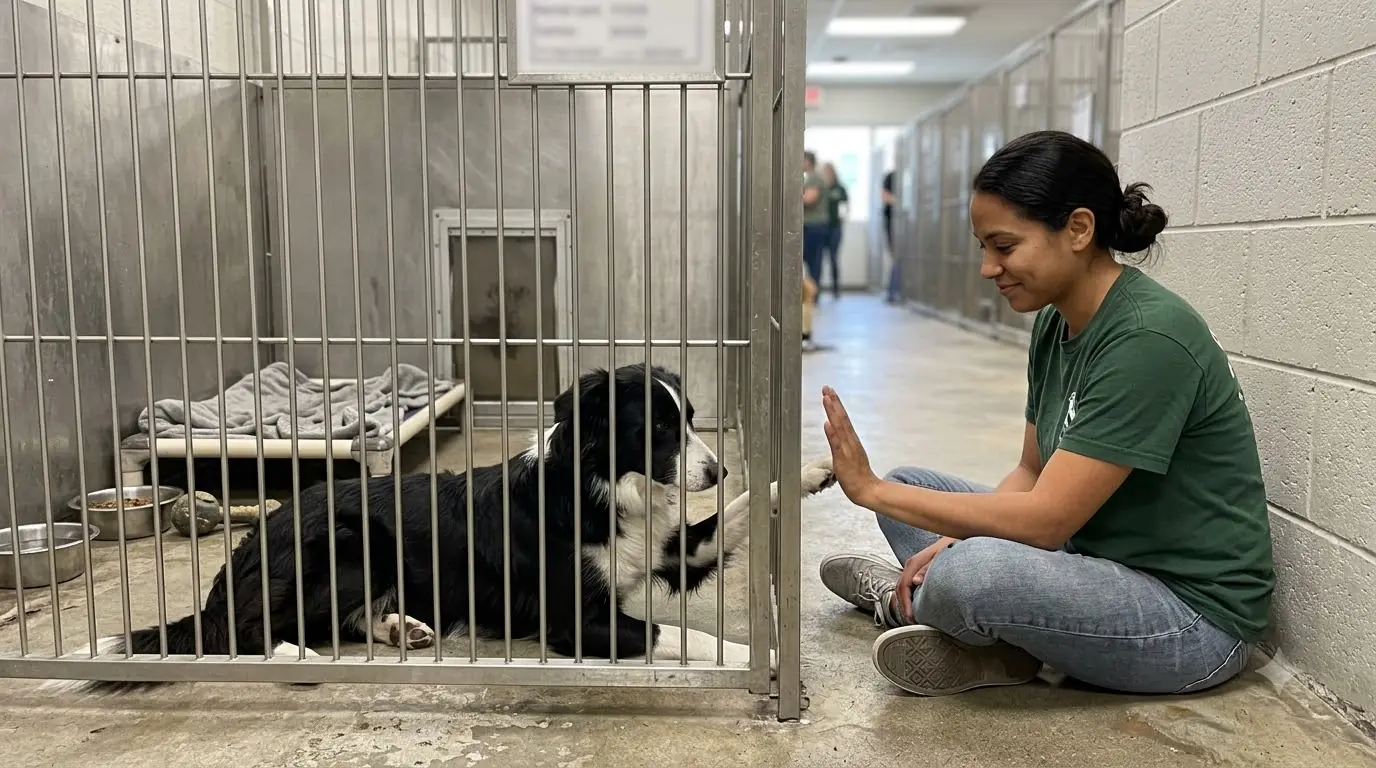
Milo’s relationship with the volunteer who first sat outside his kennel has continued.
Her shelter visits had followed the same pattern every afternoon. She arrived quietly, placed a chair several feet from his kennel, turned slightly sideways, and read without calling him.
For more than two weeks, Milo remained at the back.
He watched her hands, feet, and face but did not approach. If another person stopped nearby, he retreated farther.
The volunteer never slid food directly toward him while staring. She occasionally placed a treat near the kennel entrance before sitting down, allowing Milo to choose whether to retrieve it.
At first, he waited until she left.
Later, he collected the food while she remained seated. His movements were fast, and he returned immediately to the bed.
The first day he lay near the gate, the volunteer did not reach inside. She rested one open hand on the floor outside the bars.
Milo shifted forward and placed his paw against her fingers.
He remained there for only several seconds. Then he stood and walked away.
The volunteer did not follow, celebrate loudly, or attempt to repeat the contact. Milo had made one choice, and allowing that choice to end safely was important.
During the next visit, he approached sooner. He lay at the gate without touching her.
A week later, he permitted the volunteer to rub his chest briefly through the bars.
When Milo moved to foster care, the volunteer visited only after he had several days to settle. She entered the home, sat in the same sideways position, and waited.
Milo observed from his covered bed. After nearly twenty minutes, he walked into the room and smelled her shoes.
He then lay beside her chair with his back turned toward her.
Turning away did not mean rejection. His loose posture suggested that he felt safe enough not to monitor every movement.
The volunteer remains part of his support network. Her presence also helps the team determine whether Milo can recognize and maintain relationships across different environments.
Milo behaves differently with his primary foster caregiver. He follows her between rooms at a distance and often lies where he can observe both her and the nearest exit.
He does not constantly seek petting. When he wants contact, he approaches slowly and touches his nose to her hand.
She offers a brief stroke along his chest or shoulder, then pauses. If Milo stays or moves closer, contact continues. If he turns away, she stops.
This consent-based pattern has reduced his tendency to freeze during ordinary handling.
Necessary medical care cannot always wait for perfect consent, but trust built during nonurgent moments makes essential procedures easier.
Milo now participates in cooperative-care exercises. He learns to place his chin on a towel, stand on a mat, offer a paw, and allow brief inspection of his ears.
Each behavior is broken into small steps. Training sessions last only a few minutes.
The goal is predictability, not performance.
His response to unfamiliar people remains cautious. Visitors are asked to ignore him when they enter.
They do not extend a hand toward his face, crouch directly over him, or trap him in a corner.
Milo usually watches from the covered bed. If the visitor sits quietly for long enough, he may approach to smell their shoes.
No one pets him during the first approach unless he clearly solicits contact.
During one recent visit, Milo entered the room after approximately ten minutes. He smelled the guest’s pants and moved away.
Several minutes later, he returned and lay near the opposite end of the couch.
This was considered progress even though he never touched the visitor.
Success for Milo is not measured by whether every stranger can pet him. It is measured by his ability to remain safe, recover from stress, and make choices without panic.
Milo has not shown unprovoked aggression toward people. He has growled twice in foster care.
Both growls occurred when someone moved too close to his covered bed while he was resting.
The caregiver immediately increased distance and changed how the space was managed.
Growling was not punished. It provided valuable warning that Milo was uncomfortable.
Punishing an early warning can suppress the sound without reducing the fear, potentially making a future reaction appear to come without notice.
A barrier now protects his resting area from visitors. Household members understand that the bed belongs to Milo and that he should never be pulled out.
His behavior around food and toys is relaxed with his caregiver. He does not stiffen when she passes the bowl, though she does not remove food unnecessarily to “test” him.
He enjoys soft food puzzles and scent-search activities.
Fast-moving toys can increase his arousal quickly. A flirt pole and rapidly thrown balls are not used indoors.
Milo will chase a gently rolled ball several times, but the game ends before his movement becomes frantic.
His strongest interest is scent work. The caregiver hides pieces of food inside cardboard boxes arranged in a quiet room.
Milo searches carefully, using his nose rather than scanning for moving light. He becomes more confident as he solves each problem.
Boxes are checked for staples, tape, or pieces he could swallow. The activity is supervised.
Milo also practices choosing between two containers holding different scents. The exercises provide controlled novelty without loud sounds or sudden physical contact.
After scent work, he usually sleeps for an hour or more.
Sleep has been an important measure of his adjustment.
At the shelter, Milo rested lightly. His head rose whenever a kennel opened, a dog barked, or a cart moved through the hallway.
Even when his body appeared asleep, his muscles remained tense.
In foster care, he initially woke at every household sound. The caregiver recorded him changing positions repeatedly through the night.
A consistent bedtime routine and quieter environment helped. His final bathroom trip occurs before the neighborhood becomes completely silent, followed by water, a small food search, and dim lighting.
The covered bed remains available, and no one disturbs him once he settles.
Milo now sleeps on his side for several hours at a time. On some nights, his legs move while he dreams.
Deep sleep suggests that his nervous system is no longer remaining on constant alert.
He still wakes if a vehicle door slams outside. His recovery is faster, and he often lowers his head again without leaving the bed.
Medication was considered as part of Milo’s behavioral treatment.
Medication is not used to erase his personality or make him easier for people to control. It may help reduce the intensity of anxiety enough for learning and recovery to occur.
The veterinary behaviorist reviewed his medical results, triggers, appetite, sleep, and response to environmental changes before prescribing anything.
Milo began a daily anti-anxiety medication at a conservative dose. The family was told that improvement would not be immediate and that dose changes must be directed by the veterinarian.
They monitor appetite, gastrointestinal effects, sleep, agitation, and any unusual behavior.
A separate short-acting medication is available for predictable high-stress events such as necessary veterinary visits or nearby construction.
It is tested in a calm setting first. A medication should not be given for the first time immediately before a critical event without knowing how the dog responds.
Milo has tolerated the plan well. He has not become sedated throughout the day or lost interest in his surroundings.
The most noticeable change is that he recovers faster after manageable disturbances. A dropped object may still cause him to retreat, but he returns sooner and can often take food afterward.
Medication works alongside environmental management and behavior modification. It does not replace them.
The team will reassess whether the dose remains appropriate as Milo’s ear pain resolves and his confidence improves.
No medication will be stopped abruptly without veterinary instruction.
The question of autism still arises when people hear Milo’s story.
The care team answers carefully. Milo has sensory sensitivities, repetitive responses, strong preferences for predictability, and limited social behavior in unfamiliar settings.
Those traits are real and deserve support.
They do not, by themselves, prove that he has the human condition called autism.
Assigning a label without evidence could distract from treatable pain, anxiety, hearing impairment, or environmental stress. It might also encourage people to assume they understand Milo before observing his individual needs.
The team therefore describes what can be documented.
Milo has chronic right-ear disease that caused pain and reduced hearing. He has significant noise-related fear. He struggles with abrupt transitions and sometimes uses repetitive pacing when overwhelmed.
He forms relationships slowly but clearly. He learns through consistent visual signals, responds well to low-pressure handling, enjoys scent work, and shows increasing curiosity in a predictable environment.
A future diagnosis of a compulsive or other behavioral disorder remains possible if repetitive behavior persists after medical and environmental factors are addressed.
For now, his treatment is based on symptoms and welfare rather than an unconfirmed label.
Milo’s ear will be rechecked after the current treatment course. If inflammation returns quickly, the team may recommend advanced imaging of the ear canal and middle ear.
Chronic middle-ear disease can be difficult to identify from the outside and may require additional treatment.
Allergy evaluation may also become appropriate if skin irritation or recurrent infections develop.
His hearing will be reassessed after inflammation has fully resolved. Some loss may be permanent because of chronic structural changes.
That does not prevent Milo from living safely. It means his caregivers must continue using visual communication and thoughtful approaches.
His behavioral progress will be reviewed through written logs and video. The team will track the frequency and duration of pacing, recovery after noise, willingness to eat around people, sleep, handling tolerance, and adaptation to small changes.
Improvement will not be judged by whether Milo becomes outgoing with every visitor.
He may always prefer a small social circle and a predictable home. A quiet personality is not a disease.
The concern arises when fear or repetitive behavior prevents eating, sleeping, medical care, movement, or ordinary quality of life.
Milo is not yet ready for a standard adoption placement. The rescue wants his ear disease stabilized, his medication response established, and his behavior observed across a longer period.
When adoption begins, potential families will receive a full explanation of his needs.
The best home will likely be quiet and structured, with adults or older respectful children who can follow handling instructions.
A household with frequent visitors, loud gatherings, constantly changing schedules, or intense neighborhood noise may overwhelm him.
A securely fenced yard would be useful but would not replace controlled walks and supervised enrichment.
Milo should never be left outdoors unattended. A frightened dog may climb, dig, or force through an opening when startled.
Doors and gates must be secured, and identification should remain current.
His compatibility with other dogs is still being assessed. Milo has observed a calm adult dog through a barrier.
He watched quietly, smelled the air, and moved away without barking or lunging.
A parallel walk occurred at a large distance. Milo remained aware of the other dog but continued taking food.
Direct interaction will proceed only if both dogs show relaxed behavior.
A confident, gentle dog might eventually help Milo, but another animal should not be acquired as a treatment. The wrong match could increase stress.
His history with cats is unknown. No assumption will be made based on breed alone.
A future family must accept that progress may be uneven. Milo may handle a sound comfortably one day and struggle with it the next.
Pain, fatigue, weather, unfamiliar events, and accumulated stress can all influence behavior.
Regression does not mean the entire plan has failed. It means the team must look at what changed and adjust the difficulty.
Recently, construction began several houses away from the foster home. The first sharp impact sound caused Milo to run into his covered bed.
His caregiver closed the curtains, increased the steady background sound, and scattered food near the entrance once the noise paused.
Milo did not eat immediately. After several minutes, he took one piece and remained inside.
The caregiver canceled the planned walk and allowed him to recover.
The next day, short recordings of similar sounds were played at an extremely low volume while Milo completed an easy scent game.
The volume remained below the level that caused visible distress. It will increase only if he continues to stay relaxed.
This process may take weeks or months. Speed is not the goal.
Milo’s most meaningful changes are often quiet.
He now enters the kitchen while his caregiver prepares meals. He sleeps with part of his body outside the covered bed. He approaches the volunteer within minutes instead of watching for an hour.
He accepts ear treatment without hiding for the rest of the day.
During one evening walk, a trash container tipped several yards away. Milo startled and moved behind his caregiver.
Previously, he might have pulled toward home and remained unable to eat. This time, he watched the container, accepted a piece of food, and resumed walking after less than a minute.
The fear was still present. His ability to recover had changed.
One afternoon, the volunteer arrived later than her usual time. Milo waited near the living-room entrance and looked toward the front door.
When she entered, he retreated briefly to his bed. Several minutes later, he approached and placed one paw on her shoe.
The volunteer lowered her hand to the floor.
Milo rested his paw against her fingers, just as he had through the kennel bars.
Then he moved closer and lay beside her chair.
No one called the moment a cure. Milo had not transformed into a dog who enjoyed every sound, person, or change.
He had learned that this particular person listened when he said he needed time.
That lesson is shaping the rest of his care.
The shelter once measured Milo’s adoption potential by whether he walked to the front of the kennel when strangers appeared. By that standard, he seemed uninterested, distant, or unreachable.
The behavior team now measures something different.
They ask whether he can choose to approach, retreat without being chased, recover after stress, participate in medical care, rest safely, eat in another person’s presence, and remain curious about his environment.
By those measures, Milo is making steady progress.
He may never greet a crowded room with a wagging tail. He may always need warning before someone touches him.
He may continue relying on routines more strongly than many dogs do.
None of those traits makes him less deserving of a home.
His future family will not need to solve the question of whether he resembles a human diagnosis. They will need to learn the dog in front of them.
They will need to notice when his mouth closes, his body lowers, or his eyes search for an exit. They will need to respect his covered bed, use consistent signals, manage noise, attend veterinary rechecks, and introduce change in small steps.
They will also need to recognize his invitations.
Milo’s invitations are easy to miss. He does not leap into a lap or push his face beneath every hand.
Sometimes he enters a room and lies ten feet away. Sometimes he turns his back while remaining nearby. Sometimes he touches a shoe with one paw.
For Milo, those gestures carry meaning because they are freely chosen.
His medical treatment continues. The right ear is more comfortable, but chronic disease may require lifelong monitoring.
His hearing difference will not be corrected through training. His anxiety will need continued support, and his repetitive behaviors will remain under evaluation.
There is no promise that every sensitivity will disappear.
Today, however, Milo eats breakfast while his caregiver sits nearby. He walks a quiet route without fleeing from every vehicle. He sleeps deeply enough to dream.
When the volunteer arrives, he no longer remains at the back of the room for the entire visit.
He watches her place one open hand on the floor. Then, when he is ready, he crosses the distance himself.
For weeks at the shelter, people wondered what label might explain why Milo would not come forward.
The person who finally reached him stopped asking him to.
She stayed in the same place, at the same time, and allowed silence to become something safe.
Milo’s paw against her hand was not proof of a diagnosis, and it was not the end of his recovery.
It was something more useful.
It was the first clear answer he had been allowed to give for himself.