The boy walked into the Iron Ledger clubhouse as though he had already accepted that he might not walk out again. He was thirteen years old, soaked through by a hard March rain, with mud drying along the hems of his jeans and a battered red notebook held tight against his chest.
His face was narrow from too many skipped meals, but it was his eyes that silenced the room. They had the exhausted vigilance of someone who had stopped expecting strangers to be kind and had learned to be suspicious when they were.
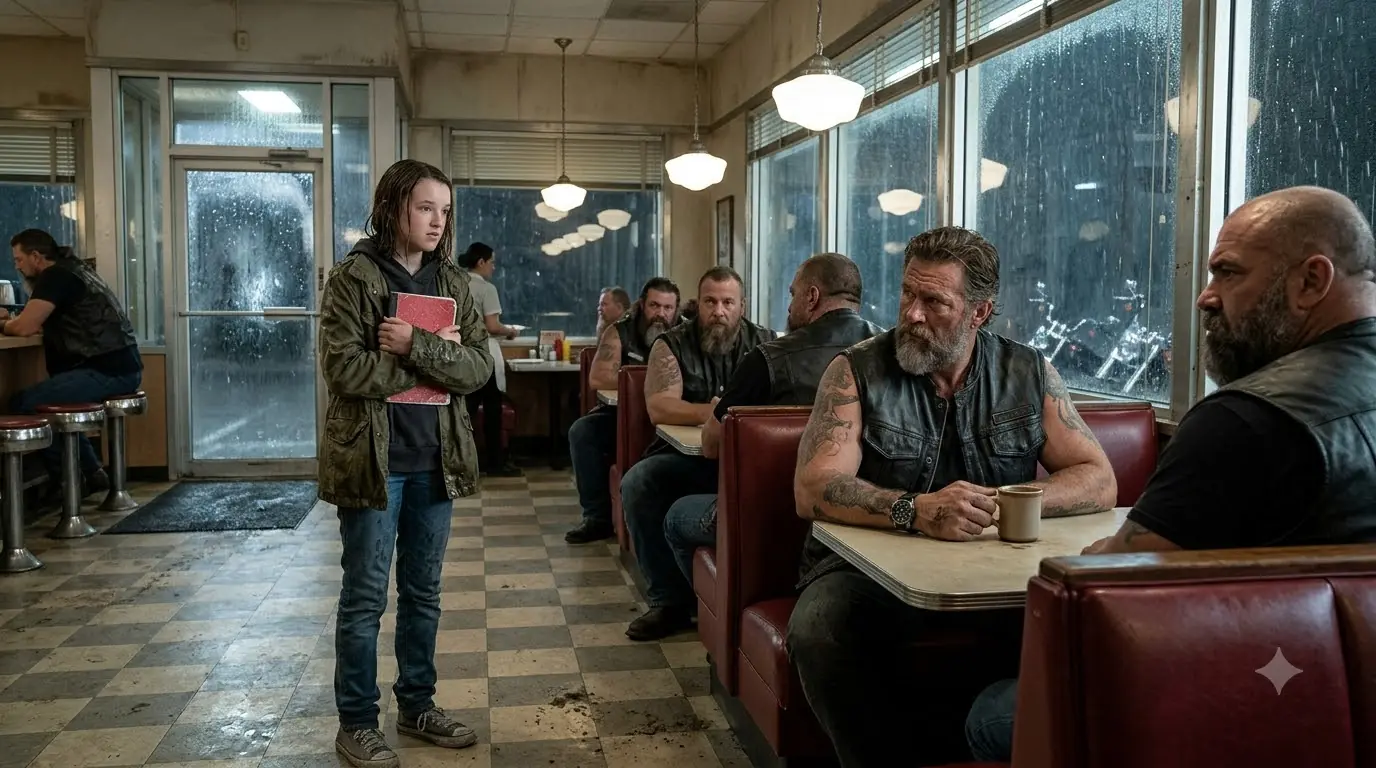
The clubhouse occupied a converted repair depot beyond the county industrial park, where the streetlights thinned and warehouses stood behind rusting fences. Motor oil lingered in the concrete even after years of cleaning, and the coffee on the warmer had become strong enough to strip paint. Six motorcycles rested beneath the overhang outside, rain flowing from their chrome in silver lines. Inside, half a dozen men and one woman stopped what they were doing as the boy crossed the threshold without knocking.
Deak Rowan rose from an old leather couch first. At fifty-three, he was a broad, deliberate man with silver in his beard and the wary patience of someone who had witnessed more trouble than he cared to remember. He took one step toward the child, then stopped when he saw that the boy was not running from a threat immediately behind him. The boy was moving toward a particular person, and he seemed to know exactly who that person was.
At the far end of the common table sat Rhett Callahan, president of the Iron Ledger Motorcycle Club. He was forty-one, six feet two, scarred along the jaw and left hand, with a dark expression that usually caused strangers to reconsider whatever they were about to say. He had spent twenty years building a reputation for remaining calm when everyone around him had lost the ability. Yet when the boy stopped two feet away and stared at his wrist, even Rhett felt a strange hesitation tighten his chest.
The watch on that wrist was a black-faced mechanical timepiece with a cracked leather strap and a scratch across the lower corner of its crystal. Rhett had received it from his closest friend, Caleb Mercer, five and a half years earlier. He had kept it after Caleb died, winding it every morning as faithfully as he checked the oil in his motorcycle. It had never occurred to him that a stranger might recognize it in a room like this.
The boy lifted his head. "Why are you wearing my dad's watch?" he asked, clearly enough for every person in the clubhouse to hear. Nobody moved. Rhett looked at the notebook, at the child's worn shoes, and finally at the unmistakable shape of Caleb Mercer's eyes staring back at him.
"What's your name?" Rhett asked. His voice sounded harder than he intended, but he needed the answer before he trusted the recognition pulling at his memory. The boy swallowed once, as though the words might cost him something. "Eli Mercer," he said. "Caleb Mercer was my father."