Why Benny Never Left His Duck Behind
Reader Theme:
Font Size:
24px
Benny’s stuffed duck was never far from him.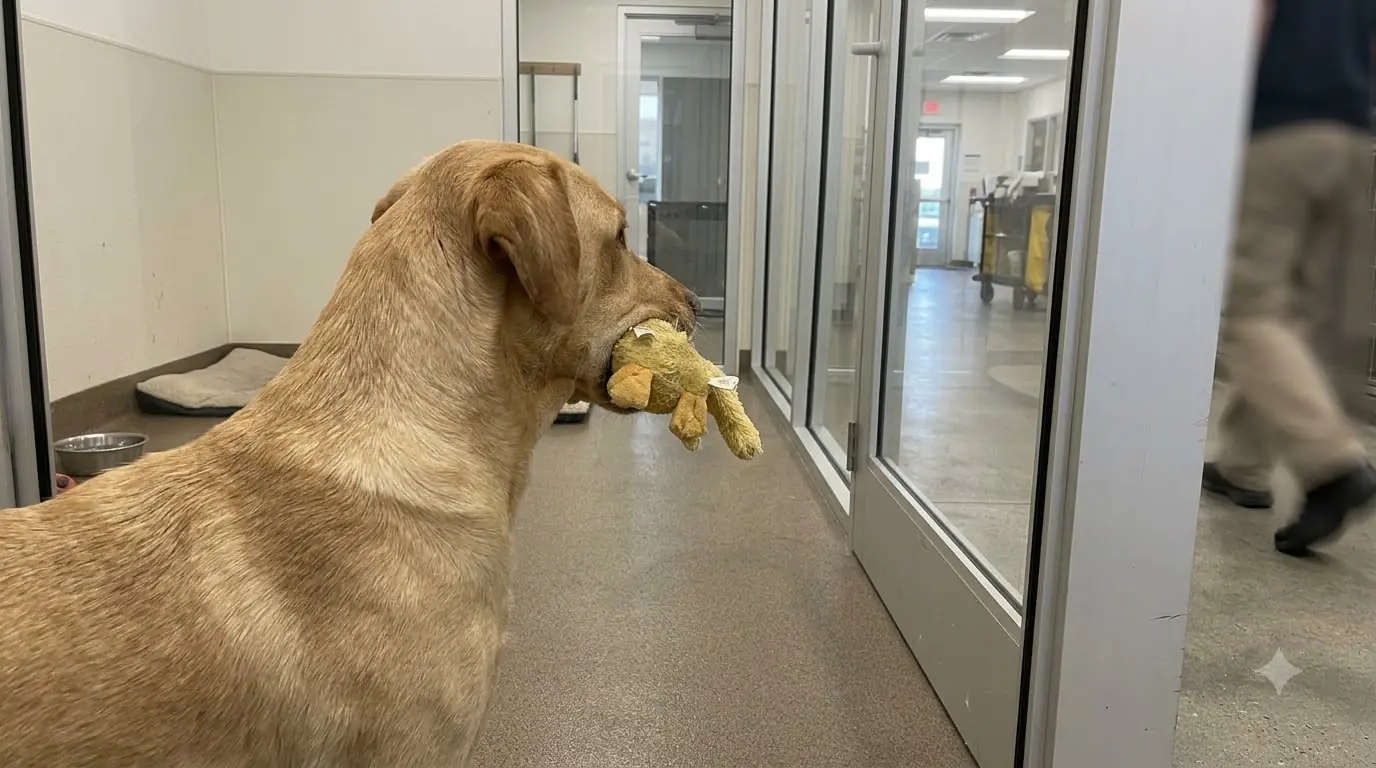
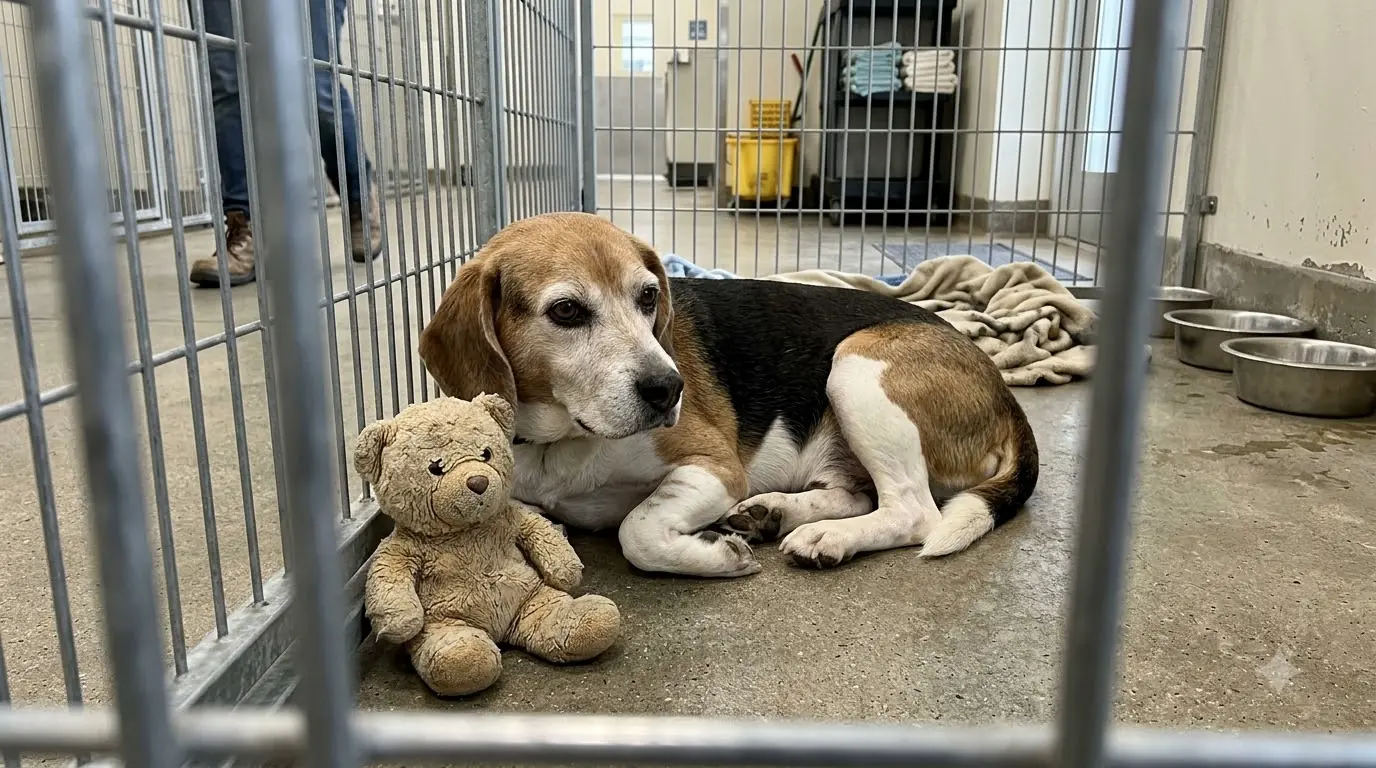
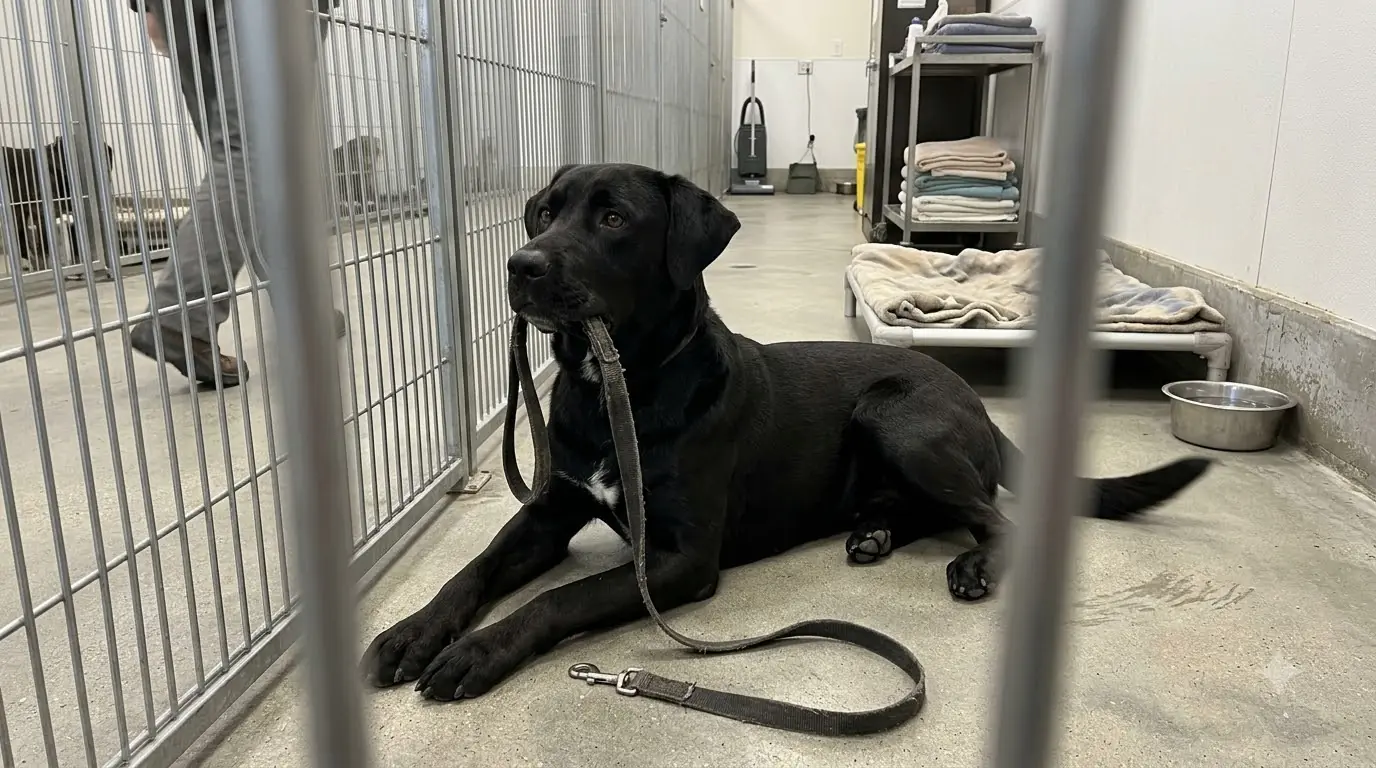
By the time the 5-year-old Labrador mix had settled into the daily rhythm of our shelter, the toy had become such a familiar part of his routine that staff members began checking for it whenever they entered his room. If Benny was resting, the duck was usually tucked against his chest or lying between his front paws. If he was walking around the indoor playroom, he often carried it gently by the middle.
And whenever footsteps sounded in the hallway, Benny picked it up.
He would rise quickly, walk to the glass door, and stand there with the duck in his mouth. His tail would begin moving in broad, hopeful sweeps as he watched the person approach.
Sometimes the footsteps stopped.
Often, they did not.
When they continued down the hallway, Benny rarely barked or scratched at the glass. He simply followed the person with his eyes until they disappeared. Then, after several seconds, he turned around, carried the duck back to his usual corner, and lowered himself onto the floor beside it.
That quiet routine told us something important about Benny.
He was interested in people. He wanted interaction. But he had also learned that not every approaching person was coming to spend time with him.
What We Know About Benny’s Arrival
Benny came into our care as an adult dog with limited reliable information about his previous life.
We cannot verify where he spent his first five years, what kind of home he may have lived in, or why he was no longer there. Nothing about his behavior allows us to responsibly fill in those missing pieces.
A dog carrying a toy to a door can look heartbreaking, but behavior alone cannot tell us whether an animal was abandoned, mistreated, or experienced a particular traumatic event. Those conclusions require evidence we did not have.
What we could evaluate was the dog standing in front of us.
At intake, Benny was alert and able to walk normally. His coat was somewhat dull, and his body condition was leaner than we wanted for an adult Labrador mix. His ribs could be felt more readily than expected, although he was not in a state of severe emaciation.
He accepted water soon after arriving.
Food was different.
Benny approached his first meal, sniffed it, ate a small amount, and then stepped away. Later, when the building became quieter, he returned and ate more.
That pattern was worth watching but was not immediately alarming. Appetite commonly changes when dogs enter unfamiliar environments. Stress, noise, disrupted routines, gastrointestinal illness, dental discomfort, and many other factors can affect eating, so we documented his intake rather than assuming a cause.
His first night was similarly quiet.
Benny circled his bedding several times before lying down. He woke when doors opened elsewhere in the building and raised his head whenever voices became audible.
He did not spend the night continuously pacing or vocalizing. Instead, he appeared to sleep in short stretches before checking his surroundings again.
Benny’s First Veterinary Examination
Our veterinary team performed a complete intake examination.
Benny’s heart and lungs sounded normal on auscultation. His temperature was within an expected range, and there was no obvious sign of an acute respiratory infection.
His eyes were clear, and his ears showed mild debris but no severe inflammation. His mouth had moderate plaque and tartar consistent with an adult dog who would benefit from routine dental care, but we did not identify an urgent oral problem that would explain his behavior.
His abdomen was soft on examination without obvious pain or distention.
The team carefully examined his legs, paws, spine, hips, and joints. Benny remained mobile and weight-bearing on all four limbs. We did not find an acute orthopedic injury.
His skin and coat were also evaluated. There were a few areas of mild dryness, but no large open wounds or significant hair loss.
The most immediate physical concern was his lean body condition.
Because Benny’s history was incomplete, we did not know whether he had recently lost weight, had always been naturally lean, or had experienced changes in diet before arriving.
Rather than simply increasing his food dramatically, we developed a controlled nutrition plan and began monitoring his weight, appetite, stool quality, hydration, and energy.
Looking Beyond What Was Visible
A physical examination provides valuable information, but it cannot answer every medical question.
Because Benny had an uncertain medical history and was thinner than ideal, our veterinary team recommended baseline diagnostic testing.
A complete blood count was used to evaluate his red and white blood cells and platelets. A serum chemistry panel provided information about organ function, proteins, glucose, and electrolytes.
His results did not reveal evidence of a major systemic illness requiring emergency treatment.
There were no findings suggesting severe anemia, significant kidney dysfunction, or an obvious acute inflammatory process.
That was encouraging.
A fecal test, however, identified an intestinal parasite infection.
Parasites can contribute to poor body condition and gastrointestinal problems, although it would have been inappropriate to assume they were solely responsible for Benny being lean. His previous diet, stress, feeding consistency, and other factors remained unknown.
Benny was started on an appropriate deworming protocol based on the parasite identified.
His veterinary plan also included routine preventive care according to his medical needs and vaccination history. Because his prior records were incomplete, our team followed standard shelter-medicine protocols rather than assuming he had received previous preventive treatment.
We continued watching him closely for vomiting, diarrhea, appetite changes, coughing, nasal discharge, lethargy, or other signs that might indicate an emerging problem.
The Behavior That Stood Out
Medically, Benny was relatively stable.
Emotionally, he required more time to understand.
During his first several days, he did not behave like the stereotypical exuberant Labrador-type dog many people expect.
He was not constantly bouncing at the door.
He did not immediately climb into every person's lap.
He did not demand attention from everyone who entered.
Instead, Benny watched.
When someone approached directly, his body could become slightly still. His ears shifted back, and he sometimes lowered his head before moving closer.
If the person turned sideways, avoided leaning over him, and gave him time, Benny often approached on his own.
He was particularly interested in sniffing hands and clothing.
Once comfortable, he relaxed noticeably.
His muscles softened. His tail moved more freely. Sometimes he leaned his shoulder gently against a familiar person.
That progression mattered.
Friendliness does not mean a dog is free from stress, and a wagging tail does not automatically mean a dog is comfortable with everything happening around him. Our staff paid attention to Benny’s entire body rather than interpreting one signal in isolation.
We allowed him to initiate much of the contact.
Then Came the Stuffed Duck
The duck was an ordinary shelter toy.
It was soft, slightly faded, and already well used when Benny first became interested in it.
During one enrichment session, several toys were placed around the indoor playroom. Benny sniffed a rubber toy, briefly investigated a ball, and then found the stuffed duck.
He picked it up carefully.
Instead of immediately shaking it or tearing at it, he walked around carrying it.
When he eventually settled in the corner, he placed the duck beside his front legs.
The behavior continued during later sessions.
We cannot know what the toy meant to Benny. It would be tempting to say it reminded him of something from his past, but there is no way to verify that.
What we could observe was that carrying soft toys appeared to be a comfortable, voluntary activity for him.
So the duck stayed.
Staff inspected it regularly for torn fabric or loose stuffing, because damaged plush toys can become ingestion hazards. When Benny was allowed to have it, his interactions with it remained gentle.
Soon another pattern appeared.
Footsteps.
The indoor playroom had a glass door facing a hallway used throughout the day. Benny could hear people approaching before he could always see them.
As soon as those sounds became familiar, he began reacting.
His head would lift.
Then he would locate the duck.
He would carry it directly to the glass.
When the person stopped, Benny’s whole posture changed. His tail wagged, and he waited at the door.
If a familiar caregiver entered, he sometimes walked several small circles while holding the toy before approaching.
If the person passed, Benny remained standing at the glass.
Then came the part that stayed with us.
He would wait.
Not long—usually only several seconds.
Then Benny turned around and walked back to the same corner.
The duck went with him.
We Did Not Want Benny to Spend His Days Waiting
Shelter housing is designed to provide safety, food, veterinary treatment, and temporary care. Even in a well-managed facility, however, it cannot perfectly reproduce life in a stable home.
Dogs experience shelter environments differently.
Some become highly vocal.
Some pace.
Some appear constantly excited.
Others become quieter.
Benny belonged mostly to that last group.
Because prolonged stress can affect appetite, sleep, behavior, and overall welfare, our behavioral team adjusted his daily routine.
Instead of relying only on large bursts of activity, we gave Benny predictable periods of lower-key interaction.
He went on regular walks where he could sniff rather than being hurried continuously forward.
Sniffing is an important natural behavior for dogs, and Benny seemed noticeably more relaxed when he was allowed to investigate his surroundings at his own pace.
We also incorporated simple food puzzles and scatter-feeding exercises when medically appropriate.
The goal was not to keep him constantly entertained.
It was to give him opportunities to make choices and engage in normal canine behavior.
Learning Benny’s Preferences
Over time, Benny showed us what he enjoyed.
He liked soft toys more than hard ones.
He enjoyed searching for small pieces of food hidden in easy locations.
He preferred calm individual attention to noisy group activity.
He liked walking beside a person once he knew them, but he often wanted several minutes of sniffing before focusing on anything else.
He was also more comfortable when routines were predictable.
A person entering suddenly and reaching toward his head could make him hesitate.
A person entering calmly, pausing, and allowing Benny to approach usually received a very different response.
Soon he began seeking familiar caregivers voluntarily.
Sometimes he brought the duck.
Other times he left it behind and walked directly toward them.
That was a small but meaningful change.
His Appetite Began Improving
Benny’s medical progress developed alongside his behavioral progress.
After treatment for his intestinal parasites and several days on a consistent diet, his appetite became more reliable.
We divided his daily food into measured meals rather than simply filling a bowl whenever it became empty.
That allowed us to monitor exactly how much he ate.
His stools also became more consistently formed.
He remained adequately hydrated, and his energy gradually increased.
Follow-up fecal testing was scheduled according to the treatment plan to ensure the parasite infection had been adequately addressed rather than assuming that one course of medication had automatically solved the problem.
His weight was checked regularly.
The goal was gradual improvement, not rapid weight gain.
Over the following weeks, Benny began adding weight at a reasonable pace. His ribs became less prominent, and his overall body condition moved closer to an appropriate range for his frame.
We adjusted his food as necessary based on his weight trend, activity level, stool quality, and veterinary assessment.
Movement Was Never Just About Exercise
Benny did not have a diagnosed major mobility problem, but physical conditioning still mattered.
A dog who has been relatively inactive can lose endurance even without an orthopedic disease.
We therefore increased his activity gradually.
His first walks were modest.
As his stamina improved, he spent longer periods outside.
He walked comfortably on all four legs and did not develop persistent limping after exercise.
Staff monitored for stiffness after rest, reluctance to climb or turn, shortened stride, excessive panting, or other signs that might indicate discomfort.
At five years old, Benny was not a senior dog, but maintaining a healthy weight and appropriate activity would still be important for his long-term joint health.
He particularly enjoyed walks where he could stop at patches of grass and investigate scents.
Those outings seemed to accomplish something the playroom could not.
Benny returned tired in a relaxed way rather than restless.
Bathroom Habits Were Closely Monitored
Changes in urination or bowel movements can provide early clues about medical problems, so these details were recorded throughout Benny’s care.
He urinated normally during regular outdoor breaks.
There was no persistent straining or unusual frequency observed.
His bowel movements improved after parasite treatment and dietary stabilization.
Any isolated soft stool was documented and monitored rather than immediately treated as a new disease.
As his schedule became predictable, Benny also began waiting near the exit when he needed an outdoor break.
That behavior would eventually be useful in foster care, although we never assume shelter behavior will transfer perfectly into a home.
New environments require adjustment.
Sleep Took Longer to Normalize
One of Benny’s slower improvements involved rest.
During his early shelter stay, he woke easily.
Hallway activity could bring his head off the bed immediately.
A door closing somewhere nearby often caused him to reposition himself.
The shelter team responded by protecting quiet periods whenever possible and making his resting area more comfortable.
Eventually, Benny began sleeping more deeply during portions of the afternoon.
His posture changed too.
Instead of always lying upright with his head positioned to monitor the doorway, he sometimes stretched onto his side.
On especially quiet days, staff occasionally found him asleep with the stuffed duck touching his front paw.
We did not interpret this as proof that all of his stress had disappeared.
But being able to settle and sleep comfortably was an encouraging welfare indicator.
The Hallway Routine Slowly Changed
Benny still noticed footsteps.
That did not disappear.
What changed was what happened afterward.
At first, virtually every approaching person seemed worthy of investigation.
Later, Benny became better at distinguishing familiar patterns.
Some footsteps barely caused him to lift his head.
Others still sent him searching for the duck.
When a favorite caregiver approached, he might appear at the glass before the person even reached the door.
But if they continued walking, Benny recovered more quickly.
Instead of remaining at the glass for an extended period, he often returned to whatever he had been doing.
Sometimes he resumed a food puzzle.
Sometimes he sniffed around the room.
Sometimes he simply returned to his bed.
The duck still came with him surprisingly often.
Preparing Benny for a Home Environment
As Benny became medically stable and behaviorally more predictable, our attention shifted toward placement.
The goal was not to find the fastest possible adoption.
It was to identify an environment likely to support him successfully.
Shelter observations provide useful information, but they are incomplete. A foster home can reveal how a dog responds to household sounds, nighttime routines, doors, visitors, meal preparation, television, neighborhood walks, and longer periods of ordinary domestic life.
Benny was eventually matched with an experienced foster caregiver who could provide a relatively calm home.
His stuffed duck went with him.
We also sent his food, medication information, veterinary records, and a transition plan designed to keep his first few days uncomplicated.
The foster was asked not to introduce him immediately to a stream of visitors.
Benny did not need a welcome party.
He needed time.
Benny’s First Night in Foster Care
When Benny entered the house, he did not immediately explore every room.
He stayed near the entrance for a moment and sniffed.
Then he moved slowly through the permitted area of the home.
His foster caregiver allowed him to investigate without following closely behind him.
He checked furniture, doorways, and corners.
He drank some water.
He accepted a small portion of his regular food.
Then he found the bed prepared for him.
The duck was placed nearby.
Benny picked it up, turned around twice, and lay down.
His first night was not perfectly restful.
He woke several times when unfamiliar household noises occurred.
At one point he stood near the bedroom doorway before returning to his bed.
There was no attempt to force him to stay in a particular sleeping position or to demand affection.
By morning, he had settled again.
Household Life Revealed More About Him
Over the next several days, Benny’s foster caregiver began sending detailed updates.
He appeared house-trained or at least familiar with eliminating outdoors, though he was given frequent opportunities to prevent accidents while adjusting.
He had no significant urinary accidents during the initial transition.
His bowel movements remained stable.
He ate more consistently than he had during his first shelter days, although he occasionally paused when unfamiliar sounds occurred.
Benny also discovered the kitchen.
Like many Labrador-type dogs, he was highly interested in food preparation.
That meant his foster caregiver had to establish boundaries around counters and keep unsafe foods securely out of reach.
He learned the household routine quickly.
Morning walk.
Breakfast.
Rest.
Another outdoor break.
A little enrichment.
More rest.
Evening activity.
Dinner.
Final bathroom break.
The predictability appeared to suit him.
Trust Did Not Arrive All at Once
One of the most important lessons from Benny’s foster period was that affection and confidence developed at different speeds.
Benny could enjoy being near someone while still becoming uncertain about particular movements.
He sometimes leaned against his foster caregiver while sitting on the couch.
But if a hand suddenly reached over his head, he might duck slightly.
Rather than correcting him, the foster caregiver adjusted.
Petting was offered along his shoulder or chest where he appeared more comfortable.
If Benny walked away, he was allowed to leave.
If he returned, interaction resumed.
This gave him control over social contact.
Over time, Benny began approaching more frequently on his own.
He started resting closer to his caregiver.
Eventually, he occasionally fell asleep with his back against a person’s leg.
Those moments were meaningful precisely because they were voluntary.
Follow-Up Veterinary Care
Benny returned for a scheduled recheck after completing his initial parasite treatment.
His physical examination remained reassuring.
His weight had increased gradually toward a healthier range, and his coat was beginning to look better with consistent nutrition and routine care.
Follow-up parasite screening helped guide whether any additional deworming was necessary.
His appetite was good.
No persistent vomiting or diarrhea had developed.
His heart and lungs remained clear on examination, and his mobility continued to be comfortable.
The veterinary team also reviewed his dental needs.
The plaque and tartar observed at intake were not an emergency, but dental care would remain part of his long-term health plan. His eventual adopter would receive that information rather than being surprised by it later.
Preventive care, weight management, regular examinations, parasite prevention, exercise, and dental monitoring would all remain important after placement.
The Duck Was Still There
The foster caregiver bought Benny another plush toy.
He liked it.
But the duck remained different.
When someone arrived at the house, Benny occasionally picked it up and carried it toward the entryway.
The behavior looked remarkably similar to what staff had observed in the shelter.
There was one important difference.
In foster care, the footsteps often belonged to someone who was staying.
Benny began greeting his foster caregiver at the door with the duck after short absences.
His tail moved so hard that his entire back end sometimes followed.
He did not always want immediate petting. Sometimes simply standing nearby with the toy seemed enough.
Then he would turn around and carry it back into the living room.
What Benny Still Needs
Benny’s progress does not mean he has become a dog without needs.
He may require patience during future transitions.
A permanent home will be another unfamiliar environment, and some of his early behaviors could temporarily return.
He may eat less for a day or two.
He may sleep lightly.
He may watch doors.
He may need additional time before feeling comfortable with visitors.
None of that would necessarily represent failure.
Adjustment is rarely a straight line.
His future family will be encouraged to maintain predictable routines initially, provide regular exercise and sniffing opportunities, continue positive reinforcement, and allow Benny to approach new people at a comfortable pace.
Any significant change in appetite, weight, bowel habits, urination, energy, breathing, or mobility should be evaluated medically rather than assumed to be behavioral.
Choosing the Right Permanent Home
As Benny moved closer to adoption readiness, our placement team began evaluating what type of home might suit him.
A calm, consistent environment would likely help.
Potential adopters would need to understand that Benny’s quiet behavior should not be mistaken for a lack of personality.
Once comfortable, he could be playful.
He enjoyed toys.
He liked food enrichment.
He enjoyed walks.
He sought affection.
He also valued rest.
We wanted a family interested in the dog Benny actually was, rather than expecting him to immediately behave like an endlessly outgoing Labrador stereotype.
Any introductions to resident animals would need to be handled thoughtfully based on observed behavior and standard adoption procedures.
Likewise, household composition and activity level would be considered individually rather than making assumptions based solely on his breed mix.
The goal was compatibility.
A Different Kind of Progress
There was no single dramatic moment when Benny suddenly became confident.
His recovery was made of smaller things.
Finishing breakfast without repeatedly checking the doorway.
Sleeping through an ordinary household sound.
Walking farther without becoming overwhelmed.
Approaching a familiar person instead of waiting for that person to approach him.
Gaining weight slowly.
Maintaining healthy stools after treatment.
Choosing to play.
Resting on his side.
Leaving the duck in another room because, for once, he did not feel the need to carry it with him.
Each change was modest.
Together, they told a much bigger story.
The Afternoon That Felt Different
Several weeks into foster care, Benny was asleep in the living room when footsteps sounded outside.
His head lifted.
For a moment, his foster caregiver expected the familiar sequence.
Get up.
Find the duck.
Wait at the door.
Benny stood.
The duck was lying near his bed.
He looked toward the entrance.
Then he looked toward his foster caregiver.
Instead of rushing to the door, he walked across the room and sat beside the person he already knew was there.
The footsteps passed.
Benny listened.
Then he lowered himself onto the rug.
A few minutes later, he went back for his duck.
We would never claim that one small moment proved every uncertainty was gone.
Dogs do not recover according to symbolic milestones, and Benny cannot tell us what he thinks when he hears someone outside.
But his behavior had changed in measurable ways.
He was eating reliably.
He was maintaining a healthier body condition.
His parasite treatment had been addressed with veterinary follow-up.
He was sleeping more comfortably.
He was engaging in normal activities.
Most importantly, he was learning that human interaction could be predictable rather than fleeting.
Benny Today
Benny remains under responsible follow-up while his long-term placement is planned.
His medical condition is stable, and his care team continues to monitor his weight, gastrointestinal health, dental needs, preventive care, and general wellness.
His behavioral plan remains equally important.
He benefits from routine, choice, appropriate exercise, enrichment, and people who pay attention when his body language says he needs space.
He is not expected to forget everything that made him cautious simply because his surroundings improved.
Instead, we are giving him experiences that allow new expectations to develop gradually.
The stuffed duck is still part of those experiences.
Its fabric is more worn now.
Staff and his foster caregiver continue checking it carefully for damage, and it will eventually have to be replaced if it becomes unsafe.
For the moment, however, Benny still carries it.
Sometimes he brings it when someone comes through the door.
Sometimes he takes it to his bed.
Sometimes he leaves it on the floor while he follows his foster caregiver into another room.
That last behavior may be the quietest sign of progress we have seen.
At the shelter, Benny spent afternoons watching a hallway where people constantly appeared and disappeared.
He learned the rhythm of footsteps.
He learned which sounds meant someone was approaching.
And again and again, he stood behind the glass with his duck, waiting to see whether this time the person would stop.
Now Benny is learning a different rhythm.
Morning footsteps that lead to breakfast.
Footsteps beside him on a walk.
Footsteps moving around the kitchen while he rests nearby.
Footsteps returning through the front door.
Ordinary sounds in an ordinary home.
His future is not guaranteed to be effortless. He will still need veterinary care, consistency, patience, and thoughtful support as he moves toward permanent placement.
But Benny is no longer spending every afternoon alone behind a glass door waiting for someone to choose his room.
More and more often, when footsteps pass, he does not have to follow them with his eyes.
He can pick up his duck if he wants to.
Or he can leave it beside his bed, stretch out, and rest—because he is beginning to understand that someone is still there.