“Get out.” Aaron Brooks stopped three steps inside the glass entrance of Summit Air Aviation.
For a moment, he thought the salesman must be talking to somebody behind him. Aaron turned slightly toward the doors, saw only the Oklahoma morning reflected in the glass, then looked back at the man standing near the reception desk.
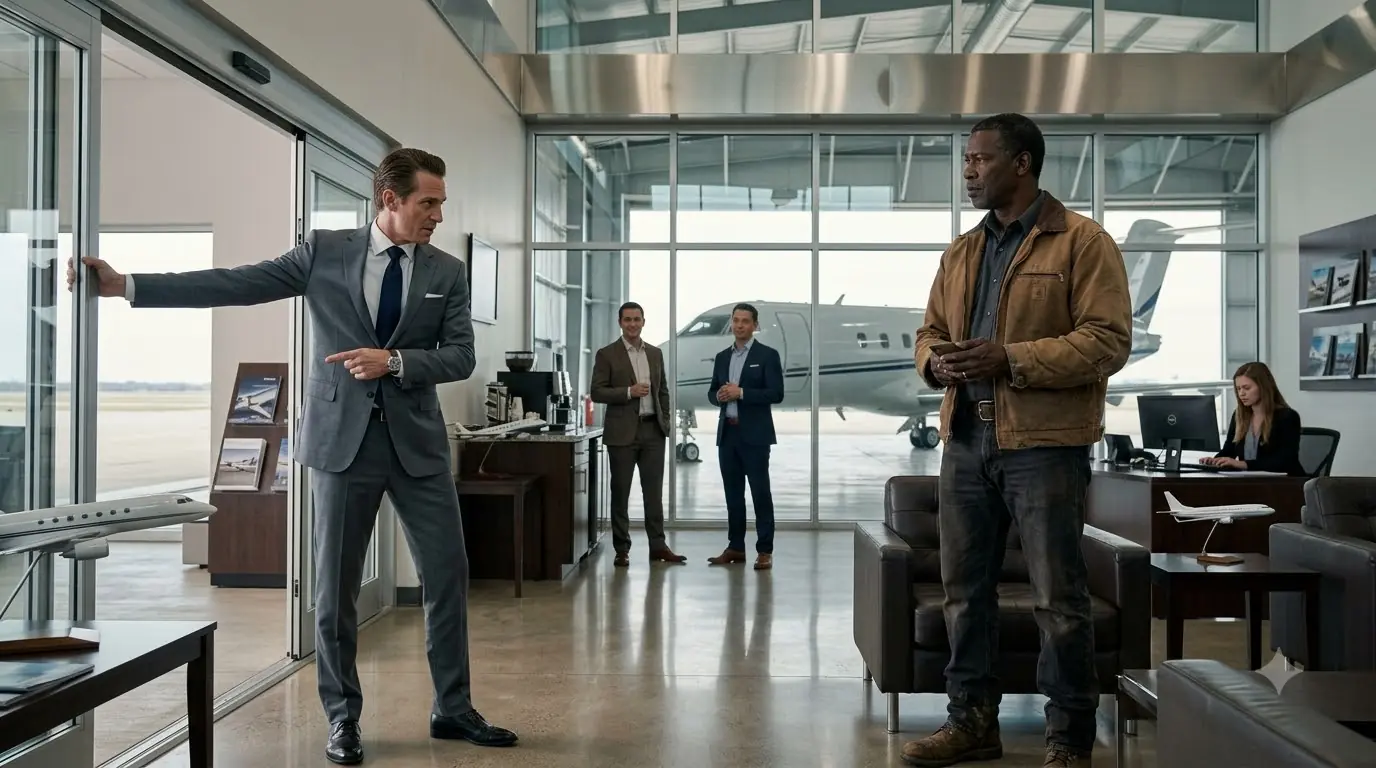
“Sir, I have an appointment.”
Craig Whitfield’s eyes traveled from Aaron’s face to his faded brown work jacket, down his jeans, and finally to the red Oklahoma soil dried around the seams of his boots.
“I don’t care.”
Craig pointed toward the entrance.
“Get your filthy boots off my floor.”
The receptionist behind the desk froze.
Aaron did not.
He had spent enough years negotiating contracts, land purchases, commodity agreements, and bank financing to recognize the moment when another person wanted anger more than an answer. Anger could be used against you. Calmness forced people to stand beside their own words.
“I’m here about the G280,” Aaron said.
Craig stared at him.
Then he laughed.
“A jet?”
He turned toward another salesman near the coffee station.
“Garrett, come here.”
Garrett Mills approached with a paper cup in his hand.
Craig pointed at Aaron.
“This farmer says he’s here to buy a jet.”
Garrett looked at Aaron’s boots.
Then his jacket.
Then at Craig.
A smile spread across his face.
Craig laughed harder.
Aaron stood quietly while the sound traveled through the polished showroom.
“I scheduled online last week,” Aaron said. “I have the confirmation.”
Craig stepped closer.
“Listen to me.”
The laughter faded.
“You smell like you walked straight out of a cattle pen. People like you don’t walk into places like this expecting everyone to play along.”
Aaron’s eyes remained steady.
“I’d like to speak with your manager.”
“My manager?”
Craig laughed once more.
“My manager would laugh harder than I am.”
He pointed toward the door.
“Now move.”
Aaron did not move one inch.
Craig had no idea the man standing in front of him controlled an agricultural company generating roughly eighty-five million dollars in annual revenue.
He did not know Aaron’s personal net worth was estimated at more than two hundred twenty million dollars.
He did not know Aaron had spent the previous three months comparing private aircraft with the same discipline he used when evaluating farmland, processing facilities, and grain contracts.
He did not know Aaron had come prepared to purchase not one Gulfstream G280, but potentially two.
And he certainly did not know that Aaron had learned long ago that the most useful thing a man could sometimes do while being underestimated was allow the other person enough time to reveal exactly who he was.
Aaron Brooks was fifty-three years old.
His hands were rough.
That was the first thing most people noticed when he shook theirs.
Years of weather, machinery, fencing wire, hydraulic fittings, tractor repairs, loading equipment, and fieldwork had left calluses no expensive hand cream could completely erase.
Aaron liked them.
They reminded him that wealth had arrived after work, not instead of it.
Every morning, he woke at 4:30 without an alarm.
His body had learned the hour decades earlier.
Feet touched cool hardwood.
Coffee started.
By five, Aaron was usually outside.
In winter, he walked beneath a black Oklahoma sky while frost silvered the edges of wheat leaves. In summer, he went out before the heat rose from the plains and turned the horizon white.
His primary Oklahoma operation stretched across thousands of acres of winter wheat, soybeans, and grain sorghum. Brooks Agricultural Holdings also controlled acreage and production interests in Arkansas and Kansas, along with two processing facilities, grain-storage operations, contracted transportation, and a fleet of sixty trucks.
The company employed people whose names Aaron knew.
Not every employee anymore.
The business had grown too large for that.
But more than his executives expected.
Aaron still stopped mechanics beside broken trucks and asked what failed.
He still walked processing floors.
He still knew which fields held water after hard rain.
He still asked drivers whether dispatch had given them impossible schedules.
And despite having enough money to live almost anywhere, Aaron remained in the farmhouse his grandfather had built in 1956.
The original structure had been modest.
White siding.
Two bedrooms.
A narrow kitchen.
A porch facing west.
Aaron renovated it twice.
He added space, replaced nearly every mechanical system, reinforced the foundation, expanded the kitchen, and built a new office wing for Denise.
But he refused to demolish the central house.
His grandfather Elbert’s fingerprints seemed to remain in the place.
Not literally.
In decisions.
The angle of the porch.
The oak trim.
The uneven floorboard near the back hall that Aaron could have replaced but never did.
Elbert Brooks had bought ninety acres in Oklahoma in 1952.
Ninety acres did not sound like much compared with what the Brooks family eventually controlled.
At the time, it was almost impossible.
Elbert was a Black man trying to buy productive farmland in a region where access to credit did not operate equally, no matter what language banks used to describe their decisions.
He approached one lender with a plan.
The banker looked at the papers.
Then at Elbert’s hands.
Then pushed the application back.
“Come back when you have real collateral.”
Elbert already had the land under contract.
What he lacked was cash for equipment.
He returned home without shouting at anyone.