The first thing Hazel Anderson heard was the front door coming apart. It was not a knock, or even a warning she could understand through the early morning quiet.
It was a heavy, splintering impact followed by the sound of men shouting over one another, and for a second she thought something had exploded in the hallway.
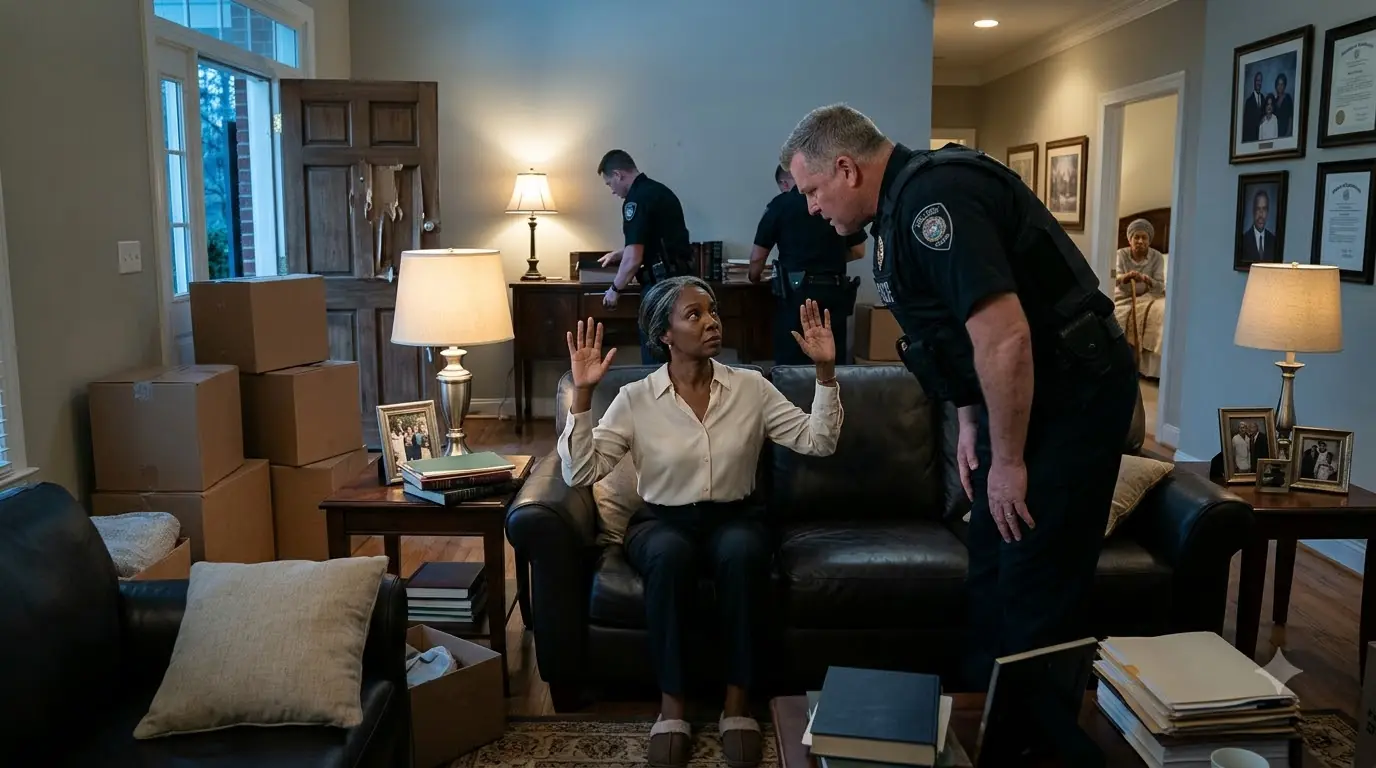
Her coffee was still warm beside her on the living room table, and her eighty-year-old mother was asleep less than thirty feet away.
"Police! Hands where we can see them! Get on the ground!" someone shouted. Boots crossed the hardwood, flashlights swept the ceiling, and the walls filled with the frantic movement of armed officers. Hazel raised her hands slowly, spreading her fingers so nobody could mistake what she was doing. Then Lorraine screamed from the bedroom, and all the discipline Hazel had built over a lifetime had to hold back a daughter's instinct to run toward her mother.
The man who entered the room last was the chief of police. Garrett Buckley wore black tactical armor over his uniform and carried himself as though the house already belonged to him. He looked at the furniture, the books, the framed photographs, and finally the Black woman sitting beneath the nearest light. The expression that crossed his face was not surprise at finding someone unharmed; it was satisfaction at finding someone he thought he could humiliate.
"We received a report of an armed intruder," he said, standing over her. Hazel told him, very clearly, that she was unarmed and that she owned the house. His eyes narrowed, and he laughed at the idea that a Black woman could own a four-bedroom colonial in Maplewood Estates. Before the morning was over, he would pull her from that couch, damage the home her mother had waited years to live in, and make a public spectacle of her on the front lawn.
What Buckley did not know was that a portrait hanging in the hallway identified Hazel as a United States district judge. He had walked past it during the breach because he was too busy proving the story he had already invented. He would walk past it again before finally seeing what had been there all along. But the real mistake was not failing to recognize a judge; it was believing that a woman without a title would have deserved what he was doing.
Three weeks earlier, Hazel had stood at the front gate of Maplewood Estates while a moving company argued with its navigation system. The driver had somehow reached the residents' exit instead of the visitor entrance, and an irritated guard had sent the truck around the block twice. Hazel, fifty-two years old and accustomed to solving problems with patience rather than volume, took the telephone from the driver and gave the gate attendant the moving permit number herself. Five minutes later, the truck rolled through, and Hazel followed it in her gray sedan with Lorraine beside her.
Maplewood was a neighborhood of broad lawns and expensive-looking restraint. Most of the houses were brick colonials set well back from the street, with white mailboxes, trimmed hedges, and garages large enough to hold more vehicles than the families inside needed. The homeowners association paid for the gate attendants, landscaping around the entrance, and a newsletter thick with rules about paint colors and seasonal decorations. Hazel liked the mature trees and the quiet streets, but she had not bought the house for the neighborhood's reputation.
She had bought it because Lorraine could no longer manage the steps in her old home. The house on Briarwood Lane had a bedroom and full bathroom on the ground floor, a kitchen wide enough for a walker, and a sunroom where Lorraine could grow the plants she loved without climbing stairs. Hazel had spent two years looking for a place that met those needs without feeling like a medical facility. When she walked through the property for the first time, Lorraine had stood in the sunroom and said, "I can see myself getting old here," before correcting herself with a smile: "Older than I already am."
Hazel had laughed and told her that eighty was a number, not a deadline. Lorraine had looked around the sunroom again, following the morning light across the tiles. "Your father would have liked this," she said. That settled the matter more completely than the inspector's report or the real estate agent's assurances. The house was expensive, but Hazel could afford it, and she wanted her mother to have an easy place to live after decades of making do.
The closing had been ordinary in every respect that mattered. A licensed title company verified the chain of ownership, a lender recorded its security interest, and the county records reflected the transfer to Hazel Anderson. There were property taxes to pay, insurance to arrange, and HOA dues that Hazel accepted as part of buying the house. She was under no illusion that owning a home exempted her from rules; her entire professional life had been spent asking how rules were made and whether they were applied fairly.
Before the move, Hazel had served twenty-two years in the law, first as a public defender, then as a federal prosecutor, and eventually as a judge in the United States District Court for the Northern District of Georgia. The words sounded imposing when someone read her biography at a banquet, but her days were mostly spent on evidence, motions, calendars, and the hard work of listening before deciding. She was careful about the authority of her office because she had seen what happened when people confused authority with permission. Her clerks teased her for carrying a cheap mechanical pencil to important meetings, even when the conference table cost more than her first car.
Lorraine knew her daughter in a way no clerk or attorney ever could. She knew the girl who had once cried because a teacher accused her of copying a spelling test when the real problem was that she had finished too quickly. She knew the teenager who memorized bus schedules so she could make it home in time to help with dinner. She knew the young lawyer who came home furious after a client spent a weekend in jail because nobody had bothered to verify his address. When Hazel became a judge, Lorraine had hugged her and said, "Remember how it felt when nobody listened."
Hazel remembered. She remembered it each time an attorney spoke over a witness, each time a complicated motion threatened to turn a person's life into an abstract argument, and each time the headlines made a case sound simpler than the record showed. She did not believe judges were above the people appearing before them. She believed judges owed those people more care because the consequences of careless authority could last years.
Lorraine's late husband, Robert Anderson, had worked as a school maintenance supervisor and volunteered as a choir director. He had never earned much, but he had kept a small garden, repaired neighbors' broken appliances, and left little handwritten notes in the books he gave his daughter. One of those books was a Bible that had belonged to Lorraine's mother, its leather softened by decades of handling. A dried rose pressed inside the Psalms came from Robert's final wedding anniversary with Lorraine, the last spring before his illness took him.