The voice of her squad leader in her ear. Sergeant Williams. Three seconds to decide, then move. Whitney opened her eyes.
Tyler was still grinning at the crowd. His finger was still in her face. His two students were still pressing on her shoulders. She did the math in her head, the way she had been trained.
The taller student on her left, 6'4", 230, grip on her bicep, weak point, planted knee. The shorter one on her right, 6'1", 250, grip on her forearm, weak point, left elbow hyperextended. Tyler, six feet exactly, 190, standing one arm's length in front of her.
A fighter stance, but sloppy. He thought the fight was already over. 1.4 seconds. That was her estimate.
She glanced once toward the exit signs at the back of the room. Two of them. She glanced once at the news crew tripod at the side of the stage recording. Good.
She took one deep, slow breath in, out, and then Whitney Williams made her decision. It happened in 1.4 seconds. The taller student on her left felt her shift her weight first.
He felt her bicep tense under his hand. He thought she was trying to pull away. He tightened his grip. That was his mistake.
Whitney dropped her left shoulder six inches. The student's locked arm went with it. His balance broke forward. Whitney's left elbow drove backward into his planted knee.
The joint folded sideways. He screamed and collapsed onto the mat. The shorter student on her right was still processing what had happened to his partner when Whitney's right hand reached up.
She caught his wrist. She rotated. She stepped under his arm. His elbow hyperextended with a wet pop.
He went down to one knee, gasping. Both students released, both incapacitated. 0.8 seconds. Tyler was still grinning at the crowd when he heard the screams.
He turned his head. He saw both his men on the mat. His mouth opened. He never got to close it.
Whitney was already moving. She launched forward off her back leg, not at his face, not at his throat. She drove her shoulder into his sternum. Tyler went airborne.
Three feet back. He landed hard on his shoulder blades. The wind exploded out of his lungs. Whitney was on him before he could blink.
She rolled him onto his stomach. She caught his right wrist. She locked it into a textbook MCMAP armbar. Knee on his shoulder blade, wrist bent past the natural range.
One ounce of additional pressure and the bone would break. She did not add that ounce. She held him there, calm, steady, breathing even. 1.4 seconds, exactly her estimate.
The room went silent. 600 people, not one sound. Even the bass from the speakers seemed to have stopped breathing. A water bottle rolled across the floor near row 12.
You could hear it clearly across the entire room. Somebody in the back gasped. Then nothing. Tyler was face down on the mat, his cheek pressed into the rubber, his arm bent at an angle that should not exist.
He could feel her knee on his shoulder. He could feel her breath on the back of his neck. He whispered into the mat. Get off me!
Whitney did not move. Get off me. Whitney spoke for the first time on that stage. Her voice was level, almost gentle.
Tap the mat three times slow. He did not tap. She added one ounce of pressure. Just one.
He tapped three times slow. She released him immediately. She stood up. She stepped back two paces.
Her hands went down to her sides. That was when the crowd noticed her right sleeve. It had torn during the takedown. From shoulder to elbow.
The gray cotton hung in shreds and underneath, in the harsh white stage light, was the scar. Long, crescent-shaped, pale against her dark skin from shoulder all the way down to her elbow. A scar that anyone in the combat sports world would recognize on sight.
A man in row four stood up. He was 68 years old. He wore a faded Marines windbreaker over a white polo shirt. His name was Colonel Frank Whitaker, retired.
He had been the head instructor of the Marine Corps Martial Arts Program from 2010 to 2017. He had personally presented the gold medal at the 2016 All-Marine Combatives Championship final. He had been the one who taped Whitney Williams' arm back together after the knife incident.
He had written the recommendation letter that got her promoted to level four instructor. Tears were streaming down his face. His voice cracked, but it carried. My God, that's Williams. That's the Sickle.
I gave her the gold medal in 2016. 600 heads turned to look at him. A woman in row 11 stood up next, mid-40s, short brown hair. She wore a Navy and Marine Corps Commendation Medal pin on her jacket lapel.
Her name was Lisa Brennan, former gunnery sergeant. She had served alongside Whitney in Helmand in 2014. Her voice was barely a whisper, but the room was so quiet. Everyone heard it.
Whitney. Whitney Williams. Oh my God. Then a man in row 8 stood up, younger, mid-30s.
He wore a Marine Corps veteran's hat. He spoke louder than the other two. I watched that 2016 final on YouTube a hundred times. That's her. That's the scar.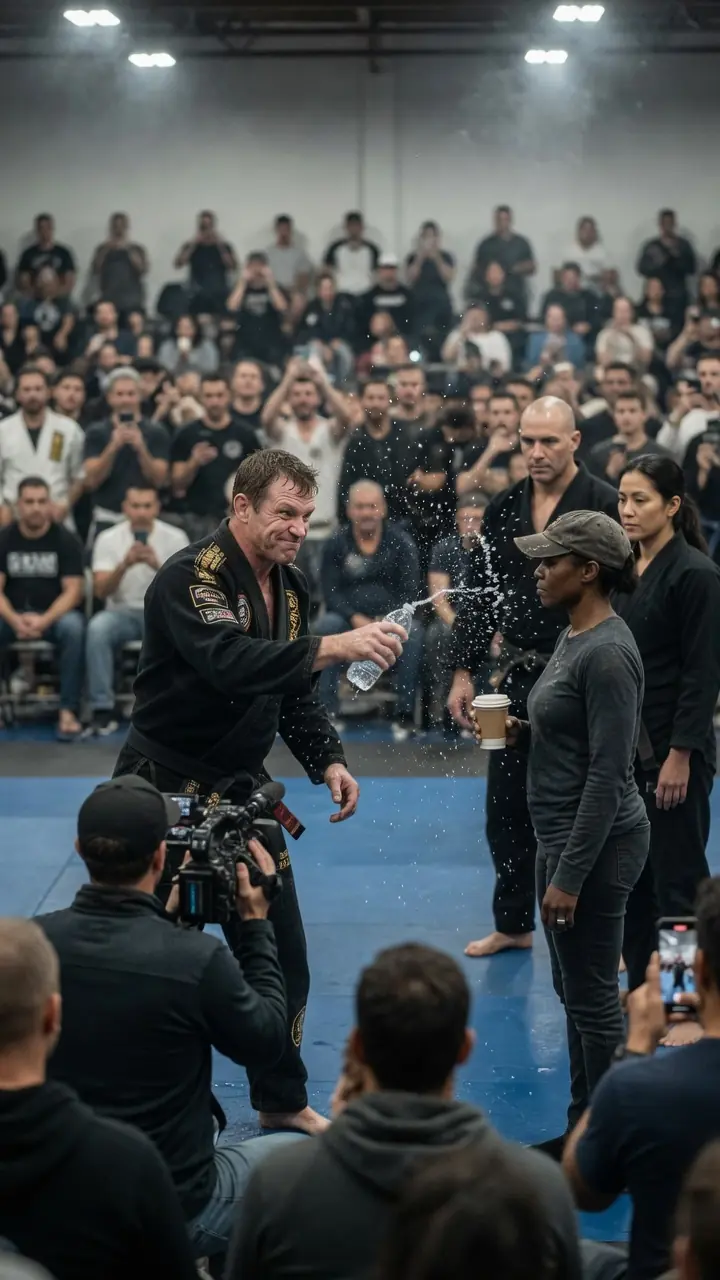
Three people standing, then five, then twelve. A retired Navy chief in row two, a former Army medic in row 17, a widow of a Marine in row 9, holding her husband's old dog tags. They all stood up.
None of them said anything. They didn't have to. Whitney looked at Colonel Whitaker for a long moment. She did not move.
She did not speak. Then she did something nobody expected. She raised her right hand to her brow. Slowly, calmly, a textbook military salute.