The bus stopped so smoothly that several passengers did not realize anything had changed until the parking brake released its long mechanical hiss. Outside, snow swept sideways across Route 42, swallowing the yellow centerline and turning the canyon beyond the guardrail into a gray-white emptiness. Inside, fifty-eight-year-old Elias Boone unfastened his seat belt and placed both hands on the steering wheel for one quiet second.
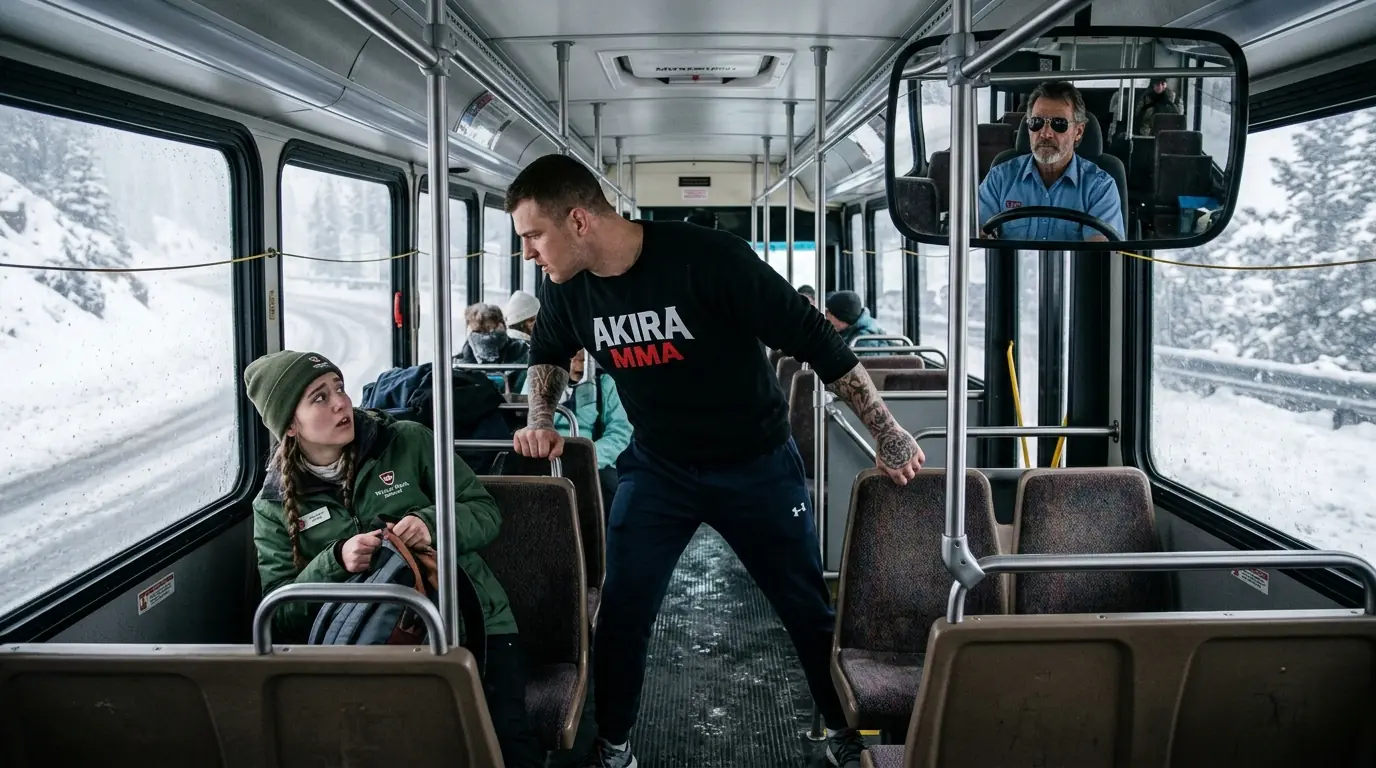
Then he picked up the public-address microphone. “Gentleman in the black sweatshirt, step away from the young woman and take your seat.” His voice filled the bus without anger, yet something in it caused every passenger to look up.
Twenty-four-year-old Trent Lawson slowly turned from the nineteen-year-old resort employee he had trapped against the window. Trent was six foot two, about two hundred ten pounds, heavily tattooed, and built like someone who regarded every mirror as an audience. Around his waist there was no black belt that evening, but everyone in Oak Creek knew he had one.
Trent owned Apex Striking and Grappling three blocks from the transit center. He competed regularly, had won several regional grappling tournaments, and possessed the kind of legitimate skill that should have made him careful around violence. Instead, success had convinced him that being able to control another trained fighter on padded mats meant ordinary people existed beneath him.
The young woman, Hannah Morales, still held the loose headphone cord Trent had pulled from her phone. Her back pressed against the window while his right arm remained across the top of the seat, blocking the aisle. His friends Greg Porter, Liam Cross, and Cody Benton watched from the rear seats with expressions ranging from amusement to discomfort.
Trent smiled toward the front. “You stopped a bus in a blizzard because I’m talking to somebody?”
Hannah spoke before Elias could. “I told you to leave me alone.”
Trent glanced down at her as though she had interrupted him. “Nobody asked you.”
Elias returned the microphone to its cradle. “Move away from her.”
The smile left Trent’s face.
Three weeks earlier, nobody in Oak Creek had known much about Elias Boone. He had arrived at the municipal transit depot with a clean driving record, an old knee injury, a commercial license, and references strong enough that the operations manager hired him after a single interview. He never volunteered stories about himself, and because small towns dislike empty spaces in biographies, people filled his.
Some passengers decided he had been a truck driver. Others thought he was an unemployed mechanic waiting for Social Security. Mrs. Higgins, who rode Route 42 every Tuesday, believed he had probably been military because he folded his lunch bag too neatly.
She was closer than anyone realized.
Elias had spent twenty-four years in the United States Army, most of them in infantry and training assignments. During the later part of his career, he became an instructor responsible for teaching soldiers close-quarters defensive skills, restraint, weapons retention, and decision-making under stress. He did not consider himself some secret master, and he particularly disliked men who described fighting as though it were magic.
Training was simply training. It gave a person options, and if it was good training, it also taught when not to use them.
An explosion during his final deployment damaged Elias’s left knee and lower leg badly enough that reconstructive surgery ended his field career. He retired as a first sergeant, spent several years teaching safety and defensive tactics to government contractors, then stopped after his wife became ill. When she died, Elias discovered that retirement gave grief far too much empty time.
Driving a bus was supposed to be simpler. Stay on schedule, keep people safe, handle mountain weather, go home at the end of the shift. Nobody cared what rank he once held, and Elias liked it that way.
Until Trent Lawson stepped across the yellow line that Tuesday afternoon.
The problem had begun at the Fourth Street Transit Center when Trent climbed aboard with his three training partners. He dropped one dollar into the fare box despite the posted fare being two-fifty, then walked toward the rear without waiting. Elias called him back once.
“Fare is two dollars and fifty cents.”
Trent looked around to make sure his friends were watching. “That dollar is more than this bus is worth.”
“The fare is two-fifty.”
“You going to throw me off over a buck fifty?”
Elias studied him for a moment. Then he removed six quarters from the change tray he kept for elderly passengers who occasionally came up short and dropped them into the box himself.
“Take a seat.”
Trent laughed. “That’s what I thought.”
Elias did not answer.
Mrs. Higgins had watched the exchange from the priority seats. Later, she would tell police that the driver did not look intimidated. He looked disappointed, which she believed was much more insulting.
For the next twenty minutes, Elias drove north as the storm thickened. Snow accumulated quickly along the shoulders, and wind pushed loose powder across the road in shifting sheets. Every curve demanded concentration, especially where Route 42 narrowed beside the canyon.
Behind him, Trent and his friends became progressively louder. They argued about submissions from the afternoon seminar, mocked another competitor, and reenacted portions of a sparring round in the aisle until Elias told them once to remain seated while the vehicle was moving. They obeyed for approximately three minutes.
Then Trent noticed Hannah.
She worked evenings at a ski lodge near the upper end of the route and wore a navy resort jacket over her uniform. She was exhausted after a double shift and had headphones in, hoping everyone would understand the universal language of someone who did not want conversation. Trent apparently regarded that as an invitation.
He called to her. She ignored him.
He called louder.
She turned the volume up.
That was when he leaned across the aisle and pulled the headphone cable from her phone.
Hannah stared at him. “Please don’t.”
Trent smiled. “Relax.”
“I said please leave me alone.”
“I’m talking to you.”
“I don’t want to talk.”
Greg laughed nervously. Liam looked toward the floor. Cody, the largest of the three friends, stopped smiling completely.
Trent stood and placed one hand on the seat in front of Hannah and the other behind her. It was not technically a strike. It was not yet a fight. But every person on the bus understood what the position meant.
You cannot easily leave unless I decide you can.
Elias saw it in the mirror.
He also saw the road widening into a maintained turnout two hundred yards ahead.
That was when he stopped the bus.
Now Trent stood in the aisle staring toward the driver. “You want to come back here and make me move?”
Elias glanced through the windshield. The bus sat completely outside the travel lane, hazard lights flashing. He had already pressed the silent operator-assistance switch beside the steering column, sending their location and a priority request to dispatch.
“I want you seated,” Elias said.
Trent laughed. “That wasn’t my question.”
“Move away from her.”
Hannah slipped sideways while Trent’s attention was on Elias. She moved two rows toward the front and sat beside Mrs. Higgins. The older woman immediately placed an arm around her shoulders.
That should have ended the immediate danger.
Instead, losing his audience made Trent angrier.
He walked toward the front.
Cody said, “Trent, let it go.”
Trent looked back. “Stay out of it.”
“I’m serious.”
“So am I.”
Elias remained beside the driver’s seat. His limp was more visible when he stood, and Trent noticed it immediately.
The young fighter’s expression changed.
Confidence returned.
“Look at you,” Trent said. “You can barely walk.”
Elias said nothing.
“You think because you drive a bus you get to order people around?”
“On this bus, when passenger safety is involved, yes.”
Trent crossed the yellow line.
Elias raised one hand. “Stop there.”
Trent took another step.
“Return to your seat.”
“Or what?”
Elias looked at him. “Police are on the way.”
That made Greg stand.
“You called cops?”
Elias did not look away from Trent. “Dispatch did.”
Greg swore.
Liam whispered, “We should get off.”
The front door remained closed because the turnout opened toward traffic and the snowbank made an uncontrolled exit unsafe. Elias had already requested officers meet the bus before passengers were released.
Trent stepped closer. “You think you can hide behind cops?”
“No.”
“You think I’m scared of some transit security guy?”
“I’m not transit security.”
“Clearly.”
Trent looked toward the passengers. “Anybody here think this old man is going to do something?”
Nobody answered.
Trent grinned.
Elias recognized that moment.
He had seen it in young soldiers, inexperienced security contractors, and men who confused adrenaline with courage. Trent was no longer reacting to a transportation dispute. He was performing.
That made him unpredictable.
It also made him easier to read.
Elias lowered his voice. “Trent, you have already frightened a passenger. You threatened me at the terminal, interfered with service, and crossed the safety line after being instructed not to. Sit down, wait for the deputy, and this evening ends with paperwork.”
Trent’s face tightened. “You remember my name.”
“You announced it when you boarded.”
A couple of passengers almost smiled.
Trent heard them.
His ego heard them louder.
He shoved Elias with both hands.
The bus erupted in gasps.
Elias moved backward one step and caught the fare barrier with his right hand. Pain shot through his damaged knee, but he remained upright.
“Do not touch me again.”
Trent spread his hands. “What are you going to do about it?”
Cody stood now. “Trent.”
“Shut up.”
“You’re screwing this up.”
Trent turned just enough to look back at him.
That was when Mrs. Higgins said, loudly and with perfect elderly contempt, “Young man, you have already screwed it up.”
Several passengers laughed.
Trent’s face burned red.
He turned toward Elias again.
Then swung.
The punch was fast.
Technically clean.
A straight right delivered by someone who knew exactly how to generate force.
Elias moved just enough that it did not land squarely.
The fist clipped his cheek.
Then the young black belt suddenly discovered that the limping bus driver had stopped behaving like a bus driver.
Elias did not trade punches.
He did not throw a spinning kick.
He did not attempt to prove anything about martial arts.
He stepped inside Trent’s reach, redirected his balance, and used the narrow geometry of the bus to prevent the younger man from building momentum. The movement was short, controlled, and over before most passengers understood what they were seeing.
Trent hit the padded side panel shoulder-first.
Elias controlled one arm.
“Stop.”
Trent roared and tried to turn.
Elias adjusted with him.
Not faster in the way movies show speed.
Earlier.
That was the difference.
Trent knew techniques.
Elias recognized intention.
The young fighter drove backward, attempting to overpower him.
Elias let the movement travel where it was already going and Trent stumbled against the front wheel housing. His knee touched the floor for less than a second before he surged upright, furious now.
Greg started forward.
Cody grabbed his sweatshirt.
“No.”
Greg shoved him. “He’s choking Trent.”
“He isn’t.”
“He’s got him.”
“Because Trent attacked him.”
Liam stayed seated.
That decision probably prevented the incident from becoming far worse.
Trent tried to strike again.
Elias controlled him against the partition.
No dramatic slam.
No broken arm.
No triumphant punch.
Just pressure, position, and a voice near Trent’s ear.
“Stop fighting.”
Trent cursed.
“Stop.”
Another surge.
Elias tightened control only enough to keep him from turning.
Trent finally shouted, “Get off me.”
“Stop trying to hit me.”
“I stopped.”
Elias waited.
“Say it again.”
“I stopped.”
Elias released him gradually and backed away.
Trent turned.
For the first time since boarding, uncertainty appeared on his face.
Elias was breathing harder now. His left leg shook slightly, and a red mark was developing beneath one eye where the punch had clipped him.
He looked very much like a fifty-eight-year-old man.
That seemed to confuse Trent more than anything.
“How did you—”
Elias pointed toward the rear.
“Sit down.”
Trent stared.
Then he sat.
No one laughed.
Sheriff’s deputies reached the turnout eight minutes later.
By then, snow covered the bus windshield faster than the wipers could clear it. Elias remained at the front while the passengers stayed seated, and Trent’s three friends had moved away from him.
Deputy Rachel Kim boarded first, followed by Deputy Marcus Dean. Both wore snow jackets over their uniforms and carried the strained expressions of people whose entire county was producing traffic emergencies at once.
Rachel looked at Elias’s face. “Driver?”
“Yes.”
“Are you injured?”
“I’ll need to be checked.”
She looked toward Trent. “Who struck you?”
Elias pointed.
Trent immediately said, “He attacked me.”
Rachel nodded. “Okay.”
She did not argue.
She did not decide.
“Everyone stays where they are while we sort this out.”
That irritated Trent. “I just told you what happened.”
“And I heard you.”
“I’m a professional fighter.”
Rachel looked at him. “Congratulations.”
Cody covered his mouth.
Even Elias almost smiled.
The bus had eight interior cameras.
That solved most of the disagreement.
The footage showed Trent refusing the full fare, threatening Elias at the front, pulling Hannah’s headphone cable, blocking her seat, ignoring repeated instructions, crossing the yellow line, shoving Elias, and throwing the first punch.
It also showed Elias’s response.
Deputy Dean watched the relevant portion twice.
Then looked at Elias.
“You done this before?”
Elias answered, “A long time ago.”
Trent overheard.
“What does that mean?”
Nobody answered him.
Rachel interviewed Hannah outside the bus after moving her into the heated patrol SUV. Hannah’s hands were still shaking, but her statement matched the video.
Cody gave his statement next.
He did not protect Trent.
Neither did Liam.
Greg tried.
That lasted until Deputy Dean asked whether he wanted to give a knowingly false written statement after being informed the bus contained multiple cameras.
Greg reconsidered.
Trent was arrested for assault, harassment, interfering with public transportation operations, and several related offenses that prosecutors later adjusted after reviewing the evidence. He was not beaten unconscious, carried away on a stretcher, or humiliated by some secret martial-arts execution.
He walked to the patrol vehicle under his own power.
That was enough.
As Rachel guided him toward the door, Trent looked back at Elias.
“Who are you?”
Elias wiped a small line of blood from his cheek.
“The driver.”
The story might have ended there if nobody had posted the footage.
Municipal transit initially released only a short statement saying an assault occurred aboard Route 42 and that the operator acted to protect passengers while law enforcement responded. Hannah asked not to be identified publicly, and the town mostly respected that.
Then somebody recognized Trent.
By the next afternoon, people were discussing the arrest at grocery stores, bars, gyms, and ski lifts.
Apex Striking and Grappling posted a statement describing the incident as a “private misunderstanding unrelated to gym operations.”
That statement lasted six hours.
Then Trent’s own coach called him.
His name was Roberto Delgado, fifty-two, owner of a respected academy in Denver and the man who had promoted Trent to black belt eighteen months earlier. Roberto had spent his adult life teaching grappling and disliked nearly everything about the mythology that surrounded martial arts online.
He requested the full publicly releasable transit footage through Trent’s attorney.
Then he watched it.
The next phone call was not gentle.
“You threatened a bus driver?”
Trent said nothing.
“You trapped a nineteen-year-old woman in her seat?”
“I wasn’t trapping her.”
“I have eyes.”
“She could’ve moved.”
“She told you to leave her alone.”
Trent paced his apartment.
“The driver escalated everything.”
“You punched him.”
“He grabbed me.”
“After you punched him.”
Trent’s voice rose. “You don’t understand what happened.”
Roberto became quiet.
That frightened Trent more than shouting.
“I understand exactly what happened.”
“You had multiple opportunities to stop.”
“You kept going because you believed nobody there could make you.”
Trent said nothing.
Then Roberto asked, “What was the driver’s name?”
“Elias Boone.”
Silence.
A long one.
Trent frowned. “What?”
Roberto said, “Elias Boone?”
“Yeah.”
“Late fifties?”
“Yes.”
“Gray beard?”
“Yes.”
“Left-leg injury?”
Trent stopped pacing.
“You know him?”
Roberto exhaled slowly.
“Not personally.”
“How?”
“Because when I was twenty-seven, I attended a defensive tactics program at Fort Carson.”
Trent’s stomach tightened.
Roberto continued. “There was an instructor everybody called Sergeant Boone.”
Trent looked toward the wall of medals above his couch.
“No.”
“Older soldiers talked about him for years.”
“He trained instructors, not beginners.”
Trent sank onto a chair.
Roberto added the part that mattered more.
“And before you turn this into some legend where you accidentally challenged a secret assassin, listen carefully.”
Trent stared at the floor.
“You did not lose because he was secretly dangerous.”
“You lost before he touched you.”
“You lost when a girl said no and you decided your ego mattered more.”
Roberto suspended Trent from teaching at the academy network immediately.
He could not magically revoke a Brazilian jiu-jitsu black belt. There was no central authority capable of erasing rank from a database.
But lineage mattered.
Community mattered.
Trust mattered.
Roberto released a short statement saying Trent would no longer represent his academy while the criminal and disciplinary matters proceeded.
Membership at Apex dropped.
Not to zero.
Not overnight.
Some loyal students defended Trent.
Others said the video had been taken out of context.
Several insisted competitors were always targeted because people envied successful fighters.
Then parents began canceling youth memberships.
That changed the economics.
A mother interviewed anonymously by the local paper put it simply.
“I sent my son there because I wanted him to learn discipline.”
The sentence hurt more than online insults.
Trent eventually closed the youth program.
Months later, he sold his share of the gym to a training partner.
His martial-arts career did not disappear.
It changed.
He competed less.
Lost sponsors.
Stopped appearing at regional seminars.
Consequences were rarely as neat as stories wanted them to be.
Elias returned to Route 42 four days after the incident.
The transit authority had required medical evaluation because of the punch and because his old knee had swollen after the struggle. Nothing was broken.
Operations manager Denise Harper offered him paid administrative leave.
He declined after two days.
“Are you sure?”
“I drive buses.”
“You were assaulted.”
“Yes.”
“You’re allowed to take time.”
“I know.”
She watched him carefully. “Then why come back?”
Elias thought about it.
“Because if I stay home until I stop remembering it, I may never drive again.”
Denise accepted that.
The first Tuesday back, Mrs. Higgins boarded at her usual stop.
She placed exactly two dollars and fifty cents into the fare box.
Then added six quarters.
Elias looked down.
“What’s that?”
She pointed toward the extra fare.
“You paid for that idiot.”
Elias almost laughed.
“I don’t think transit accepts revenge fares.”
“Then buy coffee.”
She walked away before he could return the money.
Hannah boarded two stops later.
That surprised him.
She had not ridden since the incident.
Elias opened the door.
She stood outside holding her phone and staring at the steps.
“You okay?”
“I think so.”
“You don’t have to get on.”
“I know.”
That seemed important to her.
She stepped aboard.
Paid the fare.
Then stopped.
“Thank you.”
Elias nodded. “You’re welcome.”
“I froze.”
He looked at her.
“When he grabbed my headphone cord, I kept thinking I should yell or hit him or do something.”
“You told him to stop.”
“It didn’t feel like enough.”
“It was.”
Hannah looked toward the rear seats.
“I hate that everybody saw me scared.”
Elias shook his head.
“Being scared is not misconduct.”
She looked back.
“That sounds like something you’ve said before.”
“Probably.”
She smiled faintly and took a seat near Mrs. Higgins.
Elias closed the doors.
Then drove.
The court process lasted almost nine months.
Trent eventually pleaded guilty to assault and harassment-related charges as part of an agreement that included probation, community service, mandatory counseling, and restrictions connected to the transit system. Because his record had been clean before the incident and Elias had not suffered serious injury, prosecutors did not seek the maximum punishment available.
Some people in Oak Creek were angry.
They wanted prison.
They wanted Trent destroyed.
Elias did not.
At sentencing, the judge allowed him to make a victim statement.
He stood beside the prosecutor.
Trent sat at the defense table.
Elias said, “I do not want his life ruined.”
Trent looked up.
“I want him to understand that skill creates responsibility.”
The courtroom stayed quiet.
“A person who trains long enough to control another human body has fewer excuses for intimidation, not more.”
Trent lowered his eyes.
Elias continued. “The dangerous thing that night was not that he had a black belt.”
“It was that he believed the belt made other people smaller.”
Then Elias sat down.
Six months after sentencing, Trent entered Roberto Delgado’s Denver academy for the first time since his suspension.
No cameras.
No announcement.
No dramatic return.
Roberto was teaching teenagers.
Trent waited beside the wall.
After class, Roberto walked over.
“What do you want?”
“To train.”
“No.”
Trent looked down.
“I figured.”
“You asked the wrong question.”
Trent looked at him.
Roberto crossed his arms. “Why do you want to train?”
Trent took a long time to answer.
“Because without it I don’t know who I am.”
Roberto’s expression softened slightly.
“That is the problem.”
He pointed toward the mats.
“You built your whole identity around being able to beat people.”
“Then somebody embarrassed you.”
“So now you want the thing that made you feel powerful again.”
Trent said nothing.
Roberto continued. “Come back when training is something you do, not the proof that you matter.”
Trent left.
He did not return for four months.
When he did, Roberto let him mop the mats.
Nothing else.
That was where the rebuilding began.
Elias heard about none of this until much later.
He did not follow Trent online.
Did not search for interviews.
Did not watch clips of their confrontation.
He disliked the internet’s version of the story anyway.
The headlines always used words like DESTROYED, HUMBLED, or SECRET MASTER.
One video title claimed:
MMA BLACK BELT PICKS FIGHT WITH RETIRED SPECIAL FORCES LEGEND — INSTANT REGRET.
Elias laughed when Denise showed it to him.
“I wasn’t Special Forces.”
“I know.”
“And he didn’t challenge me to a fight.”
“I know.”
“And I nearly fell when my knee hit the wheel housing.”
“That part is less clickable.”
“Apparently.”
He handed her phone back.
People wanted the story to prove that old age concealed superior violence.
Elias thought that was exactly the wrong lesson.
He had handled Trent because of decades of experience, because Trent attacked predictably, because the environment limited movement, and because Elias stayed calm.
Change any of those variables and the outcome might have been different.
That uncertainty was the reason experienced people avoided unnecessary fights.
Not the reason they sought them.
One winter afternoon nearly two years later, Elias finished the Route 42 run and found a man waiting near the depot.
Trent.
Older somehow.
Not physically.
In the face.
He wore jeans, winter boots, and a plain jacket without a single gym logo.
Elias stepped off the bus.
“Mr. Lawson.”
“Mr. Boone.”
“You waiting for me?”
“Yes.”
Elias looked toward the depot office.
“Why?”
Trent swallowed.
“To apologize.”
Elias said nothing.
Trent continued. “Not about losing.”
“Good.”
“I was angry about that for a long time.”
“I assumed.”
“I told myself you embarrassed me.”
“You punched me.”
“I know.”
Snow moved lightly between them.
Trent looked toward the pavement.
“Hannah told me to leave her alone.”
“Yes.”
“I heard her.”
“Yes.”
“And I stayed there anyway.”
Elias waited.
Trent finally looked up.
“That’s the part I’m apologizing for.”
“Why to me?”
Trent frowned.
Elias continued. “Did you apologize to her?”
“Yes.”
“Did she accept?”
“She said she appreciated the apology and didn’t want further contact.”
“And?”
“I haven’t contacted her again.”
Elias nodded.
“Good.”
Trent breathed out.
“I also owe you.”
“Yes.”
“I’m sorry.”
Elias studied him.
“Thank you.”
That was all.
Trent looked surprised.
“That's it?”
“What else do you want?”
“I don’t know.”
“Forgiveness?”
“Maybe.”
Elias shook his head.
“You came to apologize.”
“Do that without demanding a reward.”
Trent absorbed the sentence.
Then nodded.
“Fair.”
He turned to leave.
Elias stopped him.
“Trent.”
He looked back.
“A black belt is a piece of cloth.”
Trent almost smiled.
“I know.”
“No.”
Elias pointed gently toward him.
“You’re starting to.”
Elias retired from the transit authority at sixty-four.
Not because of another fight.
Because his knee finally made long driving shifts uncomfortable.
On his last day, Route 42 passengers decorated the front of the bus with a ridiculous banner that read:
WATCH YOUR STEP, SERGEANT BOONE.
Mrs. Higgins denied making it.
Nobody believed her.
Hannah attended too.
She had finished college by then and worked for the county as a social worker. She gave Elias a small framed photograph of Route 42 climbing through the canyon during autumn, yellow aspens surrounding the road.
On the back she had written:
Thank you for stopping the bus.
Elias kept that photograph.
Not the viral screenshots.
Not newspaper articles.
Not the old Army certificates people eventually discovered.
That one.
Because stopping the bus had been the most important thing he did that night.
Before any confrontation.
Before any technique.
Before anyone learned his history.
He saw somebody afraid and decided the schedule could wait.
Years afterward, the story continued traveling online.
People repeated the dramatic version.
A cocky black belt bullied an old limping bus driver.
The driver turned out to be a military combat legend.
The kid attacked.
The old master destroyed him.
Instant karma.
Elias hated almost every word.
When a local reporter once asked whether Trent had “challenged the wrong old man,” Elias answered immediately.
“There was no right bus driver to assault.”
The reporter smiled.
Elias did not.
“And there was no right young woman to intimidate.”
That became the quote people shared instead.
It was less exciting.
More important.
The incident also changed Apex Striking and Grappling after Trent sold his interest.
Cody Benton eventually took over the gym with another coach. Cody had been the friend who told Trent to stop on the bus, though he had waited far too long before doing so.
He never forgot that.
The first rule posted beside the mats under his ownership was not about shoes, uniforms, or sparring.
It read:
SKILL DOES NOT MAKE YOU ENTITLED TO FEAR FROM OTHER PEOPLE.
New students occasionally asked what it meant.
Cody told them.
Not the legend.
The embarrassing version.
He told them he had watched his friend harass someone.
He laughed at first.
Then became uncomfortable.
Then told himself it was not his problem.
Only when Trent approached the driver did Cody finally say something.
“Too late,” Cody would tell the class.
“I was waiting for the situation to become bad enough that speaking felt justified.”
“It was already bad enough when she said leave me alone.”
That lesson produced better martial artists than anything Trent had once shouted beside a cage.
Elias eventually visited the gym once.
Cody invited him repeatedly.
He declined repeatedly.
Then Mrs. Higgins learned about the invitations and told him he was being rude.
Elias surrendered.
He arrived on a Saturday morning wearing jeans and walking shoes.
Dozens of students expected a demonstration.
They imagined the secret master would show them some impossible military technique.
Elias disappointed them.
He stood beside the mat and talked.
“Most fights are stupid.”
A teenager raised his hand.
“Even if you win?”
“Especially if you think winning makes them smart.”
A few adults smiled.
Elias continued. “Training is useful because panic is expensive.”
“You learn balance.”
“Distance.”
“Awareness.”
“You learn what your body does under pressure.”
Then he looked around the room.
“But if the only lesson you take from martial arts is that you can hurt people better than they can hurt you, you have spent years getting worse.”
Nobody moved.
Cody stood at the back.
Trent was not there.
That was appropriate.
The talk was not about him anymore.
When Elias left the gym, snow had begun falling over Oak Creek.
He walked slowly toward his truck, favoring the left leg.
A boy from the youth class followed him outside.
“Mr. Boone?”
Elias turned.
The boy was perhaps thirteen.
“Yes?”
“Were you scared when Trent punched you?”
Elias thought about it.
The truth would disappoint him.
“Yes.”
The boy blinked.
“You were?”
“I’m old, not dead.”
The boy laughed.
Elias continued. “Fear tells you something matters.”
“What matters is what you do after it tells you.”
The boy nodded.
Then asked, “Did you know you could beat him?”
Elias shook his head.
“No.”
That answer disappointed him even more.
“But you did.”
“I kept him from hurting me long enough for the situation to stop.”
“That’s different.”
The boy considered.
“Isn’t that winning?”
Elias smiled.
“Now you’re learning.”
On winter evenings, Route 42 still climbed through the canyon.
Different drivers sat behind the wheel.
Different students boarded at Fourth Street.
Mrs. Higgins eventually stopped riding after moving closer to her sister.
Hannah occasionally took the route home from county offices.
Nobody remembered which turnout the famous incident had happened at because every snow-covered bend looked similar after enough winters.
That was fine.
The bus did not need a plaque.
The canyon did not need a monument.
The useful part of the story traveled elsewhere.
Into gyms.
Academies.
Transit safety meetings.
Parents talking to sons.
Coaches talking to students.
People learning that confidence without restraint was merely another form of insecurity.
And that real strength often looked disappointingly ordinary.
A bus driver paying a passenger’s missing fare instead of arguing.
A young woman saying no.
A friend finally telling another friend to stop.
A driver pulling safely off the road before confronting danger.
A trained man choosing control instead of revenge.
A former bully learning that apology did not purchase forgiveness.
None of those moments made exciting fight highlights.
Together, they mattered more than the fight.
Because Trent Lawson had boarded Route 42 believing physical skill placed him above ordinary rules. Elias Boone never needed to prove he was tougher.
He only needed to remind Trent of something every good martial artist should already know.
The moment your training convinces you that another person’s dignity is optional, the belt around your waist has stopped meaning what you think it means.