Then Philip called his final witness, Colleen Brooks. She walked to the front slowly, bad knee, no cane, she refused to use one. She sat down and placed a manila folder on the table in front of her. Mrs. Brooks, Philip said, can you describe your qualifications as a martial arts instructor? Colleen opened the folder. 22 years, United States Army, military combatives instructor, Fort Benning, Fort Bragg, Fort Hood. International military combatives competition. 512 wins, 31 losses. Two-time all Army champion, one-time interservice champion, recognized by the Army combatives Hall of Fame, inducted 2009. She laid each document on the table as she spoke. Certificates, competition records, letters of commendation. A photograph of a younger Colleen in army fatigues standing on a podium, gold medal around her neck. The room went dead silent. Not quiet, silent. The kind of silence where you can hear the air conditioning humming in the ceiling. "I was denied volunteer instructor status," Colleen continued, "because I lacked current certification under new municipal guidelines. Guidelines that were proposed by Douglas Pratt 4 days after Garrett Wilson asked him to find a way to shut our program down." She looked directly at Garrett. Not with anger, not with hatred, with the steady patient gaze of a woman who had waited six decades to sit in a chair like this. "I was more qualified than Mr. Wilson before he ever put on a white belt, and he knew it." Howard Bancroft stood. "Mrs. Brooks, your military record, however impressive, does not constitute a recognized civilian certification. The municipal guidelines are clear." Colleen didn't blink. "The guidelines were written to exclude me specifically. The emails your client sent to Mr. Pratt prove it. Would you like me to read the dates?" Bancroft sat down.
Calvin Taylor called Garrett Wilson to respond. Garrett stood, straightened his jacket, walked to the front of the room. He started strong, calm, rehearsed, professional. But Philip began his cross-examination. "Mr. Wilson, is your current instructor certification active?" Garrett paused. "It's in the process of renewal." "Is it active? Yes or no?" "It expired in January." A gasp from the back of the room. The man who had attacked Colleen for lacking certification was himself uncertified. Philip pressed question after question. Garrett contradicted himself once on the timeline of the safety complaint. Then again on whether he had communicated with Douglas Pratt before filing. Then a third time on whether he had contacted a real estate broker about the rec center property. Three contradictions, each one worse than the last. On the third, Garrett's composure cracked. He slammed his hand on the table and pointed at Calvin Taylor. This is a setup. This whole hearing is a setup. You're trying to destroy me because I built something in this town and she, he pointed at Tanya, she's a nobody. She came from nothing and you're choosing her over me. The room erupted. Calvin Taylor called for order. It took two full minutes. When the room finally settled, Calvin Taylor read a prepared statement. Effective immediately, the rec center self-defense program was reinstated. Full funding restored. An independent review of all recreation board contracts would begin within 30 days. Douglas Pratt had already submitted his resignation from the board that morning. Tanya sat at her table, hands still flat, face still calm. But under the table, where no camera could see, Colleen reached over and placed her hand on top of her granddaughter's. Tanya's fingers curled around it. Tight. The civil case hadn't been decided yet. The judge hadn't ruled. But everyone in that room already knew how this story was going to end.
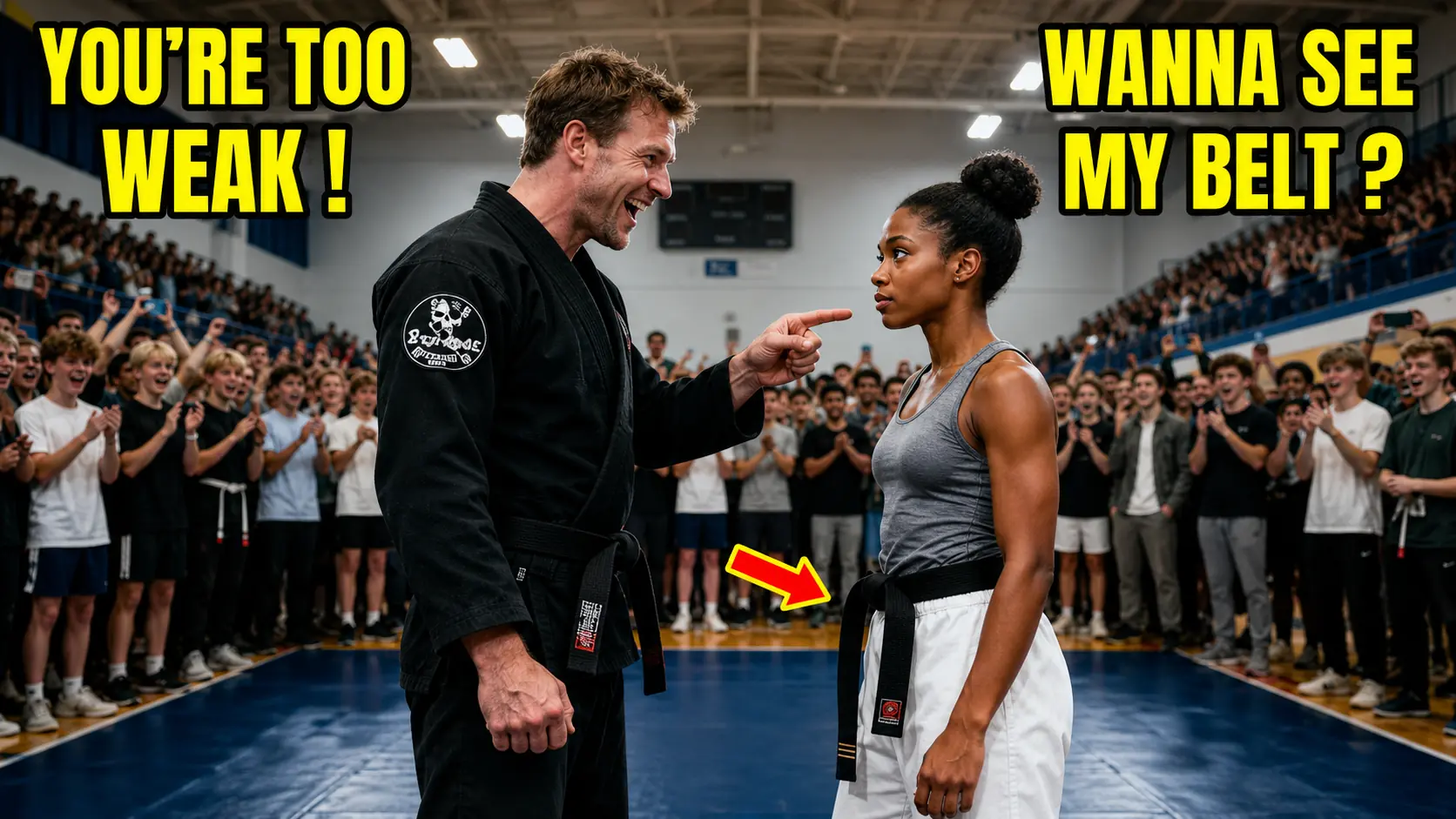
The ruling came on a Tuesday. Millfield County Court. Judge Patricia Callahan. 16 pages. Every word deliberate. Garrett Wilson's lawsuit against Tanya Adams dismissed with prejudice, meaning it couldn't be refiled, meaning it was over permanently. The judge wrote that the exhibition match was fully sanctioned, properly refereed, and voluntarily entered by both parties. She noted that Garrett had signed his own registration form. She noted that the event was open weight, open rank, his choice. She noted that at no point during the match did Tanya Adams use excessive force, illegal technique, or unsportsmanlike conduct. Then she addressed the countersuit. Fraud, defamation, civil rights violations, all three counts sustained. Garrett Wilson was ordered to pay compensatory damages. The amount wasn't enormous. This was a small town civil case, not a federal trial, but the number didn't matter. What mattered was the next line. A mandatory public apology, court-ordered, to be published in the Millfield Gazette and read aloud at the next city council meeting. Garrett's attorney requested a private settlement. Judge Callahan denied it. Public harm requires public accountability. That was her phrase. It made the regional news that night. The dominoes fell fast after that. The Ohio State Athletic Commission launched an investigation into Elite Combat Academy's certification records. What they found was worse than anyone expected. Garrett's instructor certification had been expired for 11 months. Not since January, as he'd claimed at the hearing, since the previous March. He had been operating an uncertified dojo for nearly a year, collecting fees from students whose parents trusted that gold logo on the wall. The commission revoked his license. Douglas Pratt, Garrett's ally on the recreation board, resigned the morning of the hearing. But that wasn't enough. The independent review Philip Moore had demanded uncovered two additional contracts between Pratt and businesses connected to Garrett. Conflict of interest. The city referred the matter to the state ethics commission. Elite Combat Academy closed its doors four months later. The glass front went dark. The LED sign went off. Someone taped a for lease sign in the window. It stayed there for a long time. Garrett Wilson left Millfield before the end of the year. No interview, no statement, no goodbye. He just disappeared one morning like Tanya's father had disappeared 12 years earlier. Except this time, nobody wondered why.
Tanya's story didn't stay in Millfield. The fight clip, the real one, not Garrett's edited version, had crossed 12 million views by the time the ruling came down. News outlets from coast to coast picked it up. Not the sports section, the front page. A story about a girl who was told she was too small, too black, too poor, too everything, and proved every single word wrong without raising her voice. She was invited to demonstrate at the National Martial Arts Expo in Columbus. She walked onto that stage in the same plain gi she'd worn in Millfield. No gold embroidery, no logo, just the worn black belt. The crowd gave her a standing ovation before she threw a single technique. Colleen was recognized that same month by a national veterans organization. Lifetime achievement in service and mentorship. She accepted the award in a simple gray dress. She said four words into the microphone. For my granddaughter. Always. The Millfield City Council passed a resolution the following spring, unanimously. Free self-defense classes would be offered at every community recreation center in the city, funded annually from the general budget. The program was named the Adams Brooks Community Defense Initiative.
So, where are they now? Tanya Adams is 20 years old. She competes at the national level in judo and Brazilian jiu-jitsu. Her record is 38 wins, four losses. She maintains a 3.8 GPA. She still drives back to Millfield every Friday to teach the free self-defense class at the rec center. Last month, 26 students showed up. The room was so full, they had to prop the back door open. She still doesn't talk much. She still doesn't celebrate after a win. She just looks for Colleen in the crowd. Every single time. Colleen Brooks turned 70 this year. The bad knee finally got a replacement. She teaches a weekly self-defense class for veterans at the VFW hall on Tuesdays. Attendance has tripled since it started. She still doesn't talk about her military record unless someone asks directly. And even then, she keeps it short. I served. I competed. I came home. That's it. But the garage is still there. The heavy bag still hangs from the rafter. And on nights when Tonia is home, the neighbors can still hear the sound of someone training past midnight. Philip Moore expanded his civil rights practice after the case. He took on three more cases involving discriminatory interference with public programs in small Ohio towns. He won all three. He still doesn't charge families who can't afford his fees. Nora Dotson, the best friend with the phone, graduated from community college with a degree in communications. She now runs the social media accounts for the Adams-Brooks Community Defense Initiative. The page has over 200,000 followers.
I chose this one because I'm sick of watching big dudes mistake small for weak. Tonya trained on cold concrete for 6 years while that man sold trophies to himself. She didn't need his gym. She needed him to find out. And he found out. One last thing. Go back and watch the moment she takes off that jacket. Watch Garrett's hand. You'll catch something you missed the first time. Sometimes the smallest person in the room carries the biggest fight. And sometimes that's exactly enough.