Chapter 3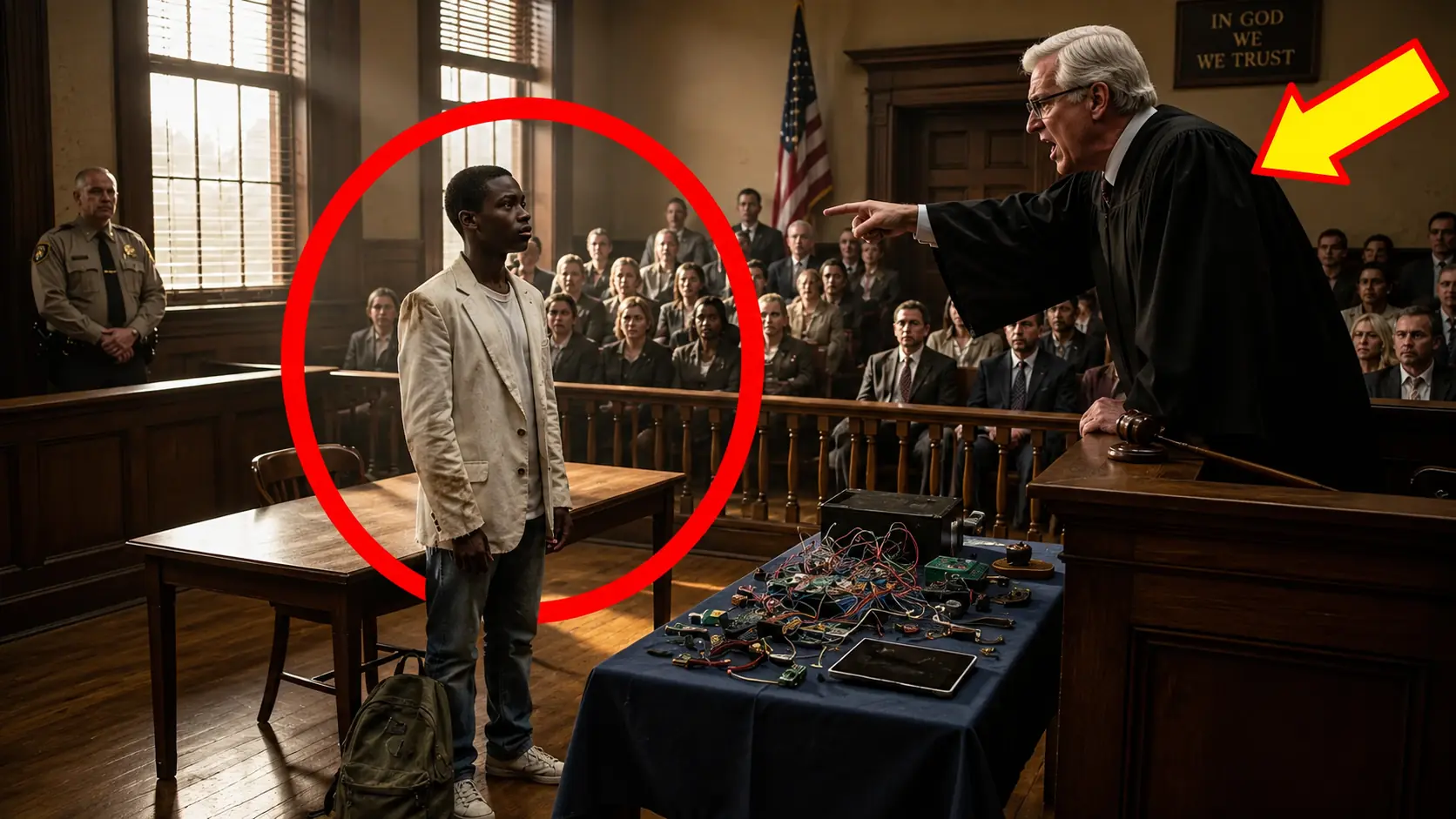
Courtroom B. Wood-paneled walls, an American flag, the state seal mounted above the bench. Thirty people packed into the gallery, mostly Black families from the south side, people who had come to watch because the Lewis case was their case, too. If Clarence lost, they all lost, and they knew it. When Andre walked through the door carrying that leather briefcase, the room went still. He walked to the respondent’s table, his head barely rose above it, and set the briefcase down. He opened it. He laid out his index cards in a neat row. He placed one folder to the left and one to the right. Then he sat down, hands folded, feet dangling above the floor, and waited.
Victoria Ashton let out an incredulous laugh. “Your honor, this is absurd. There is a child at counsel’s table. He can’t be more than 10 years old.” Judge Caldwell looked down from the bench. For a moment, something flickered in his eyes — irritation, amusement, contempt, all three at once. “Boy, who are you, and what do you think you’re doing in my courtroom?” Andre stood on his toes so his voice would carry. “My name is Andre Lewis, your honor. I’m here on behalf of my father, Clarence Lewis, the respondent in this matter. I’ve filed a motion requesting permission to assist in presenting his case under the court’s authority to ensure fair representation for parties who cannot afford counsel.” He held up the handwritten motion, clean, precise, every citation correct. The courtroom murmured. Caldwell took the document. He read it slowly. His jaw shifted. He flipped the page, read the citations, flipped back. Then he looked at Andre with an expression that had changed — not to respect, but to something harder to read. Weariness, maybe. The first faint recognition that this was not what he expected. “Who helped you write this?” “The Hadley Public Library, your honor. It’s open to everyone.” A few people in the gallery smiled. Caldwell did not. “I’ll allow it,” he said, his voice flat. “Provisionally, but I will be watching very closely. One misstep and you’re done. Understood?” “Understood, your honor.”
Victoria Ashton delivered her opening statement like a woman who had already won. She was smooth, polished, unhurried. Every sentence was designed to make the Lewis family look like they were clinging to a mistake. She presented Whitmore Development as a pillar of the community, a company investing in Hadley’s future, creating jobs, raising property values. The boundary survey was conducted by a licensed professional with 26 years of experience. The law was clear. The math was clear. The line was the line. “This is not about history,” she said, straightening her jacket. “This is not about feelings. This is about where a line is drawn on a map… and the map is clear.” She sat down. She didn’t look at Andre.
Andre stood. He had to push his chair back to make room. The briefcase was open on the table behind him. His index cards were arranged in a row. His feet barely reached the floor. He didn’t try to match Ashton’s polish. He couldn’t. But his voice was clear and steady for a child — the voice of someone who had practiced this in his grandmother’s kitchen a hundred times. “My father has owned this land for 22 years. That’s longer than I’ve been alive. My mother is buried in the church three blocks from our garage. The deed hanging on our wall has been valid for two decades. Nobody questioned it. Nobody challenged it. Not until Whitmore Development decided they wanted it.” He paused. He looked at the gallery, the faces he recognized from the neighborhood, from church, from Sunday dinners. Then he looked at Caldwell. “Miss Ashton says this is about a line on a map. She’s right. But the question isn’t where the line is. The question is who moved it and why.” The courtroom went dead silent. Not the polite silence of waiting. The electric silence of people realizing something had shifted.
Then Ashton moved to cross-examine Clarence. She started gently. “Where did he grow up? How long had he owned the property?” Simple questions to build rapport. Then the blade came out. She asked if he was a surveyor? No. A lawyer? No. An engineer? No. Had he ever studied property law? No. Had he ever read his full deed before this lawsuit arrived? Clarence hesitated. “I read most of it when we bought the land.” “Most of it,” Ashton repeated. “So you’re asking this court to take your word? A man with no legal training, no surveying credentials, no education beyond high school over the assessment of a 26-year licensed professional.” Clarence sat up straight. He looked at her and for the first time all day, his voice was steady. “I’m asking this court to look at the truth.” Andre watched from his seat. His jaw was tight, but he didn’t intervene. He wrote a note on one of his index cards. He knew exactly what Ashton was doing — trying to provoke him into an emotional outburst so Caldwell would have an excuse to shut him down. Every instinct in his body wanted to stand and object. He stayed seated. He stayed silent. His pen moved across the card because he had something bigger coming. Something Ashton didn’t know about. Something Caldwell didn’t know about. Something hidden in the front pocket of a dead man’s briefcase — written on a 3x5 index card in a child’s block letters. One question. That was all he needed.
Caldwell called a recess for lunch, but before the gavel came down, he leaned forward on the bench and looked directly at Andre. Not with contempt this time, with something colder, something careful. “Boy, I’ve given you more patience today than you deserve. When we come back this afternoon, I expect evidence. Real evidence. Documents, numbers, not speeches, not feelings. If you don’t have anything to show me, I will rule on what’s in front of me.” He let that settle. “And what’s in front of me is a licensed survey and a valid claim. Are we clear?” “Yes, your honor.” “Good. Recess until 1:30.” Ashton gathered her papers and smiled. Not the tight smile of someone performing confidence — the real smile of someone who believed she had already won. She leaned over to whisper something to the Whitmore representative and they both looked at Andre and shook their heads. Caldwell stepped down from the bench and disappeared through the side door. The gallery emptied slowly. Some people stopped to touch Clarence’s shoulder. Most just filed out in silence, their faces heavy with the weight of inevitability.
In the hallway, Clarence sat on a wooden bench and put his head in his hands. He didn’t speak. He didn’t need to. His body said everything — the curve of his back, the way his fingers pressed into his temples, the slow shake of his head. Twenty-two years of work, his wife’s memory, his son’s future. All of it balanced on a hearing that felt like it was already decided. Andre stood at the hallway window looking out at the town — the rooftops, the church steeple, the Whitmore billboard in the distance. For the first time since this began, his composure cracked just slightly. His hand trembled as he held the briefcase strap. The briefcase was almost as tall as his waist. He looked small against the window. He looked like exactly what he was — a child carrying something too heavy for anyone his age. Then he opened the briefcase. He pulled out the index card, the one from the front pocket, the one with the single question. He read it silently, lips moving. Once, twice. His breathing slowed, his hands steadied, his face went calm. He closed the briefcase and held it with both hands. He was ready.
That was when Caldwell appeared in the hallway, not in his robe, just his shirt and suspenders. He walked toward Andre slowly, deliberately, his shoes clicking on the marble. Then he crouched down so they were eye to eye. Close enough that Andre could smell the coffee on his breath. Close enough that the gesture was unmistakable — a grown man lowering himself to a child’s height, not out of kindness, but out of power. The way you crouch to speak to a dog. “You’ve got guts, kid. I’ll give you that.” His voice was low, almost friendly, almost warm. “But guts don’t win cases in my courtroom. You know what wins? Knowing when you’ve lost.” He straightened up. “Tell your daddy to take whatever Whitmore offers. Save yourself the embarrassment. Save your daddy the embarrassment.” Andre looked at Judge Caldwell, the man who had called him a filthy rat, who had told his father he was trash, who had spent 22 years deciding who mattered and who didn’t, and said: “I don’t have a counter-offer, Judge Caldwell. I have a question.” Caldwell’s smile didn’t disappear, but it thinned, just barely, just at the corners. The smallest crack in the armor of a man who hadn’t been challenged in two decades. He turned and walked away without another word.
Outside the courthouse, under the old oak tree in the yard, the Black community members gathered. Ruth was among them. She wasn’t crying. She was sitting on a bench with her eyes closed and her hands clasped together, praying. Not loudly, not for show. Just a grandmother asking God to steady the hands of a 10-year-old boy carrying a briefcase full of truth into a room full of people who wanted to crush him. A neighbor put her hand on Ruth’s shoulder. “That boy has no chance in there, Ruth. You know that.” Ruth opened her eyes slow and certain. “That boy has been preparing for this his whole life. He just didn’t know it.” Tanya Moore, the county records clerk who had pulled those files, was watching from the courthouse steps. She hadn’t gone to lunch. She was too nervous to eat. She knew what Andre had found in those records. She was the one who had watched him read page nine of Caldwell’s financial disclosure, watched his eyes go wide, watched him copy the numbers into his notebook with hands that shook. She had said nothing. She had done her job. She had given a citizen access to public records, and now she was hoping it was enough. The courthouse bell rang. Lunch was over. Andre tucked in his shirt, picked up the briefcase with both hands. Clarence stood. They looked at each other — the tall man and the small boy — and walked back through the courthouse doors together, side by side, step by step. When that door closed for the afternoon session, 30 people held their breath because a 10-year-old Black child was about to do something that no attorney, no politician, and no adult in Hadley County had ever dared to do. Look Judge Preston Caldwell in the eye and call him a fraud.
The afternoon session began with silence — the kind of silence that presses against your chest. The gallery was fuller than before. Word had spread during the lunch recess. People were standing along the back wall, faces pressed against the window of the courtroom door. Andre stood and said, “Your honor, I’d like to call a witness.” Caldwell raised an eyebrow. “You have a witness?” “Yes, sir. Walter Gibson, the licensed surveyor who conducted the boundary assessment filed by Whitmore Development.” Ashton stood immediately. “Objection. Mr. Gibson is our witness.” Caldwell looked at Andre for a moment. He seemed ready to deny it. One more way to tilt the floor. But 30 people were watching. A clerk was recording. So he said, “The respondent has a right to cross-examine. Overruled.” Walter Gibson took the stand. He was a heavy-set man in his 50s with a receding hairline and sweat already forming at his temples. He sat down, adjusted the microphone, and looked at Andre. He had not expected to be questioned by a 10-year-old.
Andre began gently, carefully, the way Ruth had taught him. “Mr. Gibson, how long have you been a licensed surveyor?” “26 years.” “And you conducted the boundary survey submitted in this case?” “I did.” “Could you walk me through your process? Specifically, where did you begin your measurement?” Gibson relaxed. This was his territory, familiar ground. “I started from the GPS coordinates of the county reference marker on the northwest corner of the Whitmore parcel. Standard procedure.” “Standard procedure,” Andre repeated. He nodded. Let Gibson feel comfortable. Let him settle in. Then Andre reached into the briefcase and pulled out two transparent sheets — hand-drawn overlays on clear plastic, traced from the documents he’d studied. One showed the original county plat survey from 22 years ago. The other showed Gibson’s survey. He held them up, one on top of the other, and walked toward the witness stand. His head barely reached the railing. “Mr. Gibson, in the original plat recorded with this county 22 years ago, the reference monument on the northwest corner is located at this position,” he pointed, “but in your survey, the starting GPS coordinate is here,” he pointed again, “that’s approximately 14 feet to the east. Can you explain why your starting point is not the same as the original?” Gibson blinked. “It was updated.” “Updated by whom? The coordinates I used were the most current available.” “Do you have documentation of that update from the county surveyor’s office?” Silence. Gibson’s mouth opened then closed. “I’d have to check my records.” “I checked them for you,” Andre said. He held up a printed page, the county’s confirmation letter stamped and dated. “There has been no update to the reference monument coordinates for this parcel since the original plat was filed. The county confirmed it. The marker hasn’t moved in 22 years.” Gibson shifted in his chair. The sweat at his temples was running now. He wiped his forehead with the back of his hand. Andre let the silence hold for three seconds, then four, then five. He had learned this from Ruth. She told him silence was a weapon. Let the lie sit in the air, she’d said. Let everyone smell it.
Then Andre placed both overlay sheets on the table and pulled out the index card from the front pocket of the briefcase — one question written in a child’s careful block letters, underlined twice. “Mr. Gibson, I have one more question.” The courtroom was so quiet you could hear the ceiling fan turning above the bench. “I also obtained the survey you conducted for the Henderson property — the land Whitmore Development purchased last year. Same county, same neighborhood, same client.” He paused. “In that survey, the reference point is offset from the original monument by the same distance, 14 feet. Same direction, east. Same result. The boundary shifts in Whitmore’s favor.” Gibson said nothing. His hand gripped the armrest of the witness chair so hard his knuckles went white. Two properties. Same surveyor. Same offset. Same client. Same outcome. Andre looked directly at Gibson. His voice didn’t waver. “Mr. Gibson, did Whitmore Development or anyone acting on their behalf instruct you to use a shifted reference point for these surveys? Yes or no?” Gibson’s eyes darted to Ashton. Then, involuntarily, helplessly, they darted to Judge Caldwell. That glance said everything — the connection between the surveyor, the company, and the judge laid bare in a single terrified look. “I… Gibson swallowed. I was given coordinates to work from.” “Given by whom?” “By the client’s office.” The gallery erupted, voices overlapping. Someone shouted. Ashton was on her feet objecting. Caldwell banged the gavel. “Order! Order in this court!” But Andre wasn’t finished. He waited for the noise to die. He stood perfectly still. The briefcase was open on the table behind him. The index card was still in his hand.
Then he did something nobody expected. He turned away from Gibson. He turned toward the bench. He looked up at Judge Preston Caldwell, the most powerful man in Hadley County, the man who had called him a rat, who had told him to leave, who had spent 22 years deciding who belonged and who didn’t. And Andre Lewis, 10 years old, asked the question that no one in that courtroom saw coming. “Your honor, before you rule on this case, I have one final question. Not for the witness, for the record.” Caldwell’s face tightened. “You’re out of order.” “According to the Hadley County Financial Disclosure Records — public records filed annually, available to any citizen — you, Judge Preston Caldwell, hold an investment interest in Whitmore Development Group valued at $185,000.” The courtroom stopped breathing. “If that is true, your honor, then you have a direct financial interest in the outcome of every case Whitmore brings before this court, including this one.” Andre’s voice didn’t shake. His hands didn’t tremble. He held up the printed disclosure page — page nine, highlighted in yellow — and his eyes never left Caldwell’s face. “My question is simple. How can you judge this case fairly when you profit from the verdict?”
Preston Caldwell’s face went white. The gavel didn’t come down. His hand was frozen above it. Ashton was standing, mouth open, with nothing to say. The clerk had stopped typing. Gibson was staring at the floor. The gallery was silent. Not the silence of shock, but the silence of something shattering. Something that had held this town in its grip for 22 years, cracking right down the middle. A 10-year-old Black child had just broken it with one question. What happened next unfolded in minutes, but it would echo through Hadley County for years. Caldwell tried to regain control. He slammed the gavel once, twice, three times. “This is outrageous. This is a child making baseless accusations in my courtroom.” “The disclosure is a public record, your honor.” Andre held up the printed page. “Filed by you. Signed by you. Dated last January. Page nine.” Ashton grabbed her phone and began scrolling frantically. Her fingers were shaking. The color drained from her face. She had never checked. In all her years working Whitmore cases in Caldwell’s courtroom, she had never once thought to look at the judge’s financial disclosures. No one had. Because no one had ever needed to. Because no one had ever dared. Because no one had ever imagined that the answer to 22 years of injustice was sitting in a filing cabinet in the county clerk’s office, waiting for someone to simply ask.
A man in the gallery, a retired attorney who had come to watch out of curiosity, stood up. His voice was calm and clear. “Your honor, if this disclosure is accurate, you are required by the South Carolina Code of Judicial Conduct to recuse yourself from this proceeding immediately. Failure to do so constitutes a violation of Canon 3E. And with respect, sir, everyone in this room just heard the evidence.” Caldwell’s gavel hand dropped to the bench. He looked out at the courtroom. Thirty pairs of eyes, maybe more now, staring back at him. Black faces, white faces. The bailiff who had laughed that morning, the clerk who had recorded the insult, the attorneys who had smirked. All of them seeing for the first time who he really was. He looked at Andre. The boy looked back at him. No hatred in his eyes, no triumph, no revenge, just the steady, quiet gaze of a child who had come to tell the truth and had done exactly that. Caldwell stood, his hands pressed flat against the bench. He didn’t speak for a long moment. The courtroom waited, then he said in a voice barely above a whisper: “This court is in recess, indefinitely.” He gathered his papers, stepped down from the bench, and walked through the side door. He did not look back. He did not return.
Within 48 hours, the Hadley County Clerk’s Office forwarded Andre’s evidence — the financial disclosure, the two matching surveys, Gibson’s testimony — to the South Carolina Judicial Standards Commission. An emergency review was ordered. A replacement judge, Judge Martha Simmons, brought in from Columbia, was assigned to the Lewis case. Judge Simmons reviewed everything — the surveys, the offset, Gibson’s admission, the disclosure, the pattern. Her ruling was swift. The boundary claim against the Lewis property was dismissed. The survey submitted by Whitmore Development was found to be unreliable and based on manipulated reference points. Judge Simmons further recommended that the Henderson family’s case be reopened for review and that both Walter Gibson’s surveying license and Whitmore Development’s pending land acquisitions in Hadley County be referred to the state attorney general for investigation. And Judge Preston Caldwell, 22 years on the bench, untouchable, unquestioned, the most powerful name in the county, was formally suspended pending a full ethics investigation.
When the replacement judge read her decision, the courtroom was packed. Every seat taken, people standing along the walls, people standing in the hallway, faces pressed against every window. Judge Simmons looked at Andre and said, “Young man, I have been on the bench for 16 years. I have never, not once, seen a more thorough, more courageous, or more honest presentation in any courtroom in this state. You have done your father a great service. You have done this community a great service, and you have done this court and the law itself a great service.” The gallery erupted — not in chaos, in applause, in tears, in something that Hadley County hadn’t felt in a very long time: justice. Clarence wrapped his arms around Andre and held him so tight the boy’s feet left the ground. He didn’t say anything. He couldn’t. His tears said everything. Ruth was there crying and laughing at the same time — the way only grandmothers can. The community surrounded them, hands on shoulders, arms around backs. Tanya Moore stood in the doorway, smiling through tears she didn’t bother to wipe. Mrs. Coleman, the librarian, was in the back row, pressing a tissue to her eyes. Andre opened the briefcase. He reached into the lining and pulled out the yellowed note in his grandfather’s handwriting. “The law belongs to those who study it.” He handed it to Ruth. She pressed it to her chest, closed her eyes, and whispered her husband’s name. Three generations. One briefcase. One truth.
Outside the courthouse, the afternoon light came through the oak tree and golden columns. The same tree where Ruth had prayed that morning. Clarence and Andre walked to the car. They didn’t speak. They didn’t need to. They drove home through town, past the dollar store, past the church where Andre’s mother was buried, past the Whitmore Development billboard. Andre looked at it. He didn’t stare this time. He just looked and then he looked away. He didn’t need to stare anymore. They pulled into the garage. The old car’s headlights lit up the faded sign, “Lewis and Sons Garage.” Clarence turned off the engine. He sat for a moment, his hands rested on the steering wheel. Then he said quietly, “Your mother would have been so proud of you.” Andre looked at the sign, at the garage, at the land his parents had bought together 22 years ago with nothing but love and a dream and a piece of paper that said this was theirs. “She already is, Dad.”
Walter Gibson’s surveying license was revoked. Whitmore Development Group was placed under investigation by the South Carolina Attorney General. Eleven property acquisitions across Hadley County were flagged for review. Three families, including the Hendersons, filed motions to reclaim their land. Judge Preston Caldwell never returned to the bench. The judicial ethics investigation found a pattern of undisclosed financial conflicts spanning 14 years and nine cases — every one of them involving Black families on the south side of Hadley. His law license was permanently revoked. His name was removed from the courthouse plaque he had walked past every morning for 22 years. The building he once controlled no longer carried his name. It carried his shame. And Andre Lewis, a 10-year-old boy who walked into that courthouse with a briefcase too big for his body and a question too big for the most powerful man in the county, became the youngest person in South Carolina to receive a commendation from the state bar association — not as a lawyer, as a citizen who, in their words, demonstrated extraordinary courage and commitment to justice in the face of systemic abuse of power. Clarence Lewis paid off the garage’s debts that year. He repainted the sign himself one Sunday afternoon with Andre holding the ladder. It now reads “Lewis and Sons Garage, Established 2004.” Still standing. Still standing.