“Son, you just paid twelve thousand dollars for a rock pile.”
Dale Pruitt stood on the courthouse steps with one thumb hooked beneath his belt and looked at Marcus Hollis as though he had just watched a boy buy a broken truck because he liked the color.
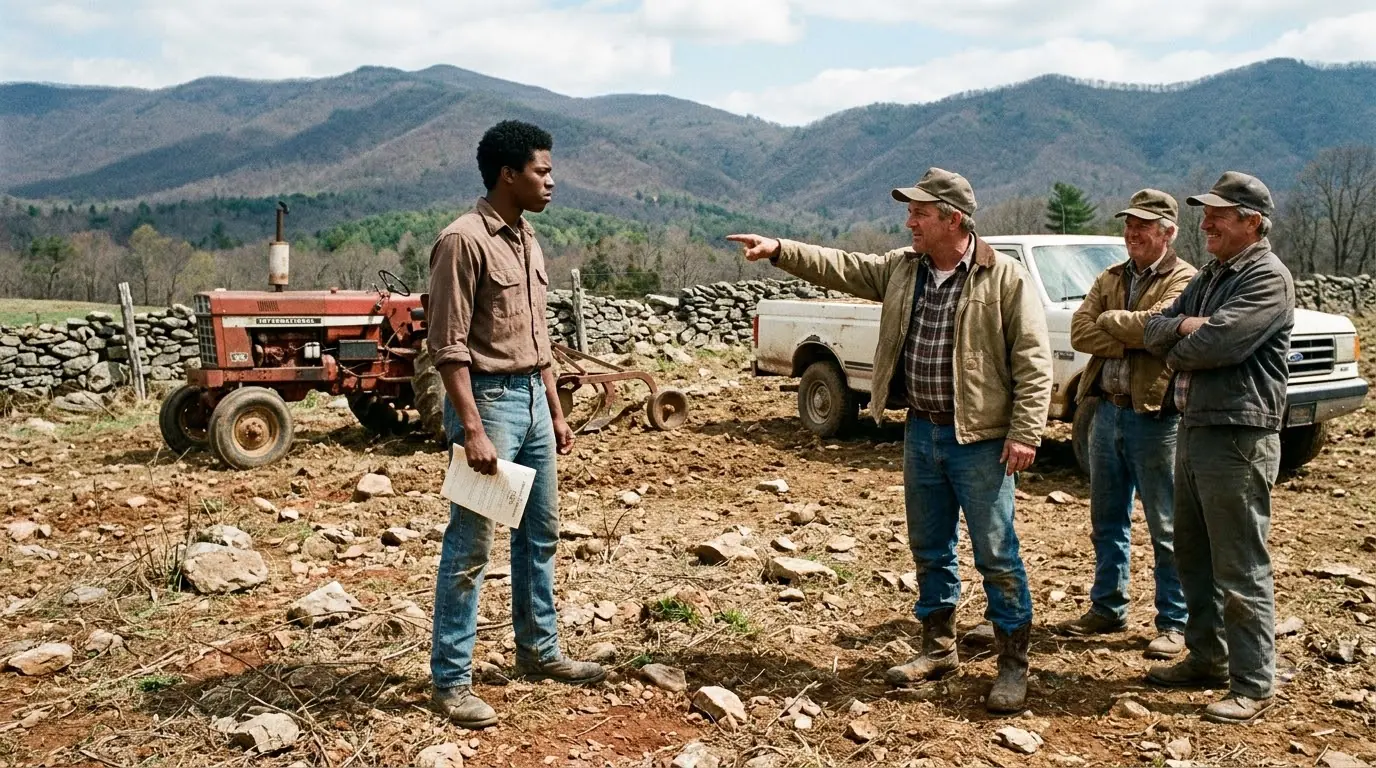
“You’ll be begging me to buy it from you by first frost.”
Marcus was nineteen years old, Black, tall and lean from years of lifting engine blocks and transmission housings at his uncle’s diesel shop. Red grease had worked permanently into the small cracks across his knuckles, and there was a thin scar over his left thumb where a slipped wrench had opened him up the previous winter.
He said nothing.
Dale laughed once more, shook his head, and walked toward his pickup.
Six months later, Marcus’s old Farmall would strike something buried eighteen inches beneath the red Virginia clay.
Something nine feet long.
Something sealed with lead.
And on the brass plate riveted to its top would be a name Marcus had spent his entire childhood hearing at his grandmother’s kitchen table.
HOLLIS.
But in April of 1991, none of that had happened yet.
All Marcus had was nineteen acres everybody else considered worthless, nine thousand dollars of his own savings, three thousand dollars his grandmother could barely afford to give him, and a stubborn belief that land did not become useless simply because the people around it had stopped trying to understand it.
Grayson County sat high in the Blue Ridge Mountains of southwestern Virginia, where a farm could look beautiful from the road and still make a man poor.
The ridges folded into one another beneath blue haze. Summers were green and humid. Winters arrived early enough to punish anyone who waited too long to finish outdoor work. Thin soil clung to some slopes while heavy red clay filled others, and rocks appeared everywhere, pushed upward by frost and exposed by every plow.
The nineteen-acre parcel outside Independence had earned its local name honestly.
The Stony Waste.
Nobody knew who first called it that.
By 1991, everybody did.
The lower field was choked with blackberry and broom sedge. Young locust trees had spread into what had once been pasture. Limestone lay scattered across the surface, but the worse stones sat just below it, invisible until steel found them.
When rain came, the clay became sticky enough to build with.
When summer heat baked it, the ground hardened around every stone like brick.
The property had been on the county’s delinquent-tax list for more than three years. Twice, people had looked at it. Once, a man from North Carolina considered buying it for a hunting cabin. Another time, a nearby cattle farmer asked whether the county would split off the road frontage.
Nobody completed a purchase.
There was no house.
No working barn.
No reliable well anyone could identify.
Only the remains of a collapsed shed, stone walls running through brush, an enormous oak near the southern corner, and enough rock to make every farmer in the room at the tax auction understand why the opening price was so low.
Marcus saw something different.
He saw ownership.
That mattered to him in a way that had nothing to do with acreage.
He had grown up in a small white clapboard house with his grandmother, Ruth Hollis, on the edge of Independence. The house had two bedrooms, a patched metal roof, a front porch that leaned slightly toward the road, and a kitchen table where almost every important story Marcus knew had been told.
Ruth had raised him since he was six.
His mother had moved to Richmond after years of trying to make ends meet in Grayson County. His father had never been part of his life in any consistent way.
Ruth never spoke badly about either of them.
She simply made room.
Marcus’s bedroom had once been a sewing room. His clothes went into drawers that still smelled faintly of cedar. His school papers shared a shelf with old church programs and family photographs. He learned multiplication at Ruth’s kitchen table and learned how to change oil behind Uncle Walter’s shop.
But the lesson that stayed deepest came from the stories Ruth told about land.
“We had something once,” she said.
She would fold both hands around her coffee cup.
“Don’t let anybody tell you we didn’t.”
Marcus first heard that sentence when he was eight.
He did not understand it then.
By twelve, he knew more.
The Hollis family had owned farmland somewhere in Grayson County during the early twentieth century.
Ruth’s grandfather was named Josiah Hollis.
Black farmer.
Blacksmith when money was short.
Farmer whenever weather allowed.
According to Ruth, Josiah and several other Black families had bought ground together during a period when land ownership for families like theirs was rare enough to be remembered generation after generation.
Then the Depression came.
Taxes.
Debt.
County sales.
Paperwork nobody in the family could later reconstruct.
Somewhere in the 1930s, the Hollis land disappeared from the family story.
“Taken,” Ruth always said.
Marcus once asked exactly who took it.
Ruth shook her head.
“My daddy was a child. People didn’t explain things to children. By the time he got old enough to ask, half the people who knew were dead.”
“Where was it?”
“Out in the county.”
“That’s not very specific.”
“No.”
“Do you know the road?”
“No.”
“Creek?”
“No.”
She looked annoyed with herself.
“We lost more than dirt, Marcus. We lost the information that went with it.”
That sentence stayed with him.
At fifteen, Marcus began working afternoons at his uncle Walter’s diesel shop.
Walter Hollis was Ruth’s younger brother, twenty years younger than her and built like a man assembled from old machinery.
Wide shoulders.
Large hands.
Gray hair cut close.
He believed broken equipment should be diagnosed before it was discussed.
If Marcus told him an engine “sounded bad,” Walter asked which cylinder.
If Marcus said a pump “didn’t work,” Walter asked what pressure it produced.
Feelings had a place in Walter’s world.
Measurements came first.
Marcus thrived there.
He learned fuel systems.
Hydraulics.
Electrical troubleshooting.
Welding.
Machining.
By seventeen, long-haul drivers were asking whether “the Hollis kid” was working before leaving a truck overnight.
Walter noticed.
“You stay here,” he told Marcus one evening, “you’ll be running half this place by twenty-five.”
“That what you want?”
“I want you earning money.”
“That wasn’t what I asked.”
Walter wiped his hands.
“No.”
He considered.
“I want you doing something you can live with when your back starts hurting.”
Marcus understood.
Walter liked mechanics.
Marcus was good at mechanics.
Those were not the same thing.
Every afternoon, after finishing work at the shop, Marcus drove county roads.