“I don’t care who you think you are. You need to leave my store right now, or I will have security remove you.”
The words carried cleanly through the showroom of Luminous Designs on Rodeo Drive, loud enough to silence a conversation near the engagement rings and make a salesman at the opposite counter look up from his tablet.
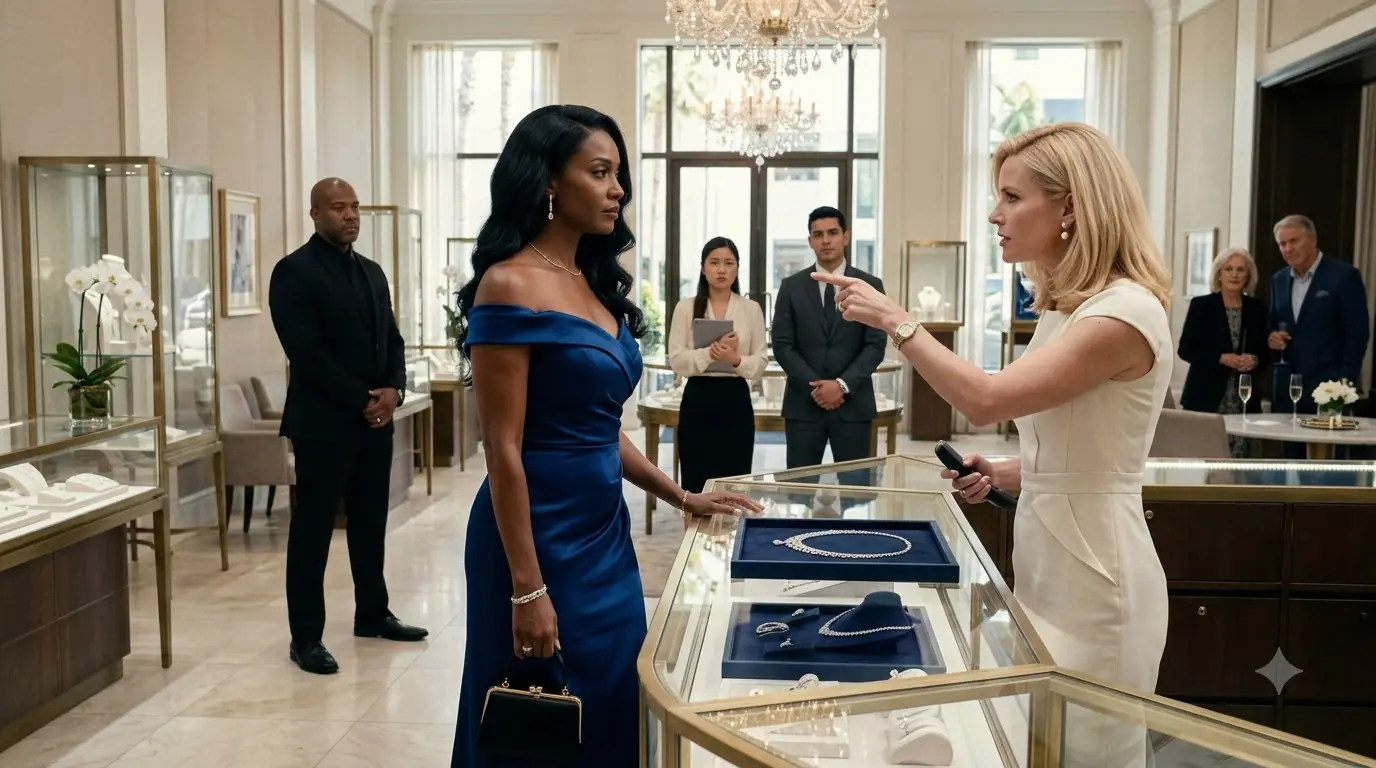
Beneath soft architectural lighting, diamonds continued to glitter inside perfectly polished cases as though nothing had happened, but every person in the flagship store had turned toward the confrontation taking place beside the Aurora Collection.
Diana Mitchell stood absolutely still.
At forty-two, she had spent more than half her life learning how not to react when someone underestimated her. She had learned it in bank offices when lenders looked past her toward male colleagues. She had learned it in trade shows when suppliers assumed she was an assistant. She had learned it in luxury boutiques before she had money, and later in the same boutiques after she had more money than most of the people serving her.
But this was different.
This was her store.
The navy blazer Diana wore was tailored but understated, the sort of jacket an ordinary professional woman might buy and keep for years. Her trousers were dark, her shoes comfortable, and the leather handbag hanging from her shoulder showed signs of use. The only piece of jewelry that looked remotely distinctive was a tarnished silver bracelet around her left wrist, its surface worn smooth in places by decades of contact with skin.
Patricia Wittmann stared at that bracelet as if it confirmed everything she already believed.
Patricia was thirty-eight, immaculate from her carefully styled blond hair to the narrow heels of her cream pumps. She had been manager of Luminous Designs Beverly Hills for eight months, and in those eight months she had developed the confidence of someone who had begun confusing responsibility for a store with ownership of it.
“I’m serious,” Patricia said.
Diana’s hands, which had trembled for perhaps three seconds from the force of her anger, became steady.
“Go ahead.”
Patricia blinked.
“What?”
“Call security. Call the police if you want.”
Several customers shifted uneasily.
Then Diana reached into her handbag and removed her phone.
“But before you do,” she said, “I’m making a call of my own.”
Patricia’s mouth tightened.
“You think threatening me with some lawyer is going to change anything?”
Diana looked at her.
“No.”
She unlocked the phone.
“I’m calling the people who are going to need to understand exactly what happened in this store today.”
Patricia gave a short, contemptuous laugh.
She had no idea that the woman standing in front of her was the founder and chief executive officer of Luminous Designs.
She had no idea that the flagship store she had just called “my store” existed because Diana had designed it, financed it, approved its lease, selected its lighting system, chosen the marble beneath Patricia’s heels, reviewed the training manual Patricia had signed, and personally approved the values statement framed in the employee room thirty feet behind them.
And she had no idea that the most important part of Diana’s surprise visit had already happened.
Diana had seen enough.
Three hours earlier, none of this had seemed possible.
At 5:03 that morning, Diana Mitchell woke in her house in the Hollywood Hills before her alarm.
She always did.
For more than twenty years, she had slept lightly before major decisions, difficult negotiations, and unannounced store visits. Success had given her a larger bedroom, a better mattress, and the option never to set an alarm again, but it had not convinced her nervous system that mornings were safe to waste.
She sat on the edge of the bed for a moment, listening to Los Angeles waking below her.
Then she reached for the silver bracelet resting beside a book on her nightstand.
The bracelet was not valuable.
Not in the way Luminous Designs measured value.
No rare stone.
No famous maker.
No investment-grade metal.
It had belonged to Diana’s grandmother, Evelyn Mitchell, who had worn it while cleaning hotel rooms in Detroit, while raising three children, while stretching grocery money through winters when the heating bill came before everything else.
When Diana was sixteen, Evelyn had given it to her.
“You keep this,” she had said.
Diana had turned the bracelet over in her palm.
“Why?”
“Because people confuse price with value.”
At sixteen, Diana had rolled her eyes.
Evelyn noticed.
“You think I’m being sentimental.”
“You are being sentimental.”
“I’m being correct.”
Diana smiled at the memory as she fastened the bracelet around her wrist.
Her grandmother had been gone seventeen years.
The bracelet remained.
By 5:30, Diana was downstairs drinking coffee while reviewing the previous day’s store reports on a tablet. Luminous Designs had forty-seven locations in twelve states, from Manhattan and Atlanta to Chicago, San Francisco, Dallas, Miami, Scottsdale, and Beverly Hills. The company generated approximately $180 million in annual revenue, though Diana disliked hearing people describe the business only through revenue.
Revenue did not tell you whether a customer felt welcome.
It did not tell you whether a junior employee felt safe disagreeing with a manager.
It did not tell you whether the person buying a $900 anniversary band received the same respect as someone buying a $200,000 diamond.
Diana believed those things mattered precisely because luxury businesses often forgot them.
She had founded Luminous Designs twenty-three years earlier with a rented workbench, borrowed tools, three thousand dollars in savings, and a frightening amount of confidence.
At nineteen, she had enrolled in college while working evenings for a small Detroit jeweler named Samuel Rosen. Samuel had been seventy-one, impatient, and nearly impossible to impress.
He taught her how to inspect a stone.
How to see a weak prong.
How to feel poor polish with the edge of a fingernail.
How to understand that craftsmanship lived in details customers might never consciously notice.
Most importantly, Samuel let her work.
Other jewelers had seen a young Black woman and assumed front counter.
Samuel handed her a loupe.
“Tell me what’s wrong with that setting.”
Diana looked at the ring for nearly five minutes.
“The stone’s slightly off center.”
Samuel grunted.
“Anything else?”
“One prong is thinner.”
He took the ring.
“Good.”
That was the entire compliment.
She remembered it for years.
By twenty-four, Diana was designing pieces under her own name.
By twenty-seven, she opened her first tiny store.
By thirty-two, she had eight locations.
By thirty-six, private investors were offering numbers that would have allowed her to sell the company and never work again.
She refused.
Not because money was unimportant.