"Ma'am, you need to leave. This dealership isn't for people like you."
The security guard had not even touched his radio when Brad Hutchinson said it, and that detail would matter later. He had been summoned to a problem that was already being described as a problem before anybody had bothered to identify an actual threat.
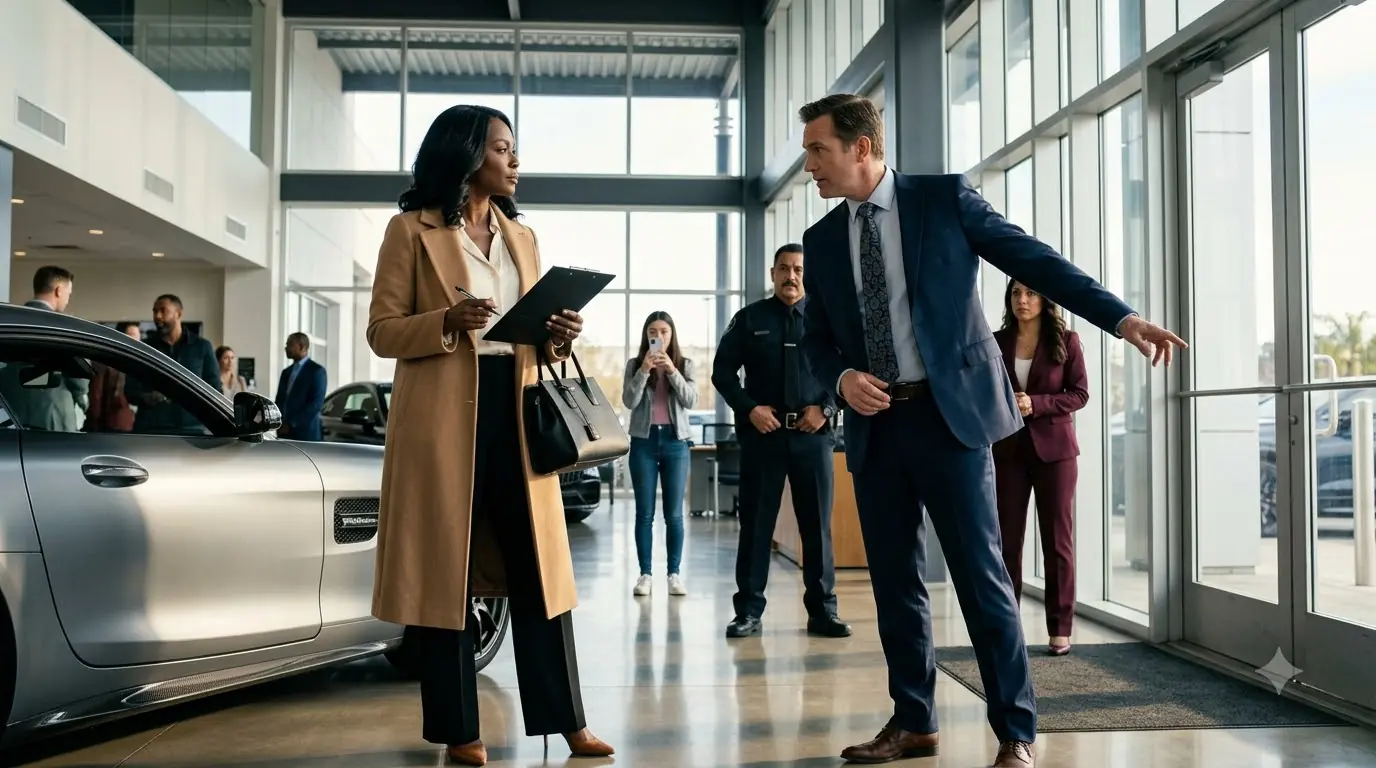
A woman in a gray hoodie stood beside a silver Mercedes-AMG GT, holding a clipboard and an ordinary pen, while the sales manager pointed toward the showroom doors as though the building itself had rejected her. Twenty feet away, a college student lifted her phone and began recording what she feared might happen next.
Outside Premier Mercedes-Benz of Riverside, the afternoon sun had turned the rows of parked automobiles into strips of white and silver light. Inside, polished concrete reflected the long shadows of showroom columns and the quiet movement of people who had come to spend extraordinary amounts of money. The building smelled faintly of new leather, floor polish, and the coffee brewed in the customer lounge. Classical piano music played at a volume calculated to make expensive decisions feel peaceful.
Dr. Kesha Williams stood still enough that Brad mistook her silence for surrender. She was a American woman in her early forties, with closely gathered natural curls, a calm face, and a way of listening that made people say more than they intended. Her jeans had faded at the knees, and her gray hoodie bore no visible brand beyond the soft wear of many washings. The pen in her right hand moved only when she heard something worth preserving.
"I came to discuss a vehicle," she said. "I'd like to finish that discussion before anyone decides I have to leave."
Brad gave a short laugh and glanced toward the man standing at the security desk. "You can discuss a vehicle at plenty of places," he replied. "This is a premium dealership. We have standards."
Kesha lowered her eyes to the clipboard. She wrote down the sentence without underlining it, then checked her watch. The narrow hands showed 3:47 p.m., leaving thirteen minutes before the end of the observation period she had scheduled for herself. At four o'clock, the role she was playing would end whether she had learned what she needed or not.
Brad did not know that. To him, the woman in the hoodie was a disruption that could be removed before the serious customers noticed. He had spent twenty years learning how to read a person within seconds, or so he told himself, and the habit had hardened into a theory about clothing, accents, neighborhoods, and who belonged in rooms full of luxury merchandise. His confidence had been rewarded often enough that he no longer recognized how little of it rested on evidence.
That morning, Kesha had woken before dawn in a hotel suite twelve miles from Riverside and left a prepared suit hanging untouched in the closet. The charcoal jacket and cream blouse were appropriate for the quarterly call with Stuttgart, where regional performance results would be discussed with executives from multiple markets. Her plain hoodie was appropriate for another kind of meeting, one where she did not want her title to speak before she did. She had packed both outfits because she was accustomed to moving between rooms that treated the same person differently.