"Get off that bench. You're trespassing." "I live here, Officer." "You live here? You stink. That ratty jacket, those busted shoes. You crawled out of a shelter."
"Sir, I just moved." "Shut up. You people sneak into nice neighborhoods acting suspicious, scoping houses." "I'm not scoping anything. I'm a vet."
"A veteran? You?" He leaned in, spit landing on Fletcher's cheek. "You dug that disgusting rag from a trash can. Liar. Trespasser. On your knees."
"Please. Please, my son." The open hand cracked across Fletcher Sullivan's face. Maple Drive went silent. Fletcher knelt. His wrinkled army jacket pressed into the curb.
Blood found his chin. He whispered at once, "My son is on his way." Nobody on that street had any idea what was coming.
Six hours earlier, Fletcher Sullivan stood in the doorway of his new home on Maple Drive and breathed in the smell of fresh paint. The house was modest by Willow Creek standards. Three bedrooms, a small yard, a porch with a wooden swing. But to Fletcher, it was everything.
40 years of saving, three combat tours in Vietnam, two Purple Hearts, a body full of shrapnel that still set off metal detectors at airports. All of it led to this quiet street where his son lived four blocks away. He set down the last cardboard box and ran his hand along the porch railing. His wrinkled army jacket, the same one he'd worn the day he came home from Saigon in 1971, hung loose on his shoulders.
The fabric was soft from decades of washing. The stitching along the collar had come undone twice, and twice he'd sewn it back by hand. He never went anywhere without it. Fletcher checked his watch.
Ethan would come by at 5 to help him unpack. Plenty of time. He decided to walk the neighborhood, learn the streets, see where the grocery store was, where the park was, maybe find a bench and sit for a while. Maple Drive was lined with oak trees and mailboxes shaped like little barns.
Sprinklers clicked across perfect lawns. A woman in yoga pants jogged past without looking at him. A man washing his BMW glanced up, then looked away quickly. Fletcher found a bench near the community garden.
He sat down, stretched his bad knee, and watched the afternoon light move through the trees. Three houses down, Diane Holloway stood at her kitchen window. She'd lived in Willow Creek for 22 years. She knew every face on every block.
She did not know this one. She picked up her phone. 911. "Yes.
I'd like to report a suspicious individual. " Black male sitting on the bench near the garden on Maple Drive. Old wrinkled military-style jacket. He's been looking around at the houses.
He definitely doesn't live here. She paused. "Please send someone quickly. I don't feel safe. " She hung up and watched from behind the curtain, arms folded, already certain she was right. The cruiser rolled up Maple Drive with no sirens, just the slow crunch of tires on clean asphalt. Two officers stepped out. The driver was young, mid-20s, name tag reading Cole.
He adjusted his belt and looked around like he wasn't sure why they were here. The passenger was different. Sergeant Wade Prescott was built like a man who spent more time in the gym than on the street. Square jaw, mirrored sunglasses pushed up on his forehead.
He walked like every block he stepped on belonged to him. He spotted Fletcher on the bench from 30 yards away and didn't slow down. "On your feet. " Fletcher looked up.
He'd been watching a cardinal hop along the garden fence. "Good afternoon, Officer. Something wrong? " "I said on your feet.
We got a call. Suspicious individual matching your description. " Fletcher stood slowly. His bad knee popped. "Suspicious? I'm sitting on a public bench in Willow Creek. " Prescott looked him up and down. The wrinkled army jacket with its frayed cuffs, the faded trousers, the old boots, his lip curled. "You don't exactly fit the neighborhood, do you? " "I just moved in. Three houses that way. " Fletcher pointed toward Maple Drive.
Prescott's hand shot out and grabbed his wrist. "I didn't say reach. I said, 'Do you have ID?'" "There's a difference. Keep your hands where I can see them. " Fletcher lowered his arm. "Officer, I'm 68 years old. I'm not a threat to anyone. " 68.
Prescott repeated the number like it proved something. He circled Fletcher slowly, looking him over the way a man inspects something he's about to throw away. 68 years old, wandering around a neighborhood you can't afford, wearing a jacket that smells like a thrift store dumpster. And you want me to believe you live here? "I do live here. " "Where's your car? " "I walked. " You walked from where?
The highway overpass? The bus station? Prescott stopped in front of him and crossed his arms. Because let me tell you what I see.
I see a man who doesn't have a car, doesn't have a house, and doesn't have any business being on this street. What I see is a vagrant. I'm not a vagrant. "Then prove it. " "I tried. You won't let me reach my ID. " Prescott's jaw tightened. He didn't like being caught in his own logic.
He turned away and spat on the sidewalk 3 inches from Fletcher's boot. "That's not for you to decide. " He stepped back. Cole, pat him down.
Officer Cole hesitated. "Sarge," he said he lives here. Maybe we should just... " Cole stepped forward. "Sir, I'm going to check your pockets. Is that okay? " Fletcher nodded. Cole's hands were careful, almost apologetic.
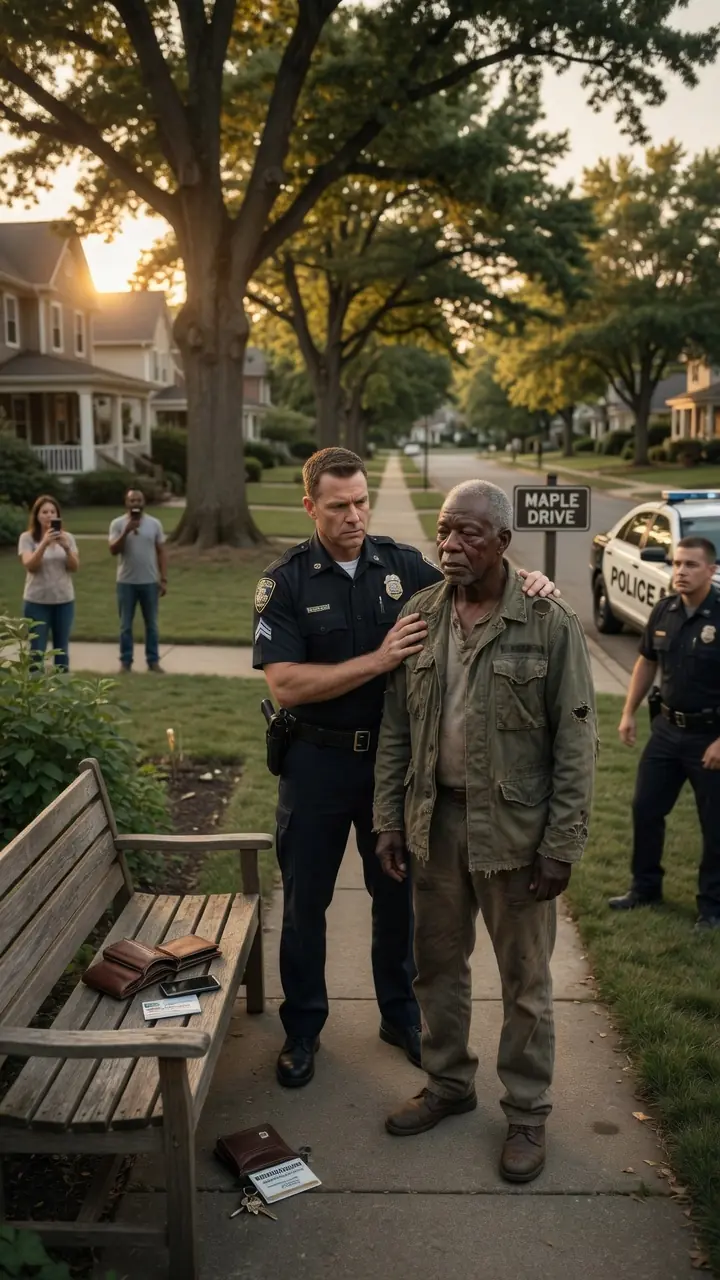
He pulled out a wallet, a set of house keys, and a cell phone. Prescott snatched the wallet, flipped it open, and studied the driver's license. He held it up next to Fletcher's face, squinting as if the photo couldn't possibly match. "This says Maple Drive. " "That's right. " "This could be fake. " "It's a Virginia state ID, Officer. " "I've seen fakes that look better than this. " Prescott tossed the wallet back at Fletcher. It hit his chest and fell to the ground. The wallet landed face up on the pavement. Fletcher's military veteran designation was visible on the front of the ID printed in bold letters.
Prescott didn't look down. Fletcher bent slowly to pick it up. His knee popped again. His fingers swollen at the joints, stiff from years of arthritis, fumbled with the leather. "Leave it," Prescott said. "It's my wallet. " "I said, 'Leave it. Stand up straight.
You don't touch anything until I say so.'" Fletcher straightened, leaving his wallet on the ground. A breeze pushed it open. His VA medical card slid out and lay on the concrete next to a leaf. Those keys, Prescott pointed at the bench where Cole had placed them. "Could be anyone's keys. Prove they open a door on this street. " "Walk with me three houses down. I'll show you. " "I'm not walking anywhere with you. " Prescott's voice rose. A woman across the street stopped pulling weeds and looked over. You're going to stand right here until I figure out what's going on.
Because right now, right now, I've got a grown man in a beat-up jacket sitting alone in an upscale neighborhood looking at houses. That's textbook suspicious behavior. "I was looking at trees, Sergeant. " "Don't get smart with me. " More neighbors appeared. A man in a golf shirt stepped onto his porch. A teenager pulled out a phone and started recording. Diane Holloway walked to the edge of her property, phone already raised, filming.
Prescott didn't care. He was louder now. Performing. "Where'd you get that jacket? " "It's mine. I served. " "Served where? " "United States Army.
Three tours. Vietnam, 1968 to 1971. " Prescott laughed. It wasn't a chuckle.
It was a full open-mouthed laugh, head tilted back, loud enough for the neighbors to hear. Vietnam. You look at you. You can barely stand up straight.
You're telling me you carried a rifle through a jungle? "I carried more than a rifle, Sergeant. " "Yeah, like what? Other people's wallets? " Two neighbors laughed. The sound carried across the manicured lawns like something breaking. Fletcher said nothing. He looked at the ground, his jaw tightened.
A woman in a white tennis skirt stepped off her porch and walked closer, arms folded. She didn't speak to Fletcher. She spoke about him as if he were a piece of furniture someone had left on the curb. "I saw him earlier, too," she said to Prescott.
Walking slow, stopping at every house. Made me nervous. Thank you, ma'am. Prescott wrote in his notebook without looking up.
Appreciate the help, Fletcher turned to her. "I was walking. That's all I was doing. " The woman stepped back as if he'd raised a hand. "Don't talk to me. " "I was just... " "I said don't. " She looked at Prescott. "Are you going to let him talk to me like that? " Prescott put his hand on Fletcher's shoulder and squeezed. "Eyes forward. You don't speak to anyone unless I tell you to. " Fletcher faced the street. The wallet was still on the ground. The VA card was still on the concrete. The house keys were still on the bench.
Every piece of evidence that proved who he was sat within arms reach, and not one person on that street cared enough to look. Prescott stepped closer. You know what I think? I think you found that jacket in a Goodwill bin.
I think you put it on because it makes people feel sorry for you. I think you walked into this neighborhood to see what you could take. "That's not true. " Then why are you here?
Huh? "Why are you here? " "I told you I live here. My son... " Your son? Prescott's eyebrows shot up. He turned to Cole with a grin. His son lives in Willow Creek.
Sure. And my mother's the Queen of England. He looked at the crowd playing to them now, feeding off their silence like a comedian who mistook discomfort for approval. You hear that, folks?
This guy says his son lives on this street. Probably says his daughter runs NASA, too. More laughter from the growing crowd. Diane zoomed in with her camera.
A man in a polo shirt shook his head and muttered, "Unbelievable. " But it wasn't clear whether he meant Fletcher's claim or Prescott's behavior. "Call him," Fletcher said quietly. "Call my son.
He'll tell you everything you need to know. " Prescott leaned in. "I don't need to call anybody. I've got eyes. " I've got 20 years on this job, and everything I see tells me you're full of it. "One phone call, Sergeant. That's all I'm asking. " And I'm telling you, no.
You know what? "Turn around. " Hands behind your back. " "For what?
I haven't done anything. " "Failure to comply. Loitering. Trespassing.
Pick one. " "I'm standing on a public sidewalk. " "Turn around. " Prescott grabbed Fletcher's shoulder and spun him.
The old man stumbled. His bad knee buckled for a second. Prescott caught his arm and wrenched it behind his back. The handcuffs clicked shut. "That's too tight," Fletcher said. "I have arthritis in my... " "Should have thought about that before you decided to act suspicious in a neighborhood that's way above your pay grade. " Cole stood three steps behind Prescott.
His hands were at his sides. His face was tight. He opened his mouth, then closed it. He looked at Fletcher's wallet on the ground, at the VA card lying in the open, at the house keys on the bench.
He looked at all of it and said, "Nothing. " Fletcher noticed. He looked at Cole the way a teacher looks at a student who knows the answer but won't raise his hand. Cole looked away.
Fletcher stood there cuffed, facing the street. 15 neighbors now. Some on porches, some on lawns, some standing at the edge of driveways with coffee cups in their hands, watching a 68-year-old man in handcuffs the way people watch a car accident. Disturbed, but not enough to move.
A sprinkler hissed somewhere behind a hedge, Diane called out from her lawn. Thank you, officer. We've been worried all afternoon. He was looking at my house for 10 minutes. "I was looking at your magnolia tree," Fletcher said. See? Diane turned to her neighbor. "He's been watching my property. " I told you. Prescott walked around to face Fletcher. So, you're a liar and a trespasser. "I am neither. " "You're whatever I say you are right now. You understand that? " out here. I'm the law and the law says you don't belong.
Fletcher's phone buzzed in the pile of belongings on the bench. The screen lit up. Ethan calling. "That's my son," Fletcher said.
Please just let me answer that. No, he's expecting me. He'll worry. "Good.
Maybe he'll come down here and I can arrest him, too. " The phone rang out. Then it rang again and again. Prescott picked it up, looked at the screen, and set it face down on the bench. "Nobody's coming to save you, old man. " Fletcher looked at Prescott. For the first time, something shifted in his face. Not anger, not fear, something deeper.
The look of a man who had survived things this sergeant couldn't pronounce. "You have no idea," Fletcher said softly, "what you've just done. " Prescott's face went red. What did you just say to me? "I said, you have no idea. " No, you don't get to threaten me. Prescott stepped in chest to chest. You think because you put on some costume you can talk to me like that?
You're nothing. You hear me? You're a nobody in a wrinkled jacket pretending to be something you're not. And right now you're one word away from spending the night in a cell.
Fletcher held his gaze. "I'm not pretending to be anything. I am exactly what I said I am. " "Then you won't mind kneeling. " "I served my country. I don't kneel. " "You kneel when I tell you to kneel. " Prescott put his hand on top of Fletcher's head and pushed down.
Fletcher resisted for one second. Then his knee gave. He went down hard on the concrete. Pain shot up his thigh.
His wrinkled army jacket bunched around his shoulders. Diane started clapping slowly. "Finally, some order. " Prescott stood over Fletcher, breathing hard, pointing down at him. "Stay right there. " "You move, I'll charge you with resisting. " Fletcher knelt on the sidewalk of the neighborhood he just bought a house in. His cuffed hands pressed against his lower back.
His knee screamed. His phone kept ringing on the bench behind him. The sun moved behind the oaks. The shadows grew longer.
A school bus passed without stopping and not one person on Maple Drive said a word. Prescott called it in at 4:47 p.m. "Dispatch, this is Unit 14. " I've got a black male in custody on Maple Drive near the community garden.
Possible trespasser. Refuse to comply. Requesting backup. The radio crackled back. "Copy, Unit 14. Backup en route. " Fletcher knelt on the sidewalk and said nothing. The concrete pressed into his kneecap like a dull blade.
His cuffed hands had already gone numb behind his back. The arthritis in his right wrist throbbed with every heartbeat. He focused on breathing. The concrete was still warm from the afternoon sun, but Fletcher's body had gone cold.
The swelling under his left eye pulsed. The dried blood on his lip cracked every time he pressed his mouth together. His wrists burned where the metal cuffs dug into arthritic joints, and his right hand had gone from numb to tingling to something that felt like a swarm of needles. But he'd felt worse. much worse.
In out like the field medic taught him 53 years ago when the shrapnel hit his back outside Da Nang. Stay still. Stay calm. Pain is temporary.
Panic kills. Prescott paced in front of him. Boots clicking on the pavement. Chest puffed like a man who just won something.
He pulled out a small notebook and started writing slowly, deliberately, making a show of it. Trespassing, he said aloud, scribbling, loitering, failure to identify, resisting a lawful order. He glanced down at Fletcher. You want to add threatening an officer to that list? "I didn't threaten you. " You have no idea what you've done. "That's a threat in my book. " "It wasn't a threat.
It was a fact. " Prescott stopped writing. He crouched down so his face was level with Fletcher's. "You're not in a position to talk about facts, old man.
Facts are whatever I put in this report. " Fletcher held his gaze but said nothing. A second cruiser arrived. Two more officers stepped out.
One tall and thin, one stocky with a shaved head. They walked over, assessed the scene, and deferred to Prescott without question. "What do we got, Sarge? " Suspicious male, no credible ID, refused multiple commands, got aggressive when confronted.
Fletcher's jaw tightened. Every word was a lie. But he knew. He knew from 68 years of living in this skin that correcting a lie in handcuffs only makes the lie louder.
The stocky officer looked down at Fletcher. He give you trouble. Tried to. Prescott smiled.
Not anymore. The thin officer crouched down to Fletcher's eye level. Not out of kindness, out of curiosity. The way someone bends down to look at an animal behind a fence. "You really say you live here? " "I do live here. 4436 Maple Drive. " I have the deed in a box in my living room.
The officer stood up and looked at Prescott. "You want us to walk down and check? " "No. " Prescott didn't hesitate.
We're not doing his errands. If he lived here, someone on this street would know him. Look around. Nobody's stepping up.
Fletcher looked at the neighbors. He waited. He gave them a chance. One more chance to say something, to nod, to walk over, to do anything at all.
Nobody moved. A man in a driveway turned his back and went inside. The woman in the tennis skirt pulled out her phone and started texting. A child pressed his face against a second floor window and a hand pulled him away.
Diane Holloway appeared at the edge of the scene like she'd been waiting for an audience. She walked up to the stocky officer and put on a voice dripping with rehearsed concern. "Officer, I'm the one who called. " Diane Holloway, 4412 Maple Drive.
I've lived here 22 years. I've never seen this man before in my life. Thank you, ma'am. Can you describe what you saw? "He was walking up and down the street for over an hour, stopping in front of houses, looking at windows. " He sat on that bench and just watched. "My daughter's room faces the garden. I felt unsafe. " Fletcher closed his eyes. An hour. He'd been outside for 20 minutes. He also tried several door handles, Diane added.
She said it casually, the way someone adds an item to a grocery list, as if a man's freedom was just another thing to cross off. The stocky officer wrote it down without verification. No follow-up question, no request for specifics, just pen to paper. As if the word of a woman in a cardigan outweighed the ID, the keys, and the clean record of the man on the ground.
Fletcher's eyes opened. "That is a lie. " "Quiet," Prescott said. "I never touched anyone's door.
That woman is lying. " "I said quiet. " Prescott put his boot on the ground next to Fletcher's knee. Close enough to be a warning.
Gerald Morton walked over from across the street. Gray polo pressed khakis. The kind of man who alphabetized his recycling and measured his grass with a ruler. He nodded at the officers like they were old friends.
The nod of a man who paid his taxes and expected the world to arrange itself accordingly. "I can confirm what Diane said. " I saw him from my window walking slow, stopping at every house. He was definitely looking at houses.
He lowered his voice, but not enough. "People like him don't live in Willow Creek. Never have. " "I'm not trying to be rude, but that's just the reality. " He was trying to be rude. Everyone on the street knew it. Nobody corrected him. people like him. Fletcher heard the words land and felt them settle into a place inside him that was already crowded, a place where similar words had been stacking up since 1958.
The thin officer ran Fletcher's name through the system. The radio crackled back clean. "No warrants, no record, no history. " Prescott barely reacted. "Doesn't mean anything. Could be a first offense. " "Sarge," the thin officer said, lowering his voice. Clean record.
Virginia ID checks out. Address matches this street. Maybe we should Maybe we should what? Prescott turned on him.
Let him go so we can come back tomorrow and hit the houses he was scoping today. Use your head. The officer stepped back and said nothing more. Or Fletcher said quietly, "It could mean I'm exactly who I said I am. " Or, "It could mean you haven't been caught yet. " The phone on the bench lit up again. "Ethan, calling? " The screen glowed against the wooden slats.
It had rung nine times in the last 15 minutes. Cole glanced at it. "Sarge," someone keeps calling him. Maybe we should don't touch it.
But what if it's I said don't touch it. Cole stepped back. His hand dropped to his side. He looked at Fletcher for a long moment, then looked away.
Fletcher watched him. He'd seen that look before, too. the look of a man who knows something is wrong but calculates the cost of saying so and decides it's too high. The sun dipped below the tree line. The shadows stretched across Maple Drive like long fingers pointing at something no one wanted to see.
Fletcher's knee had gone from pain to a deep grinding ache that pulsed up through his hip. He looked down at his chest. The wrinkled army jacket, green, faded almost to gray, stitching loose along the right shoulder. A small tear near the bottom pocket where a piece of shrapnel had once been pulled out by a 19-year-old medic in a mud-filled trench hung on him like a second skin.
He remembered the day he earned it. December 1968, Fort Bragg. The commanding officer had handed it to him and said, "Wear this with pride, Private Sullivan. You've earned the right. " 53 years later, a man with a badge told him he'd stolen it from a trash can. Fletcher didn't cry. He hadn't cried since 1971, the day they buried Corporal James Whitfield, the man who'd carried him two miles through enemy fire with a shattered femur. But kneeling on that sidewalk, hands numb, face swelling, phone ringing with his son's name, Fletcher felt something crack inside his chest that wasn't bone.
It was the last piece of something he'd been protecting his whole life. The belief that this country would one day see him before it saw his skin. A black SUV turned onto Maple Drive. It moved slowly, headlights catching the last of the daylight.
It passed the first house, the second, the third. Prescott didn't notice. He was too busy writing his report. Cole noticed.
He looked up, squinted, and saw the government plates. He said nothing. The SUV stopped four houses away. The engine idled.
The driver's door did not open. Not yet. The black SUV's door opened. The man who stepped out was tall, 6'2, broad shoulders, the kind of posture that made the air around him tighten.
He wore a full army dress uniform. The green fabric was crisp, pressed to razor lines. On his chest, rows of ribbons and medals caught the fading light. A silver star, a bronze star with valor, a combat infantryman badge, and above them all, the insignia that made military professionals stand up straight on instinct.
Colonel's eagles, and beneath those eagles, a patch that very few men in the world were authorized to wear. First Special Forces Operational Detachment Delta. Delta Force. Ethan Sullivan closed the car door with one hand.
In the other, he held his phone, the same phone that had called his father 11 times in the last 20 minutes with no answer. He walked toward the scene on Maple Drive. His boots hit the pavement in a rhythm that turned heads. The teenager with the phone stopped recording his own video and pointed the camera at Ethan.
The woman in yoga pants froze on her porch step. Prescott had his back turned. He was still writing his report, pen moving in slow circles, savoring the paperwork the way some men savor a good steak. Cole saw Ethan first.
His face changed. The color left his cheeks in a single wave like someone had pulled a plug at the base of his neck. He recognized the uniform. He recognized the rank.
And when he saw the Delta patch, his hand moved involuntarily to his own badge as if checking whether it was still there. "Sarge," Cole said. "Not now. " "Sarge," I said not "Sergeant Prescott. " The voice came from behind him, deep, controlled, the kind of voice that had commanded men through firefights and hostage rescues and missions that would never appear in any newspaper. Prescott turned around. Ethan Sullivan stood 6 ft away. His uniform was immaculate.
His jaw was set. His eyes, his father's eyes, dark brown and unblinking, were locked on Prescott with a focus that made the sergeant's hand drop from his belt. "Who the hell are you? " Prescott said, but his voice had already shifted, smaller, less certain.
Ethan didn't answer immediately. He looked past Prescott and saw his father, Fletcher Sullivan, 68 years old, three tours in Vietnam, two Purple Hearts, kneeling on a sidewalk in handcuffs, face swollen, blood dried on his lip. His wrinkled army jacket, the same jacket Ethan had watched his father iron every Veterans Day since he was 5 years old, pressed into the concrete like a rag. Ethan's chest expanded with a breath so deep the medals on his uniform shifted.
He exhaled slowly. Then he spoke, "Take the handcuffs off my father. " The words didn't echo. They didn't need to.
They landed on Maple Drive like stones dropped into still water. Heavy, precise, impossible to ignore. Prescott blinked. "Your... your father? " "Colonel Ethan Sullivan, United States Army Commander, First Special Forces Operational Detachment, Delta. " He held up his military ID without breaking eye contact. That man on the ground is Master Sergeant Fletcher Sullivan, retired, three tours in Vietnam, recipient of two Purple Hearts and a Bronze Star. He bought the house at 4436 Maple Drive 6 days ago.
He is not a trespasser. He is not a criminal. "He is my father. " "And you will remove those handcuffs now. " Prescott's mouth opened. Nothing came out. The notebook slipped from his fingers and hit the pavement. His pen rolled into the gutter.
The backup officers exchanged a look. The stocky one took a full step back as if distance from Prescott might save him from whatever was coming. Cole was already moving. His hands shook as he unlocked the cuffs.
They fell away from Fletcher's wrists with a metallic click that sounded louder than it should have. Fletcher didn't stand right away. His knee had locked. Ethan stepped forward, crouched down, and put his hand under his father's arm.
He lifted him gently, the same way Fletcher had once lifted Ethan from the floor of their apartment after a nightmare about monsters in the closet. "Dad, I'm here. " Fletcher looked at his son. His swollen cheek twitched. "You're early. " "Your phone kept ringing. I got worried. " "I'm okay. " "No, you're not. " Ethan straightened his father's jacket. He smoothed the wrinkled fabric at the shoulders, adjusted the collar where the stitching had come undone, and brushed the dirt from the sleeves with the careful precision of a man who understood what that jacket meant. Then he turned back to Prescott.
The sergeant had not moved. His notebook hung at his side. His pen was on the ground. The two backup officers stood behind him like statues.
Badges suddenly heavy on their chests. Fletcher's wallet was still on the ground where Prescott had thrown it. The VA card still lay on the concrete. Ethan bent down, picked up both, and placed them gently in his father's jacket pocket.
He didn't say a word while he did it. He didn't need to. The gesture said everything. This man's identity was never in question.
Only one side refused to see it. Ethan pulled out his phone. He made three calls in 90 seconds. Each one was short, precise, and devastating.
Call one. "This is Colonel Sullivan. I need the JAG duty officer immediately. " Call two.
FBI Civil Rights Division, please. I'm reporting an assault on a retired veteran by local police. I have badge numbers and I have video. Call three.
Pentagon Public Affairs. This is Colonel Sullivan, JSOC. I need to flag an incident involving a decorated Vietnam veteran and local law enforcement. It's already on social media.
It's going to be everywhere by morning. He hung up and looked at Prescott. "Your body cam is recording, Sergeant. Everything you said, everything you did, the slap, the handcuffs, the refusal to verify ID, the refusal to let him answer his phone, all of it. " Prescott's face had gone from red to white to something close to gray. His mouth moved, but produced only fragments. I We got a call. She said he was.
She said. Ethan looked at Diane Holloway who was backing away toward her front door. Phone clutched to her chest. Ma'am.
Diane stopped. Your 911 call is recorded. You reported a suspicious individual. You described my father as a threat.
You told officers he was trying door handles. My father has arthritis in both hands. He can barely open a jar. Filing a false police report in this state is a Class 1 misdemeanor.
If the report motivated a civil rights violation, it becomes a federal offense. Diane's mouth opened and closed. She looked at the neighbors for support. No one looked back.
I I didn't know he lived here, she stammered. I was just trying to keep the neighborhood safe. Safe from what? Ethan said.
From a 68-year-old man sitting on a bench. Diane turned and walked quickly into her house. The door slammed behind her. Gerald Morton had already disappeared.
His porch was empty. His curtains were drawn. The teenager with the phone was live on TikTok. The viewer count in the corner of his screen read 14,000 and climbing.
Prescott found his voice. Colonel, I listen. I was just doing my job. We got a call.
We responded. Standard procedure. Standard procedure includes verifying identification. You refused. "Standard procedure includes de-escalation. You escalated. " Standard procedure does not include slapping a 68-year-old veteran in the face because he told you he served his country. Prescott said nothing.
You didn't see a citizen. You didn't see a veteran. You saw a black man in an old jacket and you decided he was guilty before you said a single word. Ethan paused. "That's not procedure, Sergeant. That's prejudice. " The street was silent. The sprinklers had stopped.
The school bus was long gone. Even the birds in the oak trees had gone quiet as if the whole neighborhood was holding its breath. Fletcher put his hand on Ethan's arm. "Son. " Ethan looked at him. "That's enough for now. " Ethan held his father's gaze for a long moment. Then he nodded.
He turned back to Prescott one last time. "Don't leave town, Sergeant. " You're going to be hearing from several agencies by morning, and I suggest you call a lawyer. A good one.
Prescott stood alone on the sidewalk. His backup had retreated to their cruiser. Cole sat in the driver's seat of unit 14, staring at the steering wheel. The TikTok had hit 200,000 views, and the sun set on Maple Drive like it always did, slow, golden, indifferent, as if nothing had happened at all.
The call reached police Captain Barbara Wells at 5:22 p.m. while she was sitting down to dinner with her family. She arrived on Maple Drive 14 minutes later. No siren, no lights, just a dark sedan pulling to the curb with the quiet precision of someone who already knew exactly how bad this was going to be. Wells stepped out in full uniform.
She was a 26-year veteran of the force, silver-haired, square shouldered, the kind of woman who had fought her way through a department that didn't want her and came out the other side with a reputation no one questioned. She had fired officers before. She had never enjoyed it, but she had never hesitated either. She surveyed the scene in three seconds.
Fletcher Sullivan sitting on the bench, face swollen. Ethan standing beside him. Prescott and the backup officers clustered near their cruisers. Neighbors scattered across porches and driveways.
Phones raised like a field of glowing periscopes. She walked to Prescott first. "Sergeant, body cam footage now. " Prescott fumbled with the device and handed it over.
Wells pulled a small tablet from her car, plugged in the camera, and watched 30 seconds of footage right there on the sidewalk. Her jaw tightened. She watched another 30 seconds. Her hand pressed flat against her thigh.
She unplugged the camera and looked at Prescott the way a surgeon looks at a tumor. "Badge. " "Captain, if you just let me explain. " "Badge. " Gun. " Now, ma'am. We received a call from a resident. I followed protocol. "You followed nothing. " Wells's voice cut through the evening air like a blade. I just watched you slap a 68-year-old man in the face. I watched you refuse to check his identification.
I watched you handcuff him after he told you multiple times that he lives on this street. And I watched you force a retired veteran to kneel on a public sidewalk while neighbors filmed and laughed. She stepped closer. "That's not protocol, Sergeant.
That's assault. That's a civil rights violation. " "And that's the end of your career. " Prescott's hand trembled as he unclipped his badge.
He held it out. Wells took it without looking at it. She held out her other hand. Prescott unholstered his service weapon, checked the safety, and placed it in her palm.
You are suspended without pay. Effective immediately. You are not to contact the victim or any witnesses. You will be served with formal charges by the end of the week.
Do you understand? Yes, ma'am. His voice was barely audible. "Get in your vehicle. " Drive to the station. Turn in your keys, your access card, and your department phone. Speak to no one. Prescott walked to his cruiser.
His boots, the same boots that had clicked so confidently an hour ago, now dragged on the asphalt. He opened the door, sat down, and stared at the dashboard for a long moment before Cole started the engine. The cruiser pulled away from Maple Drive. No lights, no siren, just a quiet departure that felt louder than anything that had come before it.
Wells turned to the backup officers. Were either of you involved in the physical contact? No, ma'am. Did either of you attempt to deescalate?
Silence. Did either of you verify the man's identification? More silence. You'll both submit written statements by 8:00 tomorrow.
Consider yourselves under review. They nodded and retreated to their vehicle without a word. Wells walked to Fletcher. She stopped 3 feet away, removed her hat, and held it against her chest. "Mr. Sullivan, I'm Captain Barbara Wells. I am deeply sorry for what happened to you today. " Fletcher looked up at her.
The swelling under his left eye had turned purple. The blood on his lip had dried into a dark line. "Are you sorry because of what happened, Captain? Or because of who my son turned out to be? " Wells held his gaze. "I'm sorry because you are a citizen of this community and a veteran of this country, and you were treated like a criminal for sitting on a bench. " "That would be wrong regardless of who your son is. " Fletcher studied her face for a moment.
Then he nodded slowly. Thank you. An FBI agent arrived at 5:51 p.m. Special Agent Doris Wyn, mid-40s, no nonsense, a civil rights specialist who had handled cases from Mississippi to Michigan.
She collected the body cam footage, took preliminary statements from Fletcher and Ethan, and photographed Fletcher's injuries. She knocked on Diane Holloway's door. It took four knocks before Diane opened it. Just a crack.
Mrs. Holloway, I'm Special Agent Wyn with the FBI. I need to discuss your 911 call. I "I don't have anything to say. " Your call is recorded, ma'am. You reported that Mr. Sullivan tried door handles on your street. Officers found no evidence of that.
If your statement was intentionally false, that's a federal offense under section 242. Diane's face collapsed. I didn't I just thought he didn't look like he belonged. "That's not a crime, Mrs.
Holloway, but what you told the dispatcher might be. " The door closed. Agent Wyn turned to Ethan. Colonel, the TikTok video has crossed 5 million views.
CNN and MSNBC have both called our field office. This is going national tonight. Ethan looked at his father. Fletcher was sitting on the bench again, the same bench where this had started.
His wrinkled army jacket hung on his thin frame. His hands rested on his knees. He was watching the last strip of orange light disappear behind the trees. "Dad, do you want to go inside? " Fletcher shook his head. "Not yet. I want to sit here a little longer. " He looked down the street at the empty spot where Prescott's cruiser had been, at Diane's darkened windows, at the neighbors who had finally put their phones away. "This is my street," Fletcher said quietly. "I'm going to sit on my bench. " The video hit 30 million views in 72 hours. Every major network ran the story.
CNN led with the body cam footage, the slap, the handcuffs, the moment Ethan Sullivan walked onto Maple Drive in full dress uniform. MSNBC aired an interview with Captain Wells, who called the incident a systemic failure that started long before Sergeant Prescott arrived on that street. Fox News ran a panel debating whether the 911 call constituted racial profiling. The clip of Fletcher saying, "This is my street.
I'm going to sit on my bench. " became a meme, a protest sign, and a t-shirt within a week. The hashtag #LetFletcherSit trended for five consecutive days. Three weeks after the incident, a grand jury indicted Wade Prescott on two counts, aggravated assault and deprivation of civil rights under color of law.
If convicted, he faced up to 10 years in federal prison. His attorney released a statement calling the charges politically motivated. No one in Willow Creek signed the support petition his wife circulated. She collected four signatures.
Three were from relatives. Diane Holloway was charged with filing a false police report, a Class 1 misdemeanor carrying up to 1two months in jail, and a $2,500 fine. She pleaded no contest and received six months probation, 200 hours of community service, and a mandatory implicit bias course. Her daughter, a senior at the local high school, posted a public apology on her mother's behalf.
Diane herself never spoke publicly again. The magnolia tree in her front yard, the one Fletcher had stopped to admire on his walk, bloomed that spring without anyone noticing. Gerald Morton, the neighbor who had said, "People like him don't live here," was not charged. But the video captured his words clearly.
His employer, a regional insurance firm, terminated him within a week, citing a values misalignment. His wife filed for separation two months later, telling a friend that she couldn't live with a man the whole country had seen say something like that. The Willow Creek Police Department underwent a full restructuring. Captain Wells, promoted to acting chief after the former chief resigned under pressure, implemented mandatory de-escalation training, implicit bias testing for all officers, and a civilian review board with subpoena power.
Body camera policies were rewritten. The department hired its first community liaison officer, a retired Army chaplain who had served with Fletcher in Vietnam. Officer Danny Cole submitted his resignation the morning after the incident. Wells rejected it. "You don't get to quit. " She told him, "You get to do better. " Cole stayed. He enrolled in the department's new training program, volunteered for community outreach shifts, and spent three Saturday mornings helping Fletcher build a vegetable garden in his backyard.
He never talked about that day on Maple Drive. He didn't need to. Everyone who saw him pulling weeds next to the man he'd failed to protect understood what he was doing and why. Six weeks after the incident, the local Veterans of Foreign Wars chapter held a ceremony at the Willow Creek Community Center.
300 people attended. Fletcher Sullivan was awarded the chapter's distinguished service medal, not for his time in Vietnam, but for what the chapter president called extraordinary dignity in the face of extraordinary injustice. Fletcher stood at the podium in his wrinkled army jacket. He didn't give a long speech. "I bought a house," he said. "I took a walk. I sat on a bench. " That shouldn't require courage.
But in this country, for some of us, it still does. He paused. I didn't kneel because a sergeant told me to. I knelt because my knee gave out.
But I stood up again. I'll always stand up again. And if this old jacket bothers you, he touched the frayed collar. That's your problem, not mine.
The room stood. The applause lasted two full minutes. Ethan Sullivan sat in the front row. He didn't clap.
He just watched his father with a look that every child recognizes. The look of someone realizing, maybe for the first time, that their parent is the strongest person they have ever known. On a Sunday in October, Fletcher Sullivan sat on his porch swing with coffee. His wrinkled army jacket hung over the railing, warming in the sun.
Ethan pulled in. He sat next to his father. A neighbor walked past with her dog and waved. Fletcher waved back. "Nice morning," Ethan said. "Every morning here is a nice morning." The bench by the community garden still stood. Someone had bolted a brass plaque to the back rest. Reserved for Fletcher Sullivan: veteran, neighbor, citizen.
He never asked for it. He never asked them to take it down.
END