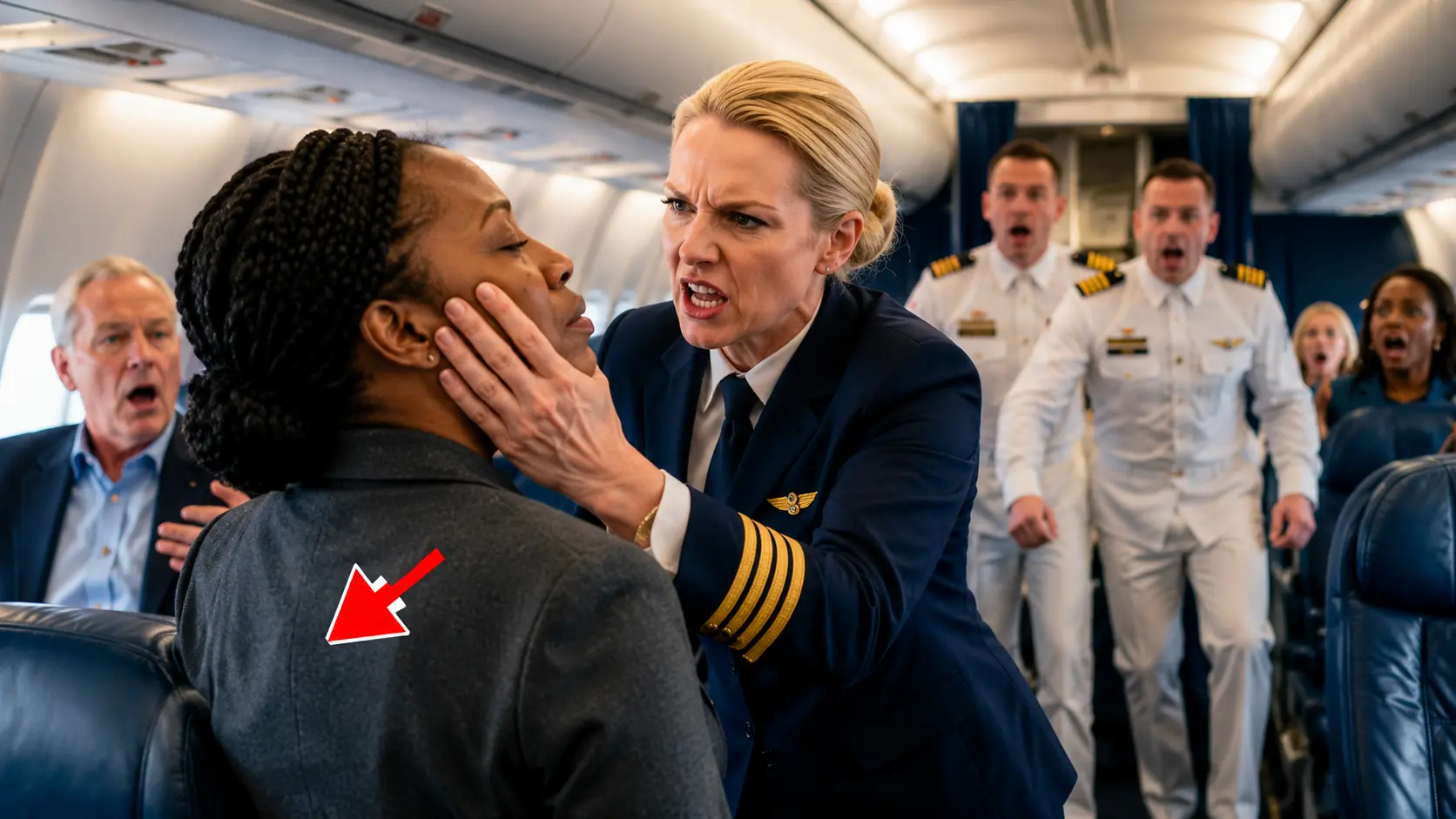
The slap cut through the cabin like a snapped branch.
Blood touched her lip. Something cold and metal slipped loose in the inside pocket of her charcoal blazer. Ten minutes. That was all it would take for the captain to lose everything.
Brooke Mitchell had arrived at the gate forty minutes early, the way she always did. One slim leather briefcase. A coffee she never finished. To everyone around her she looked like a tired professional heading home—just another woman in a dark blazer. That was the point. Most travelers at Gate B12 would never guess what she did for a living. Twenty-two years of habit had taught her that people showed their true faces only when they believed no one important was watching.
Today she was not supposed to be anyone. She was simply a name on a manifest: seat 3A, Meridian Airways flight to Denver. She liked it that way.
While other passengers scrolled their phones, Brooke’s eyes moved. She watched the ground crew load bags. She counted the seconds between the fuel truck’s arrival and departure. She noted which mechanic signed the logbook near the jet bridge and how quickly he signed it. This was not nosiness. This was training.
When the boarding call came she let the families and frequent flyers go first. On the jet bridge she paused for half a second at the aircraft door and breathed in recycled air, coffee, jet fuel—and something else. Faint. Warm. The smell of plastic that had been heated a little too long. She filed it away and said nothing.
At the front of the cabin Captain Diane Whitfield greeted passengers with a thin, practiced smile. Four gold stripes on each shoulder. She nodded at the men in suits. She complimented a little girl’s backpack. Then her eyes landed on Brooke and the smile cooled by ten degrees.
“First class is to your left,” Whitfield said, “if you’re sure that’s your seat.”
“It is,” Brooke answered gently. “Thank you.”
She took 3A by the window, set her briefcase under the seat in front of her, and simply watched. The younger flight attendant, Megan Sutton, gave her a long look and a longer pause before handing over a water. The older one, Claire Bennett, smiled warmly and asked if she needed anything. Two people. Two completely different welcomes. Brooke noticed that too.
First Officer Grant Holloway appeared briefly across the aisle, three stripes on his shoulder. He caught Brooke’s eye and gave her a small, easy nod.
“Busy day up there?” she asked.
“Always,” he said, smiling. “But she runs a tight ship.” His eyes flicked toward the cockpit and something behind the smile tightened. Then he was gone.
The doors closed. The safety briefing played. The aircraft pushed back, taxied, and climbed into a flat gray sky. For the first hour nothing happened. Boring meant safe. Brooke could not let go of that smell. It drifted from somewhere near the forward galley—fainter, then stronger, then faint again. Warm plastic. The ghost of something electrical working harder than it should.
She had read the reports. She knew what that smell could become at thirty-five thousand feet in a sealed metal tube. Most in-flight fires gave you minutes, not hours. She had seen the photographs of what came after.
She waited for an attendant, kept her voice low, and asked the quietest question she could.
“Excuse me. Do you smell that? Like something burning up front?”
Claire paused, uncertain. Megan, passing behind her, did not.
“It’s the ovens,” Megan said flatly. “It’s nothing.”
But it was not the ovens. Twenty minutes later the smell returned stronger, sharper, carrying the bitter edge of insulation cooking against a hot wire. Brooke turned toward the forward galley and watched a thin gray haze hang under the ceiling lights—so faint most people would call it a trick of the eye. She did not.
She pressed the call button. Claire arrived first, already worried.
“It’s getting worse,” Brooke said quietly. “There’s haze near the ceiling. You need to tell the flight deck.”
Claire glanced up and saw it too; Brooke could tell by the way her smile faltered. “I’ll let the captain know.”
Before she could move, Megan stepped between them.
“Ma’am, I already told you it’s the galley. The ovens run hot on this route.”
“Ovens don’t smell like burning wire,” Brooke said. “Please just have someone check the panel.”
“Are you a mechanic?” Megan asked, smiling without warmth.
“No,” Brooke answered. “I’m a passenger asking you to follow your own checklist.”
That was the wrong thing to say. The word “checklist” landed like a challenge. Megan turned and walked straight to the cockpit phone—not to report a smell, but to report a problem passenger.
Two minutes later the cockpit door opened and Captain Diane Whitfield stepped into the cabin. She did not look toward the galley. She did not sniff the air. She walked directly to row three, planted herself in the aisle, and looked down at Brooke like a teacher who had already decided who broke the rules.
“You’re the one causing trouble back here.”
“I’m not causing trouble,” Brooke said. “I’m reporting a burning smell and visible haze near the forward galley. That’s a safety issue.”
“My crew checked it. There’s nothing wrong with my aircraft.”
“With respect, no one opened the panel. I watched.”
A few heads turned. Whitfield heard them turn and raised her voice to perform for them.
“Let me explain something to you. I have flown for nineteen years. I do not need a passenger telling me how to run a flight deck—especially not one who clearly bought the cheapest seat she could find and wandered up to first class.”
The words hit the cabin like cold water. A man in 2C lowered his magazine. Somewhere behind them a phone camera rose an inch.
“I paid for this seat,” Brooke said evenly. “Same as anyone here.”
“Show me your boarding pass. Right now.”
Brooke drew it out and held it up without a word. First class, seat 3A, paid in full. Whitfield barely glanced at it.
“Anyone can print a ticket.”
A few nervous laughs rippled through the cabin—the kind people give when they are afraid of the person in charge. Brooke did not raise her voice. She never did. But she did not sit back either.
“Captain, I’m going to ask you one more time, on the record: please send someone to inspect the forward galley electrical panel. If you refuse, I need your name and your refusal noted.”
Two small words—“on the record.” To a trained ear they should have been a siren. Whitfield did not hear a siren. She heard insolence.