The entire leasing lobby went silent as the Black CEO lowered her phone. Behind the glass reception counter, two leasing agents stopped typing, while prospective tenants seated beneath the towering windows turned toward the confrontation. The white Leasing Manager still held her tablet across her chest, but the confident smirk on her face had begun to weaken. She had expected the elegant woman in the chocolate-brown suit to retreat, not claim ownership of the luxury Manhattan tower.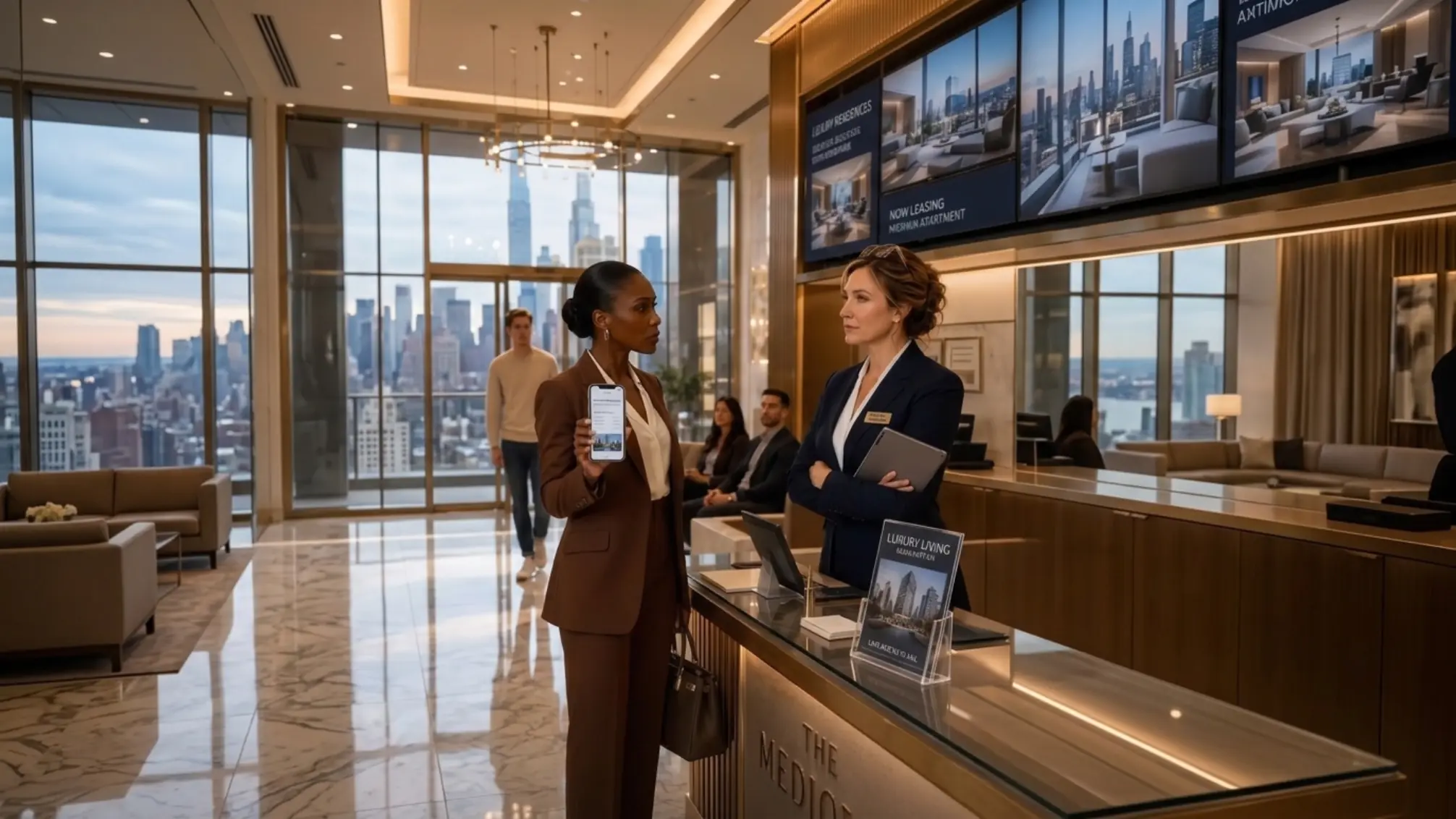
At thirty-nine, the CEO carried herself with controlled authority that did not depend on anyone recognizing her. Her rich brown skin, sharp dark eyes, and sleek low bun complemented a tailored pantsuit, ivory blouse, gold earrings, and pointed heels. A structured leather handbag hung from one hand, while the other held a phone displaying three apartment listings confirmed by the office that morning. Nothing visible identified her as the founder and chief executive of the development company that owned the building.
The forty-six-year-old Leasing Manager had made her judgment before hearing the CEO’s name. She had fair skin, carefully styled brown hair, and an immaculate navy suit bearing a gold nameplate that identified her as Senior Leasing Manager. For eight years, she had controlled access to some of the most expensive apartments in Manhattan. She believed that gave her the right to decide who looked wealthy enough to enter the elevators and who should be pushed back toward the street.
The CEO’s name was Naomi Carter. Carter Urban Holdings owned twelve residential towers, three mixed-use developments, and several commercial properties across New York. The company’s newest acquisition was Meridian Heights, a forty-story luxury building marketed as a place where accomplished professionals could live without sacrificing privacy, comfort, or dignity. Naomi had approved that promise personally.
During the previous six months, however, anonymous complaints had begun reaching the corporate office. Several prospective tenants claimed Meridian Heights advertised available units but refused to show them after applicants arrived in person. Others described sudden income requirements that did not appear in published policies, unexplained credit restrictions, and leasing agents who became hostile after seeing certain applicants.
The reports shared another pattern.
Most came from Black, Latino, Middle Eastern, or younger professional applicants. Many earned more than enough to qualify, carried strong credit, and had scheduled appointments in advance. Yet their appointments disappeared, available apartments became unavailable, or staff insisted that only less desirable units remained.
The Leasing Manager denied every accusation.
Her monthly reports showed high occupancy, strong revenue, and almost no unresolved complaints. She claimed disappointed applicants often accused luxury buildings of discrimination after learning they could not afford them. Because Meridian Heights remained profitable, several corporate executives accepted her explanation without looking deeper.
Naomi did not.
She ordered the compliance department to compare appointment records, advertisements, availability reports, and leasing outcomes. The numbers revealed that apartments were sometimes marked unavailable for specific appointments and restored to the system minutes after the applicants left. Certain leasing agents used unwritten income requirements far above company policy, while preferred clients received exceptions and discounted deposits.
Someone was controlling who entered the building.
Naomi decided to visit without announcing herself.
She created a legitimate rental inquiry using her legal name, personal phone number, and accurate financial information. Her income exceeded every requirement, her credit history was flawless, and the leasing office confirmed three available apartments in writing. She scheduled a morning appointment and arrived alone, dressed as she would for an ordinary business meeting.
The receptionist greeted her politely and entered her name into the system. The moment the Senior Leasing Manager saw Naomi waiting, she crossed the lobby and asked whom Naomi was meeting. Naomi showed the confirmation email and requested tours of the three units.
The Manager barely glanced at the screen.
“Those apartments are no longer available.”
Naomi looked toward the large digital display mounted above the reception desk. All three units were still advertised as ready for immediate leasing. One was a two-bedroom corner apartment on the thirty-second floor, another faced Central Park, and the third was a furnished corporate residence.
“Your office confirmed them less than two hours ago,” Naomi said.
“The website has not updated.”
“Then which apartments are available?”
“None within your likely range.”
Naomi’s expression remained neutral. “You haven’t asked my budget.”
The Manager looked at the brown suit, handbag, and understated jewelry. “People usually misunderstand what luxury living costs.”
“I understand the listed rent.”
“Do you?”
The question carried enough contempt to make the receptionist look down. Naomi asked the Manager to open the appointment record and review the income documentation already submitted. Instead, the woman folded her arms and claimed no financial file had been received.
Naomi displayed the submission receipt.
The Manager did not examine it.
“You may have contacted a third-party broker.”
“The confirmation came from this office.”
“Then someone made a mistake.”
Naomi stepped closer to the counter. “Correct it.”
The Manager’s eyes narrowed. She was accustomed to applicants becoming embarrassed and leaving quietly after being challenged. Naomi’s refusal to apologize for her presence irritated her more than any raised voice could have.
The Manager lowered her tone.
“This building is not appropriate for everyone.”
“What makes it inappropriate for me?”
“You’re becoming confrontational.”
“I asked for the appointment your office confirmed.”
“You’re disturbing our residents.”
Several people in the lobby were not residents at all. They were waiting for tours, completing applications, or meeting brokers. One young white couple had arrived without an appointment and was already being offered champagne by another leasing agent.
Naomi noticed the contrast.
The couple asked about the same corner apartment Naomi had scheduled to see. The leasing agent told them it was available and could be toured immediately.
Naomi turned toward the Senior Leasing Manager.
“You just said that unit was unavailable.”
“It is unavailable to you.”
The words were quiet, but the receptionist heard them.
So did the young couple.
Naomi raised her phone and opened the email again. “Your office confirmed three available apartments this morning.”
The Manager stepped into her path. “Not for someone like you—leave before I call security.”
Naomi moved closer rather than stepping back. “Say that again and let the entire office hear you.”
The Manager looked around the lobby, then smiled with the confidence of someone who believed the staff would protect her version of events.
“You couldn’t afford a closet here.”
Naomi pressed a button on her phone.
The complete recording of the conversation, appointment confirmation, listing screenshots, and leasing data was sent simultaneously to the company’s board chair, general counsel, compliance director, and regional operations president.
Then she delivered the line that silenced the room.
“Call security—then tell the board you just threatened the woman who signs your paycheck.”
The Manager stared at her.
For one second, the words did not register. Then her tablet vibrated, followed by the receptionist’s phone and both computers behind the counter. A corporate notification appeared across the leasing system.
Executive compliance hold initiated by Naomi Carter, Chief Executive Officer, Carter Urban Holdings.
The Manager’s face lost its color.
She looked again at Naomi’s photograph on the corporate profile now displayed on her tablet. The woman she had dismissed as an unqualified applicant stood in front of her with the same composed expression, but the power inside the lobby had completely reversed.