A Manager Refused to Respect a Black Couple in Casual Clothes — Then He Saw Their Picture Hanging on the Wall
Reader Theme:
Font Size:
24px
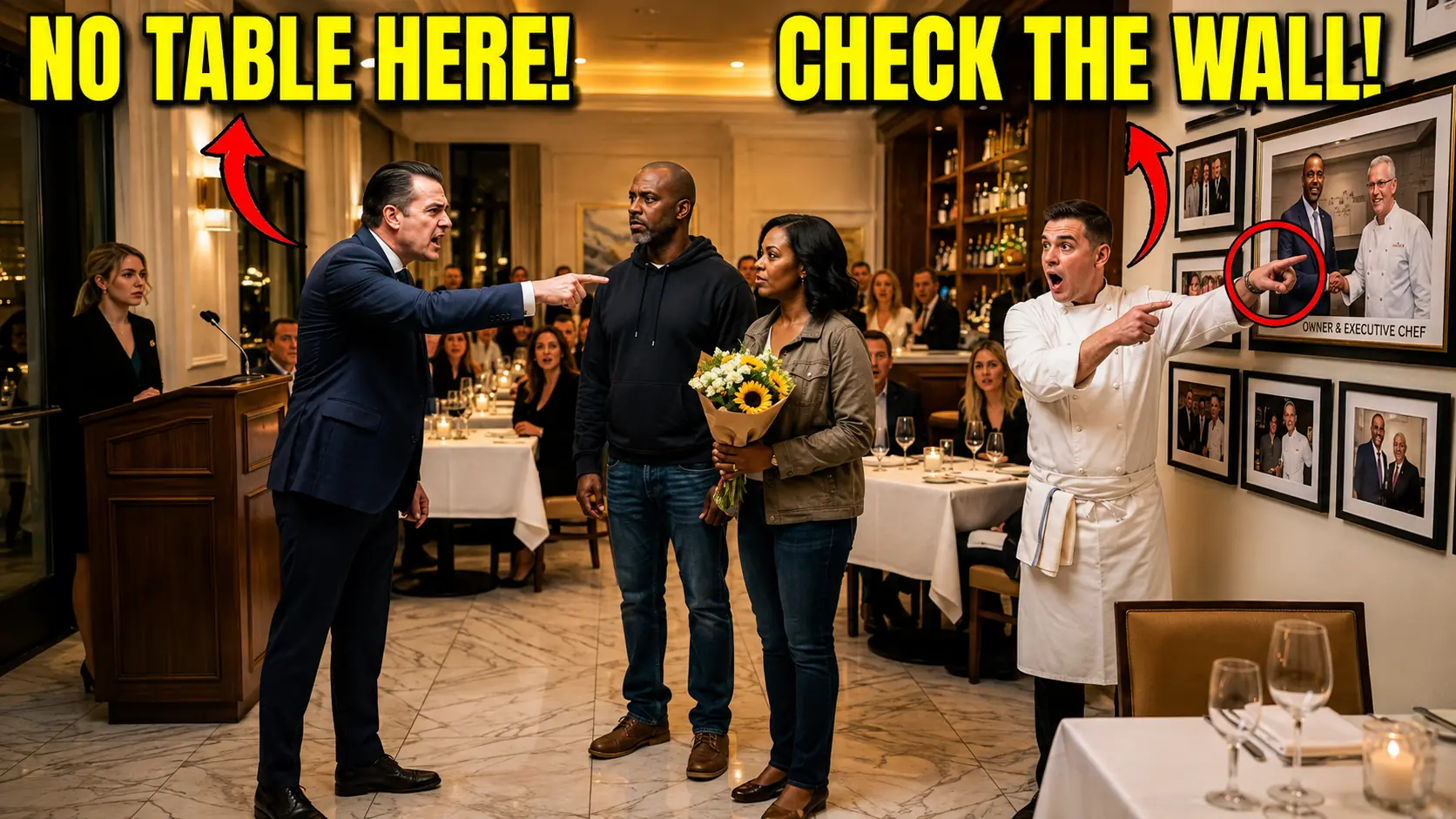
The manager of the Sterling Room restaurant yelled as a black couple in hoodies walked through the door. This is a five-star restaurant. We don't tolerate homeless people. The woman stiffened. The man beside her gently placed his hand on her back. "We only want one table, sir," he said softly, politely, almost a whisper.
The manager stepped closer, close enough for them to hear. "People like you aren't publicly allowed to eat here. You'll upset my guests and everything will go bad." The manager pointed outside. "Now get out before I call the police."
The man said nothing. He just glanced at the wall behind the manager's shoulder. The manager had no idea that the worst night of his life had just begun. Let me take you back to that morning before the insults, before the police, before any of it. Saturday, 7:14 a.m. Richmond, Virginia.
Curtis Crawford stood in his kitchen, barefoot, flipping pancakes on a cast iron skillet that was older than his marriage. The kitchen smelled like butter and maple syrup. The radio on the counter played low. Old Motown, the kind that makes you sway without thinking. Nothing about this house screamed money. The fridge was covered in magnets from family vacations. A kid's drawing taped to the cabinet read, "Best uncle ever." The floorboards creaked when you walked too fast.
But here's what you didn't know yet. Curtis Crawford was the CEO of Crestline Hospitality Group, nine high-end restaurants across the East Coast. Net worth deep into nine figures. The kind of man whose signature could buy an entire city block before lunch. You'd never guess it looking at him. He wore a faded college t-shirt and basketball shorts. His reading glasses sat crooked on his nose. He hummed along to the radio while he cooked. That was Curtis. Quiet money. No flash. No show.
Denise came downstairs in hospital scrubs, still smelling like hand sanitizer from an early morning surgery shift. She was a pediatric surgeon, the kind who opened children's chests and fixed their hearts. She literally kissed him on the cheek, stole a pancake off the plate. "So, what's the plan tonight, Mr. Crawford?"
Curtis smiled. "20 years, baby. I'm taking you somewhere special." "Somewhere special in these scrubs. We'll change after volunteering or we won't. Doesn't matter." He meant it. Curtis never cared about appearances. He cared about people.
That afternoon, they spent four hours at a youth center downtown. Curtis funded a culinary mentorship program there, teaching teenagers from rough neighborhoods how to cook, how to run a kitchen, how to build something from nothing, the same way he did. By 6:45 p.m., they were tired, sweaty, and happy. Hoodies and sneakers, no jewelry, no designer labels, just two people who'd spent their Saturday giving back.
On the drive to dinner, Curtis pulled over at a sidewalk flower stand. He bought a small bouquet. Nothing fancy. Daisies and sunflowers wrapped in brown paper. Denise laughed. "You own nine restaurants and you're buying me gas station flowers." "These aren't gas station flowers. These are sidewalk flowers. Big difference." She shook her head, smiling. "You're ridiculous. 20 years of ridiculous. You're welcome."
What Denise didn't see was the small velvet box Curtis slipped into his hoodie pocket when she wasn't looking. Inside was a bracelet, white gold, engraved "20 years, still my favorite seat at the table." He'd been planning this moment for weeks.
Now, let's talk about where they were headed. The Sterling Room, one of Richmond's most prestigious restaurants. A new American fine dining destination in the heart of the arts district. Tasting menus starting at $200 a plate. Crystal glassware, linen napkins. The kind of place where people proposed, celebrated promotions, and closed business deals. Near the entrance, there was a wall of framed photographs. Founders, investors, key figures who built the restaurant from the ground up. Curtis's face was in one of those frames, a group photo from opening night four years ago. Him shaking hands with chef Raymond Ellis, smiling.
But the photo was small, easy to miss if you weren't looking. And nobody was looking. Three months ago, the Sterling Room hired a new general manager. Bradley Thornton, white, 38, came from a failed steakhouse chain in Charlotte. Sharp suit, firm handshake, big talk about brand standards and clientele management. The staff noticed something within the first week. Bradley liked to stand near the entrance. He watched who came in. He watched what they wore. He watched the color of their skin. If you were white and wearing khakis, you got a smile and a table by the window. If you were black or brown or anything that didn't fit Bradley's picture of the right kind of guest, you got excuses. Fully booked, private event, dress code violation.
In three months, at least six parties of color had been turned away. Nobody reported it. Nobody said a word until tonight. Because tonight, Bradley Thornton was about to make the biggest mistake of his career. He just didn't know it yet.
7:15 p.m. The Sterling Room was alive. Warm golden light spilled across white tablecloths. The clink of wine glasses mixed with soft jazz from hidden speakers. The smell of seared duck and truffle butter drifted from the kitchen in rich, heavy waves. Every table was dressed with fresh flowers and candles flickering behind crystal glass. Waiters in black vests glided between tables carrying silver trays without making a sound. It was the kind of place that made you whisper without knowing why.
Curtis held the door open for Denise. She stepped inside with the bouquet of sidewalk flowers in one hand and his arm in the other. Cool air hit them like a wall, clean, sharp, scented with something expensive. The marble floor gleamed under their sneakers. At the hostess stand, Gabrielle Foster looked up and smiled. 22 years old, college student, working weekends to cover tuition. She reached for two leather-bound menus. "Good evening. Welcome to the Sterling."
A hand came down on the menus before she could finish. Bradley Thornton. [clears throat] He appeared from the side like he'd been watching the door all night, waiting for exactly this moment. His eyes locked onto Curtis and Denise. He scanned them the way a bouncer scans a fake ID, top to bottom. Hoodie, faded jeans, beat-up sneakers, brown paper bouquet with a drooping daisy. His lip curled upward slowly. "What the hell is this?"
Curtis blinked once. "Excuse me." Bradley didn't lower his voice. Didn't even try. "I said, 'What the hell is this? You two smell like a deep fryer. This is a five-star restaurant, not a damn soup kitchen.'" The couple at the nearest table stopped eating. A woman in pearls slowly set her fork down. Her husband cleared his throat and looked away, pretending to study the wine list. The jazz kept playing, but the room already felt different. People were listening now.
Curtis took a breath. Slow, measured. The kind of breath a man takes when he's choosing peace over war. "We don't have a reservation, but we were hoping a table might open up." "No reservation?" Bradley let out a full open-mouthed laugh. Head tilted back, shoulders shaking like Curtis had just delivered the funniest joke of the century. "We've been fully booked since Tuesday. Every table, every seat, nothing available tonight."
Denise looked past Bradley's shoulder. Right at that moment, a couple walked in behind them, white. The man wore a wrinkled polo and loafers without socks. The woman wore a sundress with flat sandals. "No reservation," Denise heard them say so clearly. Bradley turned around. His entire body transformed. Shoulders dropped, smile bloomed, voice turned to warm honey. "Welcome to the Sterling Room. Perfect timing. We just had a cancellation. Right this way, folks." He grabbed two menus and walked them personally to a window table overlooking the courtyard, pulled out the chair for the woman with both hands, placed the wine list before the man like a sacred offering. He even leaned in and whispered something that made them both laugh. Then he strolled back toward Curtis and Denise. Same hallway, same floor, different world entirely.
Denise's voice stayed level, but her eyes were on fire. "You just told us every single table was booked. They're members of our loyalty program." "You don't have a loyalty program. There's nothing about one on your website, your door, or anywhere in this building." Bradley's jaw tightened. A vein on his neck pulsed. He was not accustomed to being corrected. Especially not by a black woman in a hair wrap. "Ma'am, I don't have time to stand here arguing with you. We have standards. If you can't meet them, I suggest somewhere with plastic chairs and paper napkins. More your speed."
Curtis stepped forward. Not aggressive, just present. "We'd like to speak with Chef Raymond Ellis, please." Bradley snorted. "Chef Ellis doesn't take meetings with random walk-ins off the street. He's an award-winning chef running a serious kitchen, not a drive-thru window you knock on whenever you feel like it." "I understand. But if you could just let him know, let him know what? That two people in gym clothes showed up wanting a $200 meal. Trust me, he'd laugh even harder than I did." Bradley raised his walkie-talkie, pressed the button slowly, deliberately, keeping his eyes fixed on Curtis the entire time. When he spoke, he spoke loud. Loud enough for 30 guests to hear every word. "Hey, let security know we've got two walk-ins who can't take no for an answer. Might need an escort out the front door."
Curtis felt Denise's nails dig through his hoodie sleeve into skin. Her pulse hammered against his forearm, fast and furious and barely contained. An older white man two tables away froze, napkin halfway to his mouth. His wife put a hand on his arm and shook her head slightly. A young woman near the bar dropped her gaze to her phone, pretending she heard nothing. But she heard. Everyone heard. Bradley clipped the walkie-talkie back onto his belt, satisfied. Then his gaze dropped to the flowers in Denise's hand. His smirk widened into something theatrical. "And what is that? You actually brought bodega flowers into my dining room?" He said, "My dining room?" Like his name was carved into the foundation. "That's adorable. Like bringing a ham sandwich to a Michelin tasting. Really elevates the atmosphere."
Oliver Dunn stood behind the bar polishing a glass with a white cloth. He heard every word. His hands stopped mid-motion. He didn't laugh, but he didn't speak either. Nobody did. Curtis looked down at the bouquet. Brown paper crumpled from being held too tight. Two petals had fallen from a daisy and landed silently on the polished marble floor. He didn't defend the flowers. Didn't explain that he bought them from an old woman on a street corner who reminded him of his mother. Didn't say that daisies were the first flowers he ever gave Denise, 20 years ago when his bank account held exactly $11. He said nothing. And that silence hit harder than any comeback ever could.
Denise gently took the bouquet from his hands. She pressed it against her chest and held it tight, protective, like shielding something precious from someone who would never understand its value. She looked Bradley dead in the eye and did not blink. "These flowers are worth more than anything in this building, including you." Bradley's smirk cracked for one second. Something dark shifted behind his eyes. Then the mask came back harder. "Ma'am, I'm asking you one final time. Leave this restaurant before this gets truly embarrassing for both of you."
Behind the stand, Gabrielle couldn't take it anymore. "Sir, table 14 just opened up. I can seat them right now." Bradley whipped around, his voice dropped to a whisper, the kind that slices deeper than any shout. "One more word, Gabrielle. One and you are finished tonight. I will walk you out that door personally and make sure no restaurant in this city ever puts your name on a schedule again. Are we clear?" Gabrielle's mouth shut, her hands trembled against the wooden podium. Her eyes turned red and glassy, but she refused to let a single tear fall. She swallowed hard and stared down at the floor. Curtis saw all of it. A 22-year-old girl being crushed because she tried to do something decent. Her shoulders folding inward like paper. Her knuckles turning bone white, gripping the stand to keep herself from falling apart.
Something deep inside Curtis shifted. Not anger, something heavier. Something that settled into his bones like a decision that was never really a choice. He was not leaving. Not for pride. Not for ego, not to prove who he was or what he owned. He was staying for Gabrielle. Because if he walked away tonight, Bradley wins. And tomorrow morning, Gabrielle would stand behind that same podium under that same man, swallowing that same fear with nobody beside her. Curtis turned to Bradley. His voice was the calmest sound in the building. "We'll wait at the bar." Bradley stared at him. "The bar? The bar? If something opens up, we'll be right there." Bradley rolled his eyes, certain they'd leave within 20 minutes. A couple of overpriced drinks, the slow burn of humiliation, and they'd disappear quietly through the front door like they were never here. "Fine, suit yourself." He straightened his blazer, the navy one he was still making minimum payments on, and walked away without looking back.
Curtis placed his hand on Denise's lower back and guided her toward the bar. As they passed the entrance wall, his eyes drifted upward to the framed photographs. The group shot from opening night, him shaking Raymond's hand, both men smiling wide, a ribbon cutting ceremony behind them. Four years ago, Curtis signed the check that made every wall in this building possible. Tonight, he couldn't get a single table in it. Curtis and Denise sat at the far end of the bar. Two stools, no menus, no greeting, just two glasses of tap water that Oliver Dunn placed in front of them without making eye contact. No wine list, no cocktail suggestions, just water in a restaurant where the cheapest glass of wine cost $35. Curtis didn't push it. Not yet. He let the water sit untouched. Denise set the bouquet on the bar beside her, petals brushing against the polished wood. 2 minutes passed, then five. Oliver stood 3 feet away, wiping the same glass over and over, pretending they didn't exist. Behind him, the bar shelves glowed amber and gold. Rows of expensive bourbon and wine lit from below like a museum display. A white couple at the other end laughed about something. The bartender poured them refills without being asked. Service worked just fine when you looked a certain way.
Curtis spoke calmly. "We'd like to see a wine list, please." Oliver glanced toward Bradley, who stood near the hostess stand with his arms crossed, watching them like a security camera. Bradley gave a small shake of his head, almost invisible, but Curtis caught it. Oliver turned back. "I'm sorry, sir. I think we're actually between pours right now." Between pours in a restaurant with a 16-page wine seller on a Saturday night. Denise exhaled through her nose. The kind of exhale that replaces the sentence she actually wanted to say. Curtis didn't wait for permission. He'd memorized this wine list years ago. He helped build it. Opus 1, 2018. The bottle.
Oliver's hands stopped on the glass. "That bottle cost $450." He looked at Bradley again. Bradley walked over slow, hands in his pockets, that smirk stitched permanently onto his face. "The Opus One? That's a $450 bottle, friend. You sure you didn't mean the house red? More budget friendly, easier on the wallet." "Opus 1, 2018," Curtis repeated. Same tone, same volume. Like ordering coffee on a Tuesday morning. Bradley stared at him for three full seconds. Then he extended his hand, palm up. "Card." "Excuse me. I need to pre-authorize your credit card before we open a bottle at that price point. Restaurant policy."
Denise turned on her stool. "Do you pre-authorize every guest who orders expensive wine or just the ones who don't fit your little fantasy of what rich people look like?" Bradley didn't answer. He just kept his hand out. Curtis pulled out his card. Black titanium. No name, just a number. He placed it on Bradley's palm without a word. Bradley took it to the terminal, cleared in two seconds. He handed the card back and nodded to Oliver to open the bottle. The wine came. Oliver poured two glasses with slightly trembling hands. He still couldn't look them in the eye. Curtis swirled the glass, took a sip, set it down. The wine was perfect, rich, dark, and smooth. Everything this evening should have been. But the moment was completely ruined. You could taste it in the air, the humiliation mixing with the oak and blackberry like poison.
15 minutes later, Bradley returned with a new expression. Official. Rehearsed, like he'd practiced in the bathroom mirror. "Ma'am, I'm going to need you to open your handbag." Denise froze midsip. "What did you just say to me?" "We've had items go missing recently. Silverware, small decor. Standard procedure. We're checking all guests at the bar tonight." It was not standard procedure. No one else had been asked. A white woman, three stools down, had her designer bag wide open on the counter, lipstick, wallet, phone spilling out, and Bradley hadn't glanced at it once. "I'm a pediatric surgeon," Denise said. Her voice was quiet, but cut through the noise like a surgical blade. "I operate on children's hearts, and you're standing here asking me to prove I didn't steal a fork?" "I'm asking politely, ma'am. Let's not make a scene."
Curtis stood up. The stool scraped against the floor. The sound cracked through the room like a gunshot. "6'2"." For the first time all night, his full height filled the space. He looked down at Bradley with eyes that carried 20 years of building something from absolutely nothing. "You will not touch her bag. You will not speak to her like that again. And if you say one more word to my wife, I promise you, you will remember this night for the rest of your life." Bradley stepped back. Not from fear, because he wanted witnesses. He wanted Curtis to swing first, to yell, to give him a reason to turn this into something it wasn't. Curtis saw it, read it like a page from a book he'd been handed too many times. He sat back down slowly.
Bradley smiled. He thought he'd won that round. Then came the relocation. Bradley leaned over to Oliver, loud enough for Curtis to hear every syllable. "Move them down to the very end by the kitchen door. I don't want paying guests having to look at them while they eat." Oliver hesitated. "Sir, they are paying guests. They bought a $450 bottle." "Did I stutter? Oliver, move them now." Curtis and Denise were relocated to the last two stools, pressed against the swinging kitchen door. Every time it opened, a blast of heat, steam, and clanging metal hit them in the face. The smell of dish soap and old grease replaced the truffle butter. A bus boy nearly clipped Denise's elbow, rushing past with a gray tub of dirty plates dripping. This was not a seat. This was a punishment. This was Bradley telling them exactly where he believed they belonged, out of sight, next to the trash, invisible.
Curtis looked at Denise. Her bouquet sat on the bar between them, wilting from the kitchen heat. A petal fell into her wine glass. She fished it out with her finger and placed it gently on a napkin like it still mattered. Because it did. "Happy anniversary, baby," Curtis said quietly. Denise looked at him, eyes glistening. "Best one yet." She meant it. Because he was still there. Because even here, next to the garbage cans and the kitchen smoke and the dirty dishes, he was still hers and she was still his. But Bradley wasn't finished. He moved through the dining room, table by table, leaning in close, whispering the same poisonous message at every stop. "Just a heads up. The couple at the bar. We're not sure how they got in. I've contacted security. Keep your belongings close tonight." Most guests nodded without question. A few pulled bags into their laps. One man shifted his chair to angle his back toward the bar entirely like their presence might somehow contaminate his evening.
But not everyone bought it. Harold Anderson, white, 72, retired Marine, 10-year regular, set his napkin down and looked Bradley square in the face. "Son, I've been eating here since before you learned to tie a Windsor knot. I've never once seen you ask a guest to open their purse. Not once. What exactly is going on tonight?" Bradley's smile thinned. "Just being cautious, Mr. Anderson." "No, I don't buy that for a second." Bradley walked away without another word. Harold turned to his wife, Betty, and shook his head. "Something's not right about that young man. Not right at all."
Then Bradley made his final move. He stepped into the back hallway, pulled out his personal phone, dialed 911. "Yes, I'd like to report two suspicious individuals at my restaurant. They've refused to leave despite multiple requests. They may be intoxicated. One of them stood up and threatened me physically. I feel unsafe in my own establishment." Every single word was a lie. Two officers arrived 11 minutes later. Bradley met them at the front entrance, shaking hands like old friends. He walked them toward the bar, narrating his fabricated version the whole way. "They barged in, harassed my staff, caused a scene, refused to leave." The officers approached Curtis. "Sir, we received a call about a disturbance. Can we see some identification?"
Curtis reached slowly into his back pocket, handed over his license. Denise placed her hospital ID badge on the bar beside it. One officer studied the license, studied the bottle of wine, two-thirds empty, studied two people sitting quietly on bar stools with a bouquet of wilting flowers between them. Nothing about this picture matched the story Bradley told on the phone. He turned to Bradley. "Sir, these are paying customers sitting at your bar drinking wine. What exactly is the disturbance here?" Bradley opened his mouth. Nothing came out. The officers left. No arrest, no citation, no report. They walked out the front door, climbed into their cruiser, and drove away. But the damage was already done. Burned into the evening like a brand that would never fully fade. 50 people in that dining room had watched two uniformed police officers walk up to a black couple in a fine dining restaurant. 50 people watched it happen in complete silence and not a single one of them said a word. Curtis lowered his head just for one second. One single second where the weight of every insult, every smirk, every whispered warning, every moment of this entire evening pressed down on his shoulders like wet concrete. Then he raised it back up.
What happened next changed everything. The kitchen doors swung open. Chef Raymond Ellis stepped into the dining room the way he did every Saturday night. White coat, silver hair, towel over one shoulder. It was his nightly ritual. Walk the floor, shake a few hands, thank the regulars. He made it three steps before he saw them. Two people at the far end of the bar, the dead end next to the kitchen door. A wilting bouquet between them, a half-empty bottle of Opus One. The woman holding a fallen petal in her fingers like a quiet prayer. Raymond stopped midstride, the color drained from his face, his smile vanished like someone slapped it off because the man on that stool, the man in the hoodie, the man who had been mocked and searched and relocated like broken furniture was Curtis Crawford. His business partner, his co-owner, the man who signed the check that built this place, his friend.
Raymond crossed the room in five strides, arms open wide. "Curtis, Denise, happy 20th anniversary." He hugged Curtis so hard the bar stool scraped across the floor, kissed Denise on both cheeks and squeezed her hands. Then he stepped back, looked around the kitchen door, the garbage cans, the dirty plates, and his face twisted into something nobody had ever seen from the gentle old chef. Pure fury. "What in God's name are you doing back here? Why are you sitting next to the dishwasher?" The entire dining room went dead still. Every fork froze midair. Every wine glass hovered inches from lips. Conversations died. The jazz played on, but nobody was listening. Bradley stood frozen near the hostess stand. The smirk was gone, replaced by something pale and hollow.
Raymond turned to him, warm to ice in one breath. "Bradley, why is Curtis Crawford sitting at the end of my bar next to the kitchen door?" "Chef, they're walk-ins. They didn't have a reservation." Raymond took one step forward. Every word in Bradley's throat died. "Walk-ins." His voice filled the room without effort. "Bradley, this man is Curtis Crawford. He is the co-owner of this restaurant. His money built the kitchen you just banished him next to. His investment paid for every chair, every table, every glass, every plate that went out tonight. His name is on the lease you have never bothered to read. This is his restaurant." Raymond pointed at the wall of photographs near the entrance. "That's him right there shaking my hand. Opening night. His face has been on that wall for 4 years. And you couldn't be bothered to look." The room erupted in murmurs. Whispers rolling from table to table. Heads turned toward the photograph, toward Curtis, toward Bradley.
Harold Anderson stood, nodding with quiet vindication. Gabrielle pressed both hands over her mouth. Tears streamed down her face. Not sadness, but relief. The kind that comes when you realize the world might be fair after all. Bradley collapsed. Not physically, but everything else. Confidence, vest, authority, all dissolved. "I—I didn't know. I had no idea." Curtis stood up slowly. The room held its breath. He didn't yell, didn't raise a finger. His voice was low, steady, and carried to every corner. "That's the whole point, Bradley. You didn't need to know who I was. You didn't need to know I owned this place. You didn't need to know my wife saves children's lives. A couple walks in and wants to eat. You seat them. That's the whole job. And you couldn't do it because all you saw was the color of our skin." Silence. Complete. The kind that presses against your eardrums and makes your heartbeat loud. Then one pair of hands clapped. Then two. Then 10. Harold Anderson clapped hard and steady. The couple by the window joined. Oliver Dunn behind the bar. Tears on his face, brought his trembling hands together. The entire restaurant rose to its feet. The applause filled the room. Warm, rolling, unstoppable.
Curtis reached into his hoodie pocket, pulled out the velvet box he'd carried all day, opened it with steady hands. Inside, resting on black velvet, sat a bracelet, white gold catching candlelight. Engraved "20 years. Still my favorite seat at the table." He took Denise's wrist gently right there next to the kitchen door, next to the garbage, next to the place where they'd been thrown away. He clasped the bracelet and held her hand. "Doesn't matter where they seat us, baby, as long as I'm next to you." Denise held the wilting bouquet in one hand and her husband's fingers in the other. Tears fell. She smiled. The kind of smile that doesn't need an audience. Curtis turned to Raymond, voice low. "Pull the security footage, Ray." Every minute from the moment we walked in. He looked at Bradley one last time. Every single minute, Curtis took Denise's hand. They walked through the dining room together, past the tables, past the bar, past the wall of photographs. The front door opened and the cool night air rushed in. They stepped outside. The door closed softly behind them.
Bradley Thornton stood alone in the center of the dining room. 50 pairs of eyes burning through him. No smirk, no walkie-talkie, no authority, just a man in a suit he couldn't afford, standing in a restaurant he never owned, realizing the worst night of his life had only just begun. The dining room emptied slowly that night, guests paid their bills in near silence. Some left tips larger than usual. Guilt money, maybe. A few stopped Gabrielle on the way out and whispered apologies. One woman squeezed her hand tightly without saying a single word. By 10:30 p.m., the Sterling Room was closed. Kitchen crew gone, candles out, jazz stopped. The only light still burning came from the back office where the door was shut tight. Raymond sat behind his desk, hands flat on the surface. Bradley Thornton stood on the other side, tie loosened, sweat along his hairline, shifting his weight like a child outside the principal's office. Raymond let him stand for a full minute before he spoke. "Talk."
Bradley swallowed. "Chef, I was protecting the brand. I made a judgment call based on how they presented themselves. Managing the guest experience is part of my job." Raymond leaned forward. "You told a man he smelled like a deep fryer. You called the police on him. You asked his wife, a surgeon, to open her purse. You moved them next to the garbage. That's managing the guest experience. I didn't know who they were. That's the third time you've said that. And it gets worse every time." Raymond's voice cut like a blade. "You didn't need to know who they were. That's not how hospitality works. That's not how being a decent human being works." Bradley's voice cracked. "Please, I need this job. I have bills. I just moved here." "You should have thought about that before you told a black couple to go to a soup kitchen in front of 50 people." Raymond stood up. He buttoned his chef coat like a man preparing for something final. "Held out his hand." "Keys." Bradley stared. "Keys. Access card. Name badge." "Now." Bradley reached into his pockets with trembling hands. He placed the keys on the desk. Then the access card. The name badge. General manager in gold. As he pulled the badge from his vest, something else fell out. It clattered against the desk and spun to a stop under the lamp. A store-branded credit card, $2,000 limit, balance sticker on the back, $1,850. Still paying off the suit on his body, the blazer, the pants, the shoes, every stitch bought on money he didn't have. The man who spent all night humiliating Curtis Crawford for not looking rich enough was dressed head to toe in debt.
Raymond looked at the card on his desk, said nothing. The irony spoke for itself. Suspended without pay, effective immediately. The ownership board, which includes Curtis, will make the final decision. Until then, do not set foot in this building. Bradley opened his mouth. Raymond pointed at the door. Bradley walked down the empty hallway alone. His footsteps echoed against the tile. The building that made him feel powerful three hours ago now felt like a cage. Then the staff began to talk. Gabrielle Foster wrote her statement that night on the breakroom floor. Pen, legal pad, three pages, every detail. The soup kitchen remark, the fake reservation, the loyalty program lie, the flower insult, the purse demand, the threat to fire her, the security call, the whispered warnings, the 911 call. Signed and dated. Oliver Dunn typed his at midnight. He admitted everything, serving only water, pre-authorizing the card, moving them to the kitchen door without protest. "I knew it was wrong, I did it anyway because I was afraid." That's not an excuse. That's just the truth. Three more servers came forward within 24 hours. In three months under Bradley, at least six parties of color had been turned away. Fully booked, private event, dress code. One server produced a screenshot from the staff group chat. Bradley's message, "Keep the riff raff out. You know what I mean?" Curtis called his attorney Monday morning. Not to sue. Not yet. He wanted footage preserved, statements compiled, a formal investigation opened. He filed a discrimination complaint with the Virginia Human Rights Council. His attorney made one more call to the steakhouse chain in Charlotte where Bradley previously worked. The discovery was damning. Bradley hadn't resigned. He'd been fired after a complaint from a Latino family he refused to serve. His resume listed the departure as voluntary. His employment history was built on lies. And every single one was about to surface. The ground beneath Bradley Thornton wasn't cracking. It was already gone.
The footage hit the internet on a Tuesday morning. Gabrielle posted a 90-second clip from the Sterling Room security cameras with Curtis's full permission. No narration, no filters, just raw footage. Bradley at the walkie-talkie. Curtis holding flowers. Denise asked to open her purse. Police walking in. Two people sitting quietly at the end of a bar next to a kitchen door in a building their money built. 5 million views in 48 hours. #SeatThemNow trended nationally. Then came #FlowersForDenise. People across the country sent bouquets to the restaurant. Roses, daisies, sunflowers, some wrapped in brown paper just like the ones Curtis bought from the sidewalk. By Thursday, the hostess stand was buried under flowers and handwritten cards from strangers who had never met Denise, but wanted her to know she was seen. Patricia Moore, a Richmond news anchor, ran a 12-minute evening segment. Security footage uncut. Interviews with witnesses. Bradley's full employment history on screen. The Charlotte Steakhouse. The Latino family's complaint. The termination disguised as a resignation. Harold Anderson appeared on camera. 72. Retired Marine. Voice steady. "I fought for this country so every American could walk through any door they choose. What I saw that night was un-American." The segment went national. Within a week, the Latino family from Charlotte, the Garcias, saw the news coverage and contacted Curtis's attorney. They had their own story and their own scars. Bradley had pulled the exact same routine on them, fully booked, dress code, private event. Three years apart, two states, the same man running the same ugly game. Bradley was no longer facing one incident. He was facing a documented pattern.
Then he made the worst decision of his life. He went on a local podcast. The host lobbed easy questions. Bradley in a borrowed blazer said the words that sealed his fate. "I'm a victim of cancel culture. Curtis Crawford is a billionaire using his money to destroy a working-class man over a misunderstanding. I didn't do anything wrong." The clip went viral. 3 million more views. People posted security footage beside his quotes. His mouth said "misunderstanding." The camera said something else entirely. His attorney quit the next morning. One sentence. "I can no longer effectively represent Mr. Thornton." 6 weeks later, the case went to trial. Bradley was charged under the Virginia Human Rights Act, violation of public accommodation anti-discrimination statutes. Additional charge, fraudulent misrepresentation on his employment application.
The courtroom was standing room only. Gabrielle Foster took the stand first. White blouse, no notes. Her voice never wavered. She walked the jury through every single moment of that night in precise, devastating detail. The soup kitchen remark, the walkie-talkie call for security, the fake reservation excuse, the demand to open Denise's purse, the forced relocation to the kitchen door, and the direct threat to destroy her career if she said one more word. When asked how she felt when Bradley said she would never work in this city again, she paused like "I didn't matter, like doing the right thing was going to cost me everything." Harold Anderson testified next, Marine Corps pin on his lapel. He described the whispered warnings, the chair shifting, the cruelty delivered with a smile. He looked at the jury. "I've seen a lot of ugly things in 72 years. That night was one of the worst." Curtis Crawford was the final witness called to the stand. He wore a dark navy suit, the first time anyone in that courtroom had ever seen him dressed in anything other than casual clothes. He spoke with the kind of quiet authority that made the entire room lean forward. "I built that restaurant so everyone could sit at a beautiful table and feel like they belong. Tuxedo or hoodie, you deserve to be treated as a human being. I just wish Bradley had understood that before I had to show him a photograph on a wall."
The jury deliberated less than three hours. Guilty on every single count. Gabrielle covered her mouth in the third row. Harold Anderson closed his eyes and nodded once. Denise squeezed Curtis's hand so hard her knuckles went white. Judge Helen Sullivan delivered the sentence with cameras rolling. $50,000 in fines. Bradley, still making payments on a credit card for his work clothes, would carry this debt for years, dollar by dollar, month by month, just like his blazer. 500 hours of mandatory community service at a soup kitchen in downtown Richmond. The exact kind of place he had sneered at Curtis about on the night of his 20th wedding anniversary. The insult became his sentence. He would now serve meals there himself, five days a week until every last hour was complete, a 5-year ban from any management position at any public serving establishment in Virginia. A formal public apology read aloud in open court, broadcast on live television. Bradley stood at the podium, hands shaking, voice barely past the first row. The apology was stiff, written by a discount attorney hired after the first one quit. He read every word with his eyes down. Never looked up once. In the second row sat his mother, Margaret Thornton, 61, gray hair pinned back, hands folded tight over a small purse. She didn't cry. Didn't speak, just sat still, staring at the floor, carrying the kind of shame that makes no sound but fills every corner of the room. Curtis sat across the aisle. Denise held his hand. Neither smiled. This wasn't a celebration. It was a necessary ending.
After the verdict, things moved quickly. The Sterling Room implemented mandatory anti-discrimination training for all staff funded by Crestline Hospitality Group. A new code of conduct was posted in every employee area. Curtis promoted Gabrielle Foster to front of house manager, Bradley's old position. The girl he threatened to destroy now sat in his chair, greeting every guest who walked through the door with the warmth Bradley never had. Raymond Ellis released a statement the next morning. No excuses. No guest should ever have to prove their worth to eat at our table. We failed that night. One man's prejudice was allowed to represent this restaurant. That changes now. Every person who walks through our door will be treated with dignity. We will not fail again. A national magazine ran a four-page profile on Curtis Crawford. The quiet billionaire who never put his name on a building. The man who built an empire from a single food truck, who never put his face on a billboard, and who still bought his wife flowers from a sidewalk stand because that's who he was before the money and who he stayed after. The headline, "The Owner Nobody Recognized." And the lesson a city will never forget.
One month later, Saturday evening, 7:15 p.m., the Sterling Room. Curtis and Denise walked through the front door. Same hoodies, same sneakers, same kind of Saturday, volunteering at the youth center all afternoon, tired and happy, smelling like industrial kitchen soap and teenagers burnt pancakes. Curtis carried a bouquet. Sidewalk flowers, daisies and sunflowers wrapped in brown paper. He'd bought them from the same woman on the same corner. She remembered him this time and threw in an extra stem for free.
The hostess stand had changed. Gone were the stacked bouquets from strangers. Gone was the old leather reservation book Bradley used to guard like a weapon. In its place stood Gabrielle Foster, wearing a black blazer, a Sterling Room name badge pinned to her chest. The badge read Front of House Manager. She saw Curtis and Denise before they even crossed the threshold. Her smile was the first thing they felt when they walked in. "Mr. and Mrs. Crawford, your table is ready." Curtis grinned wide. "The private dining room would be really nice tonight." Already set up, Chef Raymond insisted. She walked them through the restaurant. The dining room hummed with warmth. All kinds of people, all kinds of clothes, all welcome. A man in a baseball cap ate next to a woman in a cocktail dress. A family with three small children sat two tables from a couple on a quiet date. No one was being watched. No one was being judged. The room just breathed easy and open.
As they passed the entrance wall, Curtis slowed down. The photographs had changed. The old group shot from opening night was gone. In its place hung two new frames side by side, centered on the wall where every guest could see them. The first was a photograph of Curtis and Raymond on opening night. Just the two of them shaking hands, grinning wide. A ribbon cutting ceremony behind them. A proper portrait this time. No more hiding in the background of a group shot. The second frame stopped Curtis in his tracks. It was a photograph from that night. The security camera still frame. Curtis and Denise sitting at the end of the bar next to the kitchen door. Denise clutching the wilting bouquet against her chest. Curtis's hand resting on hers. Two people holding on to each other in the worst seat in the house. Beneath the photograph, engraved in a small brass plate, were five words. "Every seat is the best seat."
Curtis stared at it. His eyes went glassy. He pressed his lips together and breathed through his nose, the way men do when they're trying very hard not to cry in public. Raymond appeared from the kitchen, towel over his shoulder, same as always. He walked up behind Curtis and put a hand on his back. "Had it framed last week. Figured we should never forget." Curtis nodded. Couldn't speak yet. Just nodded. They sat down. Raymond brought out the first course himself. The three of them laughed about something small. The kind of laughter that only happens between people who've walked through fire together and come out the other side. Denise set the new bouquet of sidewalk flowers in the center of the table, right next to the candle, right where they belonged.
Now, one more scene. A soup kitchen in downtown Richmond. Fluorescent lights buzzing overhead. Metal trays, plastic forks, the smell of canned soup and instant mashed potatoes. Bradley Thornton stood behind the serving counter in a volunteer apron. No blazer, no vest, no walkie-talkie. Just a ladle in one hand and a pair of thin disposable gloves on the other. He didn't smile. He didn't frown. He just served. Scoop after scoop, plate after plate, day after day. 500 hours worth of scoops measured out in shame and silence. An elderly black woman shuffled up to the counter with her tray. She looked up at Bradley with soft, tired eyes and a warm smile. "Thank you, honey." Bradley stopped. The ladle hovered over the pot. Something in his chest shifted. Not guilt, not anger, but something he hadn't felt in a very long time. Maybe ever. He looked at her. Really looked at her. Not at her clothes, not at her skin, at her. "You're welcome, ma'am." It was the first time in his life he had truly served someone without judging them first. It wouldn't fix everything, but it was a start. And sometimes a start is all you need.
Can I be real with you for a second? The most expensive thing in any room is never on the menu. It's not the wine. It's not the table. It's how you make people feel when they walk through the door. That is what separates a place worth going back to from a place that deserves to be empathy. And here the white people get wrong about respect. They think it is something you earn with money, with status, with the right outfit. But respect isn't a reward. It's a starting point. Every person who walks through your door, hoodie or tuxedo, deserves to be welcome. If your kindness depends on what someone looks like, it was never kindness. It was just busyness.
But what really hit me, the people who try hardly to look powerful are usually the ones with the least to stand on. Real power doesn't need to humiliate anyone. Real power doesn't need an audience. Real power sits quietly in a hoodie and sidewalk flowers and 20 years of loving the same person. That's the kind of wealth no credit card can buy. So tell me, have you ever been made to feel like you didn't belong somewhere you had every right to be? Drop it in the comments. If this one hit you, share it, like it, subscribe so you are here for the next one. Because every seat is the best seat as long as the person next to you is the right one.
News in the same category
Restaurant Manager Humiliated a Black Couple Over Their Clothes — Until He Realized Who They Were
A Restaurant Manager Looked Down on a Casually Dressed Black Couple — Then Their Photo on the Wall Changed Everything
Restaurant Manager Mocked a Black Couple for Their Casual Clothes — Until He Noticed Their Photo on the Wall
The Fighter Shoved the Quiet Dad to the Ground — Then Mocked Him in Front of His Daughter
The Billionaire Laughed at the Old Man’s Plea — Then Told Him, “There’s Nothing You Can Do.”
Eight Armed Men Rode Onto Her Ranch — And Told the Widow to Hand Over the Only Evidence She Had
She Thought the Police Would Take Her Side After Smashing His Window — She Was Dead Wrong

HOA Karen Kept Driving Through My Fence — Then Her Shortcut Backfired
She Humiliated the Quiet Old Mechanic in Front of Everyone — Then She Saw His Tattoo
A Neighbor Broke the Gas Station Window — Then Called 911 and Blamed the Black Owner
HOA Karen Kept Smashing Through My Fence — So I Made Sure It Never Happened Again
The Black Belt Made Fun of the Old Mechanic’s Stance — Then One Tattoo Changed Everything
The Black Belt Humiliated His Daughter in Front of the Whole Class — Then Shoved Her Father
They Threw Her Out Into the Rain — Then the Private Elevator Opened
She Thought the Old Mechanic Was an Easy Target — Then His Sleeve Rolled Up
HOA Karen Refused to Stop Driving Across My Property — Then She Regretted It
She Smashed a Black Man’s Gas Station Window and Called the Cops — Biggest Mistake of Her Life