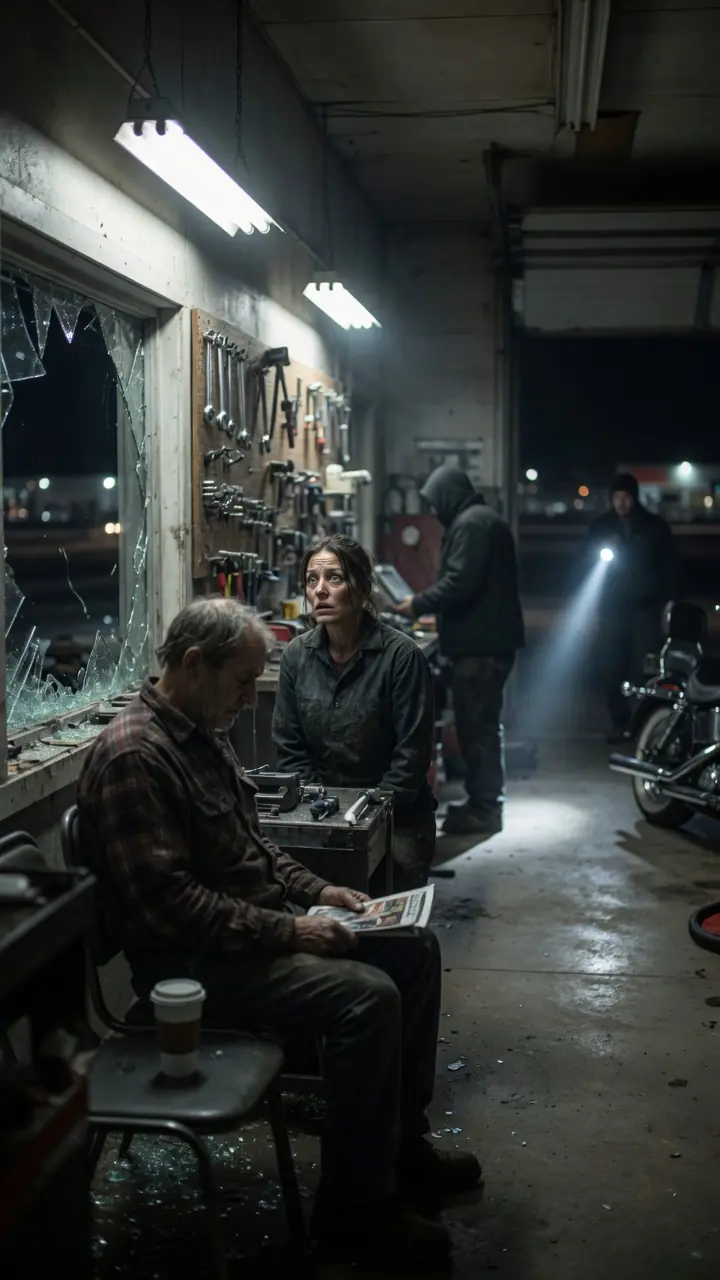
He kicked the glass case in on his way through the door and didn't slow down for a single step. Three men inside in under 30 seconds. Lock turned behind them. The big one came straight across the floor and grabbed her by the arm and walked her into the pegboard wall.
The hooks bit into her back. A wrench her father had hung there in 1991 dropped and rang off the concrete. Neither of them looked down. The second one went straight for the register. The third moved through the repair bay with a flashlight like he already knew the layout.
They hadn't said a single word to each other since they walked in. That silence was the thing that made her chest stop. At the edge of her vision in the corner by the waiting chairs, the old man in the flannel shirt had set his magazine down. Both hands flat on his knees, eyes up.
40 years ago, men twice Troy Sasser's size used to go quiet when they heard his name. Nobody in that shop knew that. Troy Sasser, least of all. Troy nodded at Kenny without taking his eyes off Clare.
Kenny was 26 years old, 6 foot 3, and 230 lb. And he had never once in his life had a problem moving someone who didn't want to be moved. He came across the waiting area like a man who had done this particular thing many times before, unhurried, certain, already thinking about what came after.
He grabbed Walt by both shoulders. What happened in the next 3 seconds did not look like a fight. It did not look like anything Kenny had a word for. Walt's left hand came up and found Kenny's right wrist and did something small and specific with it.
And then Kenny was on the floor looking at the ceiling. And his wrist was sending information to his brain that his brain was having difficulty processing. And the old man in the flannel shirt was standing exactly where he'd been standing before, hands back at his sides like the whole thing had been a minor interruption.
Kenny did not get up. The flashlight in the repair bay went still. Daryl came through the bay door in a hurry, saw Kenny on the floor, saw the old man, registered that the math of this situation had changed in a way he didn't fully understand yet, and made the decision that men make when they're angry and confused, and those two things are running faster than their judgment.
He came in anyway. He led with his right hand. Walt stepped left. Not fast, just left. One step, the way you step around something on a sidewalk.
Daryl's fist went past his ear, and Walt's elbow came back and caught the side of Daryl's head with the particular efficiency of a man who has made this exact motion so many times, it no longer requires him to think about it. Daryl's legs went wrong beneath him. He grabbed the edge of the waiting room table on the way down and took it with him, and the magazines that had been sitting on it fanned across the concrete floor, and nobody looked at them.
The shop went completely silent. Troy had not moved from where he was standing. He was 6 feet from Clare and 12 ft from Walt. And he was doing the thing his brain does when it receives information that contradicts something it believed to be permanently settled.
His eyes went from Kenny to Daryl, from Daryl to the old man. The old man was standing in the middle of the waiting area with his hands at his sides and the paper coffee cup still sitting on the chair behind him and his breathing at the same rate it had been when he was sitting reading his magazine.
There was no expression on his face that Troy could name. Not anger, not satisfaction, not the particular brightness that some men get when violence goes their way. Just presence. The specific undiluted presence of a man who is exactly where he intended to be.
Troy had built his entire operation on reading people, on knowing within the first 30 seconds of walking into a room who was going to be a problem and who wasn't. He had read this room when he walked in. He had cataloged the woman behind the register and the position of the cash drawer and the sightlines to the bay and the old man in the corner chair who was reading an 8-month-old magazine and drinking coffee from a paper cup and who had registered in Troy's assessment as furniture.
He understood now that this had been a mistake. He understood it the way you understand something that the body knows before the mind catches up. In the chest first, then the stomach, then finally, reluctantly in the part of the brain responsible for honest accounting. His hand moved to his waistband.
The gun came out. He raised it across 12 ft of concrete and held it level with Walt's chest, and his hand was steadier than he felt, which was the one thing still working correctly tonight. Walt looked at the gun. Then he looked at Troy.
You don't want to do that, Walt said. Not a warning, not a plea. The way you tell someone the stove is hot, plain, and patient, like you'd genuinely prefer they learn it another way, but you've said what you can say, and the rest is up to them. Troy's jaw tightened.
The gun didn't move, but his eyes his eyes were doing something they had not done in 11 previous jobs, in 11 previous rooms, in 11 previous moments exactly like this one. They were uncertain. Across the room, Clare had not moved from the pegboard wall.
The hooks were still in her back, and her feet still hadn't fully found the floor, but she was watching the old man in the flannel shirt stand in the middle of her father's shop with a gun pointed at his chest. And she was thinking one thing, one thing only. He isn't scared.
Not performing calm, not holding himself together through effort, just not scared. The way a man isn't scared of something he has already survived so many times that it has lost the ability to surprise him. Troy's hand came up an inch, then stopped.
Who are you? he said. Walt didn't answer right away. He looked at Troy the way you look at a question you have been asked before. A long time ago, by men who were standing in exactly the place Troy was standing now, and who had found out the answer the hard way.
Doesn't matter who I am, Walt said. Matters what happens next. He reached into his shirt pocket. Troy's gun hand came up another half inch.
Walt pulled out a phone, looked at it once, and made a call. Four words spoken quietly. Then he put the phone back in his pocket and looked at Troy again. 12 minutes, Walt said.
I'd use them carefully. Troy's mouth opened, closed. To understand why those two words, 12 minutes, drained the certainty from Troy Sasser's face. The way water drains from a cracked basin.
Slow and then all at once. You need to know who Walt Dri was before he was the man in the corner chair. Before the flannel shirt, before the bad coffee and the 8-month-old magazines and the Wednesday morning oil changes on a bike that hadn't needed them in 2 years.
What he was before all that was something else entirely. Harold Hobbs had opened that shop in 1987 with a set of secondhand tools, a two-car lift he bought off a bankrupt dealership in Cheyenne, and a loan from First Mountain Bank that took him 9 years to pay back.
He had built the sign himself, wood, not metal, because metal cost more, and painted the letters by hand on a Saturday morning, while Clare, who was 3 years old, sat on an overturned oil drum and watched him work. She couldn't remember that morning. She'd been told about it enough times that the memory felt real, but she knew the difference.
What she actually remembered was later. The smell of the place before the lights came on in the morning. Cold concrete and old grease and something underneath that she had never been able to name. Something that was just the shop itself, just the particular air of a building that had been worked in honestly for a long time.
She had grown up on that smell. Walt Dri had come to Casper 3 years ago in October on a Tuesday afternoon with one bag and a motorcycle and no particular plan beyond stopping. He had driven through four states in 6 days and Casper was where he ran out of the specific kind of forward momentum that keeps a man moving when he has nothing pulling him toward any one place in particular.
He rented a room above a hardware store on Elm Street, paid 3 months in advance in cash, and spent the first two weeks learning which diners opened early and which gas stations had decent coffee and which roads out of town were worth riding on a clear morning. He didn't tell anyone his name. Not his full name, not the name that mattered.
Troy Sasser had built his operation the way a man builds anything when he is patient and not stupid. Slowly, carefully, one piece at a time. He had started at 24 with two guys he'd known since high school, and a simple enough idea. Small businesses ran on cash.
Small business owners didn't want trouble, and the distance between those two facts was where the money lived. His first target had been a laundromat in Cheyenne. The owner had paid without a word, and Troy had walked out with $460 in a paper bag, and understood with perfect clarity that he had found something that worked.
Harold Hobbs had taught Clare to change a tire at age seven, not because he needed her to, because he believed, with the particular stubbornness of a man who had built everything he owned with his own hands, that his daughter should know how every single thing in her world worked. By the time she was 12, she could read an engine.
By 14, she had rebuilt her first transmission on a 73 Chevy pickup that belonged to a rancher named Dale, who brought it in every spring, and always paid in cash, and always left a 20 on the counter for Clare specifically, folded twice without explanation. She had worked beside her father for 22 years, not because she had to, because there was nowhere else she wanted to be.
Walt had left the chapter in 2009. Not loudly, not with ceremony. He had simply stopped showing up. And the men who might have had something to say about that had looked at each other and decided one by one that Walt Dri was the specific kind of man you let go quietly.
There were things he had done for the chapter over 20 years that nobody had written down anywhere because writing them down would have been its own kind of problem. There were debts owed to him that could never be repaid in any currency that existed. And there was the other thing, the thing that had happened with his daughter, the thing he did not talk about, the thing that had ended his willingness to be what he had been and started his willingness to be something else, something smaller and quieter and further from everything he'd known.
He had picked Casper because nobody there knew his name. That had lasted about 4 months. Troy's 11th job had been a tool rental shop in Laramie. In and out in under 20 minutes.
The owner, a 58-year-old woman named Patrice, had given him the register contents without a word and then sat down in her office chair and stared at the wall until he was gone. He had driven back to Casper on Route 80, feeling the particular satisfaction of a man whose system is working exactly as designed.
3 weeks later, he had driven past Hobbs Auto and Repair on Route 220 at 9:45 on a Tuesday night, and seen the lights still on, and a single car in the lot, and a woman working alone under a lift with the bay door open. He had slowed down without meaning to, circled the block, noted the register position, the sight lines, the distance from the nearest intersection.
He had come back twice more to confirm what he already knew. Harold Hobbs had died on a Thursday morning in March, 14 months before that Tuesday night. Clare had been changing the brake pads on a fleet vehicle when her phone rang.
She had finished the brake job first, not because she didn't care, but because her father had taught her that you finished what you started, and she had needed something to be true in that moment, that she already knew how to do. She had driven to the hospital with grease still on her hands and sat in a waiting room chair for 2 hours before a doctor came and told her what she already knew from the sound of her aunt's voice on the phone.
She had cried exactly once alone in the hospital parking garage for 11 minutes. Then she had driven back to the shop and finished the rest of the day's work. The loan her father had left behind was $47,300. The bank had been patient up to a point.
Clare had been working 6 days a week, 10 hours a day, keeping the evening shifts herself to save on labor costs. She was three months behind on the second payment. She had not told anyone. Walt had been coming into Hobbs Auto every Wednesday morning since the previous spring.
He always brought the Harley, always requested the same service, always sat in the same corner chair, always drank whatever coffee was in the pot without complaint. The other regulars had learned not to try to make conversation with him. Not because he was rude.
He was never rude, but because the answers he gave were so precisely sufficient and no longer that eventually people stopped asking questions. They already knew the shape of the answer to. Clare had figured out by the second month that the bike didn't need what he brought it in for.
She had not said anything about it. He had not explained. Some arrangements don't require language to be understood by both parties. On the night Troy Sasser kicked in the glass case and came through the door with two men behind him, Walt had been in that corner chair for 2 hours and 41 minutes, which was longer than any oil change in the history of internal combustion had ever required, and Clare had not asked him about that either.
She understood afterward that he had seen Troy's car circling the block. She understood afterward that he had stayed. It had started on a Wednesday evening in April, 6 months before that night. Walt had been the last customer of the day.
Clare had finished with the Harley by 7:30, and he had been sitting in the corner chair long enough that she had refilled his coffee twice without being asked. Outside the light had gone flat and gray and the lot was empty except for his bike and her truck and the particular silence that settles over a highway side business after the last car passes and doesn't stop.
She had been counting the register when she said it. Not looking at him. Just said it into the air the way you say things you've been carrying too long to keep carrying alone. Third time this week somebody's driven past after closing and slowed down.
Walt didn't answer right away. He set his coffee cup on his knee and looked at the front window for a moment. Same car, different cars, same slow. He nodded once.
The way a man nods when something he suspected has been confirmed. Clare put the register drawer back and leaned against the counter. She was not the kind of woman who asked for things. Her father had not raised her to be.
But she was also not the kind of woman who pretended not to see what she could plainly see. And what she could plainly see was that she was alone in this building every night. And the building sat on a stretch of Route 220 where the nearest neighbor was a closed bait shop a quarter mile east.
You ever think about getting a dog? Walt said. Can't afford a dog. He almost smiled. Almost.
He was quiet for another moment. Then he stood up from the chair and walked to the workbench beside the register. The one where she kept the most used tools laid out in order, the same order her father had kept them in. Because some habits outlast the people who teach them.
He picked up the 19 mm combination wrench. Turned it over once in his hand, set it back down on the table upside down. You know what that means? He said. Clare looked at the wrench.
Means somebody put it back wrong. Means something's wrong. Walt said in certain places to certain people an upside down wrench on a workbench means the person who put it there needs somebody to stay. She looked at him.
My father used it. Walt said in the chapter. If a prospect came into the shop and something felt off, a meeting going wrong. Somebody in the room who shouldn't be, he'd flip a wrench on the bench and whoever saw it knew to hold their position.
Don't leave. Don't make a move. Just stay. Clare was quiet for a moment.
Your father was in a chapter. I was in a chapter. Walt said. He said it the way you say something that used to be a large thing and has since become simply a fact.
Iron Valley 20 years. She didn't ask anything else. He hadn't offered it as an invitation. He picked up his jacket from the back of the chair and shook it on.
Then he stopped at the door and looked back at her. If there's ever a night somebody comes in here and you need somebody to not leave, he said, put that wrench upside down on the table. I'll see it. Clare looked at the wrench on the table, 19 mm.
Her father had bought it at a hardware liquidation sale in 2003 for 89 cents. It had been on that table in that spot for as long as she could remember. And if you're not here, she said, I'll be here, Walt said.
He walked out. The bell above the door rang once and went quiet. Clare stood at the counter for a long moment after his taillights disappeared down Route 220. Then she reached out and turned the wrench right side up and went back to closing out the register.
She had not thought about it again, not consciously. But on the nights she worked late, and there were many of them, more than there should have been, more than her father would have allowed if he'd had any say in the matter, she had noticed without quite meaning to, that the wrench was always within reach, always on that table, always in that spot. On the night Troy Sasser came through the door, she had reached for the tray of keys she kept beside the register.
It was a natural movement, a movement she had made a thousand times. Troy was 6 feet behind her left shoulder close enough that she could hear him breathing and Kenny was at the front door and Daryl was somewhere in the bay and there was no version of the next 5 minutes that she could see a way through. Her hand found the key tray and then her hand found the wrench.
She set it down on the table without looking at it upside down. One motion, the same motion she used for everything in this shop. Efficient, unhurried, like it was simply the next thing that needed doing. Troy didn't notice.
He was looking at the register. In the corner by the waiting chairs, Walt set his magazine down. The call from the bank had come at 8:17 that morning. Clare had been under a Ford F250 at the time, replacing a rear differential that had been grinding since sometime in the previous administration.
She had let it go to voicemail, finished the differential, wiped her hands, and listened to the message standing in the bay with the engine still ticking beside her. The payment was short by $1,214. The bank was prepared to work with her, the message said in the particular tone that banks use when they are not prepared to work with you, but would prefer you believe otherwise.
She had until the end of the month. She had put the phone in her pocket and taken the next car off the lot. That was how Clare Hobbs handled things. Not because she didn't feel them.
She felt them fine. Felt them in the specific way you feel something when you have decided in advance that feeling it is not going to change anything. So, you might as well keep moving. Her father had been the same way.
She used to think it was a flaw. She had since decided it was the only reason either of them had ever gotten anything done. By noon, she had taken in four more vehicles. By 3:00 in the afternoon, she had finished two of them, billed one customer for parts she'd been waiting 3 weeks to get paid for, and eaten half a sandwich standing at the register, because sitting down felt like a thing she didn't have time for.
Troy Sasser had spent that same morning doing what he did every morning before a job, running the route. He drove Route 220 at 7:00 a.m., again at 10:00, again at 2:00 in the afternoon. Each time he noted the same things. The sight lines from the road, the traffic pattern, the position of the nearest street light, which had a bulb out on the eastern pole, and had apparently been out long enough that nobody had bothered to fix it.
He noted the time the last regular customer left, a rancher in a mud-caked Silverado who pulled out at 4:52 and the time Clare pulled the bay door halfway down, which she did every evening at 5:30, regardless of whether she was done for the day or not, because the highway noise made it hard to hear the engines clearly when the door was all the way up. He had noted all of this without writing any of it down. Troy Sasser did not write things down.
Writing things down was for men who needed to remember because they weren't paying attention in the first place. Walt had arrived at the shop at 6:51 that evening. He had not planned to. He had been on the bike heading south on 13th Street toward a diner he liked on the edge of town and he had turned onto Route 220 instead without fully deciding to.
The way the body sometimes makes decisions that the mind is still catching up to. He had seen the light in the bay from 300 yards out and turned in and parked at the edge of the lot without announcement. Clare had looked up from the engine bay when she heard the Harley. You just had that bike in 2 days ago, she said.
Heard something on the way over, Walt said. She looked at him for a moment. He looked at the bike. Pull it in, she said.
He had sat in the corner chair and drunk his coffee and read his magazine while she checked over the Harley that needed nothing checked and found nothing wrong with it, which was exactly what both of them expected. Outside, the lot had gone dark by 7:30. The highway traffic had thinned to the occasional truck pushing north toward Gillette. The bulb on the eastern street light pole was still out.
At 8:45, a dark sedan had pulled into the lot across the road, the abandoned bait shop, and sat there with its engine running. Walt had looked up from his magazine once. Then he had looked back down. Clare had not seen the sedan.
She was in the back working on a clutch assembly that needed to be ready by 7 the next morning. At 9:15, the sedan had pulled out and driven north. At 9:22, it had come back south and parked again. This time two lots down, engine off.
Walt had set his magazine on his knee. At 9:40, he had heard a second car, then a third. He had not said anything to Clare. There was nothing to say that would have been more useful than staying where he was and waiting to see what the next few minutes brought.
He had learned over 20 years of situations that required exactly this kind of patience, that the most dangerous thing a man could do was move before he understood the full shape of what he was moving into. At 9:47, the front door opened. Clare spun around from the lift.
Walt turned the last page of his magazine, closed it, and set it on the chair beside him. He had already done the math. Three men, two doors, one sight line from the register to the bay. He knew which one would come for him first, and he knew what he would do when that happened.
And he knew what came after that. What he hadn't fully calculated, what he hadn't let himself think about directly. The way you don't look straight at something that might change your decision if you look at it too long. Was the particular feeling of sitting in a corner chair in a small auto shop in Casper, Wyoming, and understanding that the thing he had driven four states and 3 years to get away from had followed him here anyway, not the violence.
He had made his peace with the violence a long time ago. The feeling of being needed. That was the thing he hadn't figured out how to leave behind. Clare's hand found the wrench on the table.
He saw her set it down upside down without looking at it. One clean motion like it was simply the next thing in a long list of things that needed doing tonight. Walt stood up. Troy had the gun level with Walt's chest and 12 ft of concrete between them and two men on the floor behind him.
And he was telling himself that none of that changed anything. The gun was still in his hand. That was the part that mattered. That was the only part that had ever mattered in any room he had ever walked into.
He took three steps forward. The barrel touched Walt's sternum. Walt looked down at it one second. Then he looked back up at Troy.
And Troy felt something in that look that he did not have a word for and would spend a considerable amount of time afterward trying to find one. It was not defiance. He knew defiance. Defiance was just fear that had decided to dress up and go out.
This was something underneath defiance. Something that defiance was built on top of the way a house is built on ground that was there long before anyone thought to put a house on it. This man had been here before. Not a room like this.
This room. This exact configuration of threat and consequence and the specific silence that falls when everyone present understands that the next 30 seconds are going to determine something permanent. Troy could see it in the way Walt was standing, not braced, not tense, just settled the way a fence post is settled.
Like he had put his roots down into this particular moment a long time ago and was simply waiting for Troy to figure out what he already knew. On your knees, Troy said. Walt didn't move.
On your knees, Troy said again harder this time. The hardness was supposed to sound like certainty. He was not entirely sure it did. Walt looked at him.
Think about what you're doing. Walt said, quiet. Not asking, just laying it out. The way a man lays out the terms of something before the other party makes a decision they can't walk back from.
You came in here for a register and some car keys. That's what this was. Think about what it is now. Troy's jaw tightened.
It's whatever I say it is. No. Walt said. It stopped being that about 4 minutes ago.
Something moved across Troy's face. Fast and then gone. He pressed the barrel harder against Walt's sternum. Last chance, Troy said.
Knees now. Walt looked at him for a long moment. The kind of long that has weight to it. The kind that makes the air in a room feel different.
Then he said, No. One word. Flat and final as a door closing. Troy had been in rooms with dangerous men before.
He had been in rooms with men who were bigger than him and angrier than him and more heavily armed than him, and he had never once in 11 jobs felt what he felt in the two seconds after that word landed. The closest thing he had to a name for it was, This man has already decided how this ends, and he is not afraid of the answer. Troy's finger moved to the trigger.
From outside, faint at first, then building, then filling the lot the way weather fills a valley. All at once, and from every direction, came the sound of engines. Not one, not two, the kind of sound that has a physical weight before it has a source.
The kind that arrives in the sternum before it arrives in the ears. Troy's eyes went to the window. The first headlights swept across the shop front, then four more behind them. Then another three and two more after that.
And by the time the last set of lights turned into the lot of Hobbs Auto and Repair on Route 220, the whole front of the shop was lit up like the inside of something that had just been switched on. 14 motorcycles. They came in without hurry and parked in a line across the front of the lot and cut their engines one by one until the last one went quiet.
And the silence that followed was the kind of silence that is louder than the noise that preceded it because your body is still braced for the noise. And the absence of it lands like a physical thing. Nobody got off their bike. Nobody came to the door.
They just sat there in the dark lot in a line, engines ticking as they cooled, headlights cutting through the shop windows and laying long rectangles of light across the concrete floor. And they waited with the patience of men who have nowhere else to be and no reason to rush because they already know how this particular story ends. Troy stood with the gun barrel against an old man's sternum and looked at 14 silhouettes sitting on 14 motorcycles in the parking lot of a small auto shop in Casper, Wyoming, and felt the full weight of what he had walked into tonight settle onto him all at once.
He had done the math when he walked in. He had done it carefully, the way he always did. One woman, one register, six sets of car keys, an old man in a corner chair who didn't matter. He had not accounted for this.
He had not accounted for any of this. His arm was still up. The gun was still level, but something had gone out of it. Some essential quality that a gun requires in order to be what it is.
And they both knew it. And only one of them was pretending otherwise. Who are they? Troy said his voice had changed. Something structural had left it.
Walt didn't answer right away. He looked out at the lot for a moment at the 14 riders sitting in the dark, patient and still. And then he looked back at Troy with the expression of a man who was about to say something true. Men who remember, Walt said.
Troy looked at the window, at the silhouettes, at the particular quality of stillness coming off 14 men who were waiting because they had been asked to wait, which is a different kind of stillness than the stillness of men who have nothing to do. He looked back at Walt. Walt's hand came up slowly.
Slowly enough that Troy could have stopped it. Could have stepped back. Could have made any one of several decisions that would have changed what happened next and took the gun out of Troy's hand. Troy let him.
His fingers opened and the gun was gone. And he stood there with his empty hand at his side and the full understanding of the last 20 minutes arriving in him all at once. The way cold arrives when you've been outside long enough that your body stops arguing with it. He had walked into this shop with a system.
A system that had worked 11 times. 11 rooms, 11 registers, 11 people who had made the rational decision that cooperating was safer than not cooperating. And Troy had walked out of all 11 of those rooms with what he came for. And the absolute confidence of a man whose method has never failed him.
He had walked into the one room where the method was always going to fail. Not because of the gun, not because of the men in the parking lot, because of a 61-year-old man in a flannel shirt who had looked at a woman working alone on a dark stretch of highway and decided 6 months ago on a Wednesday evening that she deserved to have somebody stay. That was the thing Troy Sasser had not accounted for. That was the only thing that had ever mattered.
Walt set the gun on the counter behind him. He looked at Troy for a moment, not with anger, not with satisfaction, just with the particular steadiness of a man who has done what he came to do and is now simply present for whatever comes next. Sit down, Walt said calmly. And wait.
Troy sat down in the waiting chair, the one Walt had been sitting in when they walked in, the one with the paper coffee cup still on the armrest, and he put his hands on his knees and he looked at the floor. He didn't say another word. Outside on Route 220, the first siren became audible at 10:14, then a second.
Then the red and blue light began painting the front windows of Hobbs Auto and Repair in slow rotating arcs. The way it always does, arriving after everything that mattered has already been decided. Clare was still standing against the pegboard wall. She hadn't moved since Troy had put her there.
Her back hurt where the hooks had caught her, and her hands were still not entirely back to their normal temperature. And she was looking at the old man in the flannel shirt, who was standing at the counter with his hands flat on the surface, waiting for the police, the way you wait for a bus, without urgency, without performance, simply present. She thought about the wrench on the table, about the night he had shown her what it meant, about the way he had said it.
Not as an offer, not as a favor, just as a fact. The way you state something that is simply true and always will be. If there's ever a night somebody comes in here and you need somebody to not leave, she had put the wrench upside down without looking at it. And he had stood up without looking at her.
And between those two moments, between the signal and the response, there had been something that didn't have a name in any language she knew, but that she understood completely. The door opened. The first officer came through with his hand on his holster and took in the room in one sweep.
Kenny on the floor, Daryl against the wall, Troy in the chair, the old man at the counter, the woman by the pegboard, and then he said the words they always say, the words that mean it's over. The words that arrive after everything that actually mattered has already happened in the silence before them. Clare exhaled.
She hadn't known she'd been holding it. The police arrived at 10:19. Two cruisers first, then a third, then a detective in a gray sedan who parked at the edge of the lot and stood for a moment looking at the 14 motorcycles before walking inside. Troy, Kenny, and Daryl were arrested at the scene.
Kenny's wrist required medical attention. Daryl had a concussion that the paramedics confirmed at the scene and that he would feel on and off for the better part of the following 3 months. Troy said nothing from the moment the first officer walked through the door to the moment they put him in the back of the cruiser. Not one word.
He sat in the chair Walt had told him to sit in and he looked at the floor and he did not look up when the handcuffs went on. The detective, a broad shouldered woman named Reyes, who had been working property crimes in Casper for 11 years, walked through the shop slowly, taking in Kenny on the floor, Daryl against the wall, the broken glass case by the door, the gun on the counter. Then she walked over to Walt, who was sitting in his corner chair again with his paper coffee cup, and looked at him for a moment. You want to tell me what happened here? she said.
Three men came in, Walt said. They left when asked. Reyes looked at Kenny who was cradling his wrist. She looked at Daryl who was staring at the ceiling.
She looked back at Walt. That how you'd describe it? She said. That's how I'd describe it, Walt said. She wrote something in her notebook.
Then she looked at him again. The particular look of a person trying to place a face they almost recognize. Walt Dri, she said. Not a question.
Walt looked at her. Iron Valley, she said quietly. My father worked that corridor in '04. Said your name maybe twice in 20 years.
Both times like he was being careful about it. Walt didn't say anything. Reyes nodded slowly. Wrote something else in her notebook.
Then she closed it and walked back toward the door. We'll need a statement, she said over her shoulder. From both of you. Tomorrow morning is fine.
Outside, the 14 motorcycles started up one by one and pulled out of the lot in the same order they'd arrived. Headlights sweeping across the shop windows one last time before disappearing north on Route 220. Within 4 minutes, the lot was empty, no names exchanged, no words spoken, just engines fading into the dark. The way thunder fades after a storm has already decided it's finished.
Clare stood in the middle of her father's shop and listened to them go. The investigation took 6 weeks. Troy Sassar's phone contained records of 11 prior jobs across three states. Locations, timing, amounts taken, which owners had been cooperative and which had required additional persuasion.
Detectives in Cheyenne and Laramie pulled security footage. Business owners who had paid and stayed quiet found suddenly that there was someone to talk to and a reasonable expectation that talking would not make things worse. Seven of them gave statements. Three more followed within the week.
Troy was charged with 11 counts of armed robbery, two counts of assault, and one count of unlawful weapons possession. He was convicted on all 14 counts 8 months later and sentenced to 18 years in the Wyoming State Penitentiary. Kenny took a plea. Daryl took a plea.
Neither of them in any of their statements or in any of the conversations that were later reconstructed by investigators ever fully explained what had happened inside that shop. Specifically, how two men their size had ended up on the floor before Troy had time to do anything about it. The police report listed the cause as physical altercation with a third party. The third party was described as a 61-year-old male, gray hair, flannel shirt, no priors on record anyway.
Clare reopened the shop 3 days after that Tuesday night. New glass in the front case. She had measured the opening herself and ordered the replacement panel from a supplier in Denver. She had swept the floor twice before she was satisfied, and rehung every tool on the pegboard in the exact order her father had established, which she had memorized without meaning to over 22 years of working beside him.
The bank called on a Thursday, not the collections department this time, the branch manager directly, a man named Sears, who had processed Harold Hobbs's original loan in 1987, and who had, it turned out, been following the news coverage of the arrest with considerable attention. He offered Clare a restructured payment schedule with a reduced interest rate and did not make her ask for it twice. She did not cry. She sat at the register after the call and looked at the pegboard and breathed slowly for about 30 seconds.
Then she took the next car off the lot. A year later, a letter arrived at Hobbs Auto and Repair with a Wyoming State Penitentiary return address. Clare read it twice standing at the register before she folded it and put it in the drawer beneath the cash tray. She never showed it to anyone.
She mentioned it once to a friend in the particular way you mention something when you need to say it out loud but don't need a response just need the words to exist outside of you for a moment. Troy had not asked for anything had not minimized anything had not explained the childhood the father the landlords the long accumulation of reasons a man tells himself justify the things he does. He had written four sentences the last one said I chose your stop because I thought you were the easiest target on that road.
I want you to know that was the last thing I got wrong about you. That was all. Clare put the letter in the drawer and did not take it out again, but she kept it there under the cash tray in the same drawer where her father had kept the spare key to the back door and a photograph of Clare at age seven sitting on the overturned oil drum watching him paint the sign. As for Walt Dri, he came in the following Wednesday morning at 9:15.
Same as always, same corner chair, same paper coffee cup. Clare poured his coffee without being asked and went back to the bay without saying anything. He picked up a magazine from the table beside the chair. Last month's issue this time, an improvement.
They didn't talk about that Tuesday night. Not then, not afterward. Some things between people don't require discussion to be fully understood by both of them. And this was one of those things.
What Clare knew, what she had understood from the moment she watched 14 motorcycles pull silently out of her father's lot was that Walt Dri had not stayed that night because of the wrench. He had not stayed because of the signal or the system or the thing his father had taught him in the chapter a long time ago. He had stayed because he had looked at a woman working alone in her father's shop on a dark stretch of highway and recognized something he understood from the inside. The specific weight of holding something together that you are not entirely sure you can hold.
He had stayed because that weight deserved a witness. And because Harold Hobbs had built something worth staying for, even if Harold Hobbs was no longer there to see it. Think about what Troy Sasser saw when he walked through that door. A small shop on a dark highway.
A woman alone behind a register. An old man in a corner chair reading a magazine nobody had picked up in 8 months. The whole picture added up to exactly what he needed it to add up to. Easy, predictable, already decided.
He had been right about almost everything. The shop was small. The highway was dark. The woman was alone.
He had been wrong about the one thing that mattered. There is a particular kind of person the world keeps making the same mistake about. They don't announce themselves. They don't take up extra space.
They have already been to every place that violence and consequence and the specific weight of hard living can take a person. And they came back from all of it and made a decision quiet, private, final with to put that weight down and pour coffee instead. To sit in a corner chair, to read a magazine, to show up every Wednesday morning for a woman who reminded them of something they were not ready to lose again. The world looks at those people and sees nobody.
That is the world's mistake, not theirs. Walt Dri ran that corner chair for another 4 years after that Tuesday night. He was there every Wednesday at 9:15 until the morning he wasn't, which came on a Wednesday in November when Clare arrived at 6:00 a.m. to open up and found an envelope tucked under the wiper blade of her truck. Inside was a single key on a plain ring and a note with four words in handwriting she recognized from the shop log he'd signed every visit.
Take care of her. The key fit the storage unit on Elm Street where the Harley was parked, covered with a canvas tarp, full tank of gas, every piece of it in perfect working order. Clare had the bike brought to the shop. She cleared a space in the back corner of the bay, not a prime spot, not in the way, just present, and put it there.
She didn't ride it. She didn't sell it. She just kept it where she could see it from the register, the same way her father had kept the photograph of the sign. Some things you don't explain.
You just keep them where the light hits them right.