His hand closed around her arm the moment she stepped out from behind the counter.
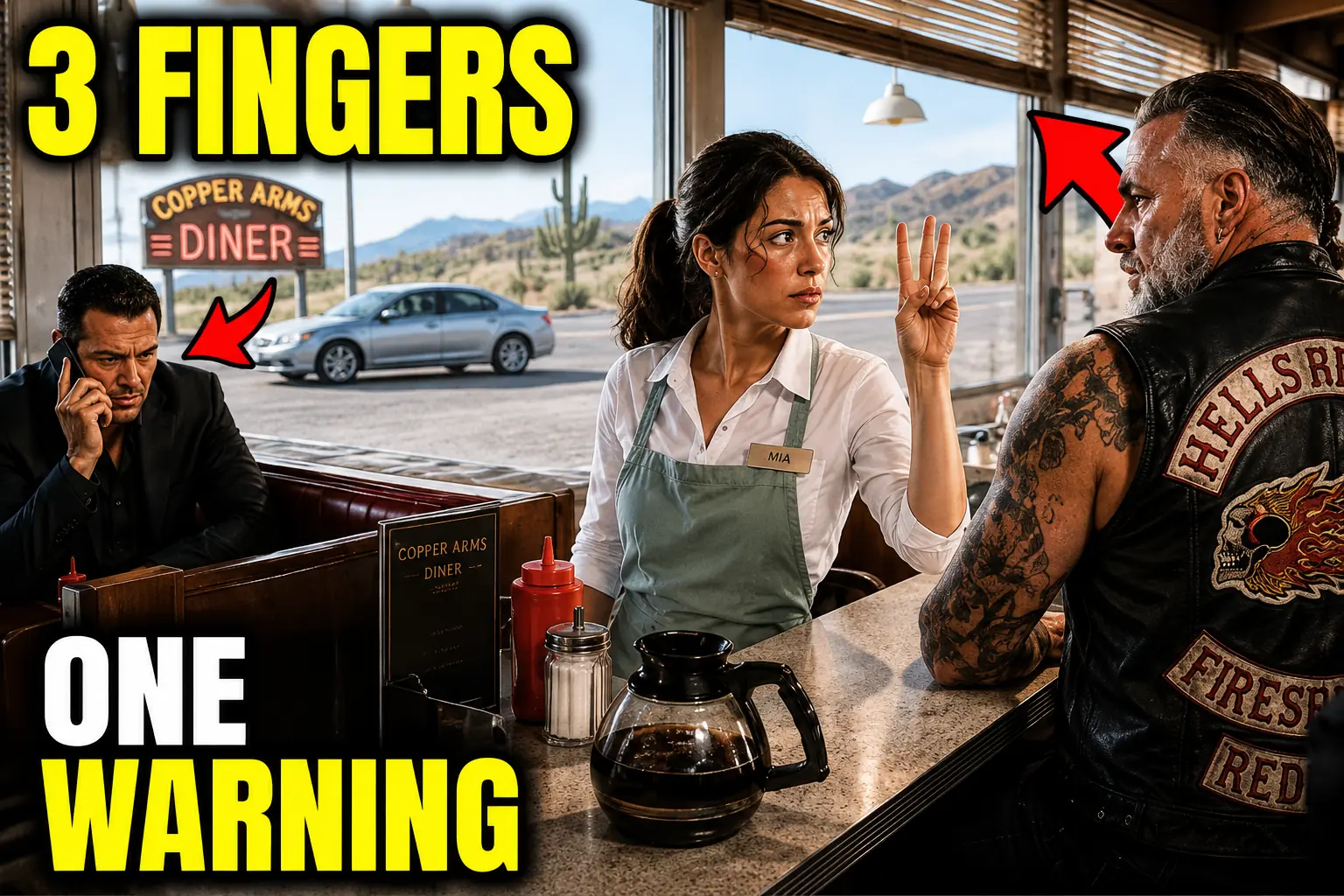
Not rough. That was the part that made it frightening. He didn’t grab. He just placed his hand there, fingers curling around her elbow with the particular calm of someone who had practiced this exact motion until it looked like affection.
“We need to talk,” he said. Quietly. The way you say it to a child you are very, very disappointed in.
Laura Mercer kept walking. Eyes forward. Chin level. Moving the way she had taught herself to move in the last two years. Measured. Ordinary. Like a woman whose afternoon was completely unremarkable.
Nobody was watching. That was what Nathan Greer had always counted on.
Laura reached the counter. She picked up a cleaning rag. She set a coffee cup down in front of the man who had just sat down at stool three. A man in a leather vest. Silver in his hair. And the particular kind of stillness that belongs to people who have nothing left to prove.
She did not look at him.
Her left hand pressed flat against the laminate countertop. She raised three fingers. Curled the fourth down. And the fifth. Pressed her thumb flat across her palm.
Two seconds. Exactly two. Then let her hand fall.
The man on stool three did not react. He lifted his coffee cup. Set it down.
And then, slowly—the way a man moves when he wants nothing about him to appear hurried—he turned and looked out the window at the parking lot.
Nathan settled into booth seven like he owned it. He crossed his ankles. Straightened his cuffs. Smiled at the wall.
He had no idea what she had just done. He had no idea what it meant. He had no idea what was coming.
Nathan Greer had spent nine days watching her schedule before he walked through that door. He knew her shift ended at two. He knew her daughter’s school was three blocks north. He knew exactly how much time he had.
He was forty-one years old. Lean through the shoulders. Eyes always slightly ahead of the conversation. He was the kind of man who did not raise his voice because he did not need to. The kind of man who always had more time than you thought he had.
He had found her in Ridgecrest the same way he had found her in the three places before that.
He waited.
Laura Mercer was thirty-one years old. A diner waitress. One daughter. Seven years old. Chloe, who collected animal erasers in a shoebox under her bed, organized by species, and called thunderstorms the sky talking.
She was the reason Laura got up every morning. She was the reason Laura had packed one duffel bag two years ago, taken her daughter out the back door of their house in Flagstaff, and driven until Nevada was behind her. And Chloe was asleep in the backseat with her erasers clutched in both hands.
She had not been fast enough. She had never, not once in two years, been fast enough.
The man on stool three was named Warren “Ironsides” Grady. Fifty-six years old. A face that had been rearranged a few times and made peace with the results. He moved through spaces the way large men sometimes do—with a deference to his own size, careful not to take more room than he needed.
He had walked into Ridgeback Diner at 11:47. Ordered black coffee. Settled in.
He noticed the dark-blue sedan in the parking lot at 11:53. Engine off. Driver still in the seat. Watching the entrance in the particular way of someone who has decided they are not leaving until they get what they came for.
At 12:02, the man from the sedan walked in.
Warren had seen that walk before. Not this specific man, but that specific walk. The cadence of someone who has made a decision and is simply allowing time to catch up with it.
He watched in the window’s reflection. Watched the man put his hand on the woman’s arm. Watched her not flinch.
Which told Warren more than a flinch would have. A flinch is surprise. What she did was absorb. The way a person absorbs something they have absorbed many times before.
Then she walked to the counter. Her hand pressed flat.
Warren was already watching her hand when she made the sign. Three fingers up. Two curled down. Thumb flat across the palm.
He went completely, absolutely still.
He had last seen that sign nine years ago in a garage in Laughlin, Nevada. Taught to him by a man named Daniel Mercer. Quiet. Deliberate. The kind of man who said things once and meant them permanently. Daniel had ridden with his chapter four years before a heart attack took him on a Wednesday morning, with his coffee still hot on the kitchen counter.
That afternoon in the garage, Daniel had shown Warren the sign and said simply, “She’s going to need people who understand this. Teach it to the chapter.”
Warren had taught it to six men. He had not thought about it in four years.
He looked at the woman behind the counter. She had her father’s jaw. The way she held her head. Slightly forward. Like she was always moving into whatever came next.
He did not move for seven seconds. He counted them.
Then he set down his cup, left two twenty-dollar bills on the counter, and walked out into the September sun.
Outside, Warren made one phone call. It rang once.
“Talk.”
Bobby Crane. The chapter’s road captain. A man who communicated in fractions of the words that most people used.
“It’s the Mercer signal,” Warren said. “Daniel’s daughter. She’s inside Ridgeback Diner on the main strip. Man followed her in. Dark-blue sedan. Been sitting the lot nine days. He’s in the booth, waiting for her shift to end.”
A pause. Then:
“She have a kid?”
“Seven years old. School’s three blocks north.”
“How many do we need?”
Warren watched Laura move between tables. Smooth. Practiced. Completely convincing to anyone who hadn’t learned to see what controlled fear looks like from the outside.
“All of us,” Warren said.
The line clicked.
He pulled out his phone again and typed to the number the chapter’s relay had already found.
Don’t look at the lot. Keep working. You’re Daniel Mercer’s daughter. We see the car. We see him. We’re already here.
Inside, Laura felt the buzz against her hip. She read it once. Twice. She looked up at the window for exactly one second and saw a motorcycle at the far end of the street moving slow. Another easing out from between two buildings. Two more from the direction of the highway, spreading out the way pieces on a board spread when someone who knows what they’re doing begins to play.
They were not rushing. They did not need to rush.
She put the phone in her apron, picked up the coffee pot, walked to table four with her hands completely steady.
What Warren was building was not confrontation. Confrontations end. He was building a door that would close behind Nathan Greer and never open again.
Nathan walked to the counter at 1:17 p.m. He waited until the crowd thinned. Until Laura was alone with her back half turned.
“You look tired,” he said. The voice soft. Considered. The kind that sounds like concern and functions like a scalpel.
She did not turn immediately. Finished what she was doing. Then turned.
“I’m working,” she said.
“I can see that.” The patient smile. “I’ll wait.”
She thought about Chloe. About the yellow jacket she’d worn this morning. About the erasers organized by species.
“Nathan,” she said, keeping her voice in the narrow register that gave him nothing to grab. “You need to leave.”
He tilted his head. A slight familiar angle.
“We have things to discuss about Chloe.”
There it was. He saved that name for when everything else was failing. The master key. He carried it carefully. Brought it out at exactly the right moment. And watched it do its work.
Her jaw tightened. He saw it.
“She’s my daughter too,” Nathan said. Measured. Reasonable. Designed for any witness. “You don’t get to make that decision for her, Laura.”
He leaned forward. Just slightly. The same half inch that had always meant the same thing.
“Or what?”