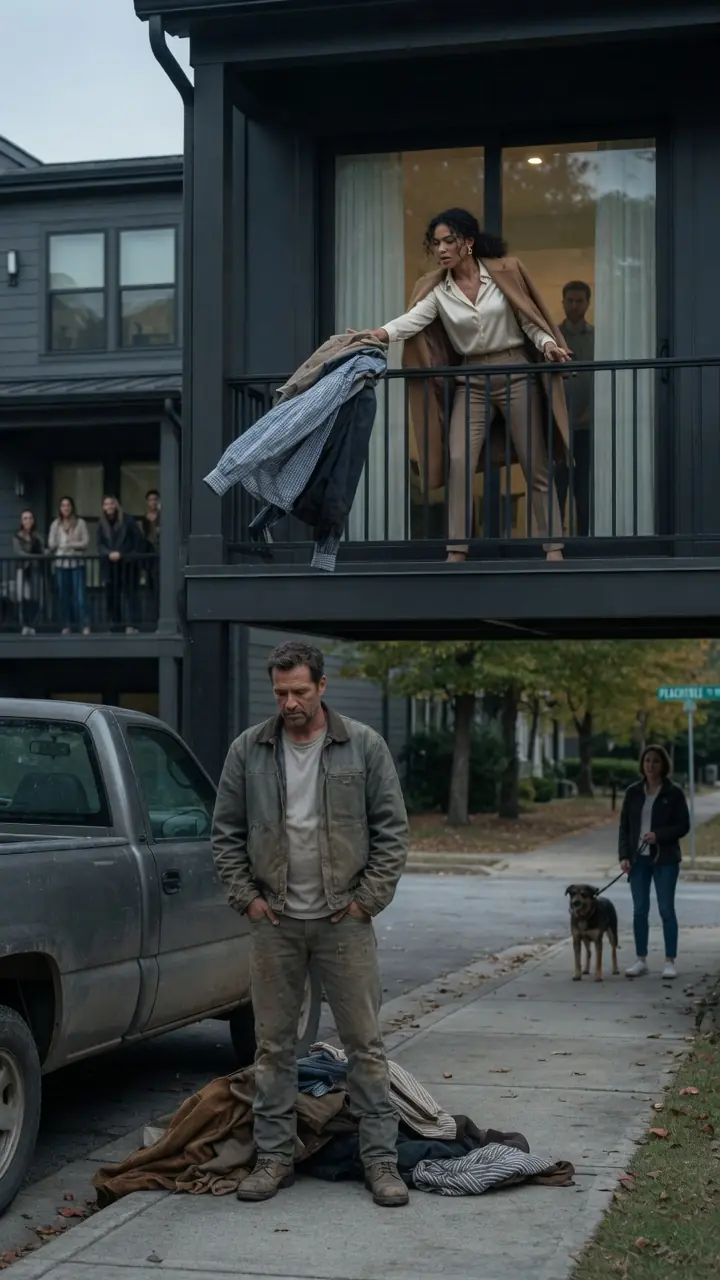
Caleb Wyn was thirty-nine years old on the Tuesday morning. His wife opened the bedroom window and threw every piece of clothing he owned onto the sidewalk below. He was standing at the base of the steps when the last shirt landed at his feet, looking up at the balcony of the townhouse he had purchased with his own money eight years prior, and his face held the same expression it always held. Quiet. Observational. Completely composed.
The neighbors came to their windows. A woman walking her dog paused on the opposite curb. Simone leaned over the railing and told him in a voice loud enough for the full block to hear that she wanted him out by Friday and that he needed to find somewhere else to be. There was a man upstairs. Caleb could see the silhouette moving behind the curtain.
She had already decided the townhouse was hers, the joint account was hers, and the future she had spent fourteen months engineering belonged entirely to her. What she did not know, what no one standing on that sidewalk could have known, was that forty-eight hours earlier, Caleb had received a call from an estate attorney in Savannah informing him that his great uncle Amos Bowmont Wyn, a man who had quietly accumulated timberland, commercial holdings, and mineral rights across four states over sixty years, had passed at the age of ninety-one. Caleb Alden Wyn was the sole named heir to an estate valued at eight hundred million dollars.
She threw his clothes off the balcony on a Tuesday. By Thursday, the paperwork was already signed. What happened next would cost her everything she thought she had already won.
The morning of that Tuesday had started the way most mornings started for Caleb. Before the sun was fully up, a thermos of black coffee on the passenger seat of his work truck. A set of site plans unrolled on the kitchen table the night before and already memorized by the time he drove away. He was a general contractor, had been since he was twenty-four, starting with small residential jobs in Decatur and building steadily to a point where his company now managed commercial retrofits and midscale developments across the Atlanta metro.
He drove a truck that had seventy thousand miles on it. He wore boots with dried concrete in the laces. His business cards were plain white with black text and his company name in a font he had chosen because it was legible, not because it was impressive. His great uncle Amos had raised him on that. The man had worn overalls to meetings with bankers. He had driven a 1994 pickup until the frame gave out.
He had once told Caleb, when Caleb was nineteen and home from his first semester of college, complaining about a classmate who drove a BMW his father had bought, “Son, the man who needs you to see what he has doesn’t have as much as he wants you to think. The man who doesn’t need you to see anything is the one you want to pay attention to.”
Caleb had written it in the margin of a textbook he still kept in a box in the garage.
He had married Simone six years ago. She was sharp and socially precise, the kind of woman who understood how a room worked the moment she walked into it. She had come from a family with modest means and a great deal of ambition, which Caleb had admired. She had wanted a life that looked a certain way, which he had understood. What he had not fully recognized until recently was the difference between building a life and performing one.
The first sign had been small and easy to explain away. A perfume he didn’t recognize that appeared one winter and was gone by spring. A text notification he glimpsed once from across the room. A first name he didn’t know. A message preview that was just warm enough to register and just brief enough to dismiss. He had not said anything. He was not a man who spoke before he understood the full picture.
In the inside pocket of his work jacket, folded neatly and slightly worn at the crease from being refolded too many times, was a letter. It had arrived six days ago from a law firm in Savannah. He had read it twice in the parking lot of a hardware store, sitting in the cab of his truck with the engine off. Then he had folded it back up and driven to the site. He had not yet told Simone about the letter. He had not yet told anyone.
The one detail he had not missed in all the months of watching and noting and filing things carefully away was the small outdoor security camera he had installed above the garage door two years ago after a contractor’s toolbox was stolen from a neighbor’s driveway. It was angled to cover the front approach of the house. It recorded to a cloud account in his name only. He had not checked the footage in weeks.
Standing on the sidewalk with his shirts at his feet, he thought about the camera for the first time in a long time.
He picked up his clothes from the sidewalk with the same methodical patience he applied to everything else. He folded them. He placed them in the bed of his truck. He drove to a hotel in Midtown, checked in for three nights, and set his thermos on the desk beside the window. Then he opened his laptop.
The cloud account for the security camera stored sixty days of motion-triggered footage. He started at the beginning of the window and worked forward, not rushing. He was looking for a pattern. Not a single moment. Engineers looked for patterns. A single data point was an anomaly. A pattern was a structure.
He found it by the third night of footage. A silver sedan, late model, Georgia plates, appeared in the driveway camera’s peripheral range on seven separate occasions over sixty days. Never parked directly in front. Always arriving after six in the evening on nights Caleb had worked late or been on an overnight job in Macon or Columbus. The sedan left before morning each time.
He ran the partial plate through a vehicle lookup service he had used before for contractor verification purposes. The registration came back to a man named Andre Tilman, thirty-six years old, a commercial real estate broker based in Buckhead. He noted the name. He kept watching.
On footage from five weeks ago, he caught a clear frame. Andre Tilman walking through the front door of Caleb’s townhouse with a key. His face remained perfectly calm.
He moved to the financial records. Next, he pulled up the joint checking account and went back nine months. What he found was not dramatic in any single instance. It accumulated the way structural damage did, slow and invisible until the load shifted. A transfer of twelve hundred dollars to an account he didn’t recognize in February. A similar transfer in March. A charge at a jewelry store in Lenox Mall that he had not made and had never been informed of. A weekend hotel charge in Athens from April that coincided precisely with a weekend Simone had told him she was visiting her college roommate in Savannah.
He built a spreadsheet. He entered every anomalous charge by date and amount. When he totaled the column, the nine-month figure came to twenty-two thousand four hundred dollars. He photographed the screen. He forwarded the bank statements to his business email. He moved with the same deliberate calm that defined all of his actions.
He searched Andre Tilman’s name alongside Simone’s on every public platform he could access. Most of her accounts were private, but a mutual acquaintance had tagged both of them in a photograph from a rooftop gathering in July, seven months ago, two months after Caleb had driven away on an extended job in Macon. They were standing two people apart in the frame. That distance was more careful than friends. It was the distance of people who had agreed on something.
He drove back to the townhouse the following morning while she was at work, using the key he had made no mention of keeping. On the desk of their shared home office, tucked beneath a stack of interior design magazines, was a manila folder. Inside it was a consultation summary from a family law attorney dated eleven weeks prior. In the margins, in Simone’s handwriting, was a preliminary division of assets she had mapped for herself. The townhouse was listed as a shared marital asset. His contracting business was listed as potentially subject to valuation. At the bottom of the page in her handwriting, “Check if he has retirement accounts.”
He photographed every page. He replaced the folder exactly where he had found it. He drove back to the hotel, sat at the desk beside the window, and opened the letter from the Savannah law firm for the third time. He read through the full valuation summary. Eight hundred million dollars in land, timber rights, commercial real estate, and liquid holdings accumulated and carefully structured over six decades by a man who had worn overalls to bank meetings. The estate had been established with the specific intention of passing intact to a single named heir. The heir was Caleb. Under Georgia law, it was classified as separate property in its entirety.
He set the letter down on the desk beside his thermos. He picked up his phone and called a number he had held in his contacts for four years without needing it.
“Claudette,” he said. “I need to sit down with you. Bring the Wyn estate file and your family law associate. I’ll explain when I get there.”
Claudette Marsh had managed the Wyn family’s legal affairs for eleven years. She had worked directly with Amos in his final decade, and she had spent those years learning that the Wyn men communicated in facts and patience and very few words. Caleb was no different.
She spread the estate documents across the conference table in her Savannah office and walked him through the full picture with the unhurried precision of someone who had been preparing for this conversation. The eight hundred million was not a round number for effect. It was a conservative valuation based on current timber prices, commercial property assessments across three states, and liquid accounts that had compounded quietly for thirty years. A single land parcel on the Georgia coast was worth more than most people would earn in four lifetimes.
Simone’s name appeared nowhere in the estate documents. It never had. Amos had met her once at a family gathering in Savannah three years ago and said nothing to Caleb about her directly. He had two weeks later quietly revised the single clause in the will, specifying that the inheritance was to pass to Caleb as his sole and separate property under any circumstance, including divorce. Claudette had drafted the revision. She had not asked why.
“The inherited estate is entirely protected,” Claudette said. “She gets nothing from Amos’s holdings regardless of how the divorce proceeds.”
“And the townhouse,” Caleb said.
“You purchased it before the marriage. The title has always been in your name only. She never signed on to the deed.”
Simone had assumed otherwise. He had never corrected her.
He drove from Savannah to his aunt Vera’s house in Augusta that same afternoon. Vera Wyn was sixty-four and the last of Amos’s generation still living, a retired schoolteacher who had watched Caleb grow from a quiet boy with a measuring tape into a quiet man with a company. She met him at the door with both hands around his face and held him there for a moment before she let him inside. She had sweet tea already poured. She did not wait for him to explain.
“Your uncle told me,” she said. “About the will. About all of it.”
Caleb sat. He wrapped both hands around the glass.
“He also told me about your wife,” Vera said.
He looked at her carefully.
“He was old, but he was not careless,” Vera said. “He hired someone about a year before he passed. She had been moving things around trying to find the door. She believed you had more than you showed.”
Caleb was quiet for a moment.
“She wasn’t wrong that there was a door,” he said.
“No,” Vera said. “She just didn’t know she was already standing inside what she was looking for.”
She set down her glass and looked at him with the steady patience of a woman who had seen a great deal and mourned the right things.
“Your great uncle used to say,” she began, “that you could tell the character of a person by what they reached for when they thought nobody was watching.” She paused. “She was reaching, baby. She just reached in the wrong direction.”
He drove back to Atlanta that evening and went to work. He met with his corporate attorney the following morning and initiated a formal review of the joint account documenting nine months of transfers as a complete financial record. He had Claudette’s family law associate file a preliminary protective response to a divorce petition that had not yet been formally submitted. A clean, precise measure that ensured Simone could not make a single asset move without it being immediately visible to opposing counsel.
He also placed a quiet call to the commercial property manager who handled a building on Peachtree where Andre Tilman’s real estate brokerage kept its office. That building, as of sixty-three days prior, when the estate transfer had been processed, was one of four Atlanta-area commercial properties that now fell within the Wyn holdings Caleb had inherited. Andre Tilman was a tenant in a building that Simone’s husband now owned outright.
A certified letter went out the following day informing Tilman that his lease renewal due in thirty days would not be extended. The letter cited a portfolio restructuring under new ownership. It included the name of the new owner. He made a note. He filed it.
He went home that evening. He had called Simone that afternoon, told her calmly that he was going to collect a few more things from the townhouse and that he hoped they could handle the situation like adults. She agreed in the tone of someone who believed she had already won.
He made dinner. He reheated a rice dish she had prepared earlier in the week. He ate at the counter. She sat at the table and looked at her phone. She asked if he had found a place to stay. He told her he was managing. She did not look up. He washed his dish. He said good night. He drove back to the hotel and slept soundly.
Some things, when they were already built correctly, did not require noise to hold.
The mediation was scheduled for a Wednesday morning at Claudette’s associate’s office on Peachtree Street. It had been framed to Simone’s attorney as a standard asset review preceding a no-contest divorce filing. Simone arrived at 9:05 with her attorney, composed and deliberate, wearing the gray blazer she wore to presentations she intended to control. Andre Tilman was not present. He had been informed the previous evening by certified letter from the property management company that his lease would not be renewed. The letter cited a portfolio restructuring under new ownership. It provided the name of the new owner. He had, by Simone’s account when she called him after reading it, said very little and hung up.
Caleb was already seated when they came in. Claudette sat to his right. His corporate attorney Gregory sat to his left. The Wyn estate files sat on the table in a gray folder. Closed.
Simone’s attorney opened with a standard recitation. Duration of the marriage. Shared assets. The marital residence. He referred to the townhouse as a jointly occupied marital property. He noted the joint checking account. He mentioned the contracting business and stated his client’s interest in a fair valuation.
Caleb let him finish.
Claudette opened the gray folder, placed the first document on the table, and slid it across. Simone’s attorney picked it up. He read the first page. He turned to the second. He set it down and looked at Caleb for a moment with the expression of a man recalibrating everything he had been told to prepare for.
Simone reached over and took the document herself. Caleb watched her read it. He watched her eyes stop on the valuation line. He watched her read it again. He watched the understanding move across her face. Not all at once, but in stages. The way light shifts when a cloud moves and you realize the day was darker than you knew.
“Eight hundred million,” Claudette said, “is the current assessed value of the estate Caleb inherited from his great uncle Amos Bowmont Wyn, who passed eleven days ago. The estate was established and held entirely in the Wyn Family Trust prior to this marriage. Under Georgia law, it is classified as separate property in its entirety. It was not co-mingled. It was not contributed to the marriage. His name is the only name on it. It always has been.”
Simone set the document down.
Claudette placed a second document on the table.
“This is the deed to the townhouse. You will note the title was transferred to Caleb’s name in the year he purchased it. Two years before the marriage. His name alone.” She paused. “She has never been on the deed.”
Simone looked at her attorney. Her attorney was reading.
Claudette placed a third document on the table.
“This is a nine-month financial summary of the joint marital account documenting twenty-two thousand four hundred dollars in transfers and charges your client made to accounts and expenditures not shared with my client and not disclosed to him. We are not pursuing recovery. We are placing it on record.”
The room was quiet.
Simone’s attorney said he would need a moment to consult with his client.
Simone was not looking at him. She was looking at Caleb with an expression he had not seen from her before. Stripped of the social precision she carried everywhere, reduced to something raw and unguarded and too late.
She said his name.
He looked at her without anger, without satisfaction, with the same expression he had worn on the sidewalk when her clothes landed at his feet.
She said, “I didn’t know.”
He let the silence hold for a moment.
“You didn’t ask,” he said. “That was always the difference between us.”
He stood. He buttoned his jacket. He picked up his phone and his keys. He looked once at Claudette, who gave him the smallest nod. He left the room without looking back.
The hallway was cool and quiet. The elevator came immediately. He rode it down alone, walked through the lobby, and stepped out onto Peachtree Street into a morning that was already warm and full of ordinary motion. Cars. Pedestrians. A construction crew working on the facade of the building across the street.
He stood there for a moment and watched two workers set a cornerstone into place with a level and a rubber mallet, tapping it down until it held.
He drove to the job site in Sandy Springs and checked the structural progress on a retaining wall his crew had poured the day before. It was clean. The angles were true. The drainage channels ran exactly where the plans called for them.
He drove home.
Ten months had passed, like water moving over something permanent.
Caleb had moved back into the townhouse three weeks after the mediation. He had repainted the living room a deep warm gray, pulled up the carpet in the back bedroom and replaced it with hardwood he had milled himself from a timber parcel on the Georgia coast. Wyn land. Old-growth oak. Wood that had been in the ground longer than any of the trouble that had come and gone.
He had built a new deck off the back of the house over a long weekend in September, working alone in the early morning before the heat settled in. Each board set level and true. He stood on it most evenings now with a glass of water and watched the light leave the sky.
Her name was Diane. She was a structural engineer with a firm in Midtown. They had been introduced at a professional association dinner in November by a mutual colleague who had made the introduction without fanfare or particular intention. She had opinions about load distribution and asked him questions about timber construction that required him to think before answering. She had not performed for him once in the four months he had known her. He was not in a rush. She appeared not to be either.
The first phase of the Wyn estate’s commercial portfolio restructuring was complete. Claudette had assembled a management team in Savannah to oversee operations. The timberland was under new sustainable harvest contracts. The commercial properties in Atlanta, Savannah, and Charleston were fully leased and managed.
Caleb had established a foundation in Amos Wyn’s name focused on construction trade education for young men from working-class families across the Southeast. The first cohort of twelve was already enrolled.
He heard about Simone through a mutual acquaintance in the spring. She had left Atlanta in January, relocated to Birmingham to take a regional sales position that paid considerably less than the role she had left behind. The townhouse sale had netted her nothing. Her name had never been on the deed. The joint account had been closed at mediation. Her attorney had extracted her from the process with minimal exposure and considerably less compensation than she had mapped out in her own handwriting eleven weeks before Caleb had photographed those pages.
Andre Tilman had relocated as well. His brokerage had folded within sixty days of losing the Peachtree office. He was, last anyone had heard, doing independent consulting from an apartment outside Charlotte. No firm name. No associates listed.
Caleb heard all of this in the time it took to walk from one end of a job site to the other. He filed it in the same place he filed everything that had already been resolved. Back and down where it belonged.
He was in the workshop behind the house on a Saturday morning when the early light came in low through the single east-facing window. He was sanding a piece of walnut he intended to use for a small side table, moving with the grain in slow, even strokes, turning the wood in his hands until the surface was smooth enough to hold the finish properly. A cardinal moved through the oak at the back of the yard and was gone.
He had built everything worth keeping.