“Seventy-two acres of nothing.”
Grant Pritchard said it loudly enough for everyone near the auction tent to hear.
“No water. No future. No point.”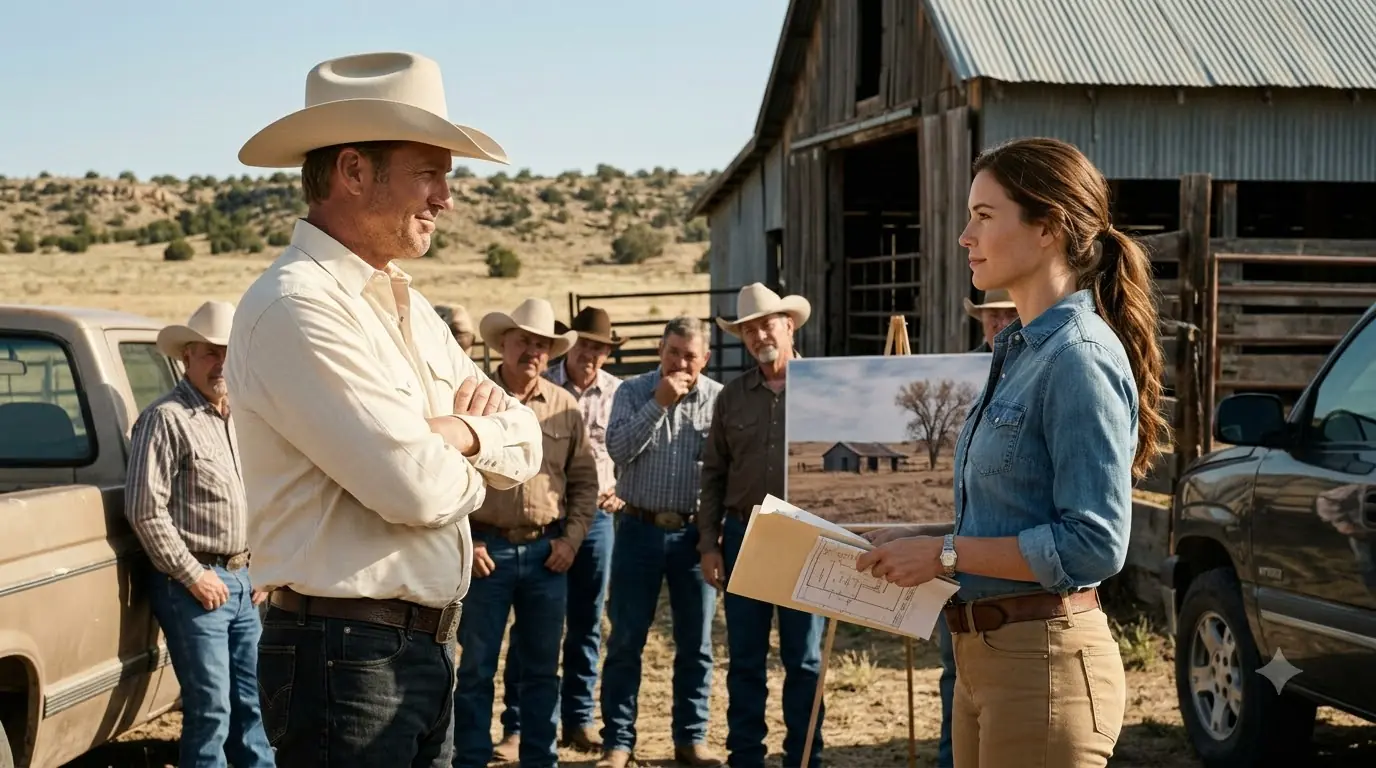
A few ranchers around him smiled. One man gave a short laugh as though Grant had summarized the property so perfectly there was nothing left to discuss.
Reina Fletcher kept her eyes on the auctioneer.
“I’ll take that chance.”
Grant turned toward her.
He was a large man in his late forties, broad through the shoulders, sun-reddened around the neck, dressed in an expensive Western shirt and boots that had seen more truck floors than mud.
He looked from Reina to the auctioneer, then back toward the seventy-two acres of dry land visible beyond the temporary sale tent.
“You’re paying real money to babysit a dead ranch.”
Reina said nothing.
The auctioneer raised his voice.
“Five thousand five hundred. Do I have fifty-seven?”
Nobody moved.
Grant folded his arms.
The auctioneer scanned the small crowd one final time.
“Five thousand five hundred once.”
Reina could feel every face turning toward her.
“Twice.”
Grant smiled.
“Call me in three months. I’ll buy it back for less.”
The auctioneer brought down his hand.
“Sold. Five thousand five hundred dollars.”
A clerk stepped toward Reina with the paperwork.
Grant laughed quietly.
“You just bought seventy-two acres of dust.”
Reina took the pen.
She signed anyway.
The day Reina Fletcher bought Juniper Crown Ranch, almost everyone at the Red Basin county auction believed Grant Pritchard had just watched a thirty-six-year-old woman make a very expensive mistake.
Grant believed it more strongly than anyone.
He owned more than sixteen hundred acres east of Juniper Crown. His cattle operation was one of the largest in that section of the basin, and he had expected the Rourke property to fall into his hands for little more than unpaid taxes and closing costs.
To him, Juniper Crown was not really a ranch anymore.
It was buffer land.
Extra grazing.
Something to absorb into the edges of a larger operation.
He had already decided what it was worth before he arrived.
Reina had not.
She had spent two hours walking the property the previous afternoon.
And during those two hours, she had noticed three things Grant had not bothered to look at twice.
That difference was about to matter more than either of them understood.
Reina had never imagined owning a ranch by thirty-six.
For nearly twelve years, she had worked as an irrigation systems technician and field designer across New Mexico and West Texas. Her job took her from commercial cattle operations to pecan orchards, horse properties, feed yards, remote well sites, and agricultural developments so large that crews needed maps just to find individual valves.
She knew pumps.
She knew pipe.
She knew pressure loss, elevation, water storage, soil infiltration, erosion, irrigation scheduling, and the thousand small ways a badly designed system could waste the one resource nobody in the Southwest could afford to waste.
Water.
Some technicians became good at equipment.
Reina became good at land.
Give her a topographic map, an afternoon in work boots, and access to a property, and she could often tell you where runoff collected, where soil compacted, where water disappeared too fast, and where vegetation was quietly telling a different story than the owner believed.
She had learned early that water rarely moved the way people wanted it to.
It moved according to gravity, geology, pressure, permeability, temperature, and time.
It also left evidence.
A mineral stain.
A different grass species.
A line of shrubs growing where the surrounding pasture had failed.
A depression that stayed cool after everything around it heated.
A cottonwood tree surviving where no cottonwood ought to have survived without access to moisture somewhere below.
Reina had built irrigation systems for men who owned ten times more land than she could dream of buying.
She would arrive, study the property, redesign something they had misunderstood, solve a pressure problem, locate a leak, reduce waste, and then drive away at sunset.
The ranch remained theirs.
The knowledge left with her.
For years she told herself that was enough.
She had a career.
Good reputation.
Steady income.
Her own truck.
No major debt.
But sometime after thirty, the feeling changed.
She began wanting a piece of ground where every improvement remained after she left.
Not a hundred thousand acres.
Not some romantic empire.
Just land that answered to her decisions.
She started saving deliberately.
Extra projects.
Weekend consulting work.
Old truck kept two years longer than planned.
Small apartment instead of a house.
By the time Juniper Crown appeared in the county auction listings, she had saved $18,700.
That amount gave her options.
It did not give her good options.
Any ranch with functioning water, usable fencing, decent pasture, and a livable house cost far beyond what she had.
So Reina changed the question.
Instead of asking what ranch she could afford to buy, she started asking what problem she could afford to solve.
That led her to tax auctions.
Estate sales.
Distressed properties.
Places everyone else already knew had something wrong with them.
She studied listings at night.
Most she rejected immediately.
Some had legal access problems.
Some had structural liabilities.
Some sat in flood zones that explained the attractive price.
Others simply required more money than she possessed to become useful again.
Then Juniper Crown Ranch appeared.
Seventy-two acres.
Red Basin.
Dwelling in poor condition.
One deteriorated cattle shed.
Boundary fencing in mixed condition.