“Excuse me. Who seated him there?”
The question cut across the seventh-floor dining room of Meridian with enough sharpness to turn three heads at nearby tables.
Nkiru Eze looked up from the tray in her hands.
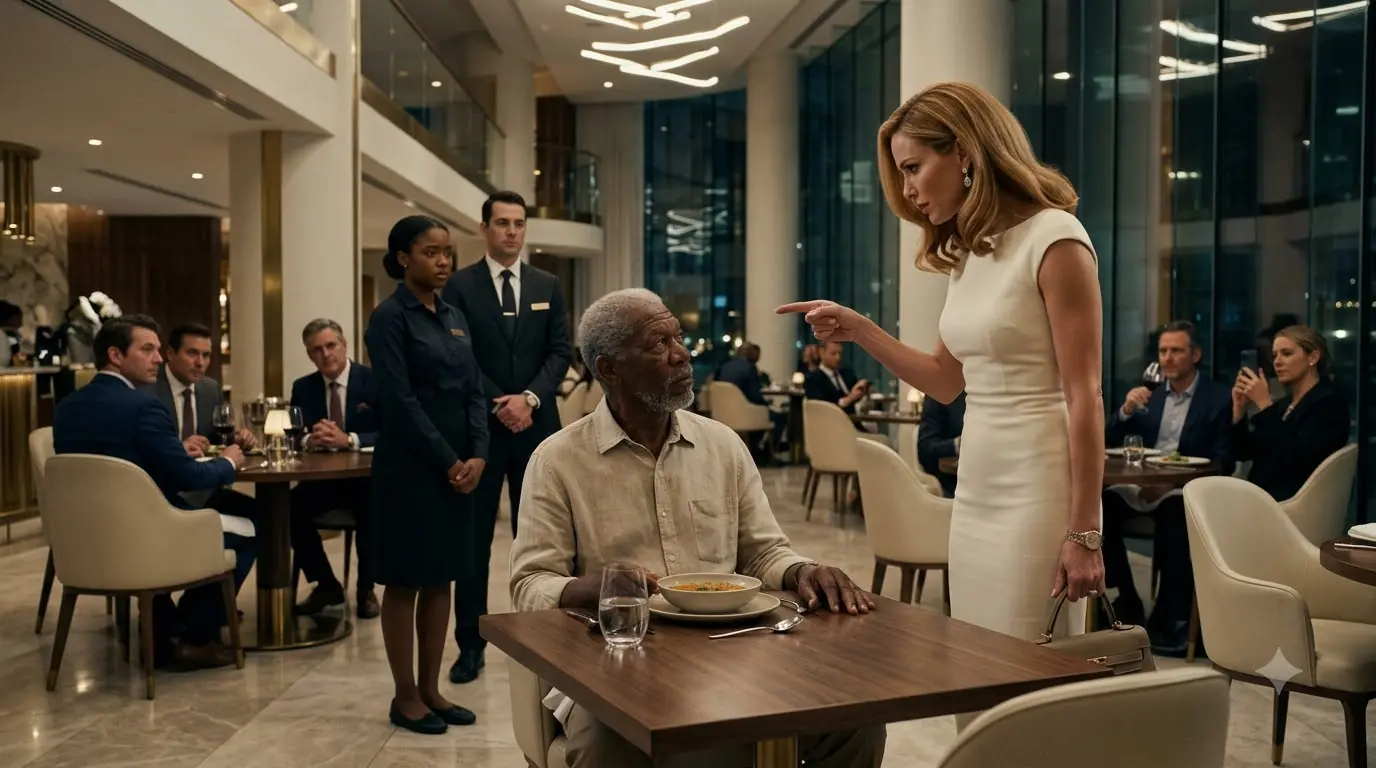
The woman standing beside Table 12 was Renée Balogun, daughter of one of the most influential men connected to Akinwale Group. Renée was dressed for a private business dinner in an ivory designer suit, gold watch, diamond earrings, and the expression of someone who had spent most of her life watching people rearrange rooms when she entered them.
“I did, ma,” Nkiru answered.
Renée looked past her toward the elderly Black man seated alone at the two-person table beside the window.
He wore a faded dark kaftan under an ordinary brown jacket, inexpensive leather sandals, and no visible watch. His closely cropped gray hair and quiet posture made him look like somebody’s retired uncle who had wandered into one of Lagos’s most expensive restaurants without realizing how carefully the room divided itself by class.
Renée lowered her voice only slightly.
“We’re discussing business.”
Nkiru nodded.
“I understand.”
“Then move him somewhere else.”
Nkiru glanced at the dining room.
Every other table near the private section was occupied.
“Table 12 was reserved for one guest, ma. He arrived before your party requested additional space.”
Renée stared at her.
“Do you know how much we are spending here tonight?”
The elderly man raised one hand.
“Young lady, it’s all right. I can move.”
Nkiru turned immediately.
“No, sir.”
Her tone softened.
“You’ve already ordered. You were seated properly. You have every right to remain where you are.”
Renée let out a quiet laugh.
“Interesting.”
Nkiru looked back at her.
“So now waitresses give lectures on rights.”
“Not a lecture, ma.”
Nkiru kept her voice respectful.
“Just the seating arrangement.”
Renée looked the elderly man over.
His jacket.
His sandals.
The bowl of pepper soup in front of him.
Then she looked at Nkiru.
“Her father sits on our parent company’s executive committee,” one of Renée’s companions murmured, clearly intending the information as a warning.
Nkiru’s face did not change.
“Does that change the price of his pepper soup?”
Silence.
Renée’s eyes narrowed.
“Don’t be clever with me.”
“I’m not trying to be.”
“Places like this need standards.”
Nkiru set her tray down on an empty service stand.
“The gentleman is a customer.”
“Everybody shouldn’t simply walk in because they can afford one bowl of soup.”
The elderly man looked down.
Not from shame.
From disappointment.
Nkiru felt something in her chest tighten.
She had spent almost a year at Meridian watching wealth perform itself in small, exhausting rituals. Who got greeted by name. Who was expected to wait. Who had their chair pulled out. Who could speak sharply to staff without consequence. Who apologized when they were late and who believed money made apology unnecessary.
Most nights she survived by moving around those rules.
Tonight, something in her refused.
“Ma,” she said, “I’ll have to ask you not to insult another guest.”
Renée stared at her in disbelief.
“You will ask me?”
The old man spoke again.
“Leave it, my dear.”
Nkiru looked at him.
He smiled faintly.
“You don’t need to lose your job because of me.”
Nkiru’s eyes stayed on his face.
“If I keep quiet because she’s rich, then I’m agreeing that money determines who deserves respect.”
The words left her before caution could stop them.
For the first time, the elderly man looked at Nkiru with real interest.
Renée did not miss it.
She turned toward the floor manager.
“Sola.”
Sola Adeyemi had been watching from near the wine station.
He was forty-six and had worked in hospitality for nearly twenty years. Meridian’s senior management had recently begun hinting that he might be moved into a regional operations role if he proved capable of controlling the restaurant’s increasingly demanding clientele.
Usually Sola handled conflict smoothly.
Tonight his face looked pale.
He knew Renée.
More importantly, he knew her father.
Kunle Balogun was not merely wealthy.
He sat on Akinwale Group’s executive committee and had controlled significant parts of the company’s finance operation for years.
Renée pointed at Nkiru.
“Either she leaves this floor or we do.”
Sola looked toward the elderly man.
Then at Renée’s party.
Six people.
Private wine selection.
Executive menu.
A bill that could exceed what Nkiru earned in several months.
His decision took less than ten seconds.
“Nkiru.”
She turned.
“Remove your apron.”
The dining room went still.
“Sola?”
“You are suspended.”
Her face changed.
“Effective immediately.”
Renée leaned back slightly.
Satisfied.
Nkiru looked at the man she had defended.
He appeared more troubled by her suspension than by anything said to him.
“Young woman,” he said quietly, “what is your name?”