Sixty tractors, every one of them broken.
And seventy-year-old Earl Whitaker had just paid $1,000 for the entire row, which was enough to make the other buyers at the auction yard laugh out loud.
They did not laugh behind their hands, either.
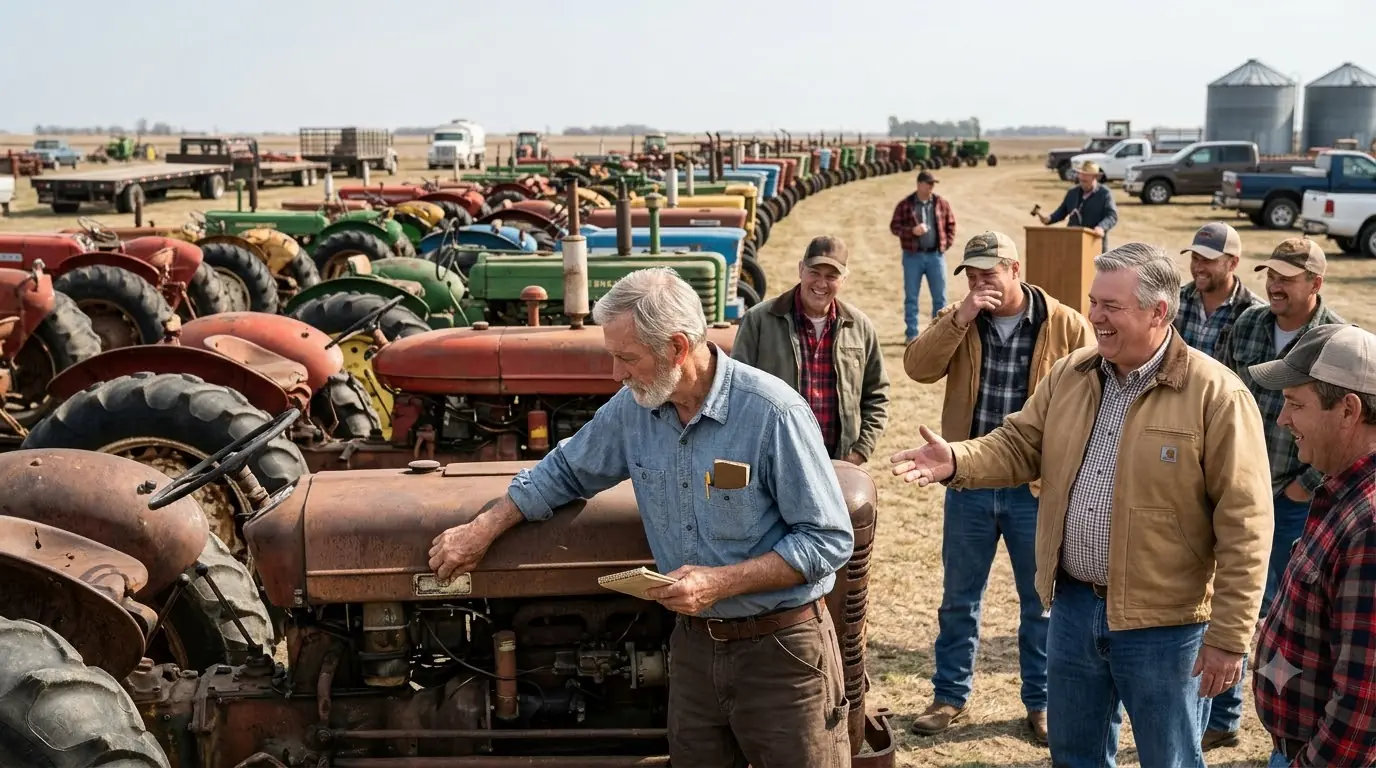
They laughed the way men laugh when they think the joke is safe, when they are sure the man they are laughing at is too old or too stubborn or too far gone to understand what he has done. ''
One fellow in a seed company cap actually slapped his knee. Another said, loud enough for half the yard to hear, "Well, there goes the farm." And somewhere near the concession trailer, where the coffee was burnt and the doughnuts were two days old, somebody whistled the long, falling whistle of a bomb dropping out of the sky.
Earl did not turn around. He folded the bidder card in half, slid it into the breast pocket of his flannel shirt beside the small spiral notebook that lived there, and looked down the row of machines he now owned.
But to understand why he did not turn around, and why the laughter rolled off him the way rain rolls off a freshly painted hood, you have to go back to that morning, three hours earlier, when the auction yard was still wet with dew and nobody had noticed him at all.
The yard sat on the edge of the county, past the grain elevator and the shuttered implement store, on twenty acres of gravel and packed clay that had been flattened by fifty years of trucks and trailers. Twice a year the auction company filled it with everything a farm could outlive: balers and combines, disc harrows and planters, livestock gates, fuel tanks, pallets of fence posts, boxes of rusted tools sold by the lot. People came from three counties. Some came to buy. Most came to look, to drink the bad coffee, and to find out which of their neighbors had finally given up.
Earl arrived at seven, which was early enough to park close and late enough that he did not have to stand around talking to anyone before the gates opened. He drove a twenty-two-year-old pickup with a bench seat and a toolbox bolted behind the cab, and he backed it into a spot near the fence because he had backed every vehicle he ever owned into every spot he ever took. You back in so you can drive out. You plan for leaving before you arrive. His father had taught him that, and his father had learned it from a war.
He wore what he always wore: work boots resoled twice, canvas pants faded to the color of dry dirt, a flannel shirt with the sleeves rolled to the elbow, and a feed store cap that had once been red. In the left breast pocket of the shirt was a pencil and the notebook. The notebook was the size of a deck of cards, with a wire spiral across the top, and it was the fourth of its kind that year. Earl went through notebooks the way other men went through chewing gum.
He walked the rows slowly. He did not need anything. That was the honest truth of it, and if anyone had asked him why he had come, he might have said he wanted to get out of the house, or that he liked to see what equipment was going for, or that he had nothing better to do on a Saturday. All of those things were true. None of them were the whole truth. The whole truth was that Earl Whitaker had spent more than forty years with his hands inside machines, and when you have done a thing that long, you do not stop wanting to see it just because somebody hands you a retirement card and a sheet cake.
He passed the combines, which drew the biggest crowd. He passed a pair of nearly new compact utility tractors that young couples with hobby farms were circling like hawks. He passed the hay equipment and the grain carts and a row of lawn tractors that somebody had pressure-washed until the decals peeled.
And then, at the very back of the lot, past the scrap pile and the stacks of used tires, he found them.
---
They had been lined up in a single long row along the back fence, nose to tail, the way a trucking crew unloads when it is in a hurry and does not care what anything looks like. Sixty tractors. Earl counted them twice to be sure. Utility tractors, mostly, and some mid-size row-crop machines, the kind that had been the backbone of small and medium farms for decades. They were all of an age, give or take ten years. They were all the same tired shade of faded paint, sun-bleached on the top and rust-streaked down the sides. And every single one of them was broken.
You did not have to be a mechanic to see it. Several sat on flat, cracked tires that had split along the sidewalls like dry bark. Two had no hoods at all. One was missing its entire steering wheel, the column ending in a bare splined shaft. Hydraulic hoses hung loose from fittings, their ends capped with nothing, their insides crusted with dried fluid the color of old honey. A few had their side panels removed and their engines exposed, and in those engines you could see empty bolt holes where starters and alternators and injection pumps had once been. Puddles of something dark had soaked into the gravel beneath half the row. A smell hung over everything, the sour, heavy smell of old diesel, burnt clutch, and gear oil that had sat too long in the heat.