“Get your dirty hands off my counter. You smell like you crawled out of a dumpster.”
The manager grabbed the old man by the collar and shoved him back from the counter. “I just want to open an account.”
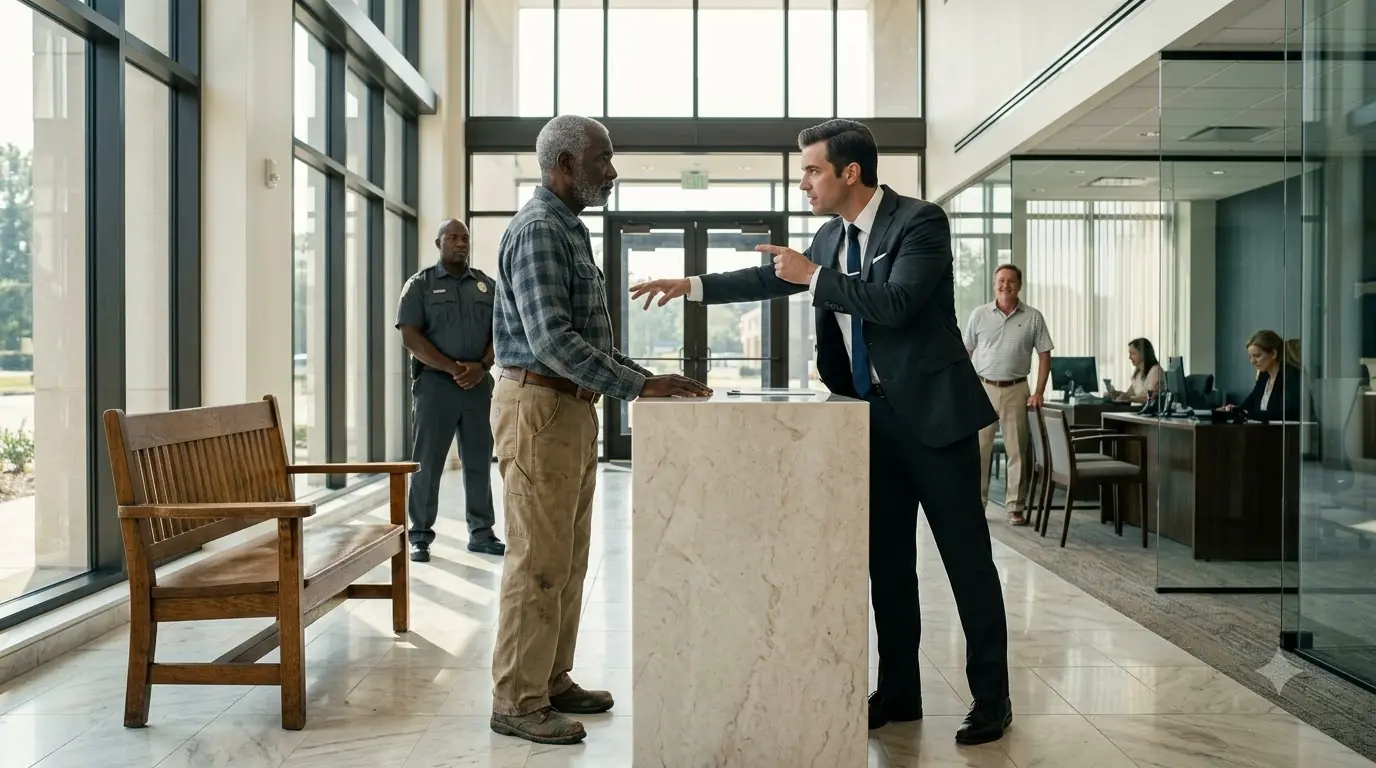
“An account? You probably can’t even afford dinner tonight.” The manager jabbed a finger in his face and laughed. “And you’re asking to open an account?”
He grabbed the man’s collar again and screamed in his face. “This bank ain’t for broke bums like you.”
A white customer in the VIP lounge watched and laughed. The old man didn’t leave. He sat down in a lobby chair, and for 45 minutes, not one person in that bank said a word to him. But those 45 minutes of silence were about to cost that manager everything.
Three hours earlier, Milton Hayes woke up at 6:00 the way he always did. No alarm, just habit. He let the dog out, filled the water bowl, and stood in his backyard in Birmingham, Alabama, watching the sprinklers tick across the lawn he had mowed himself the day before. His hands were rough, his nails were short, and he wore a flannel shirt faded from blue to something closer to smoke, along with a pair of garden boots with dried mud caked around the soles.
He didn’t look like a man who owned anything worth mentioning. That was the point.
In his home office, a small room off the kitchen with a single window and no art on the walls, Milton sat down in an oak chair with heavy, wide armrests, out of place next to the secondhand desk and the filing cabinet he had owned since the 1990s. He ran his thumb along the underside of the right armrest, slow and familiar, the way someone might touch a rosary before leaving the house. There was something carved into the wood there. He never showed it to anyone, and he never talked about it.
On the desk sat a framed photograph of a tall man in a brown suit standing in front of a storefront with a hand-painted sign: HAYES COMMUNITY CREDIT UNION — SERVING ALL. The man was Raymond Hayes, Milton’s father. The year was 1994. Raymond’s chin was lifted, his shoulders square, and behind him, through the glass door, five empty chairs waited for customers who hadn’t come yet.
Raymond never saw what his son built from that storefront. He died in 2001, four years before Heritage Union Bank opened its second branch. By then, five chairs had become 50, and a struggling credit union with $400,000 in deposits had grown into a community bank managing $280 million in assets across four branches in central Alabama. Milton did it with his teaching savings, a Small Business Administration loan, and a sentence his father had once spoken when Milton was 17.
Raymond had just been turned away from a loan office in 1971, denied a home loan with no real explanation beyond the one written across the loan officer’s face. On the drive home, Raymond gripped the steering wheel and said seven words Milton never repeated aloud but carried into every decision he made: “They’ll tell you there’s no room. You build your own room.”
Milton built rooms.
Now he was building the biggest one yet, a flagship branch in Crestwood, a suburb 20 minutes west of downtown Birmingham. Green lawns, German cars, country club memberships. Median household income: $112,000. The neighborhood was 81% white.
Heritage Union had never operated in a neighborhood like this. The board had questions. Milton had one answer: “A community bank that only serves one community isn’t a community bank.”
He hired a new branch manager from outside, Spencer Ridley, 38, poached from a commercial bank in Atlanta. Ridley had the résumé: 12 years in retail banking, regional sales awards, and a Wharton certificate in wealth management. What he didn’t have was a single day of community banking experience. He had never worked at an institution where the mission statement mattered more than the quarterly numbers.
Milton knew the risk. He hired Ridley anyway because Crestwood needed credibility with a clientele that wouldn’t trust a name they had never heard of.
The branch opened on a Monday. By Thursday, Milton was ready. Every new Heritage Union branch got one visit. Milton would drive over alone, unannounced, dressed the way he always dressed: flannel, old boots, no watch, no ring.
He would walk in like any customer off the street, walk up to the counter and ask to open an account, then sit down, wait, and watch. He wasn’t measuring revenue projections or teller speed. He was measuring one thing: How does this branch treat the last person in the room, the person nobody is watching, the one who doesn’t look like money, the one who could be anyone or no one?
Milton pulled his 2009 pickup into the Crestwood lot between a silver BMW and a Lexus SUV. He killed the engine and looked through the windshield at the building: floor-to-ceiling glass, a polished stone entrance, and the Heritage Union logo etched in gold above the door. Forty feet of modern architecture had been built on a promise a dead man made in a storefront with five empty chairs. Milton stepped out, straightened his flannel, and walked toward the glass doors.