Chapter 1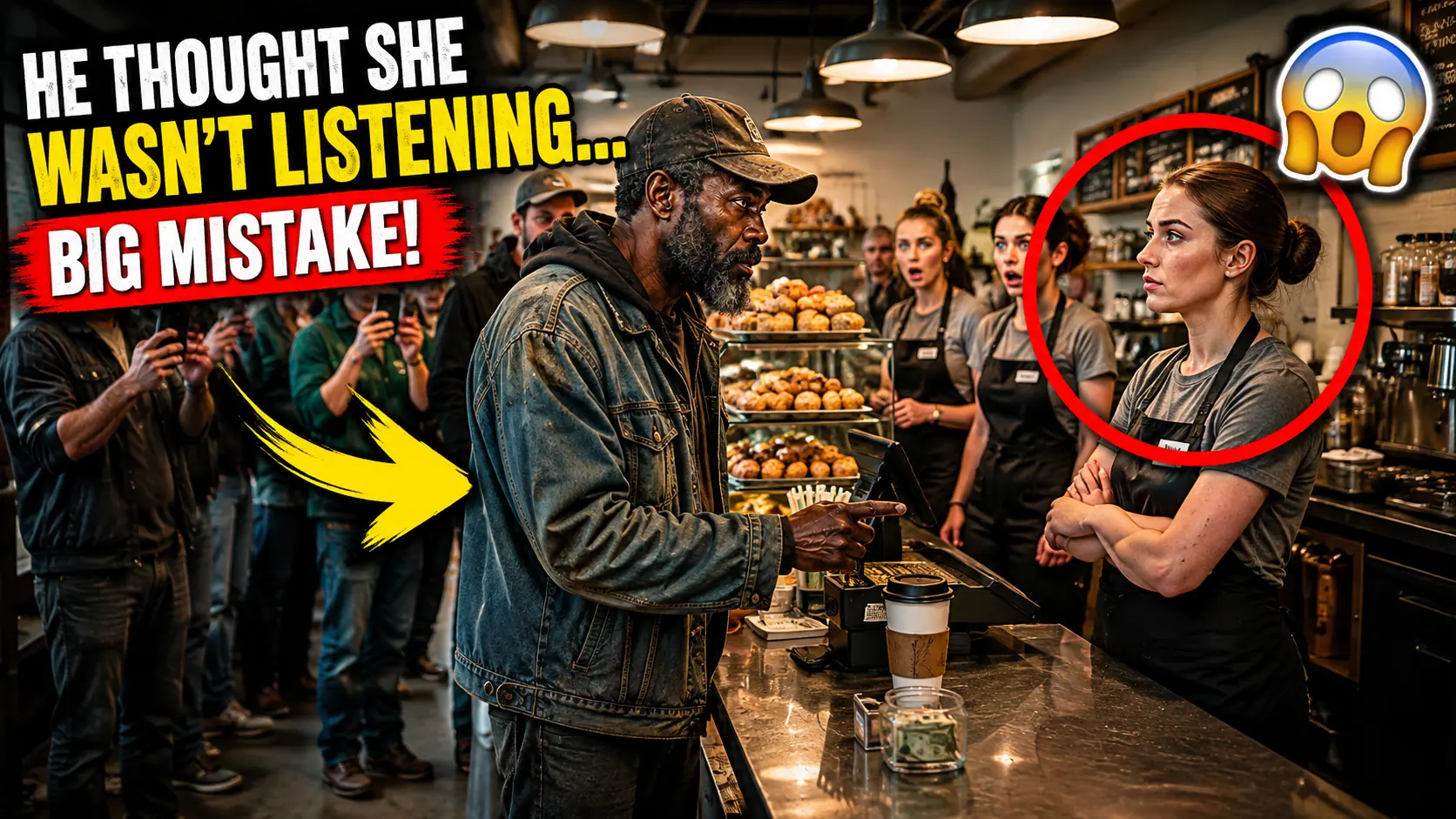
“Yo, did this dirty man just walk in here like he owns the place?” The cashier said it loud, chin up, lips curled. “Order or get out.”
“A cortado, please.” The first one barked a laugh. “A cortado? You don’t even know what that is. Get your black coffee and go sit on the curb where you belong.”
“Tiff, look at him. Dude crawled out of a trash can. Bet that card’s stolen.” Six people in line. Not one opened their mouth. The man paid cash, sat down, bit into banana bread, and froze mid-bite. Not because of what they said—he’d heard worse his whole life just for existing in rooms like this. He froze because of what they said next when they thought nobody was listening.
Harold Coleman built Iron Brew Coffee with his hands. Not a metaphor. His actual hands. Twenty-three years ago, he welded a steel cart together in his mother’s garage in Englewood, Denver. The kind of neighborhood where coffee shops didn’t exist because nobody thought the people there deserved one. He was twenty-nine, broke, and stubborn enough to believe that a black man with a cart and a dream could build something that lasted. He did. One cart became a storefront. One storefront became five. Five became forty.
Iron Brew Coffee now stretched across Colorado, Utah, and New Mexico. A specialty chain known for its seasonal menu, its hand-roasted beans, and the motto printed on every cup: Everyone deserves a seat. Harold wrote that line himself the year he opened his first real store. He was thinking about his mother, how she used to take him to a cafe downtown when he was a boy, and how the waitress always seated them by the kitchen door, never by the window. He promised himself if he ever built something, everyone would get the window seat.
Now he sat in a corner office on the fourteenth floor of a glass building in downtown Denver. The photo of the original cart hung on the wall behind his desk, faded. The wood still stained with espresso. He hadn’t touched an espresso machine in three years. Hadn’t walked into one of his own stores as anything other than a name on a letterhead. He didn’t need to. The numbers were good. Revenue up eleven percent. New locations in Albuquerque and Salt Lake City. The board was happy. The investors were happy.
Then his assistant Lisa walked in on a Tuesday morning and dropped a folder on his desk. “You need to read these,” she said. “Today.” Inside, thirty-one printed Glassdoor reviews for the Denver flagship, his original store, the first real location, the one he’d built with his own money before any investor said yes. The reviews were from the last six months. Harold read the first three and his stomach dropped.
“The cashiers looked at me like I was trespassing in my own city. I’m a fifty-eight-year-old woman. The girl at the register spoke to me like I was a stray dog. I will never go back. Hostile, humiliating. I left my coffee on the table and walked out. Didn’t even want it anymore.” He kept reading. Thirty-one reviews. Twenty-two mentioned the same thing. Not the coffee, not the prices, not the food. The staff. The way certain customers were treated differently than others. Words repeated across the reviews like a drumbeat: unwelcome, ignored, disrespected, embarrassed.
Harold pulled up the internal dashboard on his screen. The flagship store’s customer satisfaction score, dead last out of forty locations. The store he built first was now the worst. He picked up the phone and called the flagship store manager, a guy named Craig, been there two years, decent enough on paper. “Craig, I’m looking at the Glassdoor numbers for your store. Walk me through what’s going on.” Craig’s voice was calm, practiced. “Mr. Coleman, with all due respect, people leave bad reviews when they don’t get free refills. It’s noise. My team is solid. We’re hitting our sales targets.” “Your customer sat score is dead last.” “Sir, satisfaction surveys are subjective. We can’t control how people feel.” Harold paused. He recognized that tone—smooth, deflective, the voice of someone who’d rehearsed the answer before the question was asked. “I hear you, Craig,” Harold said. “Appreciate your time.” He hung up, stared at the phone for a long time.
That night Harold drove to the flagship store alone, parked across the street, engine off. It was 9:15, closing time. Through the glass he could see two young women behind the counter. One was wiping down the espresso machine. The other was on her phone, leaning against the register. A customer walked in, a man in work boots and a paint-stained shirt. Harold watched. The cashier on her phone didn’t look up, didn’t greet him. The man stood at the counter for nearly a full minute before anyone acknowledged he existed. Harold gripped the steering wheel. Forty locations, thousands of employees, and the one store that was supposed to represent everything he believed in—the original, the first, the flagship—was rotting from the inside.
He pulled out his phone and opened the employee schedule for the flagship. Fourteen names. Two kept appearing on every high-traffic shift: Tiffany Grant and Jenna Moore. A third name caught his eye, Emma Sullivan. She was only scheduled for 5:00 a.m. openings and 10:00 p.m. closings, the dead zones, every single week. Harold stared at that name, then he started the car. Something was very wrong inside his own house, and he was going to find out what.
The next morning, Harold Coleman did something he hadn’t done in three years. He got dressed like a nobody. Worn jacket from the back of his closet, old baseball cap, no watch. He left the Omega on the bathroom counter. No car service. He took the bus. Rode it fourteen stops to Colfax Avenue and walked two blocks to the Denver flagship of Iron Brew Coffee, the store he’d built with money he borrowed from his mother’s retirement fund, the store where he’d poured the first cup himself and handed it to a stranger for free. He pushed the door open. The bell above it chimed. Nobody looked up.
Tiffany Grant was behind the register, phone in one hand, the other resting flat on the counter like she was guarding it. Jenna Moore stood at the espresso machine, scrolling through something on her screen, a towel draped over her shoulder she clearly hadn’t used. Harold stepped to the counter, stood there. Five seconds, ten, fifteen. A young white couple walked in behind him. Tiffany’s head snapped up instantly, bright smile. “Hey guys, welcome to Iron Brew. What can I get started for you?” She took their order around Harold, like he was a pillar, like he was furniture. He waited. The couple got their drinks. They sat down. Tiffany went back to her phone.
Harold cleared his throat. “Excuse me, I’d like to order.” Tiffany looked up. Her eyes traveled from his cap to his jacket to his shoes, slow, deliberate, the way someone scans something they’ve already decided to throw away. “What you want?” Not a question. A verdict. “A cortado, please, and a slice of banana bread.” Tiffany tilted her head. “A cortado?” She turned to Jenna. “He wants a cortado.” Jenna snorted without looking up. Tiffany turned back to him, speaking slowly, the way adults speak to children who aren’t theirs. “Sir, do you know what a cortado is? Or do you just want a regular black coffee? Keep it simple.” Harold felt the heat climb his neck. He kept his voice level. “I know what a cortado is. I’d like one, please.” Tiffany shrugged, punched it in, didn’t ask his name, just scribbled BC on the cup. He didn’t ask what it stood for. He already knew.
He paid cash. Tiffany took the bills with two fingers like she was pulling a receipt from a wet floor, dropped his change on the counter instead of his hand. Three coins rolled. He picked them up one by one. He took his cup and the banana bread to a corner table, sat down. The cortado was lukewarm. The banana bread was good. Actually, it was excellent. The best thing on the menu, and he hadn’t even known it existed. He took a bite. And that’s when he heard it.
Jenna leaned across the register toward Tiffany. She didn’t lower her voice, didn’t even glance in his direction, as if he wasn’t worth the effort of discretion. “Yo, did you see him count those coins off the counter? That was painful.” Tiffany laughed. “I don’t know why people like that come in here. This isn’t a shelter. Go to McDonald’s.” “He’s just going to sit there all day, watch, take up a table, buy one coffee, never tip. They never do.” “At least he didn’t bring his whole family. Last week that one woman brought three kids. Three. And let them run around like animals. I told Craig if we don’t start filtering, this place is going to look like a bus station.” Jenna nodded. “For real. We need to protect the vibe. Some people just don’t fit the brand, you know?”
Harold set the banana bread down. His hand was steady, but his jaw was locked. He stared at the table. A coffee ring stained the wood. Probably been there for weeks. Nobody had wiped it. He pulled out his phone, opened the notes app, typed one word: “rot.” Then he sat there for another forty-five minutes, watched, listened, saw Tiffany greet every young, well-dressed white customer with a smile and a “Hey, babe.” Saw her hand a middle-aged black man his drink without a word or eye contact. Saw Jenna turn away from an elderly woman to take a selfie. He finished his cortado, left the cup on the table, walked out. Nobody said goodbye. Nobody said thank you. Nobody even noticed he left.
Harold stood on the sidewalk outside his own store. The store with his motto on every cup. “Everyone deserves a seat.” He pulled out his phone and called his VP of operations. “Ray, clear my schedule for next week, all of it.” “Harold, you’ve got the investor lunch on Thursday.” “All of it, Ray. I’m going back in. Not as corporate, not as the founder, as nobody. And I need you to make sure not a single person in that building knows.” That night Harold didn’t sleep. He sat in his apartment, a two-bedroom in Capitol Hill, modest for a man who owned forty stores, and replayed every second. The eye roll. The two-finger bill grab. The coins dropped on the counter. BC on the cup. The word filtering. The laughter that wasn’t meant to be funny. It was meant to be a wall. He’d spent fifty-two years on the other side of walls like that. He thought he’d built a company that didn’t have them. He was wrong.