"An old woman like you doesn't belong in a bank. You belong outside asking strangers for handouts."
Gregory Harlon's voice traveled across the marble lobby with the practiced ease of a man who had spent twenty years believing the room belonged to him.
He held the settlement check above Loretta May Johnson's head so that the people waiting in line could see it, although he took care not to show them the information that would have established its legitimacy.
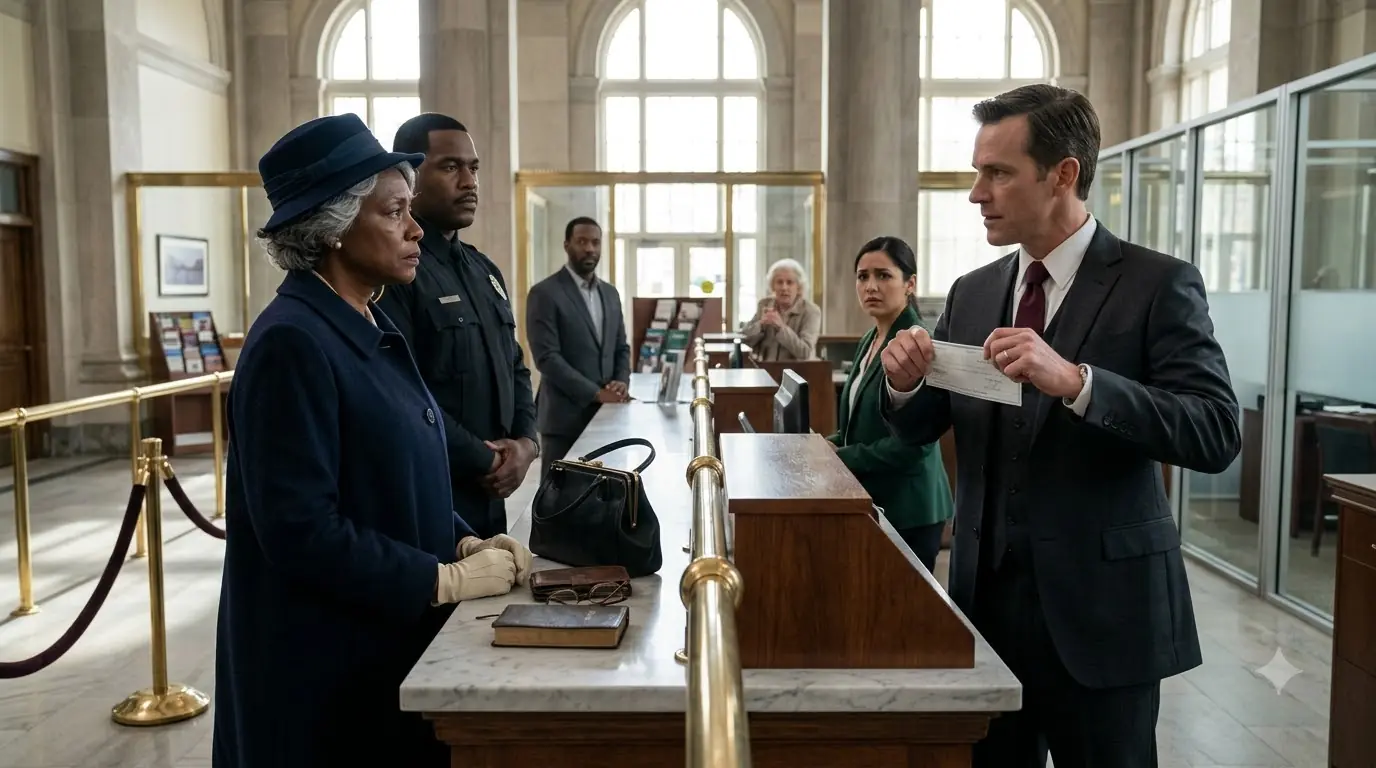
Then he placed one hand on either side of the paper and tore it straight down the middle. The sound was small, almost delicate, but the silence that followed made it seem as loud as a slammed door.
Loretta was seventy-two years old. She wore a navy dress, a pale wool coat, and the white cotton gloves she reserved for church services, funerals, and occasions when she needed to remind herself that she still had some say over how the world saw her. She had spent half the morning arranging the documents inside her handbag. The check had been her chance to pay a dangerous property-tax balance and keep the house her husband had built forty-three years earlier. She watched the two halves separate and did not move.
Harlon tore the paper again. "Fraud prevention," he announced, dropping the pieces near her polished shoes. "That is what happens when somebody comes in here with a story instead of a legitimate transaction."
Security stood close enough to touch her elbow. No one in the line spoke. Behind the third teller window, a young woman named Nina Alvarez looked as though she might be sick. And near a brochure rack in the far corner, a broad-shouldered man in an unremarkable charcoal jacket bent down and quietly collected one narrow strip of the torn check. He had watched every second. Harlon did not know who he was, and he had no idea what that small act would eventually cost him.
But this story did not begin with a piece of paper falling to the floor. It began with a house, a promise, and a woman who believed the most ordinary thing in the world was the right to walk into her own bank without being made to feel small.
Three days earlier, Loretta had been standing at her kitchen window watching a breeze move through the leaves of the oak tree in her front yard. The tree was nearly as old as the house. Her late husband, Thomas, had refused to cut it down when he cleared the lot, even though the builder who inspected his plans insisted the roots would make the work difficult. Thomas had smiled and said he would rather move the porch six feet than take down something that had already learned how to survive.
"That tree was here before we were," he had told her. "Seems only right we make room for it."