FULL CHAPTER:
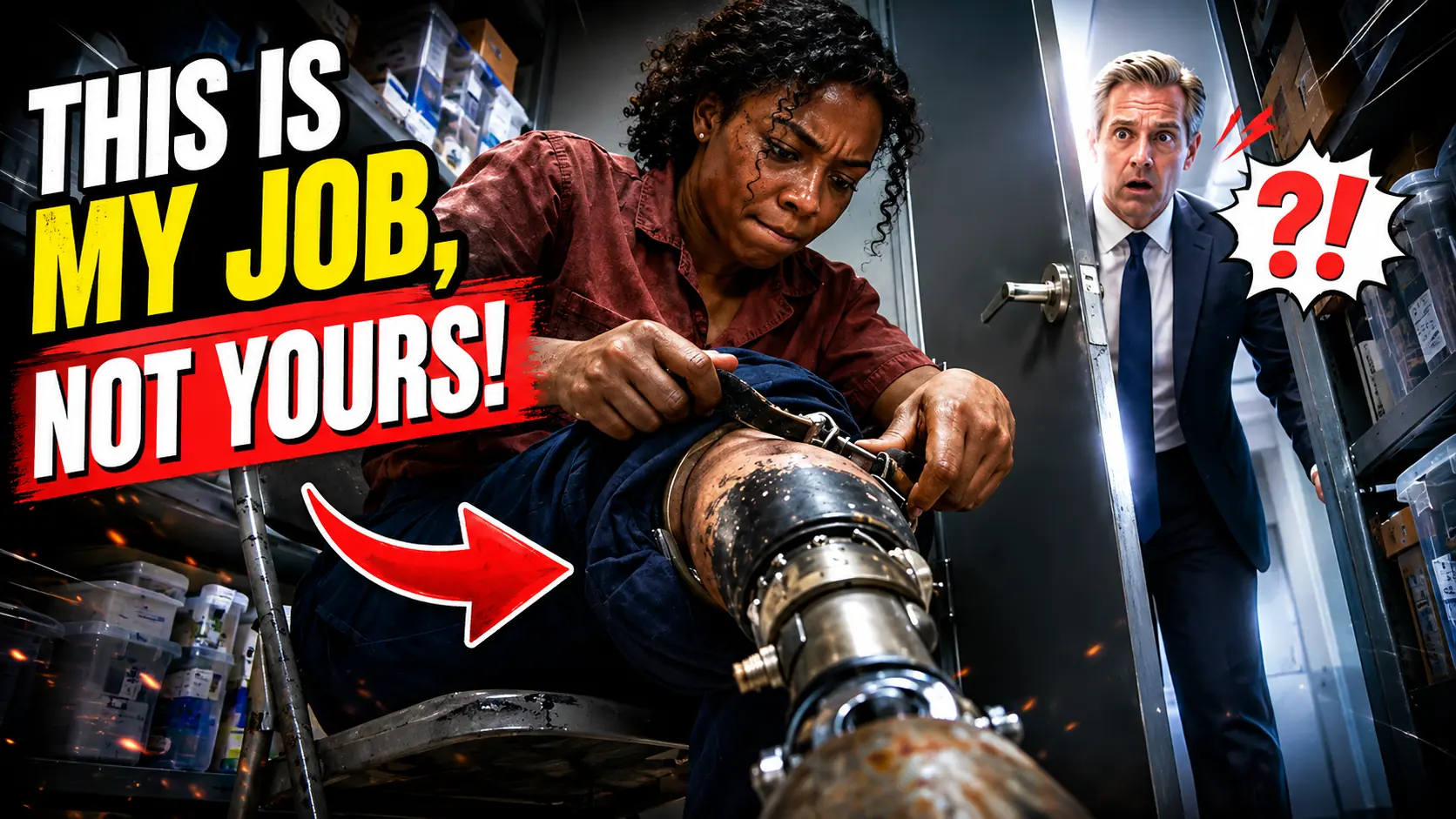
Give me 30 seconds, Mr. Wilson. A young girl called from inside the storage room. This old leg and I are having another disagreement. A metallic click followed. Then the sound of her laughter. Jonathan Bennett stopped beside the half-open door. He moved closer, curious about what she had meant by “old leg,” then looked through the narrow opening.
“Would you like to go in, sir?” his assistant asked quietly. Jonathan raised a hand, signaling him to wait. His eyes remained fixed on the young woman sitting inside. Technical drawings covered the table beside her, and she was explaining something to Samuel Wilson while struggling with a worn prosthetic leg. “Not yet,” Jonathan said. He glanced at his assistant, Daniel Price. “You know why I came here today? I want to see how people work when they don’t know I’m watching. That’s why I ordered everyone at headquarters not to announce this visit.”
Another metallic click came from the storage room. “That doesn’t sound like cooperation,” Sam said. “It’s thinking about it.” Jonathan stepped closer. A Black girl sat on a folding chair between shelves of printer paper and cleaning supplies. Her navy work pants were rolled above her right knee as she tried to attach the old prosthetic. The plastic socket had faded with years of use. One strap was badly frayed, and the locking mechanism kept slipping before it could fasten.
Samuel Wilson, the center’s technical manager, stood beside her with his arms folded. “Annie, you don’t have to force it,” he said. “I’ve told you before. That leg needs to be replaced.” “I’m not forcing it. I’m negotiating.” “You’ve been negotiating for 10 minutes.” “Then we must be close to an agreement.” Sam shook his head, though the corner of his mouth lifted. “You can go home and leave the returned joint report unfinished. Someone else can handle it.” “They can,” Annie said, adjusting the strap. “Then tomorrow I’ll have to waste half the morning figuring out what they did to it.”
A few seconds later, the locking pin snapped into place. Annie gripped the shelf and stood carefully, shifting her weight onto the prosthetic. Her shoulders tightened for a moment, but she made no sound. “See,” she said. “We reached an agreement.” Jonathan remained outside the doorway. He looked at the worn prosthetic, then turned to Daniel. “Our company produces some of the most advanced mobility equipment in the country, doesn’t it?” “Yes, sir. The research center a few miles from here is developing computer-controlled knees and a new generation of carbon-fiber joints.”
Jonathan watched Annie test the lock again, then explained why one of their own employees was sitting in a storage room, struggling with a prosthetic so old the strap was almost broken. Daniel hesitated. “I’ll look into it, sir.” Before he could say more, an older woman approached carrying a cardboard tray of coffee. “Did you get it on, honey?” she asked. “For now, Miss Helen.” Helen handed Annie a paper cup marked with a large black A. Annie accepted it, then held the door while Helen carried the remaining cups into the hallway. “Careful, Miss Helen. If you spill Mr. Wilson’s coffee, we may have to close the building.” “I heard that,” Sam said. “You were supposed to.” Helen laughed and continued down the corridor.
Annie walked toward the main office with her coffee. Her first few steps were uneven, but within seconds she had returned to the rhythm of the workday. Beside the folding chair sat a ceramic mug bearing the words “One step at a time.” A middle-aged employee was staring at the inventory system when Annie reached the main office. “It deleted the order again,” he said. Annie leaned over his shoulder. “You clicked the picture of the blue tab. There’s a difference between that and the blue tab.” “The computer thinks there is.” She clicked twice, restored the order, and showed him how to save it properly.
The telephone on Helen’s desk rang. Annie answered before the second ring. “Bennett Medical Technologies. This is Annie. How can I help you?” An elderly customer spoke rapidly through the receiver. He was frightened by an unfamiliar clicking sound coming from his prosthetic knee. “Mr. Talbot, take a breath for me,” Annie said. “First sit down somewhere safe.” She waited until he confirmed that he had. “Good. Don’t put any more weight on the unit until we check it.” She opened his file and asked for the model number near the hinge. An employee standing nearby handed her a technical manual. “Thank you,” she whispered. Annie located the model, asked several more questions, then arranged for a technician to inspect the device that afternoon. Before ending the call, she said, “You did the right thing by calling again. From here, let us take care of the rest.”
Helen returned and placed a breakfast biscuit beside Annie’s keyboard. “You haven’t eaten.” “I was busy settling a dispute.” “With whom?” Annie tapped the side of her prosthetic. “My most difficult business partner.” “Did you win?” “We signed a temporary ceasefire.” Helen laughed. Employees passing Annie’s desk greeted her by name. One asked her to check a shipping code. A new employee brought her a form and asked how to complete it. Another thanked her for staying late to answer a customer’s call the previous Friday. Nobody treated Annie like someone who needed pity. They came to her because they trusted her.
Jonathan watched a little longer before approaching Sam. “Does she always use that storage room?” Sam turned and finally looked at him closely. “Can I help you, sir?” “I’m here for a quality inspection. We weren’t told anyone was coming.” “That was intentional.” Sam glanced toward the reception desk where Daniel was pretending to read a company brochure. “You should join the morning meeting,” Sam said. “It begins in five minutes.” Jonathan followed him into the conference room, though his attention remained on Annie through the glass wall. The monthly report lay on the table. Every performance indicator met its target. Staffing was described as adequate and the center’s operations were listed as stable. Near the bottom of the final page was a single line: “No exceptional employee contributions have been identified.”
Jonathan read it twice, then looked outside. Annie had tucked a small red notebook beneath her arm. She was comparing returned components with customer complaints, checking one serial number after another. She moved more slowly than the other employees, but her attention never wandered. Jonathan lowered his eyes to the report. “Who writes these evaluations?” “The department supervisors submit them to corporate,” Sam answered. Jonathan pointed through the glass. “Her name is Annie, correct?” “Yes, sir. Her name is Annie Carter.” “Does she always work like this?” “She arrives early. She stays when customers need help, and she catches mistakes before they become expensive.” “Then why isn’t her name in this report?” Sam looked down at the page. “Maybe the people writing these reports have never actually watched her work.”
The meeting began, but Jonathan barely heard the first presentation. He had come to Charlotte to evaluate the quality of his employees. In less than an hour, he had watched an 18-year-old trainee struggle with an old prosthetic, step into the office with a smile, repair a coworker’s mistake, and calm a frightened customer. Annie was not the problem at this center. The problem was a system capable of seeing everything she did and still concluding that she had contributed nothing worth mentioning. Jonathan closed the report and turned to Daniel. “I want a complete review of Annie Carter,” he said quietly. “Her work history, evaluations, training, attendance, and every request she has ever submitted.” Daniel nodded. “How soon do you need it?” Jonathan looked through the glass again. Annie had already opened another returned package. “Before I leave Charlotte.”
Daniel left the conference room with the quality report tucked beneath his arm. Jonathan remained by the glass wall as Sam called the morning meeting to order. Paul Mercer, the regional supervisor, stood beside the screen with a remote in his hand. “Returns are down 4 percent from last quarter,” Paul began. “Customer complaints remain within the acceptable range, and this center is meeting every corporate target.” A chart filled the screen. Every line marked in green. Jonathan scanned the printed report. “How many prosthetic knee units were returned last month?” “27.” “And the month before?” “23.” Paul paused. “That’s correct, but the increase is probably seasonal.” “What caused the returns?” “Improper fitting mostly. Customers don’t always follow the instructions.”
Through the glass, Jonathan saw Annie open another box. She placed a black knee joint on a padded mat, checked its serial number, then wrote something in her red notebook. When Paul mentioned improper fitting, she looked toward the conference room. “Miss Carter,” Jonathan called. Annie glanced behind herself, then pointed at her chest. “Yes, you. Come in for a moment.” She picked up the notebook and entered. Her first few steps were measured, but the smile remained on her face. Paul lowered the remote. “Annie works in service support. She doesn’t normally attend quality meetings.” “Then today will be different,” Jonathan said.
Annie stopped near the end of the table. “Did I enter something incorrectly?” “No. Mr. Mercer says most returned knee units are caused by customers fitting them improperly. Do you agree?” Paul shifted beside the screen. “She answers service calls, Mr. Bennett. She isn’t responsible for engineering analysis.” Jonathan kept his attention on Annie. “I asked for her opinion.” She glanced at Sam. He gave her a small nod. “Not completely,” she said. Paul folded his arms. “What are you basing that on?” “The customers who called.” “Complaints aren’t technical evidence.” “They’re still evidence.” Jonathan pulled out the empty chair beside him. “Tell us what you noticed.”
Annie set her notebook on the table but remained standing. “Most customers describe the same pattern. The knee works normally in the morning. After several hours, it starts clicking or responding more slowly.” “That usually indicates an incorrect fit,” Paul said. “Sometimes, but the same problem keeps appearing in the same places.” She opened the notebook. The pages contained dates, model numbers, locations, and brief notes arranged in narrow columns. “Most of these calls came from Florida, Georgia, Louisiana, and southern Texas. The failures happened after people had been outside in hot, humid weather.” Paul let out a restrained sigh. “Heat exposure is already included in laboratory testing.” “At what temperature?” Annie asked. “Within the required federal range.” “For how long?” Paul paused. Jonathan leaned back. “Do you know?” “The engineering department has the full protocol.”