By midafternoon, the team tested a new seal made with the original adhesive. It remained stable through three hours of heat and humidity. Nathan prepared a corrective action recommendation: restore the original adhesive, add extended humidity testing, notify service centers, reinspect all units from the affected production period. Annie added one more recommendation: call the customers whose claims were classified as user error. Luis nodded. “We should replace their units.” “And apologize,” she said. Nathan included both points. When Jonathan entered the laboratory near four, the failed seal and the replacement sample were lying side by side on the workbench. “Show me,” he said. Annie explained the test from the beginning. She described the customer pattern, the production batch, and the difference between the standard cycle and real-world use. She did not exaggerate her role or minimize anyone else’s. Jonathan read the signed timeline. “Who prepared this?” “We all did,” Annie said. Nathan handed him Malcolm’s revised draft. Jonathan compared the two documents. In Malcolm’s version, Annie’s name did not appear once. “He called this a routine engineering review,” Jonathan said. Nathan nodded. “That was his instruction.” Jonathan looked through the glass toward Malcolm’s office. “Routine reviews do not begin with six weeks of ignored service notes.” Annie kept her pen. “The important thing is fixing the units.” “It is important,” Jonathan said. “So is recording who found the problem.” She glanced at him. “I don’t need a ceremony.” “No. You need an accurate record.” Jonathan handed the revised draft back to Nathan. “Do not submit this version. File the signed timeline with the test results and list every contributor.” Through the glass, Malcolm saw the exchange. His expression did not change, but he picked up his phone.
That evening, Annie received an email informing her that all future laboratory access would require direct approval from research and operations. Marcus read the message over her shoulder. “He’s shutting you out.” Annie folded the printed test results and slipped them into her red notebook. “No,” she said. “He’s showing us where to look next.” The new access restriction took effect the following morning. Annie’s badge opened the fourth-floor entrance and the records room, but the laboratory reader flashed red. Marcus tried his badge. The door unlocked at once. “So much for subtlety,” he said. Annie slipped her badge back into its holder. “Maybe the machine doesn’t like me.” “The machine got an email from Malcolm.” She looked through the glass at Luis preparing another humidity test. “Then I’ll work from the records room. You helped start the investigation, and now I can help organize the results.” Marcus held the door open. “You could call Mr. Bennett.” “I could also give Malcolm exactly what he wants.” “What’s that?” “A reason to say I only get through doors when Jonathan opens them.” She handed Marcus a list of serial numbers. “Ask Luis to compare these with the replacement claims from Georgia. I’ll review the customer notes.” By noon, Annie had connected 11 more service complaints to the same adhesive batch without stepping inside the laboratory. Jonathan learned about the restriction from Daniel, not from her. “She didn’t report it?” he asked. “No, sir. She asked records for access to archived service calls and kept working.” Jonathan looked toward Malcolm’s office. “And the restriction was approved by whom?” “Malcolm. He classified the laboratory as a controlled environment after yesterday’s test.” “Was it controlled before Annie found the defect?” “No.” Jonathan could have reversed the order immediately, but Rachel’s warning remained clear. If he reacted to every move, Malcolm would keep presenting him as an executive driven by one employee’s situation rather than evidence. “Preserve the access logs,” Jonathan said. “Her badge history, Marcus’s badge history, and the time Malcolm changed the rule.” Daniel nodded. “There’s something else. The Carolina Children’s Mobility Fund is holding a community meeting tonight. Annie and her mother are registered to attend.” Jonathan looked at him. “Why do we know that?” “The fund appears in her original benefits application. You asked for the complete file.” “Did Annie invite anyone from the company?” “No.” Jonathan considered it. “Find out whether the meeting is open to donors and local employers.”
It was. That evening, Jonathan arrived at a small community center near Freedom Drive without Daniel, a driver, or a company badge. Folding chairs faced a portable screen. Parents spoke with prosthetists at card tables while children tested crutches, socket liners, and donated mobility equipment. Annie stood near the refreshment table beside a woman wearing a navy distribution-center jacket. They had the same eyes and the same habit of listening without interrupting. Annie noticed Jonathan first. “Mr. Bennett.” The woman beside her turned. Jonathan approached. “I hope I’m not intruding.” “You came to a mobility fund meeting,” Annie said. “That usually means paperwork, money, or free cookies.” “I was told employers could attend.” Annie looked at the plate in his hand. “So, free cookies.” The woman extended her hand. “Grace Carter.” “Jonathan Bennett.” “I know who you are.” Her handshake was firm. She did not seem impressed. Annie picked up two cups of sweet tea. “Mr. Bennett, this is my mother. Mom, this is the man who keeps asking questions at work.” “Somebody should,” Grace said. They sat at the end of a long table while a volunteer explained new funding limits to the room. Grace listened closely, marking sections in a printed booklet. Jonathan glanced at Annie’s prosthetic. “Is this the organization that provided your current leg?” “Yes,” Grace answered. “She was 15. The fund paid for the socket, the joint, and most of the therapy.” Annie lifted her cup. “It survived high school. That alone should qualify it for an award.” Grace looked at Jonathan. “It was never meant to last this long.” “Why hasn’t it been replaced?” “Because the children’s program ends at 18. Our insurance calls a new device an upgrade unless the old one stops working completely.” “It failed to lock this week.” “And then it locked,” Annie said. Grace gave her daughter a look. “That is the argument she keeps using.” “It’s a strong argument.” “It is an 18-year-old argument.”
Jonathan smiled, but Grace did not. “Are you helping my daughter because she is good at her job?” Grace asked. “Or because you saw her struggling with that leg?” Annie set down her tea. “Mom.” “No, baby. It’s a fair question.” Jonathan took a moment before answering. “Seeing the leg made me stop. Watching her work made me stay.” Grace studied him. “She found a product problem that had been overlooked for weeks.” He continued, “She passed the company’s technical assessment. She earned her place in research. And yet she was locked out of the laboratory this morning.” Annie turned toward her. “How did you know that?” “You answer my questions too quickly when something is wrong.” Jonathan did not defend the company. “I’m investigating the decision,” he said. Grace folded the booklet. “Annie has spent years making people comfortable. She smiles so I won’t worry. She makes jokes so coworkers won’t feel awkward. Then folks start believing nothing hurts her.” “Mom, I’m sitting right here.” “I know. That’s why I’m saying it where you can correct me.” Annie looked down at her hands. Grace continued more quietly. “Some nights she takes that leg off and can’t sleep because the socket presses in the wrong places. By morning, she’s in the kitchen asking whether I want eggs or oatmeal.” Annie looked at Jonathan. “She’s making it sound dramatic.” “You burned the oatmeal last Tuesday,” Grace said. “That was unrelated.” Grace’s expression softened, but her voice remained steady. “My daughter isn’t cheerful because life has been easy. She is cheerful because she refuses to let a hard day take the next one with it.”
A volunteer passed their table carrying a box of donated liners. Annie stood to help her, taking half the load and placing it near the fitting area. Jonathan watched her stop to greet a boy using crutches. She complimented the blue pattern on his socket cover, and within seconds the boy was explaining how he had chosen it to match his favorite basketball team. “She makes people feel normal,” Jonathan said. Grace shook her head. “No. She makes them feel seen. There’s a difference.” When Annie returned, Jonathan spoke directly to her. “I want Bennett Medical Technologies to provide you with a properly fitted prosthetic.” Her smile faded into caution. “As a gift?” “As an employee benefit.” “Only for me?” “We can review the policy.” “That isn’t what I asked.” Jonathan understood. “No, not only for you. Any employee whose work requires an assisted device should have a clear process for repair, replacement, and fitting. And no waiting until the device fails completely.” “No.” Annie glanced at Grace, then back at him. “I’ll accept it if the policy is written first.” Jonathan raised an eyebrow. “Before the fitting.” “Before the fitting.” Grace leaned back, satisfied. “I told you she was difficult.” “Before breakfast,” Annie said. Jonathan extended his hand. “Agreed.” Annie shook it. On the way out, Grace walked beside him while Annie stayed behind to help stack chairs. “Charity helped my daughter take her first steps,” Grace said. “We will always be grateful for that.” Jonathan looked back at Annie, who was laughing with one of the volunteers as they folded a table. Grace continued, “But justice means she shouldn’t have to beg for every step.”
After that, the next morning, Jonathan sent Rachel instructions to draft the new assisted-equipment policy and add the diverted accessibility budget to the investigation. Malcolm had tried to close one laboratory door. Instead, he had given Jonathan another reason to examine every locked door in the company. Two weeks later, Bennett Medical Technologies prepared for its largest product demonstration of the quarter. Hospital buyers, rehabilitation specialists, veterans’ organizations, and medical investors filled the main research building before 9 in the morning. A temporary stage had been built inside the central atrium with two large screens displaying the company’s newest electronic knee system. Annie arrived early and found a box of printed brochures waiting beside her desk. Clare handed her a guest list. “You’ll help with registration. Then bring the technical packets backstage.” “I thought I was assigned to the demonstration team.” “You’re supporting the demonstration from registration.” Clare avoided her eyes. “Mr. Reed wants experienced presenters in front of the guests.” Annie looked through the glass toward the stage. Nathan and three senior engineers were checking the test unit while Malcolm spoke with a group of investors. “Understood,” she said. Marcus waited until Clare walked away. “You helped identify the seal problem. You should be up there.” “I know what I did.” “You’re not going to challenge it.” “Not 10 minutes before 200 people arrive.” She picked up the brochures. “Help me move these before someone writes a report saying I failed at paper.”
By 10, the atrium was full. Annie greeted guests, directed wheelchair users toward the accessible entrance, and helped an older veteran find a seat near the aisle. Several visitors recognized her from the service-center video. “You’re the young woman who found the humidity issue,” one prosthetist said. “I was part of the team.” “That was good work.” “Thank you.” Malcolm overheard the exchange as he passed. His smile remained fixed until the visitor walked away. “Miss Carter, backstage,” he said. “The demonstration begins in five minutes.” Behind the curtain, the test knee was attached to a mechanical walking frame. Nathan checked the display while Luis monitored the sensor readings. “Something is off,” Luis said. The unit flexed once, then stopped halfway through extension. Nathan reset the control system. “Run it again.” The knee moved through two steps. On the third, the joint locked. Malcolm entered. “We start in three minutes.” “We have a response delay,” Nathan said. “Use the backup unit.” Luis connected the second knee. It failed during calibration. Malcolm’s face tightened. “What happened?” “The system worked this morning,” Nathan said. Annie stepped closer to the monitor. “What changed?” “Nothing,” Malcolm replied. “Stay with the event staff.” She looked at the readings. “The internal temperature is climbing.” Nathan checked the display. “She’s right. Both units are warmer than they were during setup.” Luis glanced toward the stage lights. “Those lamps have been running for an hour.” Annie touched the outside of the protective housing. “The new seal is holding moisture out, but the sensor may still be reacting to heat buildup.” “We tested it under heat,” Malcolm said. “In the chamber—without stage lights and continuous cycling.” Malcolm checked his watch. “We do not have time for another theory.” Annie looked beneath the frame, opened the side vent, and moved the sensor cover away from the light. Nathan crouched beside the unit. “That might reduce the trapped heat.” “It could also destabilize the housing,” Malcolm said. “We’re not changing the housing,” Annie replied. “We’re cooling the sensor long enough to confirm the cause.” Malcolm stared at her. “You are not leading this demonstration.” “No, sir. I’m trying to keep it from being cancelled.” A staff member leaned through the curtain. “Mr. Reed, the guests are waiting.” Malcolm turned to Nathan. “You have 60 seconds.” Nathan opened the ventilation panel while Luis moved a portable fan behind the frame. Annie watched the temperature reading fall. When it reached the normal range, the knee completed five cycles without hesitation. Nathan looked at her. “That was it.” “Not all of it,” Annie said. “The sensor is still too close to the heat source. We need to explain that before anyone orders the current configuration.” Malcolm’s voice dropped. “We are not announcing an unresolved defect on stage.” “A customer will find it if we don’t.” “This is a product presentation, not a confession.”
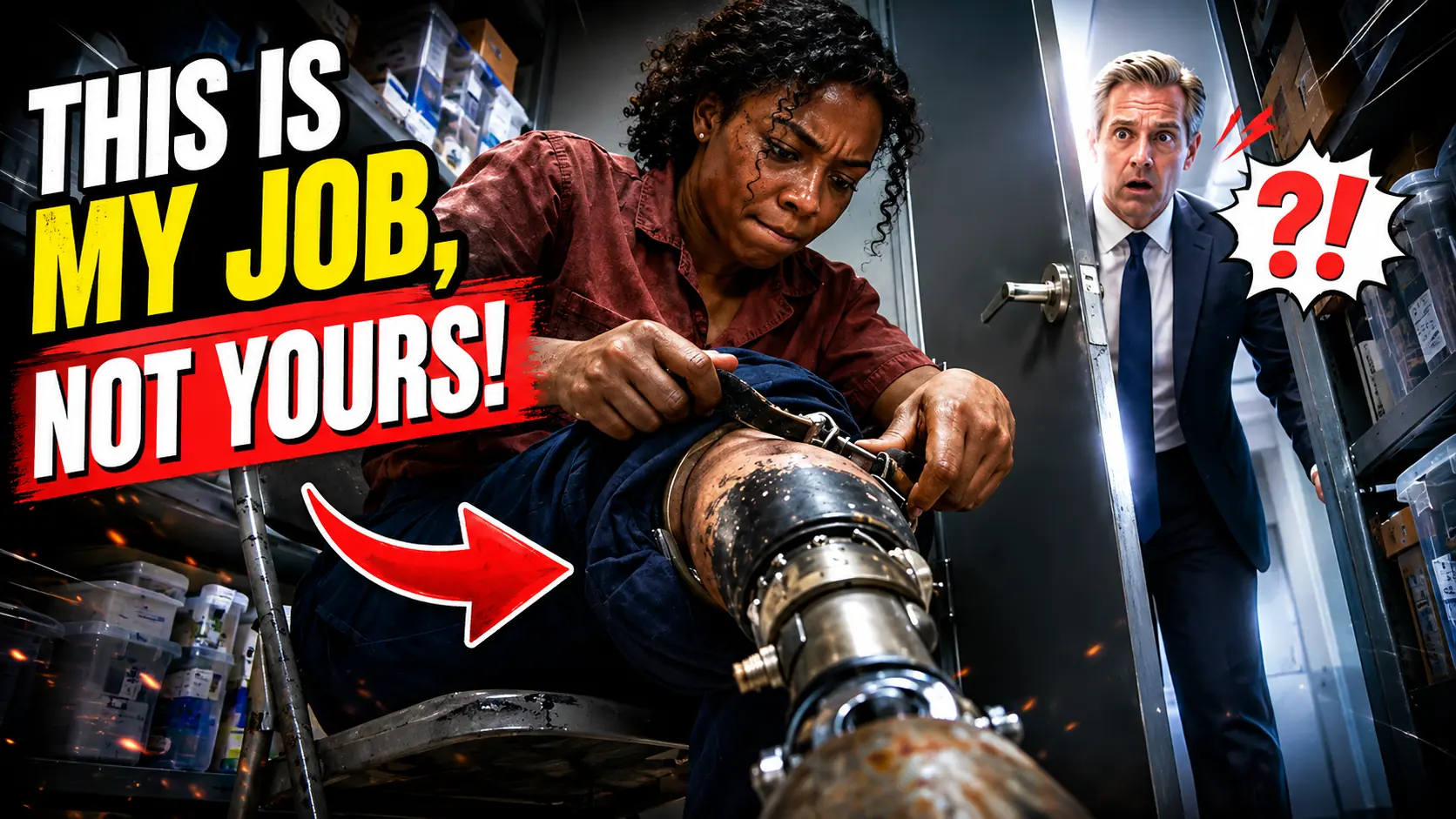
Jonathan entered backstage in time to hear the last sentence. “What is unresolved?” he asked. Nathan explained the failure, the heat buildup, and Annie’s temporary solution. Jonathan looked at Malcolm. “Was this included in the presentation?” “It happened less than five minutes ago.” “Then the presentation changes.” Malcolm stepped closer. “Jonathan, these people came to see a finished system.” “They came to decide whether they can trust us.” He turned to Nathan. “Can you explain the technical issue?” Nathan nodded, then looked toward Annie. “She can explain it better. She saw the pattern first.” Malcolm shook his head. “She is an 18-year-old trainee.” Jonathan met Annie’s eyes. “Can you do it?” She looked toward the curtain. Beyond it came the low conversation of hundreds of people. “I can explain the problem and the solution. The solution we have now is temporary. I can explain what needs to happen next.” Jonathan nodded. “That is what they should hear.” A minute later, Malcolm walked onto the stage and introduced the product. His tone gave no sign of the argument backstage. Nathan demonstrated the knee through several controlled steps, then invited Annie forward. Her name was not printed on the program. For a moment, the audience watched the young Black woman with the worn prosthetic leg approach the center of the stage. Annie adjusted the microphone and looked at the mechanical frame beside her. “This unit stopped working six minutes ago,” she said. The room went still. Malcolm’s expression hardened at the edge of the stage. Annie continued, “The problem was not the motor, the software, or the person operating it. Heat from the stage lights built up around the sensor faster than our current testing predicted.” She pointed to the side panel. “We reduced the temperature by opening the ventilation area, but that is not a final repair. Before this system is released, the sensor placement and heat protection need to be tested under longer, less controlled conditions.” A doctor in the front row raised his hand. “Why wasn’t this found in the laboratory?” “Because laboratories are controlled,” Annie said. “People’s lives are not.” Several guests nodded. She explained how different walking speeds, outdoor temperatures, and hours of continuous use could affect the device. She avoided unnecessary technical language and answered each question directly. An older veteran stood near the aisle. “So you’re telling us the product isn’t ready?” “I’m telling you we found something that must be corrected before we ask people to depend on it.” The veteran studied her, then nodded. “That’s the first honest answer I’ve heard at one of these demonstrations in years.” Applause began near the front and spread across the atrium. Annie did not smile until she stepped away from the microphone. Backstage, Nathan shook her hand. “You saved the demonstration.” “No,” she said. “We stopped a bad unit from becoming somebody else’s problem.” Across the room, several doctors and buyers were already asking for Annie by name. Jonathan watched Malcolm observe the crowd gathering around her. For the first time, Annie’s ability was no longer hidden inside a service report or a red notebook. Too many people had seen it, and Jonathan knew that made her more valuable to the company—and far more dangerous to the men who had worked so hard to keep her invisible.
By 8 the next morning, the video of Annie’s presentation had already reached several medical forums. Doctors praised the company for admitting a problem before releasing the product, and a veterans’ organization requested a meeting with the young trainee who had explained the failure. Inside Bennett Medical Technologies, the response was different. Annie arrived at her desk and found three new emails from people she had never met. One was from a rehabilitation specialist in Tampa. Another came from a prosthetist in Houston who had seen similar heat-related failures. The third simply said, “Thank you for talking about patients like people.” She read each message twice before saving them in a folder. Marcus rolled his chair toward her. “You’re famous.” “I have 43 views on the internal video.” “It had 6,000 this morning.” Annie looked at him. “That seems unnecessary.” “It’s already being shared outside the company.” “Does Malcolm know?” Marcus glanced toward the executive offices. “I think the entire building knows.” Clare appeared beside Annie’s desk with a printed form. “Mr. Reed wants a written statement about yesterday.” “What kind of statement?” “A description of your role during the demonstration.” Annie took the form. The first paragraph had already been written: “At the direction of the senior engineering team, technical trainee Annie Carter assisted with audience communication after a temporary sensor issue was identified during routine pre-demonstration testing.” She read it again. “This says the engineering team identified the problem.” Clare kept her voice low. “You assisted with the presentation.” “I found the temperature increase.” “You were part of the team. The form doesn’t say that.” Clare looked around before leaning closer. “Annie, sign it and let Legal handle the language.” “Legal wrote this?” “I don’t know who wrote it.” “Then I’m not signing it.” Clare’s expression tightened. “Refusing a factual statement may be viewed as insubordination.” “It isn’t factual.” Annie handed the form back. Clare left without another word.
An hour later, Malcolm called Annie into his office. Victoria Lang sat beside him with a tablet open on her lap. “Please sit,” Malcolm said. Annie remained standing. “My chair is comfortable enough today.” Victoria gave her a practiced smile. “This is not disciplinary.” “That usually means it might become disciplinary.” Malcolm folded his hands. “Yesterday placed the company in a difficult position. You disclosed an unresolved technical issue to customers and investors without approval.” “Mr. Bennett asked me to explain it.” “He asked you to speak. He did not authorize you to describe the product as unready.” “It was unready.” Malcolm’s jaw shifted. “That conclusion belongs to senior engineers.” “Nathan agreed.” “Dr. Cole agreed that further testing was needed. That is not the same thing.” Victoria turned the tablet toward Annie. “Your employee record now includes a note concerning unauthorized public communication and failure to follow the presentation protocol.” Annie read the screen. “You added this today.” “We document events when they occur.” “Does it mention that the unit failed before the demonstration?” “That information belongs in the engineering report.” “Does the engineering report mention me?” Neither answered. Annie looked at Malcolm. “No, it doesn’t.” Malcolm leaned back. “Miss Carter, you have received an unusual amount of access for someone at your level. I suggest you focus on learning rather than demanding recognition.” “I didn’t demand recognition.” “You refused to sign a statement because your contribution was not described the way you preferred.” “I refused because it wasn’t true.” Victoria locked the tablet. “You should consider how difficult it will be to continue in research if every disagreement becomes a question of personal credit.” Annie’s face remained calm. “I don’t need every room to like me,” she said. “I just need the record to tell the truth.” She left before either of them responded.
Back at her desk, her laboratory access had been removed completely. Her project folders were missing from the shared system, and the test report from the previous day had been moved to a restricted drive. Marcus looked over her shoulder. “They locked you out of everything.” “Not everything.” Annie opened her red notebook. She had written the time of the failure, the temperature readings, Nathan’s instructions, and the exact moment Jonathan asked her to speak. She also had copies of the humidity results signed by Luis, Marcus, and Nathan. “Did you save the emails?” Marcus asked. “Yes. The original report—printed and at home.” He nodded. “Sam trained you well.” “He told me people who fear the truth usually start by changing the paperwork.” Across town, Jonathan sat with Rachel and Daniel in a private conference room. On the screen before them were two versions of the demonstration report. The first listed Annie as the person who identified the heat buildup and proposed the temporary ventilation response. The second had been edited at 6:14 that morning. In that version, Nathan Cole and Malcolm Reed were credited with discovering the issue during a routine engineering review. Annie appeared only as presentation support. “Who edited it?” Jonathan asked. Rachel enlarged the access log. “Victoria’s administrative account opened the file first. Malcolm’s office approved the final version 23 minutes later.” Daniel placed another document beside Jonathan. “They also added a performance warning to Annie’s record.” “For what?” “Unauthorized public communication.” Jonathan read it once. “I put her on that stage.” “The warning doesn’t mention that,” Rachel said. “Can they remove her from the program?” “During the trial period, they can recommend termination for performance or conduct. But if they act after altering the record, it strengthens the argument that this is retaliation.” Jonathan stood. “I’m reversing the warning.” Rachel shook her head. “Not yet. They are building a case against her, and we are building one against them. If you erase every move they make, they will change tactics before we finish documenting the pattern.” Jonathan walked toward the window. “She is 18.” “She is also collecting evidence more carefully than half the executives in this company.” Daniel’s phone vibrated. He read the message and looked up. “Malcolm has requested an emergency meeting with three board members. He says you are interfering with research decisions and creating legal exposure by favoring one trainee.” Jonathan turned from the window. “Favoring her?” “He attached the new performance warning and the revised demonstration report.” Rachel closed her laptop. “He is no longer defending a process. He is preparing to remove you from it.”
At the research building, Annie received a calendar notification before lunch. Her technical training review had been moved forward by six weeks. The new date was Friday. Marcus read the notice beside her. “They want you out before the investigation finishes.” Annie printed the email and slipped it into her notebook. “Then we make sure Friday arrives with the correct record.” Outside Malcolm’s office, Victoria was already assembling a file marked “Annie Carter—Performance and Conduct.” In another part of the building, Rachel began preserving every version of that file. Malcolm believed he was erasing Annie’s contribution one document at a time. He had not yet understood that each change left a trail. Friday’s review lasted 12 minutes. Malcolm sat at one end of the table with Victoria beside him. Annie faced them alone. Jonathan had not been invited, and Rachel had advised him not to force his way into the meeting. Every decision needed to remain on record. Victoria opened Annie’s personnel file. “The purpose of this review is to determine whether your placement in technical research should continue.” Annie placed her red notebook on the table. “I understand.” Malcolm read from the prepared report. “During your training period, you failed to follow communication procedures, entered restricted work areas without proper authorization, and made technical statements to outside guests without approval.” “Mr. Bennett asked me to speak.” “That has already been noted.” “It isn’t in the report.” Victoria folded her hands. “We are reviewing your conduct, not Mr. Bennett’s.” Annie looked at the document between them. “Does it mention the failed unit?” “The product issue is being handled separately.” “Does it mention that the laboratory team confirmed my findings?” Malcolm set down the page. “This is exactly the problem. You continue treating team results as personal achievements.” “I’m asking for an accurate record.” “You are a trainee,” he said. “You were given access to experienced engineers, testing equipment, and executive leadership. Instead of learning from that opportunity, you have challenged the people responsible for supervising you.” Annie paused before answering. “I learned that a title can decide who signs a report. It cannot change what happened.” Victoria’s expression hardened. “Your technical placement is ending today. You will return to service support while the company reviews your future eligibility.” “Am I being fired?” “No.” “Is my performance being rated as a failure?” Malcolm answered, “Your work will be described as incomplete due to concerns about professional conduct.” Annie opened her notebook and wrote the time. “What are you doing?” Victoria asked. “Keeping the record.” Malcolm slid a form across the table. “Sign this to acknowledge the decision.” Annie read it. The document stated that she accepted the review as fair and complete. “I’ll sign that I received it,” she said. “I won’t sign that it’s accurate.” Victoria drew a line through the final sentence and wrote “Received only.” Annie signed beneath it, closed her notebook, and stood. “Thank you for letting me know.” Malcolm seemed unsettled by her calmness. “You have nothing else to say.” “I said what was true. Saying it louder won’t make you write it down.”
Her badge stopped opening the fourth-floor entrance before she reached the elevator. Marcus waited beside her desk with a cardboard box. “They told me to pack your things,” he said. Annie looked inside. Her calculator, two pencils, a coffee mug, and a copy of the company testing manual had been placed inside. “They forgot the box under my desk.” Marcus glanced at the foot support. “I thought you hated that box.” “It served with distinction.” He added it to the pile. “I copied the first version of the demonstration report,” he said quietly. “The one with your name.” “You could get in trouble.” “I watched Nathan repeat your idea in a meeting and receive credit for it. I stayed quiet. I’m not doing that twice.” Annie studied him. “Thank you.” Nathan approached from the laboratory carrying a sealed envelope. “These are the signed humidity test results,” he said. “Luis and I both kept copies.” “Malcolm won’t like that.” “He doesn’t have to.” Nathan looked embarrassed. “I should have spoken sooner.” “You’re speaking now.” “That doesn’t erase before.” “No,” Annie said. “But it changes what happens next.” The elevator doors opened. Clare stood several feet away, holding her tablet against her chest. She looked as though she wanted to say something, but Malcolm’s office was visible behind her. Annie lifted the box. “Goodbye, Clare.” Clare lowered her eyes. “Good luck.”
When Annie returned to the West Charlotte service center, Helen saw the box and immediately stopped answering her phone. “What did they do?” “They decided I needed more experience.” Sam came out of his office. His gaze moved from Annie’s old badge to the cardboard box. “Did they put the decision in writing?” Annie handed him the review. He read the first page, then the second. “This says you entered restricted areas.” “They restricted them after I entered.” “And unauthorized public communication.” “Mr. Bennett put me on stage.” Sam placed the pages on his desk. “They’re building a story backward.” Helen pulled Annie into a hug before Annie could object. “You should let me drive downtown and tell those people what I think.” “That would probably become another conduct warning.” “I’m retired from caring about conduct.” “You’re not retired.” “I can begin today.” By lunch, word had spread through the office. Employees came to Annie’s desk with documents they had saved. A customer-service representative brought printed compliments mentioning Annie by name. Luis emailed the complete return-unit data. The new employee Annie had helped with the shipping error gave Sam a written statement describing how often she assisted coworkers. Helen opened a drawer and removed a folder. “What is that?” Annie asked. “Every time you stayed late, covered someone’s call, or fixed a customer problem that wasn’t yours.” “You kept a file.” “I’m 58. We keep receipts.” Sam placed his three original training recommendations beside the altered corporate versions. “These are going to Rachel Moore,” he said. Annie looked around the office. “I don’t want anyone risking a job for me.” Helen pulled out the chair beside her. “Sit down, honey.” Annie did. “This isn’t only about you,” Helen said. “People here have watched good workers get passed over for years. We told ourselves to keep our heads down because we had mortgages, children, and medical bills. That silence didn’t protect us. It protected the people making the decisions.” Sam nodded. “Loyalty to a company does not mean helping it hide what is wrong.”
That afternoon, Rachel arrived with Daniel. She scanned every document, recorded who had provided it, and sealed the originals in numbered folders. “No surprises at the hearing,” she told them. “If you know something, say it now. If you only suspect something, label it as suspicion.” Annie handed over her notebook, but kept it within sight while Rachel copied the relevant pages. Jonathan arrived near 5. He waited until the employees had left before speaking with Annie. “I can reverse Malcolm’s decision tonight.” “And tomorrow he’ll say you rescued me again.” “He removed you because you exposed a problem.” “Then prove that.” Jonathan sat across from her. “This may become public.” “I know.” “I could arrange a private settlement. Your position would be restored, your record corrected, and your education funded.” “What happens to Malcolm?” “He remains under investigation.” “And the next employee he decides doesn’t belong?” Jonathan did not answer. Annie closed her notebook. “I spent years trying not to make anyone uncomfortable. Maybe discomfort is what finally makes people look.” Daniel entered carrying an envelope delivered from headquarters. Jonathan opened it. The board had called an emergency meeting for Monday morning. The agenda listed four matters: Jonathan’s executive authority, Annie’s technical placement, ownership of the sensor findings, and the internal personnel investigation. Rachel read the notice over his shoulder. “Malcolm believes he has enough votes.” Jonathan looked at Annie. “You do not have to attend.” “Yes,” she said. “I do.” On Monday, Jonathan could lose control of the company he had built. Annie could lose the career she had barely been allowed to begin. But when they entered that boardroom, they would not be asking Malcolm to show mercy. They would be asking him to explain the record.
Monday morning arrived under a low gray sky. Jonathan entered Bennett Medical Technologies headquarters through the main lobby at 8:15. Daniel walked beside him carrying two locked document cases while Rachel followed with her laptop bag and a folder containing the board notice. Annie waited near the elevators with Sam. She wore the navy jacket Grace had bought for her assessment and held the red notebook against her chest. “You came early,” Jonathan said. “I didn’t want traffic to become part of Malcolm’s evidence.” Sam adjusted his tie. “She has been making jokes since 6:30.” “It keeps him from giving speeches,” Annie said. Rachel looked at each of them. “Once we enter, let Malcolm finish. Do not interrupt unless the chairman asks a direct question. We answer with records, not anger.” Sam nodded. Annie did too. Jonathan said nothing. Rachel turned toward him. “That includes you.” “I heard you.” “You also heard me on Friday.” “I remember.” “Good. Today would be a poor day to develop selective memory.” The elevator carried them to the executive floor. No one spoke during the ride. When the doors opened, Daniel led Sam and Annie to a waiting room beside the board chamber. Jonathan stopped before Annie entered. “You can still decide not to testify.” She looked through the glass wall at the long table inside. “They discussed my work, my record, and whether I belong here without ever asking me. I’m done letting other people explain me.” Jonathan nodded. “Then wait until Rachel calls you.”