Atlas Airlines Flight 447 had been airborne for less than two hours when the first-class cabin became unnaturally quiet. Jonathan Rivers sat in seat 1A wearing a tailored black suit, crisp white shirt, and dark tie, his phone resting loosely in one hand. Across the aisle, every passenger had received the filet mignon advertised on the premium menu. Jonathan’s tray remained empty.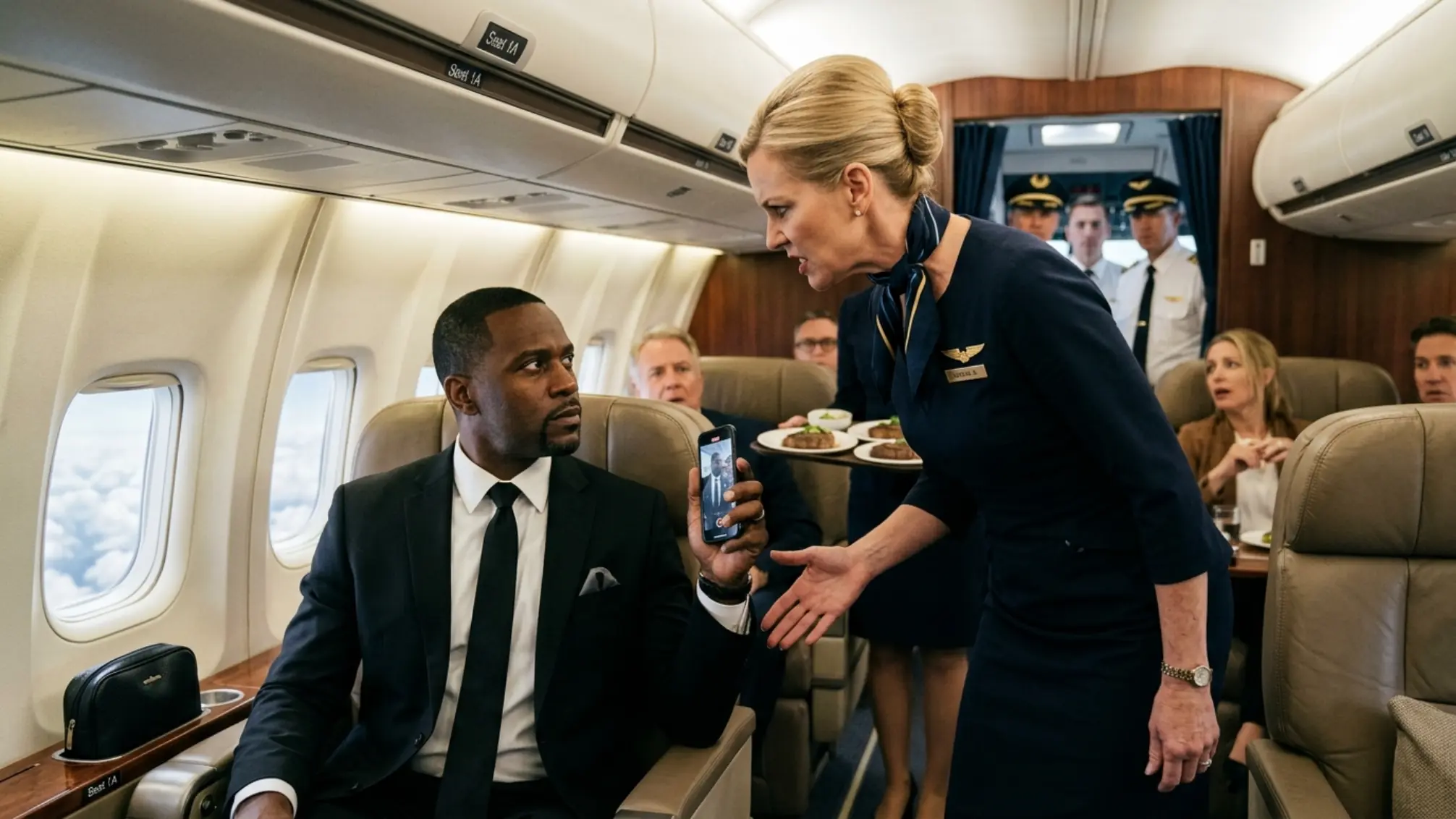
Senior flight attendant Diana Blackwood stood beside him with one hand extended, her expression hardened by twenty-eight years of unquestioned authority. Behind her, a younger attendant named Isabella Cruz held a tray containing four untouched steak dinners. Several passengers watched from their seats, and three uniformed pilots had entered from the forward galley after hearing that a confrontation was developing. Diana behaved as though the entire aircraft belonged to her.
“That steak isn’t for you,” she said. “We reserve premium service for passengers who belong here.”
Jonathan remained seated. “I paid for this seat. Bring the meal I ordered.”
“Show me your boarding pass, or I’ll have the captain remove you when we land.”
Jonathan raised his phone. “Call corporate first—and ask whose signature bought this airline seventy-two hours ago.”
Diana stared at him, uncertain whether the statement was a threat, a joke, or another attempt to challenge her authority. She had already examined Jonathan’s boarding pass during boarding, but she demanded it again because she needed the cabin to believe that he—not she—was creating the problem. Her hand remained extended while anger tightened the muscles around her mouth. Jonathan did not reach for his wallet.
The conflict had begun almost immediately after takeoff from Los Angeles. Diana served champagne in crystal flutes to every first-class passenger except Jonathan, claiming inventory was limited. When he politely requested a glass, she returned with economy-class sparkling wine in a plastic cup. She moved through the cabin smiling at wealthy travelers in designer clothing, yet she passed Jonathan’s seat as though he were an inconvenience someone had forgotten to remove.
Jonathan had noticed every difference in treatment. He had also noticed Diana’s warm conversation with Richard Coleman, a real-estate developer in a navy suit whose gold watch flashed whenever he raised his glass. Diana remembered Richard’s preference for cashews, asked about his latest property development, and promised his steak would be prepared exactly medium rare. She never asked Jonathan where he was traveling or whether he needed anything.
The younger attendant, Isabella, noticed too. She was twenty-six, supported her mother and teenage brother, and had spent two years learning that challenging Diana could destroy a junior employee’s schedule and promotion opportunities. Yet when Diana claimed the steak inventory had been exhausted, Isabella had already counted twelve entrees for twelve first-class passengers, along with several alternatives. Four steaks remained after every other passenger placed an order.
“We still have them,” Isabella whispered inside the galley.
Diana turned on her sharply. “I have managed first-class service longer than you have been alive.”
“But he selected the steak when he booked.”
“Some passengers require service suited to their expectations.”
Isabella understood the meaning hidden beneath the professional language. Jonathan’s expectations had not been measured by his ticket or behavior. Diana had judged them from his face before he spoke.
What Diana did not know was that Jonathan Rivers had spent most of his life being underestimated. He grew up in Detroit, the son of an auto worker and a public-school teacher. As a teenager, store employees followed him through aisles while pretending to organize shelves. At the Massachusetts Institute of Technology, classmates assumed he had received an athletic scholarship even though he had never played organized sports.
Jonathan responded to those experiences by building rather than begging. At twenty-six, he developed software that improved regional shipping networks. By thirty-one, he had sold his first company and invested the profits in renewable energy, commercial property, and aviation technology. At forty-two, his net worth exceeded eight billion dollars.
He still carried an old laptop with a worn keyboard because it was the machine on which he had written the code that changed his life. His watch cost less than some passengers’ shoes. He avoided designer labels because he had learned that people revealed themselves most honestly when they believed the person before them possessed no influence.
Seventy-two hours earlier, Jonathan’s company, Pinnacle Aviation Holdings, had purchased Atlas Airlines for $3.7 billion. The once-respected carrier had suffered years of declining service, outdated systems, and falling passenger confidence. Board reports blamed fuel prices, competition, and technology. Jonathan suspected the deeper problem involved culture.
He had booked Flight 447 under his own name without announcing himself to management. No red-carpet greeting awaited him, no executive note appeared beside his reservation, and no crew member knew the new owner was sitting in 1A. He wanted to experience Atlas the way an ordinary customer experienced it. Within the first two hours, he had learned more than months of corporate presentations might have revealed.
A freelance journalist named Elena Rodriguez sat across the aisle with her phone positioned discreetly near her handbag. She had begun recording after Diana served Jonathan champagne in a plastic cup. By the time the meal dispute erupted, Elena was broadcasting the incident live to thousands of viewers. The audience grew every minute as passengers shared the stream across social media.
Dr. James Patterson, a respected heart surgeon seated in row three, stopped working on his conference presentation. Attorney Margaret Chen lowered the legal brief she had been reading. Richard Coleman, initially pleased with his preferential treatment, watched Isabella’s tray and began recognizing the lie he had ignored while it benefited him.
Diana ordered Isabella to return the steaks to the galley. Isabella did not move.
“Those meals were prepared for first class,” she said.
“I gave you an instruction.”
“And I’m telling you the inventory is available.”
Diana’s expression became cold. “You can work economy service for the remainder of the flight.”
Jonathan looked toward Isabella. The young attendant’s hands were trembling, but she continued holding the tray. He recognized courage when it appeared imperfectly. Bravery was not the absence of fear; it was the refusal to obey fear when obedience would harm someone else.
Dr. Patterson spoke from across the aisle. “You told this passenger the steak was unavailable.”
Diana faced him with a strained smile. “We experienced an unexpected inventory issue.”
“There are four steaks on that tray.”
“They may be assigned to other service requirements.”
“Every other passenger has already ordered,” Margaret Chen said. “What requirement remains?”
Diana’s composure began cracking. She had relied for years on plausible explanations, assuming most passengers preferred comfort over confrontation. She could deny a drink, change an entree, or question a boarding pass while hiding behind inventory policies and security language. The difference today was that too many witnesses were paying attention at once.
Jonathan opened the reservation confirmation on his phone and held it where Diana could see it. Seat 1A, full-price first-class fare, filet mignon selected during booking. Nothing in the record supported her claim.
“Bring the meal I purchased,” he said.
“I determine service standards in this cabin.”
“No,” Jonathan replied. “The company does.”
Diana leaned closer. “Passengers like you often misunderstand premium-service procedures.”
The cabin went still.
Jonathan studied her face. “Passengers like me?”
She realized too late that she had exposed the belief beneath every decision. Retreat remained possible, but pride prevented it. Rather than apologize, she demanded his boarding pass again and suggested that his seat might have been obtained through an irregular upgrade.
Richard Coleman shifted uncomfortably. “He boarded before I did. His ticket was checked at the gate.”
Diana ignored him. “Sir, hand me your boarding pass.”
“You already verified it.”
“I’m verifying it again.”
“Why?”
“For safety and security.”
Margaret Chen spoke with the controlled tone she used in courtrooms. “What specific safety concern has this passenger created?”
Diana looked toward Captain James Mitchell, who had entered the cabin after being summoned from the cockpit. She expected him to support her authority, as he had many times before. Instead, he examined the steaks on Isabella’s tray and the phones recording from several angles.