On the morning the cannery trucks climbed Willa Hartley's gravel drive, nearly everybody in Brier Glenn decided they were watching the end of her farm.
One trailer tipped its load beside the south pasture, then another arrived, and another, until seventy tons of oversized pumpkins formed a sprawling orange-and-green ridge beside the aging barn.
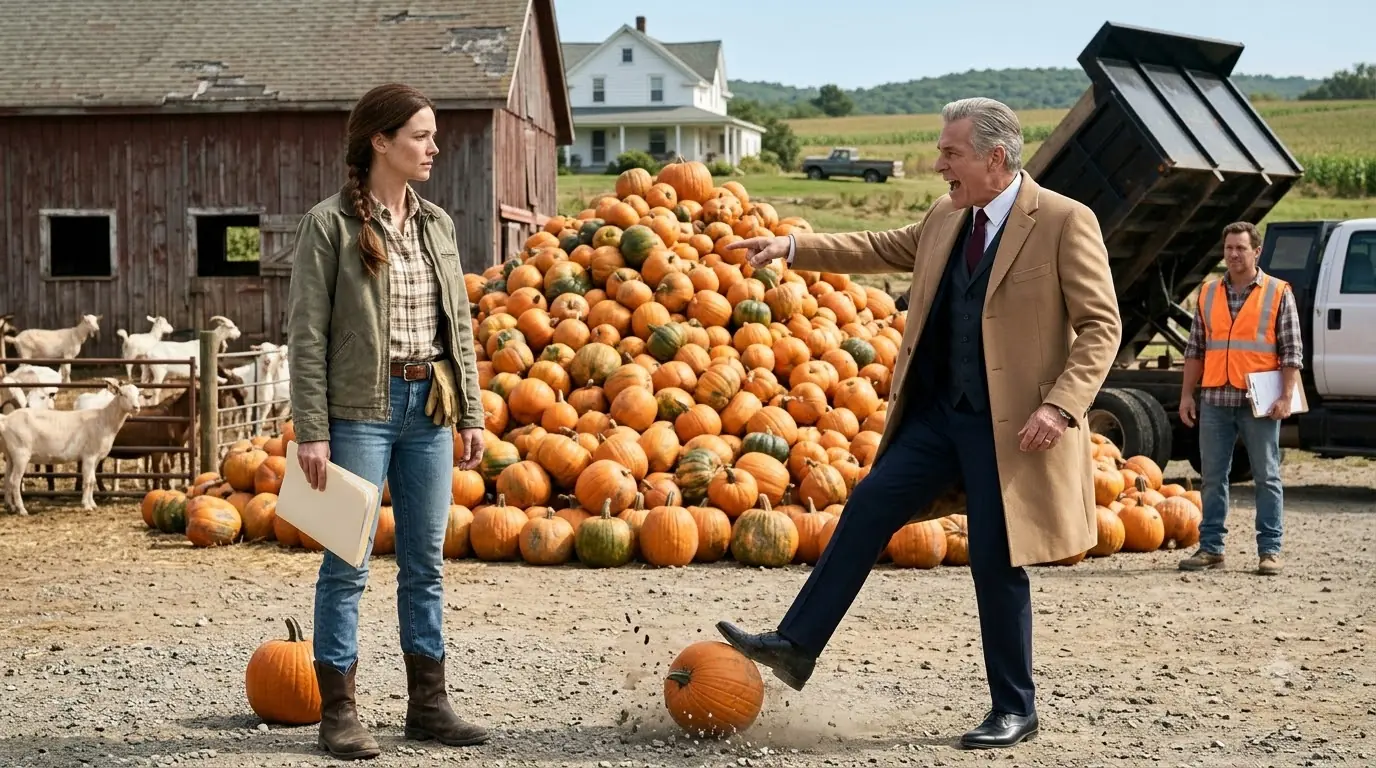
Drivers slowed along the county road to take photographs through their windshields, their tires hissing on damp pavement. Before the last truck had backed away, somebody had posted a picture with a caption that would follow Willa for months: HARTLEY HOLLOW, THE COUNTY'S NEW PUMPKIN DUMP.
Everett Blackstone, owner of Blackstone Valley Cannery, stepped out of a polished black sedan and surveyed the pile as though he had just performed an act of charity. His expensive coat was buttoned against the wind, and his shoes were much too clean for a working farm. He told the foreman that struggling people would take anything if it came with the word free attached to it. Then he raised his voice just enough for Willa to hear and remarked that he had found somebody willing to clean up his company's mistake without charging him a cent.
Willa stood at the pasture gate wearing a faded green work jacket, rubber boots, and an expression that gave him none of the satisfaction he wanted. She had read the transfer documents twice before signing them, and she had measured the free space behind the barn three times before the first delivery. She watched the pumpkins roll into place, not with the defeated look Blackstone had expected, but with the concentration of somebody looking at a problem from an angle no one else had tried. When he laughed at the possibility of her making anything from his rejects, she said only, "Thank you for delivering them, Mr. Blackstone."
Six months later, luxury cars would line that same gravel drive, and chefs who normally argued over imported truffles would argue over the last few ounces of a pale ivory goat cheese called Giant Harvest Reserve. A distributor would tell Willa that all six of her next production seasons had been committed before a single wheel from the final season existed. Blackstone would return demanding a share of the business he had publicly mocked, only to discover that the paper he had signed in such a hurry belonged to her far more thoroughly than he understood. But on delivery morning, none of those things had happened yet, and Willa had no guarantee that her gamble would save anything at all.
Hartley Hollow Farm occupied forty-three acres at the end of a winding lane beyond the last subdivision in Brier Glenn. Its white farmhouse had weathered siding, uneven porch steps, and a kitchen window that looked toward the goat barn instead of the road. The barn roof leaked in three places during heavy rain, and Willa had marked the spots with blue chalk so she could move the feed sacks when the clouds turned dark. Forty-six dairy goats lived beneath that roof, a herd that had numbered more than a hundred before feed prices, veterinary bills, and two punishing seasons forced her to sell animals she had raised from birth.
Willa was thirty-eight, with brown hair she usually secured in a loose braid and hands roughened by years of milking, fencing, and repairing equipment that was older than her daughter. She had learned long ago that exhaustion could become a kind of background noise, familiar enough that a person stopped noticing it until the body refused one more small task. Most mornings she woke before five, walked to the barn with a flashlight between her teeth, and checked each animal before making herself coffee. She was the only employee who could be counted on to arrive every day, and she did not receive a salary for the privilege.
Her daughter June was eleven and had learned the rhythms of the farm almost as early as she had learned to tell time. She knew the goats by their voices, could identify the oldest does from their footsteps on the wooden walkway, and understood that some evenings her mother claimed not to be hungry because groceries needed to last until Friday. Willa tried to keep financial worry away from her, but children who live inside a struggling business notice things adults imagine they have hidden. June had stopped asking for riding lessons the previous spring, and Willa knew exactly when she had stopped.
The farm had belonged to Willa's father, Malcolm Hartley, a patient man whose idea of wealth was a good rain at the right time and a barn full of healthy animals. When he died, the land came to Willa along with loans he had taken to modernize the milking room after a difficult year. Willa's marriage to Colin had already been fraying, and the burden of caring for her father during his last illness had widened every crack between them. Colin left two years after the funeral, promising to contribute regularly to June's expenses and discovering an astonishing number of reasons to delay whenever the month came due.
There had once been a different future. Willa had studied food science at a state college, interested in fermentation, dairy chemistry, and the ways ordinary agricultural products changed under controlled conditions. She had imagined working in a research laboratory or developing regional foods that could support small producers, perhaps somewhere with enough money for functioning equipment and enough staff to take a day off without fearing disaster. Then her father grew ill, the farm needed someone, and she returned for what she expected would be one semester. She never finished the degree, but she kept the notebooks, the lab manuals, and the habit of asking what a material was actually made of before deciding what it was worth.