Captain woke up this morning the same way he has woken up hundreds of mornings before.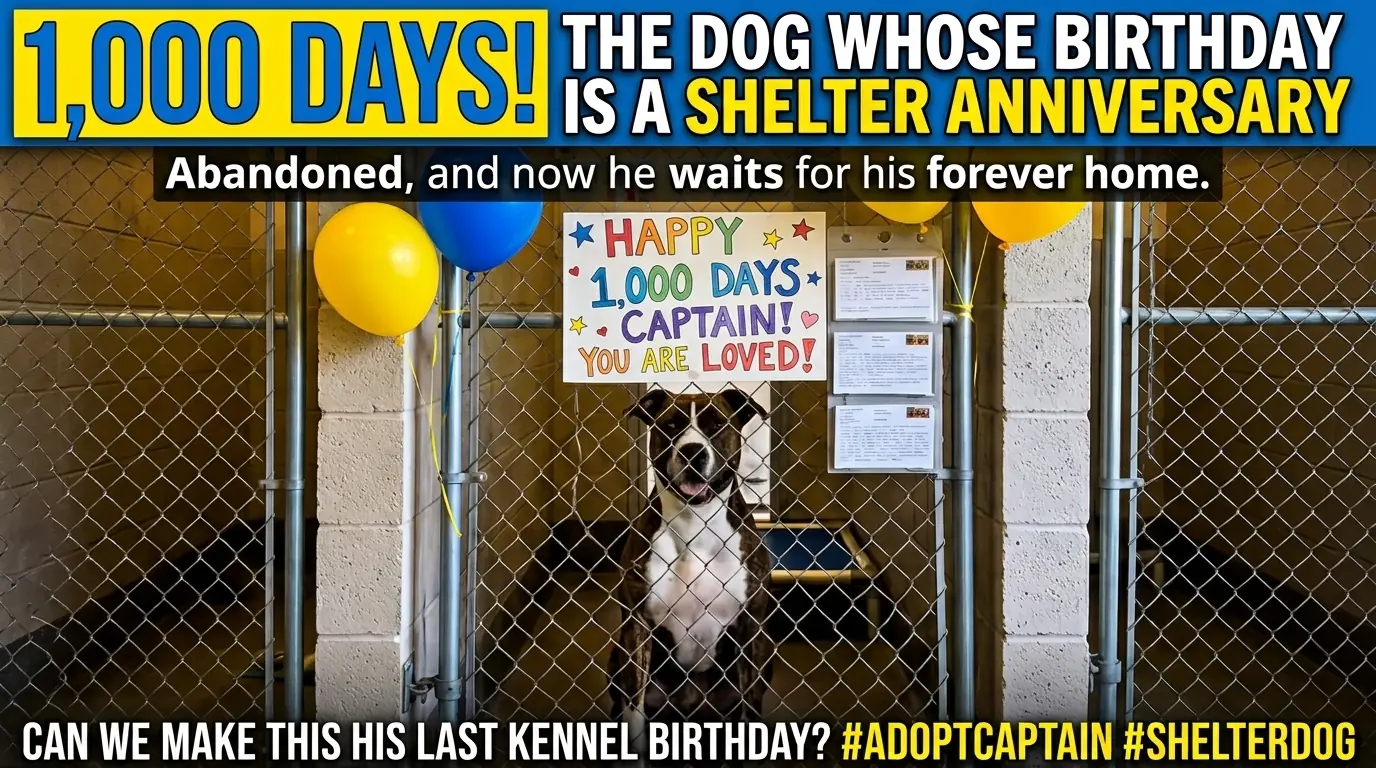
Inside his kennel.
The difference was what he found outside it.
Our staff had hung blue and yellow balloons around the gate. Above them was a handmade sign celebrating his 1,000 days with us.
Technically, we call today Captain’s birthday.
The truth is that we do not know the actual date he was born.
Captain came to us without a complete history, and there was no reliable information that could give us an exact birthday. Rather than allow him to have no day of his own, our team chose the date he entered our care.
It was the first date in Captain’s life that we could document with certainty.
So every year, we celebrate it.
This year feels different.
Because today also marks 1,000 days since Captain entered the shelter.
That is a milestone we never wanted him to reach.
Physically, Captain is doing well.
His veterinary team continues to monitor him through routine wellness examinations, and he receives the preventive care expected for a dog living in a shelter environment.
His vaccinations are current, his weight is monitored, and staff keep a close eye on his mobility, appetite, skin, coat, teeth, and overall condition.
After this much time in our care, we know Captain's routines remarkably well.
We know how he eats.
We know how he sleeps.
We know which treats make him suddenly forget all attempts at patience.
We know which volunteers he recognizes before they even reach his kennel.
And we know exactly what happens when someone unfamiliar walks down the adoption hallway.
Captain watches.
If the footsteps continue past his kennel, he usually settles again.
If they stop, Captain stands.
His ears change position.
His tail begins moving.
He waits to see what happens next.
That routine has repeated more times than we can count.
One thousand days inside a shelter means Captain has watched an enormous number of people come through those doors.
He has also watched many dogs leave.
Some stayed only weeks.
Some stayed months.
A few arrived long after Captain and found homes quickly.
We cannot explain to him why.
Dogs do not measure their worth by adoption statistics, and we try not to place human interpretations onto everything they do.
But Captain absolutely recognizes routines.
He knows when a leash comes out.
He knows when people are entering the adoption area.
He knows when another kennel becomes empty.
And he knows when someone has stopped specifically for him.
Even after all this time, he still gets up.
That is what affects our staff most.
Captain has not stopped participating in the possibility that someone might choose him.
His emotional health is something we take seriously because long shelter stays can be difficult for dogs.
Kennels are safe, but they are not homes.
There are unfamiliar sounds.
Dogs barking.
Doors opening and closing.
Cleaning schedules.
Different staff members.
Visitors walking through.
The environment changes constantly in ways a private home usually does not.
So Captain receives regular time outside his kennel.
He goes for walks.
He spends quiet time with volunteers.
He receives enrichment activities and opportunities to sniff and explore.
On calmer days, staff bring him into a quieter room simply so he can experience something different from the kennel hallway.
Those breaks matter.
One of Captain's favorite things is simply being near someone without being asked to do anything.
He will investigate the room first.
Then, once he understands there is nothing particularly exciting happening, he settles.
Sometimes he lies near a volunteer's chair.
Sometimes he stretches out and watches the door.
Eventually his eyes become heavy.
Those are the moments when we see how different Captain could look in a home.
Not Captain the long-term shelter dog.
Just Captain.
A dog asleep near his person.
His appetite remains excellent.
Captain knows meal times with impressive accuracy, and he is usually standing before the bowl reaches him.
We use some of his food for enrichment rather than simply placing everything in a bowl.
He enjoys sniffing out pieces of kibble and working with simple food toys.
It gives his mind something to do and breaks up the repetition of shelter life.
He has also learned the schedules of individual staff members.
There is one volunteer who usually walks him on particular days.
Captain recognizes her.
When she appears at the end of the hallway, his entire body becomes more animated.
The tail starts.
Then the feet.
Then the impatient look toward the kennel latch.
That relationship tells us something important about him.
Captain can form strong, positive bonds with people.
He remembers those people.
He trusts routine.
And he responds beautifully to consistency.
That is exactly why we believe the right home could mean so much to him.
A shelter gives Captain many caregivers.
A home would give him his people.
There is a difference.
Here, someone may walk him in the morning and another person feed him in the afternoon.
Someone different may sit with him tomorrow.
They all care about him.
But they eventually go home.
Captain remains.
We want him to experience being the dog who goes home too.
His mobility remains good, and he enjoys regular walks without needing unusually strenuous exercise.
Like many dogs who have spent significant time in kennels, he sometimes becomes excited when he realizes he is going outside.
Once away from the busiest shelter environment, however, he settles.
He likes having time to sniff.
He checks trees.