CHAPTER 2: "She Doesn't Speak Chinese," A Millionaire Bet $100K a Black Waitress Couldn't Speak Chinese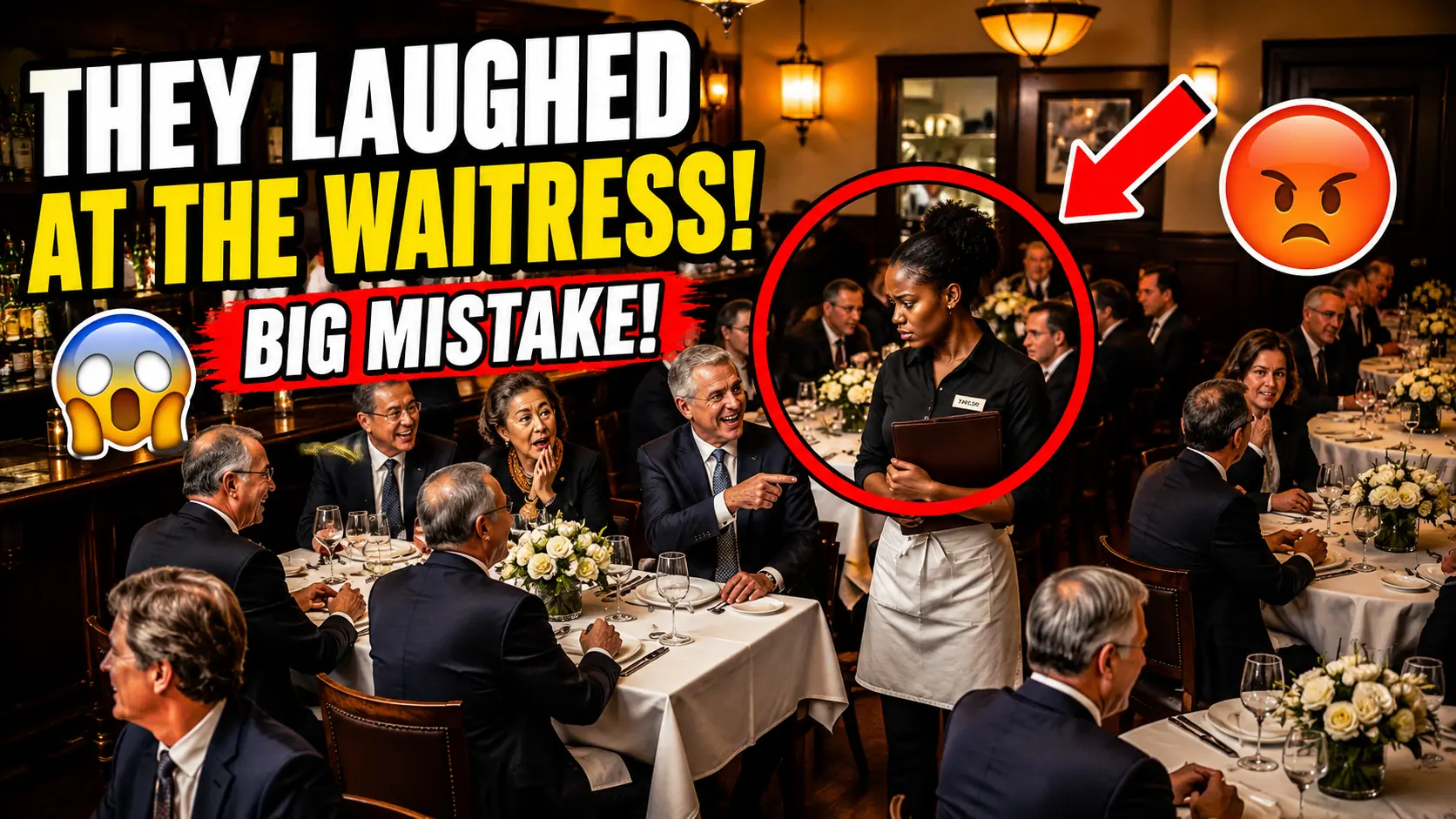
Chapter 2: The Contract, the Power Shift, and the Offer
Gerald Covington didn’t get to $300 million by losing arguments in public. He got there by doubling down until the other person quit. So that’s exactly what he did. He pulled out his phone, tapped the screen three times, then slid it across the table toward Whitney—right through the puddle of condensation from his whiskey glass.
“Read it.”
On the screen was a document. Dense Mandarin characters. Small font. It was the preliminary term sheet for the waterfront deal—the actual investment contract between Gerald’s company and Mr. Shu’s firm.
“Read it out loud. Translate it. Right now, in front of everyone.”
He was betting on something specific. Conversational Mandarin and written business Chinese are completely different skills. You can chat with aunties at a fish market your whole life and still not be able to read a legal contract. He knew that. He was counting on it.
“Unless that’s above your pay grade,” he added, “which, let’s be honest, everything at this table is.”
By now the performance had an audience. The couple at the next table had stopped eating entirely. A woman by the window was holding her phone under the table, recording. Two servers stood frozen near the kitchen door, watching through the glass.
Whitney picked up the phone. She didn’t grab it. She lifted it the way a surgeon lifts a scalpel—with precision and zero hesitation. Her eyes moved across the screen line by line, not frantically, not slowly, with the steady rhythm of someone who reads dense text the way most people read a menu. Then she started translating out loud in English, clear as glass.
Clause one: equity stake percentages. She broke it down. Who owns what. What triggers a dilution event. What the cap structure looks like.
Clause two: liability limitations. She translated the sub-clauses, flagged the mutual indemnity language, and noted that the English equivalent would typically use the phrase “hold harmless,” which wasn’t reflected in Gerald’s English draft.
Then she hit clause three. She stopped.
“This non-compete provision,” she said, still looking at the screen. “The phrasing here is ambiguous. In standard Mandarin legal writing, this could mean the non-compete applies to subsidiaries only. But in Shanghai regional convention, this same phrasing extends to individual officers. Your English draft treats it as subsidiaries only. That’s a gap. And depending on which interpretation the court applies, it could cost you the entire exclusivity clause.”
She set the phone down, looked at Gerald, and waited.
The entire table looked at Mr. Shu. Mr. Shu uncrossed his arms slowly. Then he nodded. “She is correct,” he said, in English, clear enough for everyone to hear. “We raised this exact concern with your legal team last week, Mr. Covington. They dismissed it.”
Gerald didn’t respond. His jaw was locked. His hand flat on the table. Lillian Covington looked at Whitney, and the expression on her face wasn’t surprise anymore. It was something deeper—something that looked a lot like recognition. The kind that comes from being underestimated by the same man for a very long time.
Gerald’s voice came out low, controlled, tight as a wire. “Anyone can memorize legal phrases. That doesn’t mean she belongs at this table.”
Nobody agreed with him. Not out loud. Not even with a nod. The silence at that table said everything. And the $20 bill was still on the floor.
Here’s the thing about Gerald Covington that most people don’t know. He wasn’t born rich. He grew up in a two-bedroom house in Sacramento. His father sold used cars. His mother worked the front desk at a motel. He wore the same three shirts to school for two years straight and got laughed at for it. He built his empire from nothing—no inheritance, no connections, no Ivy League degree. Just confidence, timing, and the ability to make people believe he was always the most important person in the room.
And that’s exactly why Whitney Sawyer terrified him. Not because she spoke Mandarin. Not because she found a flaw in his contract. But because she broke the only rule Gerald had ever lived by: that people like her don’t get to be smarter than people like him. That the hierarchy he’d spent thirty years climbing was real. That the world made sense the way he’d arranged it. When someone like Whitney threatens that, Gerald doesn’t see talent. He sees a threat to everything he believes about himself.
So he did what men like him always do. He went to the man with the power to make her disappear. He found Douglas Harmon near the bar. Douglas was polishing a glass—not because it needed polishing, but because that’s what he did when he was watching his dining room carefully.
“Doug.” Gerald’s voice was low but sharp. “Your waitress just embarrassed me in front of a $90 million delegation. I need her gone. Tonight.”
Douglas didn’t look up from the glass. “She translated a legal document your own lawyers couldn’t get right. I’m not sure she’s the one who should be embarrassed.”
“I’ve brought clients here for eight years. I spend $200,000 a year at this restaurant. You really want to lose all of that over a waitress?”
Douglas set the glass down slowly. Then he looked Gerald dead in the eyes. “I’ve run this restaurant for twenty-two years, Gerald. I’ve never once asked a guest to leave. Don’t make tonight the first time.”
Gerald stared at him. Then walked away without a word.
Back in the kitchen, Derek Tols, head waiter, been on staff for six years, pulled Whitney aside near the dish station. “I saw what you did out there.” His voice was quiet but serious. “And I get it. I do. But Covington is connected. He could make your life very difficult. You sure this is the hill?”
Whitney was retying her apron. Hands steady. Eyes focused. “Derek, he bet $100,000 I couldn’t speak Chinese.” She pulled the knot tight. “He didn’t bet I wouldn’t.”
Derek looked at her for a long moment, then shook his head—not in disagreement, in something closer to admiration.
Word spread through the kitchen fast. The sous chef heard first. Then the dishwasher. Then the sommelier. One by one the staff started drifting toward the kitchen door, peering through the glass window at the dining room like something was about to happen that they didn’t want to miss. Because something was shifting. Not just at Gerald’s table. In the whole building. You could feel it—the way you feel a storm coming before the sky changes. The air gets heavier. People talk less. Everyone starts paying attention.
Gerald Covington had money. He had power. He had connections that could close doors with a phone call. But tonight, in this restaurant, he was losing something no amount of money could buy back. And he knew it.
What happened next changed the entire power dynamic at that table. Mr. Shu called Douglas Harmon over—quietly, respectfully, the way a man speaks when he’s about to make a request he considers important.
“Mr. Harmon, I have an unusual ask. Would you allow Ms. Sawyer to serve as an informal interpreter for the rest of this dinner? Not as a waitress. As a linguistic consultant.” He paused, then added, “Your server understood our contract better than the law firm Mr. Covington hired. I’d prefer to work with her.”
Douglas looked at Whitney. Whitney gave a single nod. “She’s all yours,” Douglas said.
And just like that, Whitney Sawyer walked back to Gerald Covington’s table—but not as the woman he dismissed, not as the waitress he told to fetch a twenty off the floor. She returned at the specific request of the guests of honor. The people Gerald was trying to impress. The people holding ninety million dollars.
The power shift was physical. You could see it in the seating. Whitney now stood between Gerald and Mr. Shu. And Gerald—the man who’d been running the table all night—had to speak through her to communicate with his own investors.
Think about that. The woman he tried to remove was now the bridge between him and everything he wanted.
The dinner continued, and over the next twenty minutes Whitney didn’t just translate words. She translated cultures. When Gerald cracked a joke about getting this deal done fast the American way, Whitney knew it would land wrong. In Chinese business culture, rushing signals disrespect. So she softened the phrasing, kept the energy, removed the edge. Mr. Shu smiled instead of stiffening.
When Mrs. Shu asked a pointed question about the environmental impact of the waterfront project, she asked it formally. In Mandarin, the level of formality tells you how serious the concern is. Whitney translated it with the full weight of that formality, and Gerald, for once, gave a serious answer instead of brushing it off.
When one of the associates brought up a zoning regulation in Mandarin that had no clean English equivalent, Whitney broke it down in three sentences—clear, accurate, no filler. She wasn’t just translating. She was saving the deal.
And the irony was so thick you could choke on it. The woman Gerald wanted gone, the woman he called ghetto, the woman whose mother he insulted, was the only reason his $90 million deal was still breathing.
Mr. Shu’s body language changed completely. His shoulders dropped. He leaned forward instead of back. He started speaking more openly, sharing concerns he’d clearly been holding back. His associates pulled out notebooks and started writing. For the first time all evening, the conversation at that table felt real.
Raymond Cross, Gerald’s silent partner, had been watching everything without saying a word for the last hour. He leaned close to Gerald and whispered something. “She just saved your deal. You know that, right?”
Gerald didn’t respond. He lifted his whiskey glass and drank—long and slow. The kind of drink a man takes when he’s swallowing something other than liquor.
The sommelier stood in the doorway watching. A busboy stopped mid-step with a tray of dirty plates. Two servers leaned against the far wall, pretending to fold napkins but not folding anything. The whole restaurant could feel it. Something had tipped. Something that wasn’t going to tip back.
And through it all—through every translated sentence, every cultural bridge, every quiet correction that kept the deal alive—the $20 bill sat on the floor where it had landed an hour ago. Nobody picked it up. Nobody even looked at it anymore. It didn’t mean anything now.
After the main course, Douglas Harmon walked to the table. Not the casual stroll of a restaurant owner checking on guests. This was different. His back was straight. His steps were deliberate. He was carrying something in his posture that everyone in the room recognized without being told. Authority.
He stopped at the head of the table and addressed Mr. Shu directly. “Mr. Shu, I want you to know something about Ms. Sawyer. She’s been a member of my team for two years. She speaks four languages fluently, and she is the most reliable person on my staff.” He paused. “Whatever she’s contributed tonight, it’s not a surprise to me. It’s overdue.”
Here’s the truth: Douglas didn’t know. Not the full extent. He knew Whitney was sharp. He knew she was dependable. But four languages? Business-level Mandarin? Legal translation on the spot? He had no idea. But he said it anyway. Because Douglas Harmon understood something that Gerald Covington never would. In that room, at that moment, Whitney’s talent needed a roof over it. She needed someone with institutional authority to stand next to her and say, “She belongs here.” That’s not deception. That’s leadership.
Mr. Shu listened carefully. Then he pushed his chair back and stood. He reached into his jacket and pulled out a business card, but he didn’t hand it over casually. He held it with both hands—the traditional Chinese gesture of respect—and extended it toward Whitney.
“Miss Sawyer, my firm employs over two hundred bilingual consultants in Shanghai. Not one of them translates with your instinct.” He held her gaze. “I’d like to offer you a position on my cross-cultural advisory team, starting immediately.”
The table went still. Gerald’s face drained of color like someone pulled a plug. Lillian covered her mouth with her hand. Raymond Cross leaned back in his chair and let out a long breath. The two associates at the end of the table looked at each other with wide eyes.
And Whitney, for the first time all night, lost her composure—just for a second, just enough to notice. Her eyes glistened. Her lips parted, but no words came out. She blinked twice fast and looked down at the business card in Mr. Shu’s hands. This wasn’t part of the plan. She didn’t come back to this table looking for a career. She came back because a man told her she couldn’t speak. That was it. That was the whole reason. And now a man who ran a global firm was standing in front of her offering to change her life.
She took the card. Both hands. A slight bow of her head—a cultural gesture so natural that Mr. Shu noticed it immediately. His expression softened. The kind of softening that happens when someone surprises you, not with what they know, but with who they are.
“Mr. Shu, I’m honored.” Her voice was steady, but her hands weren’t. She was gripping the edge of her notepad so hard her knuckles paled. “Can I… can I have a moment to think about that?”
Mr. Shu smiled. Not a business smile. A real one. “Take your time. But not too long.”
Gerald stared at the table. His jaw was working back and forth, grinding on something he couldn’t swallow. His waitress. The woman he’d told to fetch a twenty. The woman whose mother he’d insulted. She just got offered a job at the table he was paying for—by the man he’d spent six months trying to impress. And the question that hung in the air was louder than anything anyone had said all night: Would she take it? What about her graduate-school dream? And what about that $100,000 bet that still hadn’t been settled?
>>>NEXT CHAPTER<<< CHAPTER 3: "She Doesn't Speak Chinese," A Millionaire Bet $100K a Black Waitress Couldn't Speak Chinese