CHAPTER 2: The Woman the World Buried
By the time the rescue team arrived at the cliffside lodge, the story had already been rehearsed. Kunlay stood at the front, hands on his head, pacing in short, frantic steps.
His voice trembled as he spoke to the lodge manager, then to the first unformed officer who appeared. She slipped. He kept repeating. We tried to grab her, but it happened so fast. Sad sat rigidly on a wooden bench, eyes red, her face composed into the careful shape of grief.
She answered questions when asked, offering details that sounded reasonable, too reasonable. The time of the walk, the loose gravel, the sudden loss of footing. Tundai said very little. He stared at the ground, jaw- clenched, hands trembling in his pockets. When an officer asked him directly what he saw, his voice cracked. "She fell," he said, and then he turned away.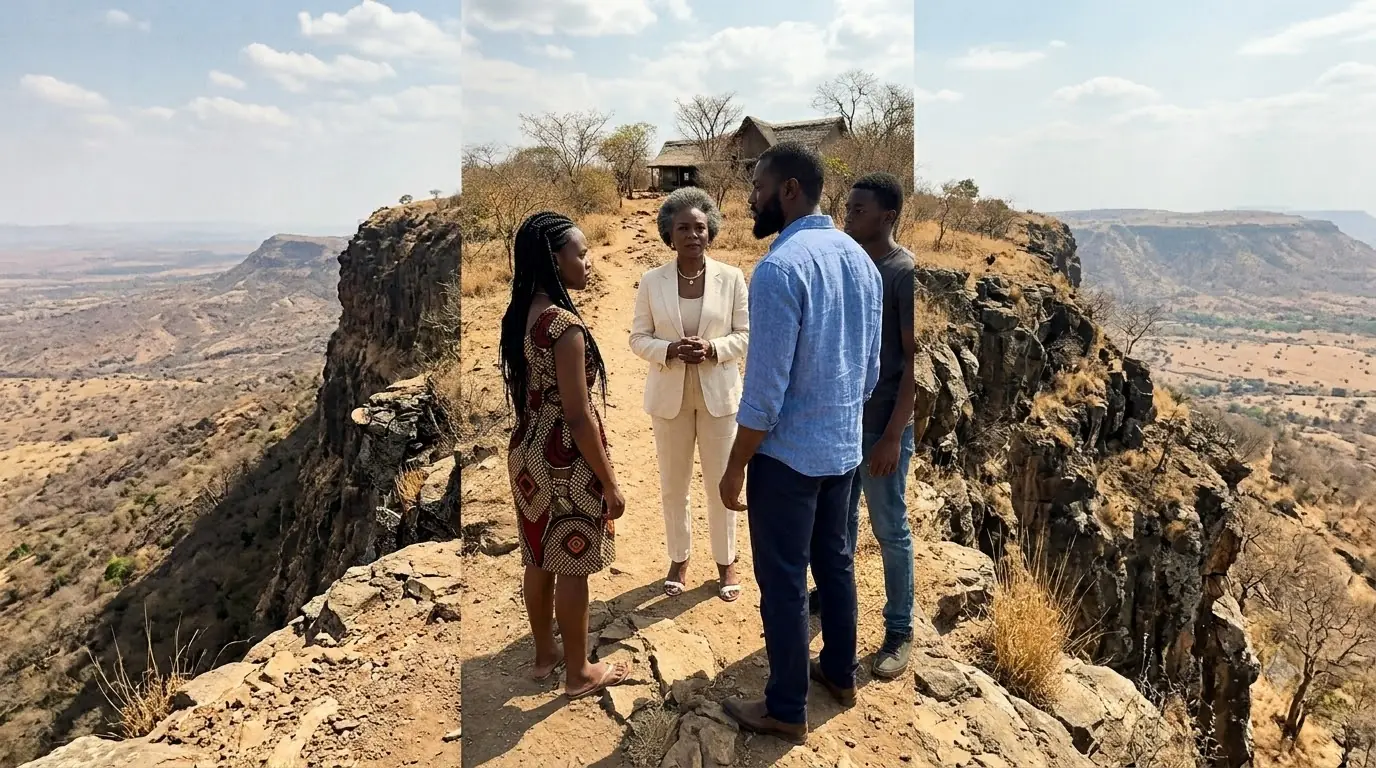
Search teams descended the slope carefully. Ropes anchored radios crackling with clipped instructions. The sun dipped lower as they worked painting the land in long shadows. Below they found blood on rock, torn fabric, signs of impact, but no body. The cliff, it seemed, had swallowed her whole.
By nightfall, the official report was cautious but grim. Given the height and terrain, the lead officer said survival is unlikely. Unlikely. That word spread faster than truth ever does. By the next morning, headlines had formed their own conclusions. African business icon presumed dead in tragic accident.
Billionaire philanthropist falls to her death during family retreat. Photos of Adisolamemensa filled screens across the continent. Her achievements were listed, her generosity praised, her strength admired. Commentators spoke of her legacy in the past tense. At the mansion, preparations began immediately.
A memorial service was announced within days. Black fabric draped the gates. Wreaths arrived in waves sent by politicians, CEOs, international partners. Messages of condolence flooded in from around the world. Her children received them all.
Kunlay stood before cameras, shoulders squared, voice heavy with practiced sorrow. Our mother was our foundation, he said. Her loss is immeasurable. Sad wept softly during interviews, dabbing her eyes with a handkerchief, speaking of her mother's wisdom and sacrifice. She taught us everything she said.
We will honor her. Tundaiai avoided the press altogether. Behind closed-doors, however, the house felt hollow. The staff moved quietly, unsure where to place their loyalty now. Some whispered doubts.
Others said nothing, afraid to lose their jobs. The lawyer arrived two days later. "The will," he said carefully, sitting across from Kunlay in the study. "We must proceed according to its terms. " Kunlay nodded solemnly, "Of course.
" Inside his chest tightened because the will did not change. Death or presumed death had not unlocked anything. The trust remained. The conditions remained. The company would be overseen temporarily by the board until further review.
She really did plan everything Kunlay muttered after the lawyer left. Side said nothing, but her expression darkened. They had crossed a line they believed would end the problem. Instead, the problem remained frozen in legal language and public reverence. Still, they told themselves it would resolve in time. Bodies are eventually found.
Paperwork moves. Influence can be applied. And so they buried their doubts beneath ceremony. The memorial was grand, held at a civic hall large enough to contain the weight of her reputation. A massive portrait of Adisola stood at the front, her expression, calm eyes, steady, almost watchful. People spoke of her as if she were a force of nature.
She changed the face of African enterprise. She lifted communities. She proved what was possible. Her children sat in the front row dressed in black. They bowed their heads at the right moments.
They accepted embraces. They said thank you. Yet not one of them cried the way children cry when they lose a parent. Kunlay's grief was tight contained. Sade's was elegant. Tundaies was silent and consuming. That night, long after the guests had gone, Tundaiay wandered into his mother's bedroom.
The room was untouched. Her scent lingered faintly in the air. He picked up her glasses from the bedside table, holding them like something fragile. "What have we done? " he whispered.
There was no answer. Across the city, far from cameras and condolences, something else was happening. Adisola Mensah did not die at the bottom of the cliff. She lay instead in a shallow ravine several meters below. The point of impact, her body wedged between rock and brush.
The fall had broken bones, torn muscle, stolen breath, but it had not taken her life. She drifted in and out of consciousness for hours, maybe longer. Time lost its shape. When she woke, it was to pain so sharp it blurred the edges of reality. Her mouth was dry. Her vision swam.
She tried to move and screamed a thin, broken sound that echoed weakly against stone. Somewhere above, birds cried. She did not know where she was. She did not know how she had fallen. Only that she was alone, injured, and very far from help. As night crept in, cold replacing heat, she slipped again into darkness.
She would have died there. But fate, it seemed, had not finished with her. Early the next morning, a young boy and his mother walked the lower trails gathering firewood. The boy stopped suddenly, head tilting. "Mama," he said. "Did you hear something?
" They listened. A sound rose faintly from the ravine. A moan, human, weak. They followed it carefully, calling out. When they saw her bloodied, barely conscious, the woman gasped. She's alive," she whispered.
They did not know her name. They did not recognize her face. They only knew one thing. They could not leave her there. As the world mourned a woman, it believed was gone forever. Adisola Mensah was being carried slowly, painfully toward a future none of them had imagined.
Above ground, her children began planning life without her. Below, she breathed. And that was enough. When Adisola opened her eyes again, the world no longer felt like stone and sky. It smelled of smoke and herbs. The light was softer, filtered through a cracked window covered with a thin cloth. Pain still lived in her body, deep and unrelenting, but it no longer came in waves violent enough to steal her breath.
She tried to move. A sharp ache flared through her ribs, and she groaned. "Easy," a woman's voice said quickly. "Please don't try yet. " Addis turned her head slightly.
The room was small mud walls, a low wooden bed, a mat on the floor. Beside her sat a woman in worn clothing, her face lined by years of sun and worry. A boy stood near the doorway, clutching a bundle of firewood eyes wide with fear and curiosity. "Where am I? " Adisola whispered.
The words scraped her throat. "You are safe," the woman replied gently. "My name is Bi. This is my son, Lani. We found you near the ravine.
The ravine. Fragments stirred in Adisola's mind. Sunlight voices, a sudden loss of balance. Her chest tightened, but the memory refused to settle into something clear. She closed her eyes dizzy.
"You fell," Bisi continued. "Your body was broken. We carried you as best we could. I sent Lani to fetch help, but the nearest clinic is far. We did what we could.
Adisola swallowed. "Thank you," she said. The words felt small compared to what they had done. Days passed in a slow blur. Pain anchored her to the present, while confusion clouded the past.
Bisi tended to her wounds with careful hands using boiled water and herbs passed down from her mother. Lani brought water, fetched firewood, and watched over her silently as if afraid she might disappear if he looked away too long. At night, Adisola drifted in and out of sleep, haunted by half-formed dreams. Children's laughter turning sharp. A woman falling through light, a ring slipping away.
She woke each time with her heart-racing tears soaking the mat beneath her head. But when she reached for memory, it slipped from her grasp. "Do you know your name, Bisi? " asked gently. One morning, Adisola opened her mouth. Nothing came.
She frowned, panic rising. I I don't know, she said slowly. I know how to speak. I know numbers. I know things. But not that.
Bisi nodded unsurprised. Head injuries do that, she said. It may return or it may not. Adisola stared at the ceiling grief settling into her chest without a clear cause. She felt she had lost something precious, something vast, but could not name it.
Weeks passed. Her body healed unevenly. One leg remained weak. Her ribs ached constantly, but she could sit up now, then stand, then take a few careful steps with Lani's help. She learned about Bisi's life in pieces.
A widow, her husband gone to an illness that took him quickly and left nothing behind. She survived by selling smoked fish at the roadside, earning barely enough to feed herself and her son. You saved me, Adisola said one evening watching Bisi count coins by lantern light. Bisi shook her head. Life brought you to us, she said. That is all.
Adisola felt something stir inside her, an unfamiliar humility, sharp and grounding. She had lived a life of command and certainty. She sensed that much. Here she was dependent, and strangely that dependence did not diminish her. It stripped her down to something truer. As her strength returned, so did fragments of memory, uninvited, incomplete.
She remembered the smell of polished wood, the sound of meetings, the weight of expectation. Faces. Three of them hovered at the edge of recognition, always just out of reach. Each time she tried to grasp them, her head throbbed fiercely. One afternoon, while Lani slept outside, Bisi spoke quietly.
People came asking about a woman who fell. She said they said she was rich. Important. Adisola's heart skipped. Did you tell them about me?
No. Bisi replied. I said we saw nothing. Adisola exhaled a mix of relief and unease washing over her. Why Bisi looked at her carefully? Because whoever pushed you to that cliff might still be looking.
The word pushed echoed sharply. Adisola's breath caught. Her head pulsed. Images surged. Voices raised anger.
The ground slipping away. She cried out, clutching her temples. Bisi was at her side instantly. Sh. Don't force it.
Adisola wept, then not from pain, but from the terror of knowing something terrible had happened and being unable to fully remember it. That night, she lay awake staring into darkness. If she had been pushed, by whom and why? As weeks turned into months, Adisola began to help around the small compound. She cleaned fish. She cooked. She sat with other women in the village, listening to stories of hardship spoken without bitterness. Their strength humbled her.
She had no jewelry, no phone, no identity. For the first time in her life, no one expected anything from her. And in that quiet anonymity, something healed that had long been bruised. One afternoon, while to sorting dried maize, she overheard a radio broadcast crackling in the background. A familiar name floated through the static. The late Adisola Mensah.
Her hands froze. She turned slowly toward the radio. The announcer spoke of a foundation bearing her name, of a legacy, of a woman remembered as a giant. Her heart pounded violently. "That's that's me," she whispered.
The room tilted, memory slammed back into place, not gently, but like a door thrown open in a storm. The mansion, the will, the cliff, her children, her children. Adisola collapsed to the floor, sobbing, Bisi knelt beside her, holding her as the truth poured out in broken fragments. When Adisola finally lifted her head, her eyes were different, clearer, sharper. "They tried to kill me," she said quietly. Bisi said nothing.
She did not need to. In the days that followed, Adisola thought deeply. Rage rose, but it did not take control. She had survived something meant to end her. Survival, she realized, was not permission for revenge.
It was an opportunity for reckoning. She made a decision. She would not return as the woman she had been. She would return as the woman her children had never known. With Bisi's help, she contacted a distant legal aid office using a borrowed phone carefully anonymously. She asked questions.
She listened. She learned how much had changed in her absence. And she waited. One year after the world buried Adisola Mensah, she stood at the edge of a different life. No longer broken, no longer lost. She was alive and she was ready.
The world had moved on without her. That was the first truth Adisola learned as weeks turned into months after her memory returned. News reports spoke of her in the past tense. Awards were accepted in her name by others. Her foundation had been launched with ceremony and speeches she never gave. Her face appeared on billboards honoring a legacy she was not allowed to claim.
She watched it all from a distance. Adisola did not rush back. She did not call the police. She did not appear at the gates of her mansion demanding answers. The woman who had survived the cliff understood something her old self had not.
Truth without timing is wasted and justice without preparation becomes noise. So she waited. She stayed in the village with Bisi and Lani slowly rebuilding her body and mind. The limp in her leg faded to a dull reminder. The pain in her ribs softened.
What remained was the ache in her chest, the realization that her children had chosen inheritance over humanity. At night, she replayed the fall in her mind, the words, the look in Kunlay's eyes, the silence from Sad, Tundaiai's hesitation. Each memory sharpened with time, not into rage, but into clarity. They didn't just push me, she said once to Bisi, staring into the fire. They erased me.
Bisi stirred the pot quietly. Sometimes, she said, people erase what reminds them of who they are not. Adisola nodded. She began to move carefully, adopting a new name, Amina, and traveling modestly. She worked with small cooperatives, offering advice without revealing its source.
She helped women organize savings groups. She listened to farmers speak of transport costs and storage losses, problems she had solved years ago, with money and scale. Now she solved them with patience and trust. No one knew who she truly was. And for the first time in decades, that felt like freedom. In the cities, her children struggled. Without her steady hand, Mensah integrated holdings became unstable.
Kunlay pushed expansion too fast, taking risky loans that alarmed the board. Sad manipulated numbers to maintain appearances, but cracks showed in the margins. Tundaiai bounced between projects burning cash without results. They argued constantly about control, about blame, about who should have stopped what. She would have known what to do.
Tundaiai snapped one night, slamming his glass down. Kunlay glared at him. She would have blocked it, he said like she always did. Sad said nothing, but her silence spoke of unease. The board began asking questions.
Investors whispered. Employees left quietly, taking institutional memory with them. The empire Adisola had built did not collapse, but it wobbled. And still the trust remained untouchable. Adisola learned all this through careful channels. Old allies who still respected her principles, lawyers who spoke in hypotheticals, journalists who mentioned rumors without names.
She took notes. She observed patterns. Most importantly, she learned who had stayed honest when she was gone and who had not. By the ninth month, she had quietly assembled a small circle. A retired judge known for integrity, a former operations director she had once mentored and a young investigative journalist with a reputation for patience.
None of them knew her full story at first. She presented facts, slowly testing trust, as she once taught her children to do. When she finally told them who she was, disbelief gave way to resolve. "You're saying they attempted murder," the judge said quietly. "I'm saying they pushed me," Adisola replied. "The law can decide the rest.
" Evidence gathering began. Not rushed, not reckless. Phone records, financial inconsistencies, the lodge's guest logs, statements from staff who had been pressured to change timelines. A pattern emerged clearer than any single accusation. Adisola remained in the shadows. On the anniversary of her presumed death, the city held a charity gala in her honor.
Her children stood on stage beneath her portrait speaking of resilience and vision. Applause thundered. Adisola watched from a small television in a roadside cafe, her face hidden beneath a scarf. They look comfortable, Bisi said softly. "Yes," Adisola replied.
"Too comfortable. " That night, she made the final decision. She would return not as a ghost seeking revenge, but as a living witness demanding truth. But she would do it on her terms. In the final weeks before her reappearance, she set her affairs in order. She ensured Bisi and Lani were provided for quietly securing a home and education funds through intermediaries.
She transferred advisory roles to trusted leaders in the cooperatives she had helped build, refusing to become indispensable. "Why not stay? " Bisi asked one evening. "You've done good here. " Adisola smiled sadly.
"Because running does not heal," she said. "Facing does. " On the morning she left, Lanine hugged her tightly. "Will you come back? " he asked.
Adisola knelt, meeting his eyes. The world is bigger than one place, she said, but you will always be part of mine. As she traveled back toward the city by bus, by train, by borrowed car, she felt no fear, only a steady resolve. The woman who had fallen from the cliff was gone. In her place stood someone tempered by loss and stripped of illusion. She did not crave apologies.
She did not seek forgiveness. She sought truth and truth she knew would not be gentle. As the city skyline came into view, Adisola removed her scarf and sat up straighter. The sun caught her face, revealing lines that spoke of survival rather than age. One year after the world buried her, she stepped back into its light unannounced, unrecognized, and unstoppable. The shadows had taught her everything she needed.
Adisola had survived, remembered, and prepared in silence. Now she would return to the empire that mourned her and force the truth into the same daylight where her children had tried to kill her.
CHAPTER 2: The Woman the World Buried
Theme:
Font Size:
24px