CHAPTER 2: WHEN THE PAPER TRAIL FINALLY CLOSED IN
Two federal agents stood in the next room, out of sight from the windows, drinking coffee I'd made that morning without knowing exactly how many people it would need to serve. "She'll come," Andrea said, checking her phone. "The moment she hears you have an official visitor, she won't be able to stay away. It's not about the reform legislation to her, it's about what it means that you're the one being visited. " I hadn't posted anything. I hadn't told anyone.
But small towns move information faster than any subpoena, and by 9:40 that morning, my phone buzzed with a text from Harold. "Heard the AG's people are at your place. Everything okay? " By 10:15, I heard the BMW. It came up the gravel drive too fast, the way it always did when Vanessa wanted an entrance instead of an arrival. Through the window, I watched her get out, already holding her phone up, already recording, already talking to whatever audience she'd summoned on her way over.
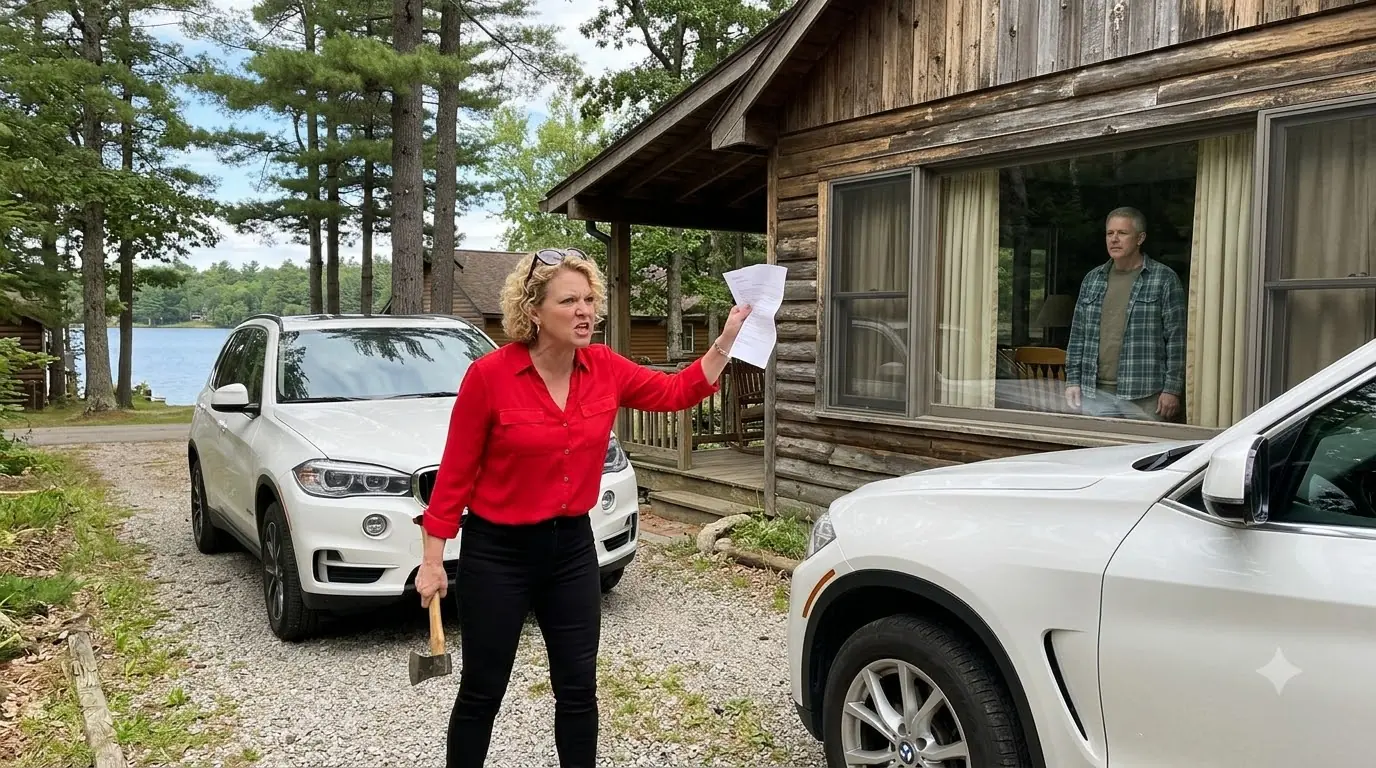
And you're not going to believe this. This is exactly the kind of government overreach I've been warning you all about. They're literally at his cabin right now, probably trying to protect him from the consequences of his own non-compliance. She reached my porch. The same porch where she'd once told me I had 48 hours before losing my dock.
She didn't knock. She never did. Her boot hit the door and it gave way harder than she expected, swinging inward. Her phone still raised, still streaming to however many people were watching live. This is what government overreach looks like, folks.
They're colluding with him to protect a man who thinks his family name puts him above. She stopped mid-sentence. The Attorney General stood up from my father's table. Calm, unhurried, the way you stand when you've done this before and know exactly how much weight your own stillness carries in a room. "Mrs.
Coleman," she said, "I believe we have some things to discuss. " Vanessa's phone was still raised, still recording, still broadcasting live to her followers the exact moment two federal agents stepped out from the next room behind her. "What is this? " she said. And for the first time in 6 months, her voice didn't sound like someone accustomed to being obeyed. "This is the end of a pattern," the Attorney General said. "Fraudulent maintenance invoices paid to a company registered to your husband.
Assessment fees for repairs never performed. A recorded lien filed against a property with a clean title dating to 1969, 22 years before this HOA legally existed, which means the lien itself was filed without jurisdiction. And three homeowners pressured into selling below market value within weeks of a personal visit from you. We have the paper trail, all of it, dated, verified, and corroborated across three counties. I stood in the doorway to the kitchen, close enough to see Vanessa's face change in real time, the exact thing I could have given her at the mailbox, at the community meeting, at my own front porch 6 months earlier.
Except now, it was happening in front of federal agents, an attorney general, and however many strangers were still watching her own live stream. "I don't—this is a misunderstanding. " I can explain the invoices. My husband's company does legitimate work. You're welcome to explain all of it, the attorney general said, to the agents, not to your followers. One of the agents stepped forward.
Vanessa's phone was still recording. She hadn't thought to turn it off, and I understood, watching her hands shake slightly around it, that she wasn't going to think to turn it off in time. Whatever was happening to her face right now, her audience was going to see all of it. I didn't say much. I'd promised myself, somewhere around day 40 of this, that I wouldn't need to.
Everything I might have wanted to say 6 months ago, about the deed, about the levy that was never repaired, about the families who'd sold their homes for pennies, was already sitting in a folder on my father's table, already verified by people whose job it was to verify such things. But I did say one thing. Quiet enough that only she and Andrea heard it as the agent guided her toward the door. "I wasn't quiet because I was scared, Vanessa. I was quiet because I needed you to say enough for me not to have to. " She didn't answer.
There wasn't anything left to say that wouldn't be used exactly the way she'd always assumed her own words would be used, against someone else. Was 6 months of silence really slower than speaking up immediately, or was it simply the only path that ended with the truth arriving somewhere. Nobody could talk their way out of it. The trial took 3 months. I didn't attend every session, but Andrea called me after the parts that mattered.
The invoice trail from Coleman Grounds and Grading held up exactly as she'd predicted. Robert Coleman's company had performed almost none of the work billed, and the emergency levee repair, when finally inspected by an actual county engineer, was confirmed to be untouched since before Vanessa ever took office. My photographs, four angles, timestamped months earlier, matched the engineer's report almost line for line. The verdict came down on a Tuesday, 4 years in federal prison, $310,000 in restitution, distributed among the homeowners she'd defrauded. The HOA itself was dissolved by court order within the month.
Its bylaws found to have been improperly enacted from the start. My plat map, it turned out, wasn't just a defense for my own property. It was the thread that unraveled the entire organization's authority to exist. The two families who'd sold their homes for pennies on the dollar were given the legal right to repurchase at the price they'd been forced to accept, adjusted fairly by the court. One of them, an elderly woman named Ruth, called me crying, not from sadness, she said, but because she hadn't believed anyone would ever go back far enough to fix it.
Harold still keeps his old notices in a shoebox, though he laughs about it now. "Guess I didn't need them after all," he told me at the boat launch last week. "But I'm glad I kept them anyway. My dock is still standing. The wrong shade of brown, same as it's always been.
Nobody's mailed me a notice about it in 4 months. " I think about my father sometimes, sitting at that pine table, measuring twice before cutting once. I understand now that patience was never about being passive. It was about refusing to let someone else's urgency dictate the terms of my own fight, about letting the truth take exactly as long as it needed to become undeniable, instead of rushing it into something that could still be argued with. Vanessa mistook my silence for surrender for 6 months. She was wrong about that the entire time, but I understand why she believed it.
Most people do when they've never once had to wait for something they were certain they already deserved. So, here's the question I keep coming back to, the one I didn't have an answer for until it was already over. If you know you can win, does waiting make you weak, or does it just mean you're the only one in the room who understands that some victories aren't worth having if they arrive too soon to be complete? And that's the part of this story that stays with me, not the door breaking, not even the moment those agents stepped out of the next room. It's the 6 months before any of that, the quiet ones, where nothing seemed to be happening at all, because Vanessa made a mistake long before she ever kicked in that door.
She looked at a man alone in a cabin, past retirement, no title, no folder full of threats of his own, and she decided he mattered less. That decision came before the invoices, before the liens, before any of it. Somewhere in her mind, she'd already sorted people into two categories, those who could push back and those who couldn't. That's usually where this kind of thing starts, not with cruelty, exactly, with a quiet, almost lazy assumption that someone's stillness means they have nothing behind it. Daniel never confused patience with permission.
He let her keep talking because he understood something a lot of people forget under pressure, that the loudest response isn't always the strongest one. Sometimes, the strongest thing you can do is stay exactly who you are while someone else keeps proving who they are. That takes more discipline than people give it credit for. It's easy to be calm when nothing's at stake. It's a different thing entirely to stay calm while someone is trying to take the one place that still holds your father's hands in every log.
END