CHAPTER 2: WHEN THE TRUTH BECAME BIGGER THAN THE CAR
And before the story ended, secrets buried for years were about to surface. Secrets that would prove this wasn't the first time she had judged someone she didn't bother to know. The videos spread faster than anyone expected. By midnight, thousands of people had watched them. By sunrise, the number had climbed into the hundreds of thousands.
The internet had done what it always did. It asked questions. And once enough people started asking questions, answers began appearing. The first video came from a teenager who had been standing near the fountain. The second came from a woman sitting outside a coffee shop across the plaza.
The third came from a tourist visiting Naples for the weekend. Different angles, different voices, same story. An elderly black man, a Ferrari, a public accusation, a billionaire son, and one question that seemed to dominate every comment section. Why didn't she believe him? The videos were shared across social media platforms throughout the night.
News stations picked them up. Bloggers discussed them. Radio hosts debated them. People who had never heard of Samuel Carter suddenly knew his name. Yet something unexpected happened.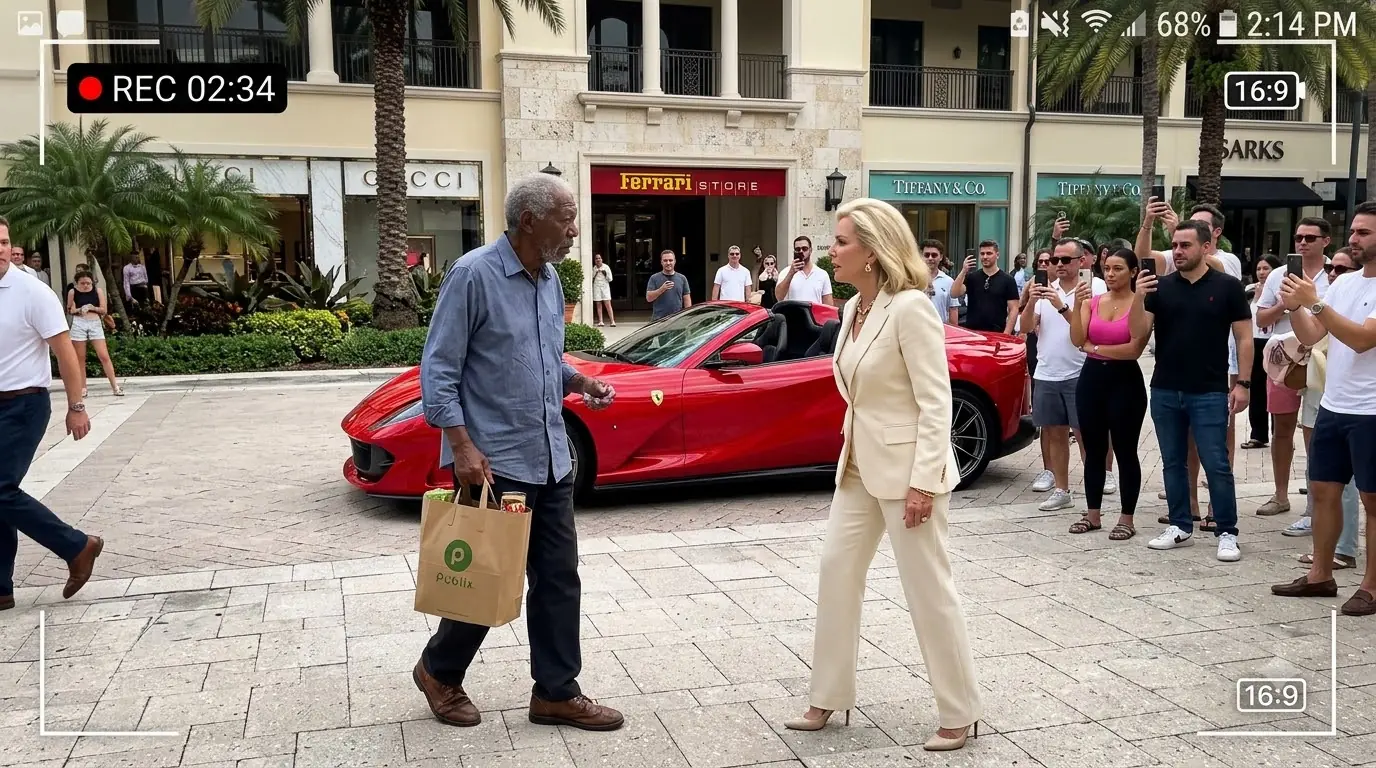
The focus slowly shifted away from the Ferrari, away from Ethan Carter, away from money, toward Samuel, toward the man himself. People became curious. Who was he? What kind of father raised someone like Ethan Carter? What kind of person stayed calm through public humiliation?
The answers began arriving the following morning. And they arrived from people Victoria Sterling had never imagined. The first call came from Orlando. A local reporter received an email from a man named Carlos Mendoza. Carlos owned a catering company, a successful one.
He attached a photograph, then another, then a written statement. By lunchtime, his story was circulating online. Three years earlier, Carlos had been delivering food to a charity event hosted by a social organization where Victoria served on the board. He remembered arriving early, professional, prepared. dressed in a pressed uniform. Yet before anyone asked his name, Victoria had questioned whether he belonged there.
A retired school teacher named Angela Henderson spoke publicly. She and her husband had attended a private fundraising event years earlier. Several guests welcomed them warmly. One person did not. Victoria.
Angela described spending an entire evening feeling unwelcome, despite holding the same invitation as everyone else. Again, Victoria never used offensive language, never raised her voice, never created a scene, yet somehow managed to communicate exactly how she felt. Angela remembered every second. The stories kept coming, one after another. Not dramatic, not sensational, just consistent.
A pattern. A hundred tiny moments revealing the same truth. Victoria judged first, learned later, if she learned at all. Meanwhile, Samuel Carter woke up Saturday morning exactly as he always did. He brewed coffee, read quietly, and tried avoiding television.
Ethan failed completely at helping with that goal. "Dad, you're everywhere." Samuel sighed. "I was hoping not to be." They sat together in Ethan's temporary Naples residence overlooking the water. The sunrise painted the gulf in shades of gold and orange. Luxury yachts drifted across the horizon.
Samuel barely noticed them. He was watching pelicans. "You know," Ethan said, scrolling through headlines. "Most people would enjoy this." "What?" "Being the center of attention." Samuel laughed. "Most people need hobbies." For the first time since arriving in Florida, Ethan relaxed.
The crisis had passed. His father was safe. Nothing else mattered. Or so he thought. The doorbell rang.
Ethan frowned. "I'll get it." A few moments later he returned accompanied by a woman. Samuel recognized her instantly. Emily. The young mother from the roadside.
She looked nervous, almost overwhelmed. Tyler stood beside her holding the same stuffed dinosaur. For a moment nobody spoke. Then Tyler pointed. "Mom, that's him." Emily nodded.
"I know." Samuel stood. A smile spread across his face. "Well, look at that." Emily laughed through tears. "I can't believe it's really you." Ethan looked confused. "You two know each other?" Samuel immediately knew what had happened.
The videos, the news coverage, the internet. Emily wiped her eyes. "You fixed my car." Recognition appeared on Ethan's face. "Oh." Samuel smiled. "It wasn't much." Emily shook her head.
"It was everything." The room became quiet. Tyler stepped forward. "You gave us sandwiches." Samuel nodded. I remember. And money.
Samuel looked slightly embarrassed. Ethan burst out laughing. You gave away money again? Samuel shrugged. The reaction told Emily everything she needed to know.
This wasn't unusual. This was who he was. For the next hour she told Ethan the entire story. The broken car, the heat, the kindness, the envelope, the advice, the way Samuel left before receiving thanks. By the time she finished, Ethan's eyes were shining.
Not with sadness, with pride. The kind only children feel when they realize the world finally sees what they've always known about a parent. After Emily left, another story appeared, then another, then another. Former volunteers from the community kitchen spoke publicly. Shelter workers, neighbors, church members, retired veterans, single parents, people Samuel had helped for decades.
Most had never met Ethan. Many didn't even know Samuel had a wealthy son. That wasn't why they loved him. They loved him because he showed up again and again and again. The story transformed.
News anchors stopped discussing the Ferrari. Commentators stopped discussing wealth. The conversation became something else entirely. Character, kindness, dignity. One evening a national television host said something that resonated across the country.
Maybe the most remarkable thing about this story isn't that Samuel Carter is the father of a billionaire. The host paused. It's that he was already before anyone knew it. The clip went viral. Millions watched.
Millions agreed. Back in Naples, Victoria Sterling sat alone in her living room. The curtains remained closed. The television stayed off. Her phone never stopped ringing.
Friends, associates, reporters, lawyers, everyone wanted something. Most wanted explanations. Few offered sympathy. For the first time in years, Victoria found herself confronting something she had spent decades avoiding. Herself.
The uncomfortable truth wasn't that Samuel had a billionaire son. The uncomfortable truth was that she never would have treated him that way if she'd known. And that realization hurt more than any public embarrassment. Because it revealed exactly who she had become. Meanwhile, Samuel spent the evening somewhere very different.
Not in a television studio. Not at a press conference. Not attending interviews. He was back at New Hope Community Kitchen. Washing trays.
Stacking chairs. Sweeping floors. Exactly where he wanted to be. Linda watched him work. You know you're famous now.
Samuel smiled. No. You are. No. He handed her a stack of clean trays.
I'm just me. Linda laughed. The answer sounded exactly like something a Samuel Carter would say. Because fame had changed nothing. Money had changed nothing.
Attention had changed nothing. He remained the same man who stopped for strangers. The same man who carried sandwiches in paper bags. The same man who believed people deserved kindness before they earned it. And before the story finally ended, Samuel Carter was about to make one last decision.
A decision that would leave everyone speechless, including Victoria Sterling herself. Three months later, the story should have been over. Most stories like this disappeared after a few news cycles. People moved on. The internet found something new.
The headlines faded. The outrage cooled. But this story refused to disappear. Not because of the Ferrari. Not because of Ethan Carter.
And not because of Victoria Sterling. It endured because people saw something rare. They saw kindness remain kind. Even after being humiliated. Even after being judged.
Even after being given every reason to become bitter. Autumn arrived in Florida. The air grew slightly cooler. Palm trees still swayed above the Gulf. Tourists still filled the beaches.
Life continued. Yet many lives had quietly changed. Marcus Reed no longer worked behind the valet podium. The events of that afternoon had become a turning point. Several business owners who watched the viral videos reached out after seeing him speak up.
One opportunity led to another. Eventually, Marcus accepted a position as guest services director for a hospitality company partnered with one of Ethan Carter's charitable foundations. His office overlooked a marina. Nothing extravagant. Just a quiet space with sunlight and a view.
On the corner of his desk sat a framed photograph. Not of celebrities. Not of business leaders. A picture of himself and Samuel standing beside a coffee truck after a volunteer event. Whenever someone asked why he kept it there, Marcus always gave the same answer.
Because that's the day I remembered who I wanted to be. Emily's life changed, too. Not overnight. Not magically. Real life rarely works that way.
But after her story gained attention, she received help. A nonprofit scholarship program funded by the Carter Foundation covered her vocational training. Within months, she secured a stable position with a local healthcare network. For the first time in years, she wasn't choosing between groceries and rent. Tyler's grades improved.
The stress inside their small apartment slowly disappeared. One afternoon, Tyler wrote an essay at school about his hero. The teacher expected an athlete, maybe a firefighter, perhaps a famous entrepreneur. Instead, he wrote about an old man who fixed a broken car. The essay ended with a sentence his teacher never forgot.
Mr. Samuel showed me that rich people aren't the ones with the most money. They're the ones with the biggest hearts. Meanwhile, Ethan Carter returned to New York. Business resumed. Meetings resumed.
Investments resumed. The world continued demanding pieces of his attention. Yet something inside him had shifted. For years, he had built companies. Now he found himself thinking more often about legacy, about impact, about the example his father had quietly set long before success arrived.
One evening, he stood before a room full of executives. The presentation behind him displayed quarterly projections worth billions. Instead of discussing profits immediately, he began with a story. A story about a man carrying sandwiches in a paper bag. A story about dignity.
A story about character. When he finished, the room remained silent. Then one executive finally spoke. Your father sounds extraordinary. Ethan smiled.
He is. Across the country, Samuel Carter's life looked almost identical to the way it had before the videos. That surprised many people. The invitations arrived. Television interviews, speaking engagements, book offers, podcast appearances, documentary proposals.
Samuel declined nearly all of them. Politely. Respectfully. Firmly. His Saturdays remained sacred.
Every weekend he still arrived before sunrise at New Hope Community Kitchen. Still brewed coffee. Still carried boxes. Still washed trays. Still greeted every person the same way.
One rainy Saturday morning, Linda Watkins shook her head while watching him stack supplies. You realize most people would use this attention. Samuel smiled. For what? Linda laughed.
To build a brand. I already have a brand. Oh, really? He handed her a box. Be kind.
She laughed so hard she nearly dropped it. The simplicity of the answer somehow made it perfect. Then came the surprise nobody expected, including Victoria Sterling. Several months after the incident, Samuel received a letter. A handwritten letter.
No lawyers. No reporters. No public statements. Just a letter. The return address belonged to Victoria.
Samuel read it alone. Slowly, carefully, several pages. No excuses, no attempts to justify what happened, no blaming anyone else, only honesty. For perhaps the first time in her life, Victoria wrote about embarrassment, about shame, about recognizing things inside herself she had spent years ignoring. She admitted she would have treated Samuel differently if she had known who he was, and realizing that truth had forced her to confront the person she had become.
The final paragraph was short. I don't expect forgiveness. I only wanted to tell you that I finally understand why I was wrong. Samuel folded the letter, placed it on the table, and sat quietly for a long time. When Ethan visited the following weekend, he found the letter.
She wrote you? Samuel nodded. What are you going to do? Ethan already knew his father well enough to fear the answer. Samuel smiled.
The exact smile Ethan expected. I'm going to write back. Of course you are. Samuel laughed. Ethan shook his head.
You know most people would never forgive her. I'm not most people. No. Ethan smiled. You're definitely not.
A few weeks later, Victoria received a letter of her own. Short, simple, written in Samuel's careful handwriting. The final line read, "Growth begins the moment we stop defending our mistakes and start learning from them." Victoria cried when she read it. Not because everything was fixed, not because forgiveness erased consequences, but because grace had arrived where she expected anger. And grace can be harder to carry than judgment.
The following spring, Ethan funded the construction of a new community center in Tampa. He wanted to name it after his father. Samuel refused. Absolutely refused. The argument lasted 2 weeks.
Finally, they compromised. The building would be called the Open Hands Community Center. Inside the entrance hung a single framed quote. No photograph. No biography.
No mention of wealth. Just words. The same words Samuel's mother once taught him decades earlier. If your hands are full of blessings, they should never stay closed. The center opened on a bright Saturday morning.
Families filled the courtyard. Children ran through the grass. Volunteers served food. Music drifted through the air. Marcus attended.
Emily and Tyler attended. Linda attended. Even Officer Morales came. The only person missing was the one everyone wanted to honor. Because Samuel was inside the kitchen helping wash dishes.
Exactly where he'd always be. Late that afternoon, a young reporter finally managed to catch him leaving. Mr. Carter? Samuel turned. The reporter hurried over.
I have one question. Samuel smiled. Only one? The reporter laughed. Just one.
He nodded. Go ahead. The young man held up a recorder. After everything that happened, after the attention, the headlines, the interviews, the controversy, what do you want people to remember? Samuel looked across the courtyard.
Children were laughing. Volunteers were serving meals. The sun was setting. Golden light stretched across the grass. For a moment he thought about the Ferrari, the police cars, the crowd, the humiliation.
Then he thought about Marcus, Emily, Tyler, the community center, his son, his wife, his mother, all the things that truly mattered. When he finally answered, his voice was quiet. But everyone nearby heard it. People deserve respect before you know whether they're rich or poor. The reporter lowered his recorder.
Nobody spoke because there was nothing left to add. Samuel smiled politely and continued walking. The crowd parted naturally, not because he was famous, not because he was connected to a billionaire, because people respected him. And that respect had been earned long before anyone knew his name. The evening sun settled low on the horizon.
The sounds of laughter drifted through the community center. Somewhere in the parking lot sat an expensive Ferrari. Almost nobody noticed it anymore because the car had never been the story. The billionaire had never been the story. Even the accusation had never been the story.
The story was a man, a good man, a man who chose kindness when bitterness would have been easier, a man who carried dignity when humiliation tried to take it away, a man who proved that character isn't revealed when life is easy, it's revealed when life gives you every reason to stop caring. And still, somehow, you choose to care anyway.
END