Charlie is still at our adoption center, and his old tennis ball is still usually somewhere within reach.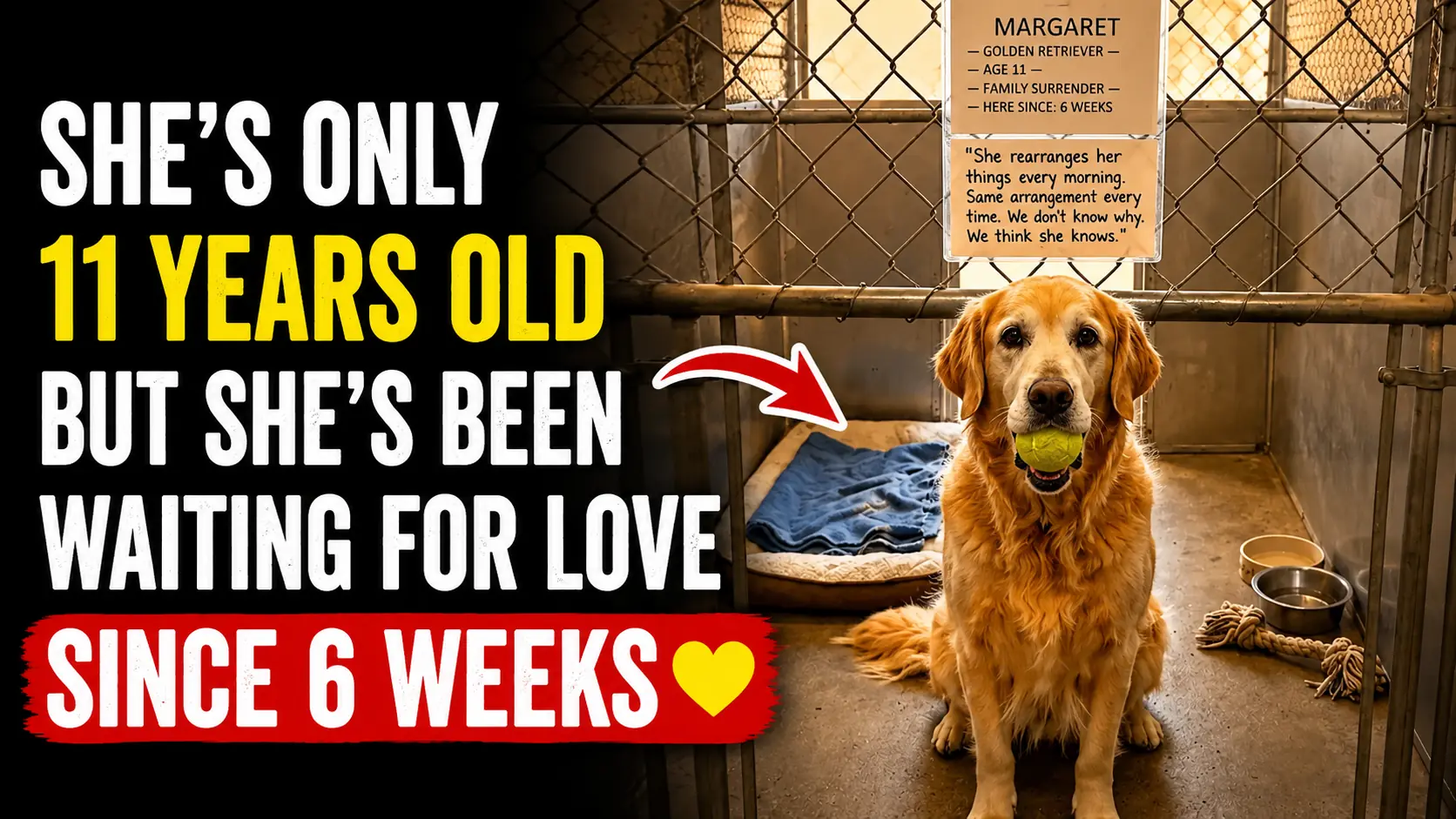
For the volunteers who care for him every day, that ball has become almost as familiar as Charlie himself. It follows him from one side of the kennel to the other. He carries it outside for enrichment time, brings it back to his bed, and occasionally rests his chin directly on top of it when he sleeps.
We cannot know exactly why the ball matters to him.
Perhaps it was a favorite toy before his life changed. Perhaps it simply became familiar during an uncertain period. Dogs can form strong associations with objects through scent, routine, and repeated experiences, and a familiar toy can provide comfort when everything else around them suddenly feels different.
Whatever the explanation, Charlie clearly prefers having it nearby.
His physical condition is stable.
A complete veterinary examination did not reveal any major injuries or serious illness. His heart and lungs sounded normal, his mobility was comfortable, and routine blood work was reassuring overall.
Charlie arrived slightly underweight, though the difference was subtle beneath his coat. His veterinarian believes inconsistent feeding before shelter intake may have contributed, so his weight is now being monitored carefully.
He receives regular, measured meals and has responded very well.
His appetite is strong.
In fact, Charlie has learned the schedule of the shelter food cart so well that he often stands before it reaches his section.
Then, once breakfast is finished, he usually looks for the ball.
His emotional adjustment has taken more time.
When Charlie first entered the adoption center, he spent long periods watching the front of his kennel.
The shelter hallway is busy during the day.
People enter.
Doors open.
Dogs bark.
Volunteers pass with leashes.
Families stop in front of one kennel and then move toward another.
Charlie quickly learned that footsteps could mean attention.
The moment someone approaches, his head rises.
Sometimes he stands.
His tail begins moving slowly.
If the visitor stops, Charlie often picks up the tennis ball.
Then he walks a small circle.
Sometimes another.
Occasionally a third.
Afterward, he lowers himself to the floor again, usually facing the gate.
The behavior appears to help him settle.
Our veterinary and behavior teams have not found signs suggesting a neurological problem. Instead, the circling seems to be part of Charlie’s normal settling routine, especially when he is excited or uncertain.
Once he lies down, the ball usually stays between his front paws.
Then he watches.
That is the part our staff finds hardest.
Charlie has a very expressive face.
When someone stands outside the kennel, his eyes follow every movement.
If the person crouches, his tail moves faster.
If they speak to him, Charlie sometimes presses closer to the fence.
But eventually most visitors continue walking.
Charlie watches until they disappear.
Then he lowers his head.
A few minutes later, another person may enter the hallway.
And Charlie tries again.
The child’s drawing on his kennel has made those moments even more memorable.
It is a simple picture.
A house.
A dog.
A young figure beside it.
Nothing elaborate.
The kind of drawing a child might make quickly with crayons or markers.
According to the information that arrived with Charlie, the drawing may have come from a young family member from his previous home. We have no way to confirm every detail of its history, so we are careful not to build a story around something we cannot verify.
What we can say is that the picture has remained with Charlie.
It is attached outside his kennel where he cannot damage it.
Visitors notice it.
Some stop to look.
Then they look at Charlie lying underneath with his tennis ball.
One volunteer admitted that she sometimes avoids looking at the drawing too long.
Not because there is anything sad about the picture itself.
Quite the opposite.
The house is cheerful.
The dog is drawn beside a person.
It represents the kind of ordinary life most shelter dogs are waiting for.
For Charlie, that ordinary life feels especially close and especially far away at the same time.
Our staff has been working to make sure his days contain more than waiting behind a fence.
Charlie receives several walks and enrichment sessions every day.
Outside the kennel, his personality changes almost immediately.
He becomes more curious.
He likes sniffing along the edge of the exercise yard and investigating whatever other dogs have left behind.
He is not excessively energetic.
After several minutes of exploring, he often settles into a comfortable pace.
Sometimes a volunteer brings his tennis ball outside.
That is when Charlie becomes noticeably brighter.
He does not always chase it immediately.
Sometimes the volunteer rolls it only a few feet.
Charlie watches.
Then he walks after it, picks it up, and carries it away as though retrieving the ball is only half the game.
Returning it is apparently optional.
He often takes it to a quiet corner and lies down.
The volunteer usually sits nearby.
Those are some of Charlie’s calmest moments.
No kennel gate directly in front of him.
No families walking past.
Just a dog, his familiar ball, and someone who has nowhere else to be for a little while.
Charlie has become affectionate with people he knows.
He does not immediately climb into someone’s lap or demand attention.
His approach is quieter.
He stands close.
He allows someone to rub his shoulders.
Then, if he feels comfortable, he leans.
Sometimes it is only a little pressure against a person’s leg.
Other times Charlie puts his full weight there and stays.
His tail moves slowly behind him.
That is usually when our volunteers see the softer dog hidden beneath all the waiting.
His sleep has also improved.
During his first week, Charlie remained alert for long periods after the adoption center closed.
Even quiet footsteps from evening staff caused him to raise his head.
Now he sleeps more deeply.
He has a padded bed and a blanket in the back of the kennel.
Most nights, the tennis ball ends up there too.
Staff members occasionally find Charlie stretched on his side with one paw still touching it.
That relaxed posture is a good sign.
It means he is beginning to understand that nighttime does not require constant vigilance.
Still, mornings bring the same routine.
Charlie wakes.
He stretches.
He eats breakfast.
He finds his ball.
Then he waits for the adoption hallway to come alive.
We are also helping him prepare for home life.
Because Charlie may have spent a significant period without a predictable household routine, we are reinforcing basic skills such as walking calmly on leash, waiting before doors, settling on a bed, and responding to simple cues.
He learns quickly when food rewards are involved.
He has also become better at settling even when the tennis ball is not directly beside him.
That is important.
We want the ball to remain something comforting, not something Charlie feels he cannot function without.
During short training sessions, volunteers occasionally place the toy several feet away.
At first, Charlie repeatedly checked its location.
Now he can focus on a person for longer periods before returning to it.
Nothing is taken away from him permanently.
The goal is simply helping him understand that familiar things can disappear temporarily and come back.
The same lesson applies to people.
Charlie has developed strong relationships with several volunteers.
When one leaves, he sometimes watches the door.
But increasingly, he returns to his bed instead of remaining on alert.
Then the volunteer comes back another day.
That repetition matters.
Someone leaves.
Someone returns.
The ball moves.
The ball returns.
Dinner arrives every evening.
Breakfast arrives every morning.
Predictability slowly replaces uncertainty.
Physically, Charlie continues to do well.
His weight has begun moving toward a healthier range, and he is maintaining good muscle tone through regular walks.
His coat and skin are healthy.
His appetite and hydration remain normal.
He does not currently require medication for a significant medical problem.
His next veterinary appointment will be a routine wellness recheck.
Our biggest concern now is simply how long he remains in the shelter.
Even when a dog receives excellent care, a kennel is not a permanent home.
Charlie deserves more space than the few steps he takes before turning in another circle.
He deserves to hear household sounds instead of rows of barking dogs.
He deserves a window he can look through without chain-link between him and the rest of the world.
He deserves a person who knows exactly where that old tennis ball belongs.
The camera that first captured Charlie’s behavior started close to him.
You could see his eyes.
The ball beneath his paw.
The small movements of his tail when he noticed someone watching.
Then Charlie stood.
He carried the ball briefly.
He walked two slow circles.
Then another half circle.
Finally, he lowered himself to the floor again.
As the camera moved farther away, more of the kennel became visible.
The metal bowls.
The concrete floor.
The chain-link gate.
And outside that gate, the child’s drawing of a little house and a dog.
Charlie remained inside.
The house remained on paper.
That wider view seemed to tell his story better than anything we could write.
Charlie already knows how to wait.
He has had plenty of practice.
What he has not had is the chance to discover what happens when the waiting finally ends.
We hope someday soon a family will stand in front of his kennel and stay long enough to meet him outside it.
They will see the dog who likes slow walks.
The dog who leans into familiar hands.
The dog who carries an old tennis ball like it is worth more than every new toy in the building.
Maybe they will notice the drawing too.
Then, hopefully, the kennel door will open.
Charlie will probably pick up his ball.
He may walk one little circle because that is what he does when something important is happening.
Then he will follow them out.
And perhaps one day the picture of a house taped outside his kennel will no longer feel like a reminder of something he lost.
It will simply look like where Charlie went.
For now, he remains safe, fed, medically cared for, and loved by the people looking after him.
But Charlie is still waiting for the one thing no shelter can permanently provide:
his own person, his own bed, and a real home where the old tennis ball can finally stay in one place.