First day in prison. First step into the yard.
“Another Black boy in my house.”
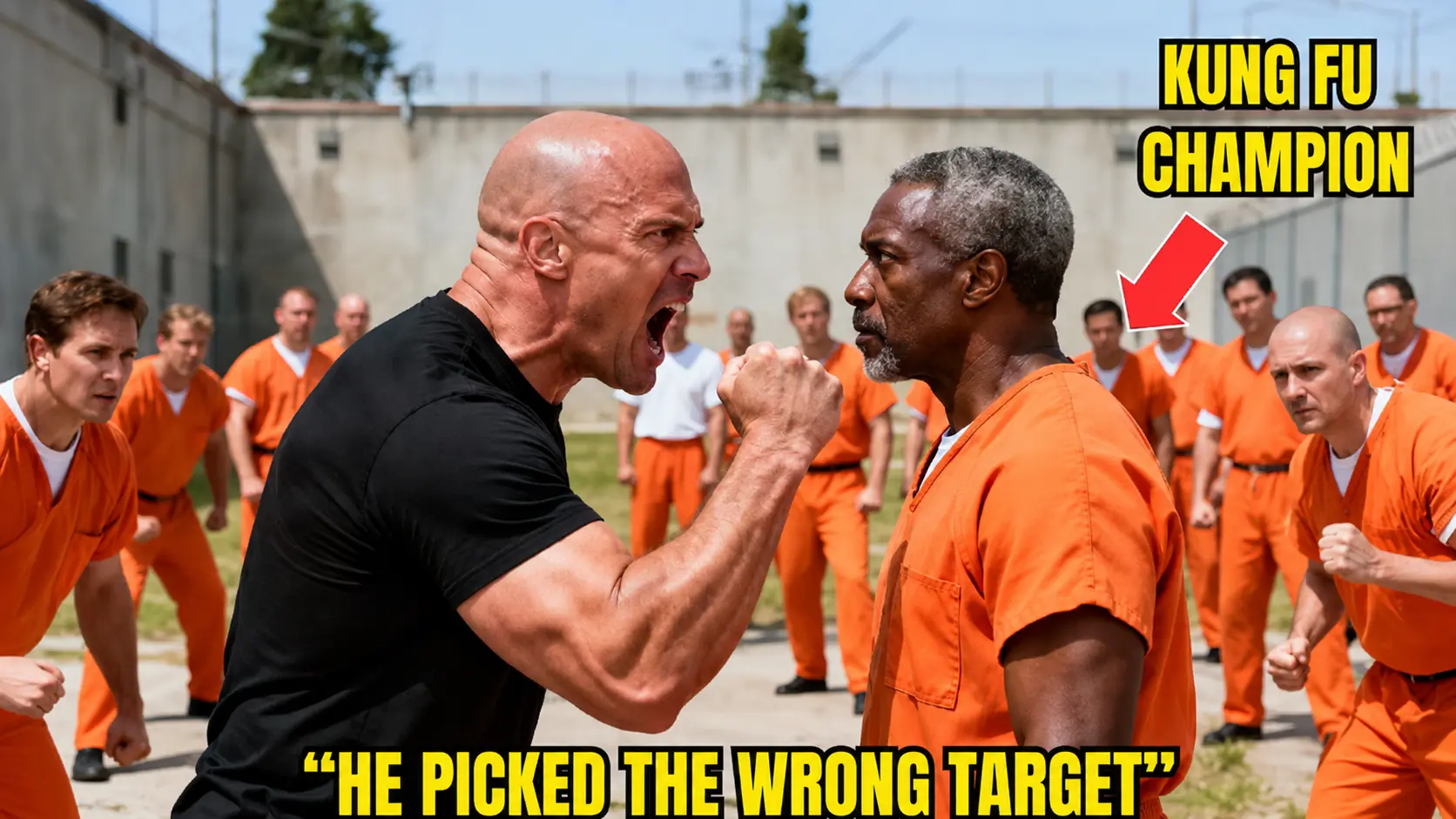
The boot swept his legs out. Byron Harrison’s face hit concrete. Blood bloomed from his lip.
Rex “Mamba” Collins stood over him. White swastika on his neck. He ground his boot into Byron’s skull.
“You people keep showing up like cockroaches.” He spat. “This is a white man’s yard.”
Two hundred inmates watching. Nobody moved.
Byron’s voice was steady.
“I don’t want trouble.”
“You are trouble. Your skin is trouble.” Rex kicked his ribs. “Call me master.”
Silence. Then, quietly:
“Yes, master.”
Rex grinned.
“Good boy. Now crawl back to your cell.”
Byron crawled. Blood dripping.
In three days, this moment would replay before every inmate. The ending would leave them silent. Because the old Black man on his knees—fifty-two fights, fifty-two victories, zero defeats—the Silent Dragon—was about to make it fifty-three.
Rex Collins had ruled this prison for six years. His gang, the Aryan Knights, controlled everything. Food distribution. Bed assignments. Protection money. Contraband. Information. The guards looked away. Some were on payroll. Others were simply afraid.
White inmates paid tribute. Black inmates paid double. Latino inmates paid triple or faced consequences no one discussed openly. Anyone who resisted met Rex in the yard. Fourteen fights. Fourteen victories. Three men never walked again. Two more ate through straws for months.
Byron learned the hierarchy quickly.
His first night, he lay in his cell listening to the sounds of prison. Metal doors clanging. Men shouting. Someone crying three cells down. The constant hum of fluorescent lights that never fully shut off.
He thought about Kevin. His son. Twenty-eight years old. A good man who’d made one desperate choice to protect his family. The drug dealers had threatened Kevin’s wife and daughter. When one of them broke into the house, Kevin fought back. The dealer died.
Self-defense, any reasonable person would say. But reasonable people didn’t make decisions in that courtroom. The prosecutor wanted a conviction. The public defender was overworked. The jury saw a Black man and a dead body.
Byron had walked into the police station three days before the trial.
“I did it,” he’d said. “My son wasn’t there. I killed that man.”
The confession was false. The evidence was thin. But Byron was convincing, and the system was tired, and a closed case was a closed case.
“I’ve lived my life,” he’d told Kevin through the visitation glass. “You have a wife. A daughter. A future. I have memories. That’s enough.”
Kevin had wept. Begged him to recant. Byron refused.
Now he was here, serving fifteen years for a crime he didn’t commit, waiting for the appeal that might free his son. Waiting to disappear into the system.
He hadn’t planned on becoming visible.
The prison was segregated by unwritten law. White tables in the cafeteria. Black tables along the wall. Latino tables near the windows. Mixing meant consequences. Byron sat alone. Ate slowly. Watched everything.
Rex held court at the center table. His lieutenants flanked him like generals around a warlord. Carter—massive, with SS bolts tattooed on his forearms—handled enforcement. Miller—lean and cruel, with dead eyes—managed the money. Thompson, whom everyone called the Butcher, did things no one spoke about.
They laughed loudly. Took food from passing trays. Made inmates kneel to retrieve dropped items. Every interaction was a performance. A reminder of who held power.
Byron observed Rex’s movements. The way he walked—chest out, shoulders back, taking up space like the world owed him room. The way he threw practice punches at his men. Wild hooks. Telegraphed jabs. Street fighting learned in back alleys and bar brawls. Powerful but undisciplined. Dangerous but predictable.
Fifty-two opponents had made that mistake. Mistaking aggression for skill. Mistaking size for superiority. Mistaking loud for strong.
Byron had beaten them all.
The Silent Dragon. Three-time world kung fu heavyweight champion. Undefeated across fifteen years of professional competition. He’d retired at forty to open a school. To teach. To build something beyond trophies.
Then Sarah got sick. Then she died. Then Kevin got in trouble. Then Byron walked into that police station.
Now he was fifty-five. Gray-haired. Deliberately small. An old Black man in a prison run by white supremacists. Invisible. Just the way he wanted.
Terrell Washington changed that.
The kid was twenty years old. Skinny. Scared. Three weeks inside for petty theft—stealing food to feed his younger sister after their mother’s overdose. He sat at Byron’s table one evening, hands shaking so badly he could barely hold his fork.
“You’re the new guy. The one Rex made crawl.”
Byron nodded.
“How do you stand it? The things they say. The things they do. Every day they find new ways to remind us we’re nothing here.”
“By remembering why I’m here.”
“Why are you here?”
Byron looked at the young man. Saw the fear. The confusion. The desperate hope that someone—anyone—had answers.
“To protect someone I love. That’s worth any humiliation. Any pain. Any amount of crawling.”
Terrell didn’t understand. Not yet. But he kept sitting there. Something about the old man felt safe. Like the eye of a hurricane. Calm while chaos raged around it.
The next day, Carter intercepted Terrell in the meal line.
“Protection fee’s due, boy.”
“I paid last week.”
“That was last week.” Carter smiled. Teeth yellow. Breath foul. “Interest. You know how it works.”
“I don’t have anything left. I gave you everything.”
“Then you better find something. Or find another way to pay.”
The implication hung in the air. Terrell’s face went pale.
“Please. I’ll get it. Just give me time.”
The slap echoed across the cafeteria. Terrell crumpled against the serving counter, his tray scattered. Food everywhere. His lip split open. Blood mixing with mashed potatoes on the floor.
“Clean it up,” Carter said. “With your tongue.”
Two hundred inmates suddenly fascinated by their own meals. Eyes down. Mouths shut. Survival meant not seeing.
Terrell looked around. Desperate. Hoping. Nobody moved. He lowered his head toward the floor.
“Leave him alone.”
Every head turned.
Byron stood three tables away. His voice was calm. Quiet. But it carried like thunder in the silence.
Carter laughed.
“The crawler speaks. You forget your place already, old man?”
“He’s a child. He has nothing. He can’t pay what he doesn’t have. Leave him alone.”
“Or what?”
The question hung between them. The whole cafeteria waited. Byron said nothing.
Carter walked toward him. Slow. Deliberate. Each step a threat. He stopped inches from Byron’s face. Close enough that Byron could smell the onions on his breath.
“Rex already marked you. He marked you property. You don’t get to speak. You don’t get to look at me. You don’t get to exist unless we say so.”
Byron held his gaze. Steady. Unblinking.
“I said leave him alone.”
Carter’s fist came fast. A sucker punch meant to drop him. End the conversation. Establish order.
Byron moved. Slight. Almost imperceptible. The fist grazed his cheek instead of shattering his jaw. Carter stumbled forward, thrown off balance by hitting nothing. He caught himself on a table. Turned. Confusion mixing with rage.
The cafeteria went silent.
Byron hadn’t thrown a punch. Hadn’t raised his hands. He’d simply moved like water around a stone.
Carter attacked again. Wild hook. Byron shifted. Straight jab. Byron tilted. Overhead smash. Byron stepped. Each time, minimal movement. Maximum efficiency. Each time, Carter hit air.
“Enough.”