“You have no business being in this neighborhood. Hands on the hood. Now.”
Officer Marcus Ellison’s voice cracked through the quiet of Oak Creek Estates with the brittle confidence of a man who had already decided he was right.
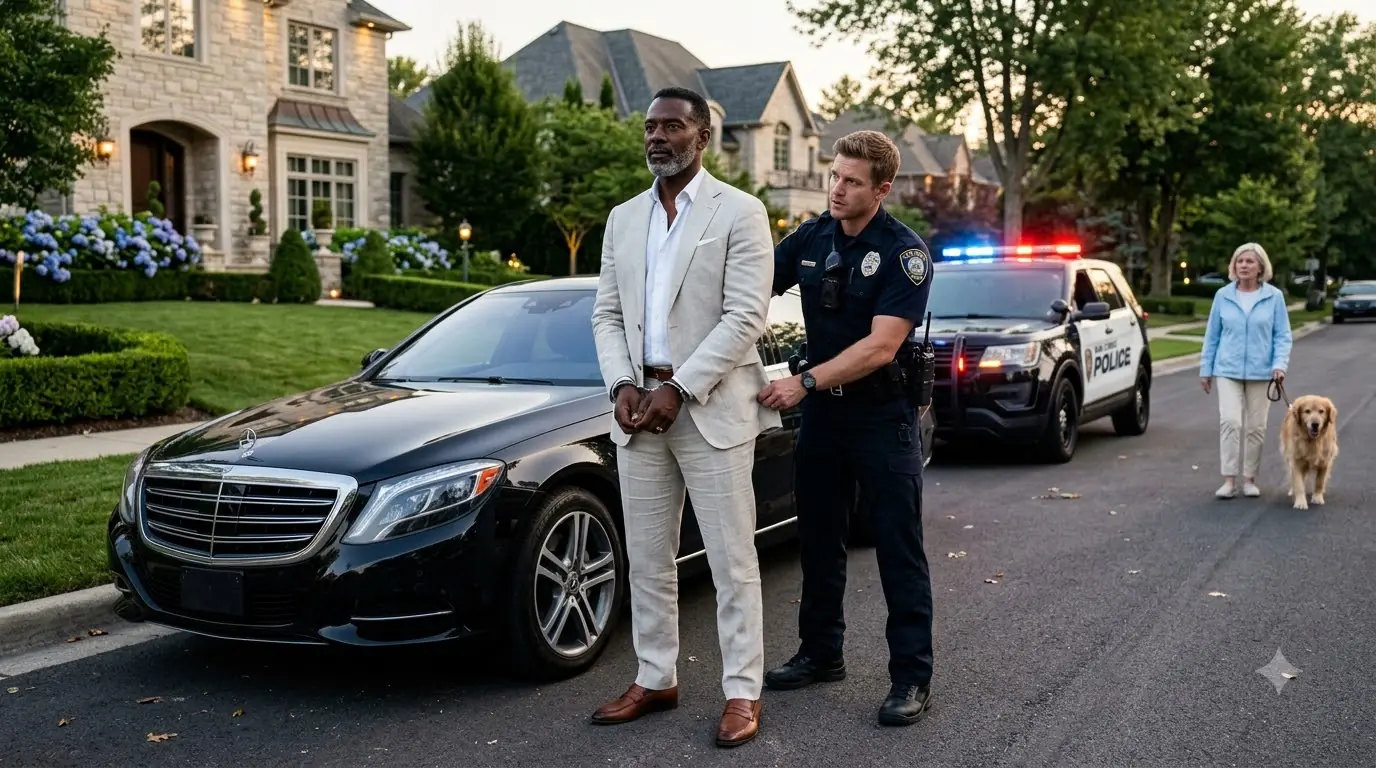
His right hand rested high on his duty belt, close enough to his holstered pistol that the gesture was impossible to misunderstand. His left hand pointed toward the hood of his patrol cruiser, its emergency lights washing the immaculate stone walls and trimmed hedges in alternating red and blue.
The man standing in front of him did not move.
Victor Langford was fifty-eight years old, broad through the shoulders despite the silver beginning to show along his beard. He wore a pale linen jacket over a white open-collar shirt, dark trousers, and loafers that had picked up a little dust during his evening walk. Nothing about him suggested urgency.
That seemed to irritate Ellison most of all.
Victor had spent thirty-one years in law enforcement.
He recognized insecure authority immediately.
It almost always arrived loudly.
The sun was dropping behind Oak Creek’s enormous homes, stretching shadows across lawns so precisely maintained they looked artificial. Sprinklers clicked behind decorative stone walls. Somewhere farther down Elmwood Drive, a lawn mower droned and then stopped.
It should have been an ordinary Tuesday evening.
Victor had intended it to be.
Three days earlier, he and his wife, Sarah, had completed the purchase of a mid-century house at 442 Willow Creek Drive, three blocks from where he now stood. The house had floor-to-ceiling windows, an aging slate patio, and a neglected garden Sarah was already planning to tear apart and rebuild.
Victor loved the garden precisely because it needed work.
After decades spent looking at institutions that claimed they could not change, he found comfort in soil.
He had left his temporary apartment shortly after six, telling Sarah he wanted to walk the neighborhood before dinner. She was still in Chicago wrapping up the sale of their old condominium and would join him permanently that weekend.
Victor had called her when he passed the Vance property because the hydrangeas planted along its southern wall were the exact deep blue she wanted for their new yard.
That was what he had been doing when Ellison saw him.
Talking about flowers.
Officer Marcus Ellison had constructed an entirely different story.
Ellison was thirty-two, five years into the department, physically fit, impeccably groomed, and obsessed with the appearance of professionalism. His uniform was always pressed. His boots were polished. His cruiser was cleaner than most.
Supervisors who liked him called him proactive.
Officers who did not trust him called him hunting.
There had been complaints.
A college student stopped while carrying groceries because Ellison claimed he matched a vehicle-burglary suspect.
A Latino landscaper ordered onto the ground after reaching toward the identification hanging around his neck.
Two teenagers detained outside a convenience store because Ellison said they appeared nervous.
None of the incidents, individually, had ended his career.
That was part of the problem.
One complaint lacked video.
Another victim refused to continue after learning how long the process might take.
A third investigation concluded that Ellison’s actions were “within the broad discretion afforded an officer during an evolving encounter.”
Every survival strengthened his certainty.
The absence of punishment became, in his mind, proof of correctness.
That evening, Ellison had been cruising Oak Creek because he liked the route. The neighborhood was quiet. Calls were rare. Residents tended to wave when they saw police cars.
He also liked the feeling of being the visible guardian of a place where everything looked expensive.
Then he saw Victor Langford.
An older Black man walking alone.
No dog.
No jogging clothes.
No visible connection to a landscaping crew, delivery truck, or service vehicle.
Victor paused beside the Vance property and looked toward the house.
To Ellison, that was enough.
He slowed.
Victor reached into his jacket.
Ellison’s posture changed immediately.
Then Victor produced a phone.
“Sarah,” Victor said warmly when his wife answered, “you should see the Vances’ hydrangeas. That color might actually work along the south wall.”
Ellison trailed him at walking speed.
Twenty yards.
Then fifteen.
Victor noticed the cruiser in the reflection of a parked SUV.
He did not react.
Years of police work had taught him not to assign intention before evidence.
Maybe the officer was looking for an address.
Maybe he had been dispatched nearby.
Maybe he was simply driving slowly.
Victor kept walking.
Ellison did not.
Red and blue lights activated silently behind him.
Victor stopped.
“Hold on, Sarah.”
“What is it?”
“Police car.”
“Everything okay?”
“I’m sure it is.”
Victor lowered the phone.
The cruiser swung across part of the sidewalk and stopped at an angle.
The driver’s door opened.
Officer Ellison stepped out.
His hand was already near his holster.
That was the first detail Victor noticed.
The second was Ellison’s face.
Not concern.
Not professional curiosity.
Suspicion already hardened into certainty.
“Hold it right there,” Ellison called.
Victor stayed where he was.
“Hang up the phone.”
Victor looked at the nameplate.
ELLISON.
He stored it automatically.
“I’m speaking with my wife.”
“I said hang it up.”
Sarah heard that.
“Victor?”
He raised the phone slightly.
“I’ll call you back.”
“Don’t—”
He ended the call.
Victor slipped the phone into his pocket slowly.