“Get on your knees and pick up this mess. Now.”
Officer Derek Hutchkins did not raise his voice. He did not need to. The authority in his tone came from the badge on his chest, the gun at his hip, and the certainty that no one standing in front of him had the right to question either one.
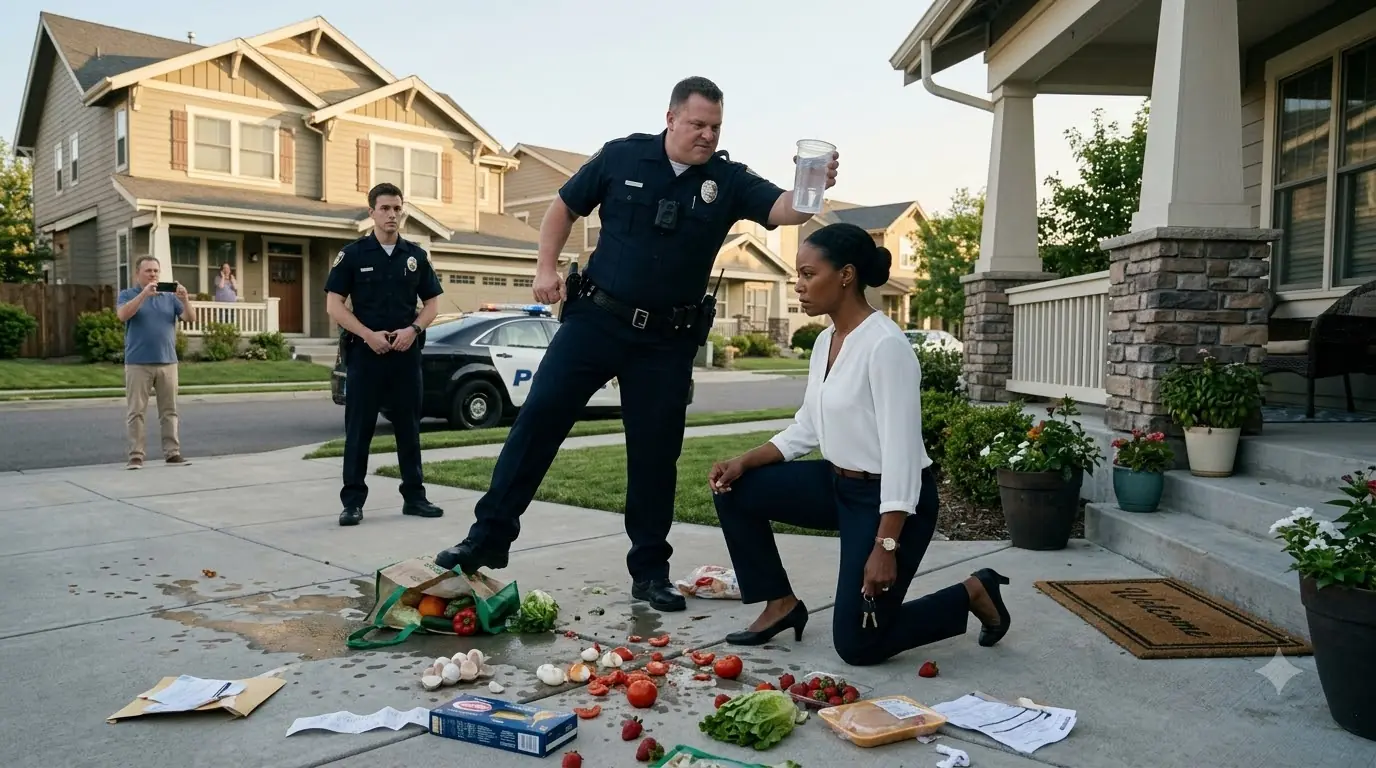
Dr. Imani Clark Richardson stood in her own driveway, eight feet from her own front door, staring at the groceries he had just dumped onto the concrete. Broken eggs leaked yellow into crushed tomatoes, dry pasta rolled toward the curb, and one corner of her cracked tablet glinted beneath a folded medical journal.
“Officer, please,” she said, fighting to keep her voice steady. “This is my home. I was just trying to go inside.”
“I don’t care what you were doing.” Hutchkins lifted the enormous convenience-store cup he had been carrying since he stopped her. “People like you need to learn respect when a badge is talking.”
Then he tipped the cup.
Cold cola poured across the back of Imani’s white blouse, through her hair, over her shoulders, and onto the papers she was trying to rescue. For three seconds, she did not move. She remained kneeling on the warm concrete, one hand around a crushed tomato, the other pressed flat against a page that had already turned translucent with soda. Across the street, Tom Carter’s phone recorded everything.
The red light on the phone blinked steadily.
Hutchkins dropped the empty cup beside her. “That’s better,” he said. “Stay down there where you belong.”
Imani rose slowly.
Her face did not show the humiliation burning through her. It did not show the fear that had been gathering since the officer first placed his hand near his weapon. It did not show how violently her pulse was beating beneath the soaked collar of her blouse. What it showed instead was control—the kind of control she had spent a lifetime building because she knew, long before that afternoon, that Black women were often punished for emotions other people were allowed to display freely.
Her house keys were still in her left hand.
The teeth of the keys had cut half-moon marks into her palm.
She looked at Hutchkins, then at the front door behind him, then at the neighbor across the street holding up his phone. She understood, with the sudden clarity that sometimes arrived in emergencies, that this moment was already larger than the insult itself. Hutchkins did not know who she was. That was precisely the point.
The day had begun fourteen hours earlier with coffee, scrambled eggs, and an argument about whose turn it was to use the family car.
At 6:30 that morning, the Richardson kitchen smelled of toasted wheat bread and cinnamon coffee. Imani stood at the counter in a soft gray robe, her natural hair twisted into a loose bun, whisking eggs while listening to her sixteen-year-old son, Devon, make a case for borrowing the sedan that evening. He delivered his argument with the confident logic of a teenager who believed every inconvenience could be solved by someone else surrendering a vehicle.
“Mom, I only need it for three hours,” he said, staring at his phone while he spoke. “And I’ll put gas in it.”
“You mean the gas your father pays for?” Imani asked.
Devon looked up. “Details.”
James Richardson entered the kitchen tying a navy silk tie around his neck. At forty-eight, he had learned how to look calm even when three crises were waiting on his desk at City Hall. He kissed Imani’s forehead, stole a piece of toast from Maya’s plate, and ignored their fourteen-year-old daughter’s outraged protest.
“Big day,” James said as he reached for his travel mug. “Police budget meeting at three. Donovan’s bringing the misconduct numbers.”
Imani’s whisk stopped for half a second. “The repeat complaints?”
James nodded. “That’s the issue. Some officers have multiple complaints over the same kinds of stops. Search, detention, disrespect, escalation. The union keeps pushing back every time Internal Affairs tries to treat patterns as patterns instead of isolated incidents.”
Maya looked between her parents. “Can we talk about literally anything else before school?”
James smiled. “Soccer?”
“Better.”
The conversation moved on because family life had a way of insisting on ordinary things even when public problems waited outside the door. Maya needed poster board after school. Devon had an algebra quiz. James had a donor dinner that evening. Imani had three patient consultations and a board packet to review for the community health center she directed.
From the street, the Richardson family looked like a political advertisement: the mayor, the physician, two bright children, a handsome Colonial home in Riverside Heights. Inside, they were four people constantly misplacing chargers, forgetting grocery lists, and arguing about who had finished the orange juice. Their life had taken years of education, debt, work, sacrifice, and deliberate choices to build. None of it had appeared overnight.
Riverside Heights, however, had opinions about what kinds of people were supposed to appear overnight.
The neighborhood sat on the north side of the city, shaded by old sycamores and maples whose roots had buckled the sidewalks into gentle waves. Home prices averaged well over a million dollars. The residents included surgeons, attorneys, executives, retired professors, and owners of businesses that carried their surnames on brass plaques downtown. When the Richardsons moved into 847 Elmwood Drive fourteen months earlier, the local real estate section ran a photograph of the house but never mentioned that the city’s Black mayor had bought it.
For the first few weeks, neighbors brought wine, flowers, and welcome baskets. Most were genuine. Some were not.
In the second month, an anonymous note appeared beneath the brass mail slot: IS THE MAID STAYING OVERNIGHT NOW? Imani found it at 6:15 in the morning while leaving for the clinic. She stood on the porch reading the sentence three times before folding the paper into quarters and putting it in her purse. James wanted to call the police, but she had refused.
“Not for this,” she had said. “Not yet.”
By month four, a woman at the homeowners association meeting asked whether the Richardsons were “renting temporarily.” When Imani said they owned the house, the woman blinked twice and answered, “Oh. I just assumed.” She never explained what she had assumed, and nobody else asked her to.
Month seven brought the first police encounter.
Imani was standing beside the curb at nine in the evening retrieving a package that a delivery driver had left near the mailbox. A patrol car slowed. The officer inside watched her for nearly thirty seconds before asking whether she lived there. She had answered yes and pointed toward her illuminated porch.
“Got ID?” the officer asked.
She had shown him because she was alone and because pride had never felt as important as getting home safely. He returned the license, said they had received a report of a suspicious person, and drove away. The next morning, none of the neighbors admitted making the call.
After that, Imani began noticing the patrol car.
Same dark blue cruiser. Same broad-shouldered officer. Same slow roll past Elmwood Drive two or three times a week. Once, while she watered hydrangeas in front of the porch, the officer stopped long enough for their eyes to meet through his open window.
He did not wave.
She did.
He drove away.