The first thing Judge Evelyn Brooks noticed was the reflection of a police cruiser in the wet pavement. The second was the way the officer walking toward her had already drawn a conclusion before he asked a single question.
He moved quickly across the parking lot, one hand near his holster, his eyes fixed on the black leather purse hanging from her shoulder.
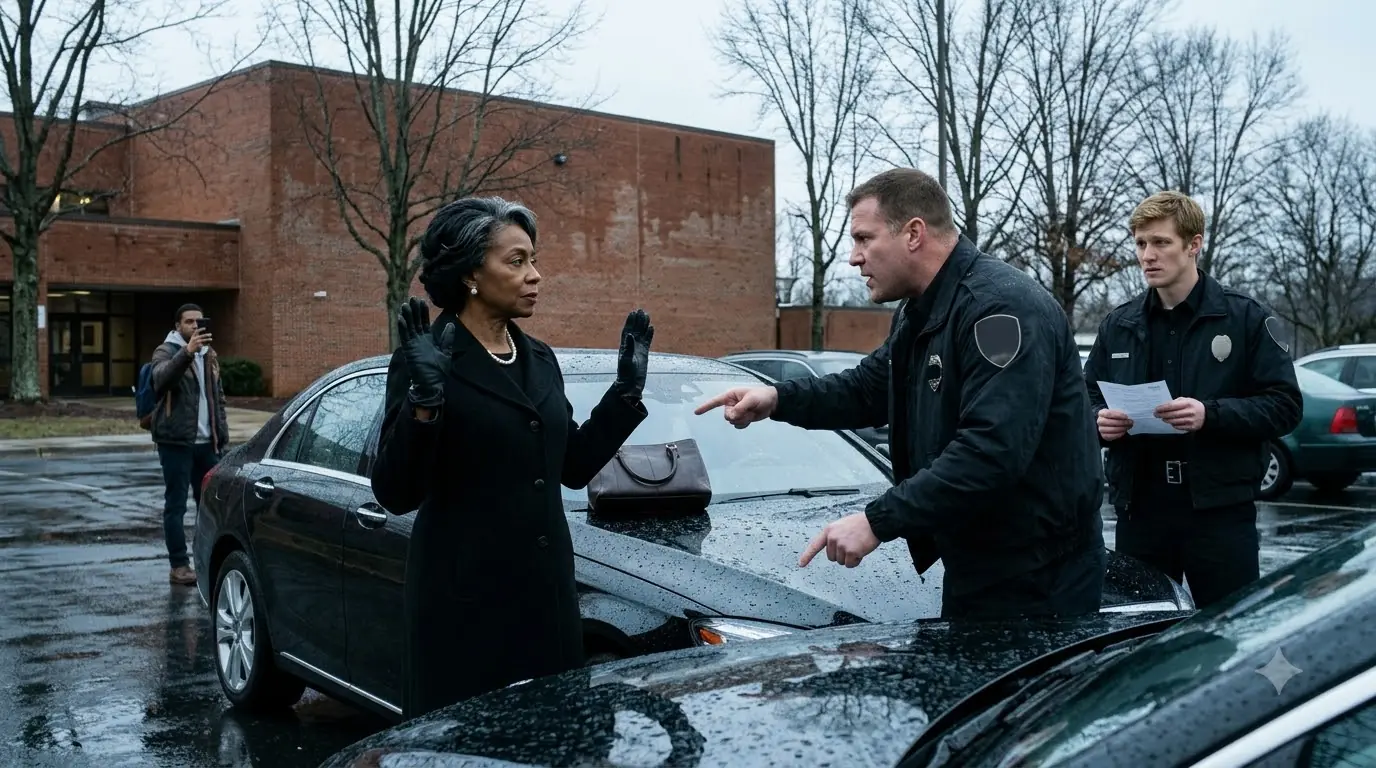
She had spent thirty years watching people make statements under oath, and she recognized certainty unsupported by evidence when she saw it.
"Ma'am, stop right there."
Evelyn stopped beside her black Lexus and turned without moving her feet. The late-November wind had a bite to it, and drops of rain still clung to the bare maple branches around Ashford Community College. She was sixty-six years old, wearing a black wool coat over a charcoal dress, with pearl earrings and a single strand of pearls at her throat. Her hair, black threaded with silver, had been arranged neatly that morning, and she had no intention of allowing an unexpected encounter to make her forget her manners.
"Is there a problem, officer?" she asked.
"Hands where I can see them. Now."
She raised both hands, palms forward, and let the purse slide down the length of her forearm until it rested against her elbow. "My hands are visible," she said. "Would you please tell me why you've stopped me?" The officer's expression hardened as though the question itself were an offense. Behind him, a younger officer slowed, looking first at Evelyn and then at the car.
"Don't argue with me," the older man said.
"I'm not arguing. I'm asking a question."
"You think sounding educated makes you special out here?" His voice rose enough to turn the heads of several people crossing the lot. "You're just another suspect. I suggest you remember that."
Evelyn could hear the scrape of a student dragging a wheeled suitcase along the sidewalk. Somewhere behind the student center, a delivery truck was backing into its loading bay, beeping each time its rear wheels moved. The ordinary sounds made the confrontation feel more disturbing, not less. People were still going about their Friday afternoons while an officer prepared to treat her as dangerous without explaining why.
"Then I suggest you watch how you speak to me," Evelyn replied, her voice measured rather than sharp.
The officer took another step. "I don't care who you think you are. When I give an order, you obey it."
His name was Detective Ryan Mercer, though Evelyn had not yet read the name stitched above his badge. At thirty-eight, Mercer was broad through the shoulders, thick-necked, and accustomed to the small satisfactions of making other people uncomfortable. Twelve years with the Ashford Police Department had taught him how to fill an uncomfortable silence with louder commands. Those years had not taught him the difference between cooperation and submission.
Mercer had built a reputation on stops that produced cash, vehicles, contraband, and elaborate reports describing the necessity of his decisions. Complaints about his manner had been filed, examined briefly, and closed. The department's clearance statistics offered administrators convenient reasons to overlook the patterns underneath. Chief Douglas Cain called Mercer energetic, and Mercer understood that description as permission.
The younger officer was Noah Bennett, twenty-seven, with sandy hair, a lean build, and three years on patrol. Noah had been assigned to assist Mercer on a follow-up visit near the college, though he had never enjoyed working with the detective. He still read policy bulletins after difficult calls, and he still remembered his academy instructors saying that a person's rights did not depend on how cooperative the officer found them. In recent months, he had begun to realize how different the printed rules looked from the habits some of his colleagues rewarded.
Noah's girlfriend, Emily, was six months pregnant with their first child. Every baby catalog on their kitchen table reminded him how expensive it would be to lose his job, while every kick he felt beneath Emily's hand reminded him that his daughter would someday ask what kind of police officer her father had been. He had not decided which fear weighed more. In the college parking lot that afternoon, the question stopped being theoretical.
"We're looking for a black vehicle involved in an armed pharmacy robbery," Mercer said. He nodded at the Lexus as if its presence confirmed something. "Need to see what you've got in the purse."
"I can tell you where I've been," Evelyn answered. "I just gave the keynote address at the scholarship fundraiser inside. The organizers and dozens of attendees can confirm that."
Mercer ignored the offer. "Black SUV. Driver matches a description."
"This is a sedan," Evelyn said. "How old was the person in your description?"
"Around thirty," Noah answered before he could stop himself.
For a second, all three looked at one another. Evelyn was more than twice the reported age, and her sedan was not a sport utility vehicle. Noah remembered the incomplete bulletin he had glanced at earlier in the cruiser: a possible sighting from another district, no confirmed plate, no connection to the college. He also remembered that the last updated dispatch message had said the pharmacy incident was no longer an active vehicle search. He could feel the error growing larger, and Mercer was already stepping closer.
"Hands up," Mercer barked.
Evelyn raised them higher. "They have not moved."
A student near a bike rack stopped walking and brought out his phone. His name was Julian Price, and he had just finished helping break down tables at the fundraiser. He recognized Evelyn from the stage, where she had spoken about how a scholarship could change a family's future. Through the phone screen, he watched an officer treat that same woman as though she had committed some unnamed offense.
"Officer, is your body camera recording?" Evelyn asked.
"Don't worry about my camera. Open your purse."
"I am not reaching into my purse while you are ordering me to keep my hands raised," Evelyn replied. "You have not explained the grounds for a search, and I have not consented to one."
Mercer leaned forward. His jaw had tightened so much that the words seemed to come through his teeth. "You don't get to tell me what I can search."
"Ryan," Noah said quietly, "we can check the campus schedule and the registration before we do anything else."
Mercer turned his head. "You want to run this stop, Bennett?"
"No, sir. I'm saying the description doesn't really—"
"Then stand where I can see you and watch her hands."
Evelyn looked from one officer to the other. She knew too much about the consequences of being mistaken for a threat to take comfort in Noah's hesitation. She shifted her weight because one heel was standing in a puddle, and the electronic key fob slipped from the edge of her glove. When she caught it between two fingers, sunlight broke through the clouds and flashed against its metal trim.
"Gun!" Mercer shouted.