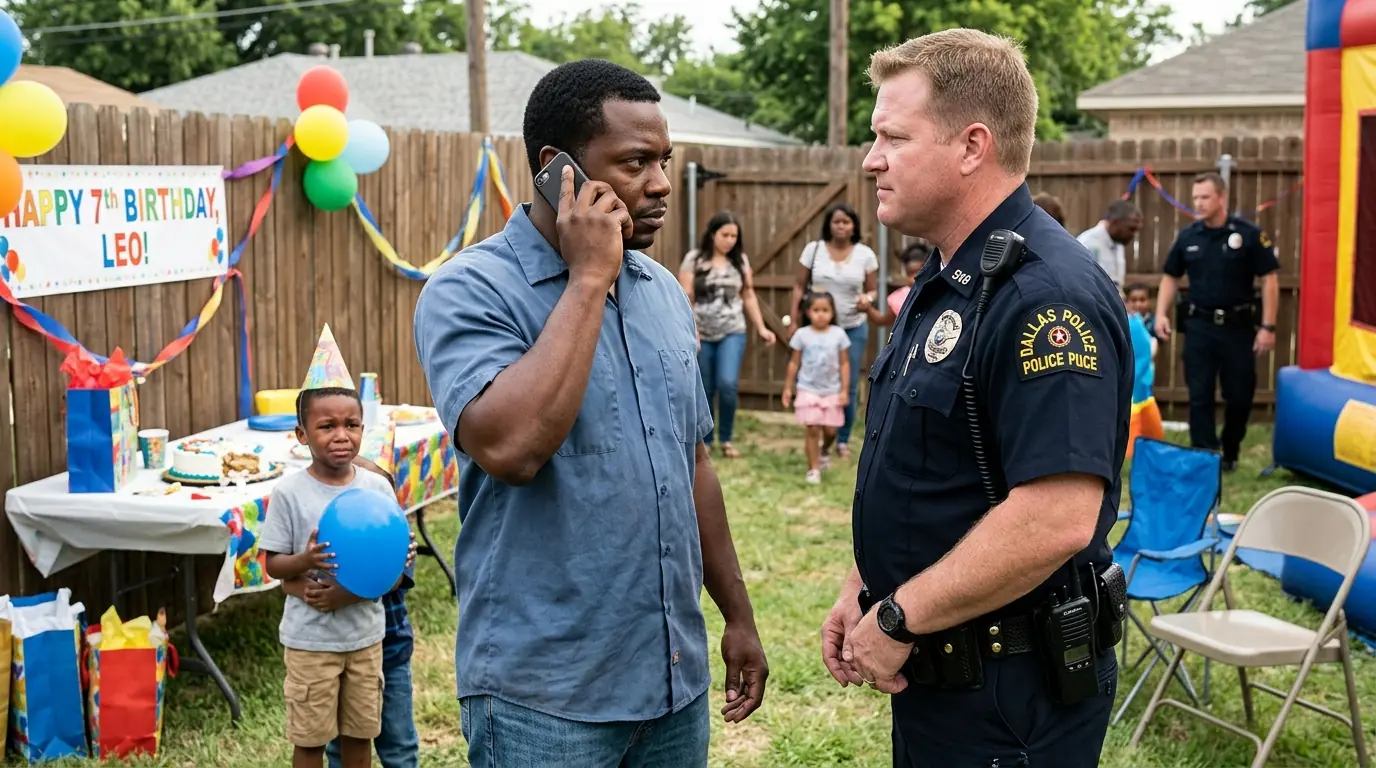
“Everybody out. This party is over.”
Officer Grant Harlow’s voice cut across the backyard like thunder.
The music stopped first.
Then the laughter.
Then the children.
One moment, seven-year-old Noah Carter was standing beside a Spider-Man cake with blue frosting on his fingers, smiling while everyone sang Happy Birthday.
The next, four police officers were walking through the side gate, stepping over balloons, pushing past folding chairs, and ordering every guest to leave.
Noah froze with the plastic cake knife still in his hand.
His mother, Angela, stood near the picnic table with her hands pressed to her chest.
Neighbors looked at one another, confused.
Children clutched paper plates and half-empty juice boxes.
A little girl in a yellow dress started crying when one officer kicked aside a stack of wrapped presents to clear a path.
Officer Harlow pointed toward the driveway.
“I said move. All of you. Right now.”
Noah looked up at his father.
“Daddy?”
His father, Daniel Carter, stood near the grill in a plain white T-shirt and jeans.
He was not a big man.
He was not loud.
He had been quiet all afternoon, flipping burgers, passing out napkins, making sure every child got a balloon.
Most of the guests knew him as the soft-spoken dad who worked long hours, fixed neighbors’ fences without charging, and waved every morning when he took Noah to school.
Nobody in that backyard knew what Daniel Carter used to do for a living.
Nobody knew why he kept a locked metal box in the bottom drawer of his desk.
And nobody knew why, when Officer Harlow stepped toward Noah’s birthday cake and said, “Pack it up before I start making arrests,” Daniel did not shout.
He did not rush forward.
He did not beg.
He simply wiped his hands on a towel, looked at his son’s frightened face, and asked one question.
“Officer, do you have a warrant?”
Harlow turned slowly.
The other officers went still.
“A warrant?” Harlow repeated.
Daniel’s voice stayed calm.
“Yes.”
Harlow gave a short laugh.
“For a backyard birthday party?”
“For entering private property and ordering lawful guests to leave,” Daniel said. “Yes. I’m asking whether you have a warrant, a court order, or an emergency basis.”
The backyard became completely silent.
The only sound was the soft plastic flutter of a red balloon caught against the fence.
Officer Harlow stepped closer.
“Listen carefully,” he said. “We received a complaint about an illegal gathering, loud music, public disturbance, and possible gang activity.”
Angela whispered, “Gang activity?”
Harlow looked at the children, then at the adults, and let his eyes settle on the Black and Latino fathers standing near the fence.
“Looks like the complaint had some merit.”
Daniel’s jaw tightened, but his voice did not change.
“This is my son’s seventh birthday.”
Harlow leaned in.
“Then teach your son that rules apply to people like him too.”
Noah heard it.
So did everyone else.
The boy’s lower lip trembled.
The cake candles were still smoking.
Daniel looked at his son.
Then at the presents on the grass.
Then at the neighbors being pushed toward the side gate while their children cried and asked what they had done wrong.
That was when Daniel reached into his pocket and took out his phone.
Officer Harlow frowned.
“Who are you calling?”
Daniel did not answer.
He tapped one number.
Only one.
The call connected after two rings.
Daniel’s voice remained soft.
“This is Daniel Carter. I need you at my house. Right now.”
He listened.
Then he added, “Yes. It’s Grant Harlow.”
Officer Harlow’s face changed.
Just slightly.
But Daniel saw it.
He had been trained to see small changes in people’s faces.
He heard the voice on the other end.
Then he said one final sentence.
“My son is standing beside his birthday cake while your officers clear my backyard without a warrant.”
He hung up.
Noah looked at him with wet eyes.
“Daddy, are they taking my birthday?”
Daniel knelt in front of his son.
“No,” he said. “They’re not taking anything from you.”
But to understand why that phone call made Officer Grant Harlow suddenly stop smiling, you have to go back thirteen years.
Before Noah.
Before the little blue house on Willow Street.
Before the backyard fence, the birthday banners, the Spider-Man plates, and the grill smoking under the oak tree.
Daniel Carter had once been a federal investigator.
Not the kind who wore sunglasses in movies.
Not the kind who kicked down doors for applause.
He worked civil rights cases.
Police misconduct.
False arrests.
Illegal searches.
Retaliation.
Patterns inside departments that good people whispered about and powerful people buried.
For nine years, Daniel worked for the Department of Justice Civil Rights Division.
He built cases carefully.
Quietly.
He was the man who read every report, compared every timestamp, found the missing page, and asked the question nobody wanted answered.
He was not famous.
He was effective.
Then came the Westbridge case.
A city three hours away.
A police unit accused of targeting Black families with illegal home entries, fake nuisance complaints, and intimidation visits.
The pattern was always the same.
A vague anonymous call.
A claim of loud music.
A claim of drugs.
A claim of “suspicious activity.”
Officers entered without warrants.
Families were humiliated.
Guests were ordered out.
Phones were knocked down.
Children watched their fathers get cuffed for asking basic questions.
For two years, nobody could prove coordination.
Then Daniel Carter proved it.
He found that the complaints were not coming from neighbors.
They were being generated from inside the department.
Officers were using the complaint system as a weapon, creating fake calls to justify entering homes and intimidating families that had filed complaints against police.
Daniel’s investigation sent two officers to prison, forced the department into federal oversight, and made him enemies in uniform across the state.
One of the names in that case was Grant Harlow.
Back then, Harlow was a young officer, not charged, not disciplined, but named repeatedly in interviews as someone who had participated in intimidation visits.
There had not been enough evidence to prosecute him.
Daniel remembered that.
So did Harlow.
Years later, Daniel left federal work after Angela became pregnant with Noah.
He wanted a quieter life.
He wanted dinners at home.
Soccer practice.
School plays.
Birthday parties.
He wanted his son to know him as Dad, not as the man who came home carrying stories too heavy for the dinner table.
So he moved to Brookhaven, bought a small house on Willow Street, and took a job as a compliance director for a medical nonprofit.
He put his old files away.
He kept one phone number active.
Deputy Attorney General Malcolm Reeves.
The man who had supervised the Westbridge case.
The man Daniel had just called.
Noah’s birthday had started beautifully.