The first shelf hit the floor before Samuel Reed fully understood that the men charging through his front door were police officers rather than robbers wearing uniforms. Bags of chips burst from a spinning wire rack, boxes of crackers scattered beneath black boots, and a young officer slammed shoulder-first into the wooden bread display Samuel had built with his father almost thirty years earlier, sending fresh rolls and bagels across the tile. At the center of the chaos stood Captain Victor Hale, a broad-shouldered veteran officer with nearly two decades on the department, holding a folded search warrant above his head while ordering everyone inside Reed’s Market to keep their hands where police could see them. Samuel remained behind the register in his white bakery apron, staring at the document in Hale’s hand until one small line of print made him say the four words that would drain every trace of confidence from the captain’s face: “Check the warrant address.”
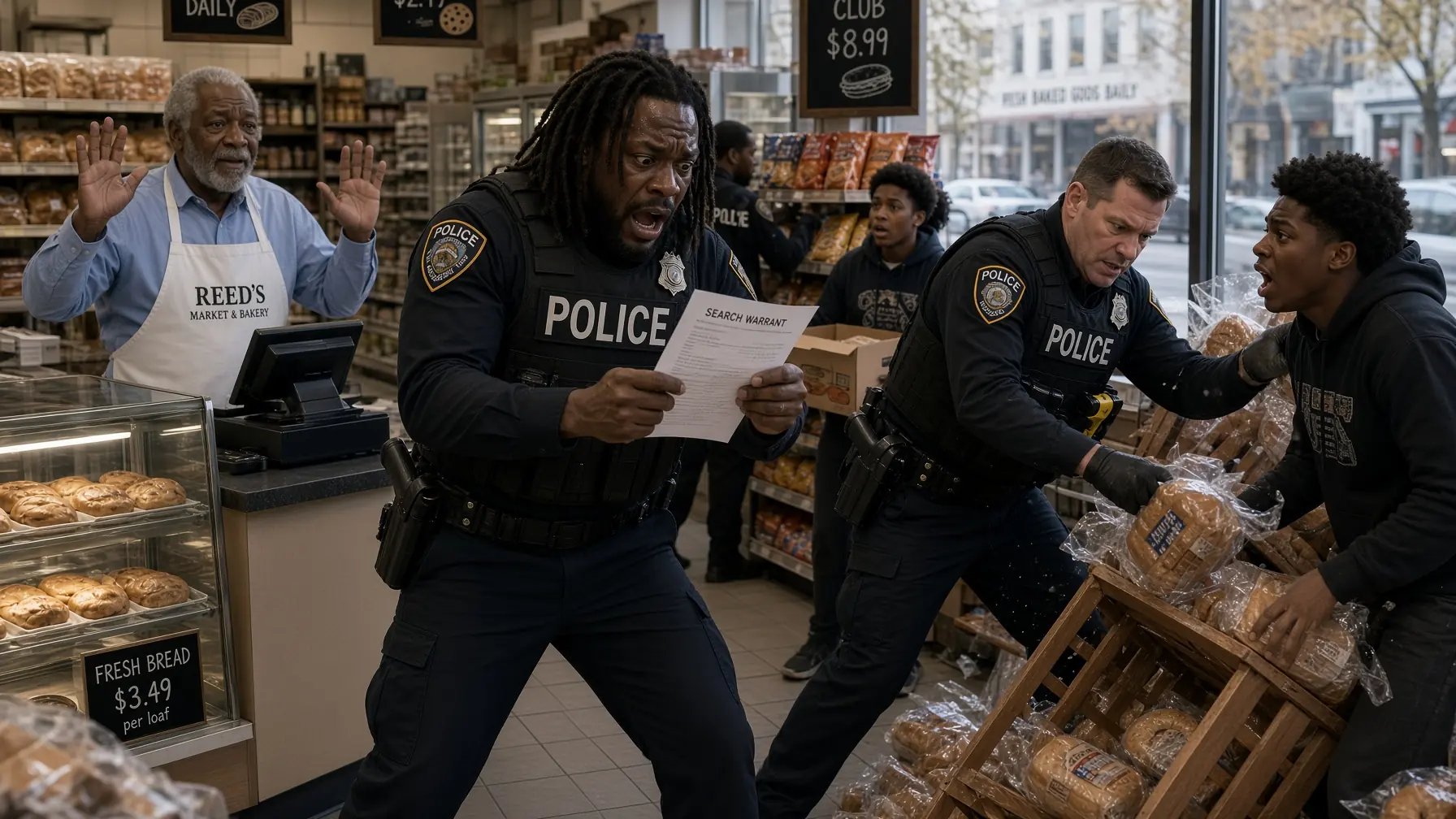
Only forty-one seconds had passed since the first officer crossed the threshold, but the store already looked as though a small storm had traveled through it. Claudia Reyes stood beside the sandwich counter with both hands raised and tears running down her face, seventeen-year-old Malik Foster was frozen near a fallen carton of canned soup, and two elderly customers remained pressed against the wall because nobody had yet told them they were allowed to move. Samuel could smell fresh cinnamon bread, spilled coffee, dust from the broken shelving, and the strange metallic odor that seemed to enter a room whenever frightened people stopped breathing normally. Above them all, the black-and-white portrait of Samuel’s father, Arthur Reed, hung crooked on the wood-paneled wall as if even the dead man had been disturbed by the sudden violence below.
Samuel Reed was seventy-one years old and had spent nearly his entire adult life behind one counter or another inside that building. His father had opened Reed’s Market in 1959 with two grocery shelves, a butcher case purchased secondhand from a closing restaurant, and enough optimism to believe a neighborhood would support a small store even when large supermarkets began appearing along the highways. Samuel started sweeping floors there at nine, learned the register at fourteen, and took responsibility for ordering produce before he was old enough to vote. By the morning police rushed through the doors, he had spent fifty-seven years learning exactly what belonged inside Reed’s Market, which was one reason the piece of paper Captain Hale carried bothered him almost immediately.
The store stood at 341 Linden Avenue, a fact Samuel knew more reliably than his own blood pressure because he had written the number on invoices, tax forms, delivery receipts, insurance claims, utility accounts, payroll records, licensing renewals, and thousands of envelopes. The white vinyl digits were also fixed above the front door in numbers large enough to be read from the opposite sidewalk, while a second painted address appeared beside the delivery entrance facing the alley. Reed’s Market occupied a corner storefront with broad glass windows, green awnings, flower boxes Samuel’s late wife had installed, and an old neon sign that glowed red after sunset. Nothing about it resembled the abandoned commercial building police had spent six weeks investigating three blocks away at 314 Linden Avenue.
Captain Hale did not know that when the operation began, although he should have. The signed search warrant inside his hand authorized entry into 314 Linden Avenue, a narrow brick property with a faded plumbing-company sign, a blue roll-up garage door, one boarded lower window, and an exterior staircase leading toward a second-floor storage room. Detectives believed thirty-one-year-old Malcolm Vance used that location to store narcotics, cash, and firearms connected to a regional trafficking organization, and the probable-cause affidavit supporting the warrant contained detailed photographs of the correct building. The investigation itself was real, the warrant had been lawfully approved by a judge, and the evidence officers hoped to recover existed, which made the error at Reed’s Market more troubling rather than less.
The wrong number entered the operation twenty-two hours before the raid when civilian planning clerk Paige Warren prepared the tactical briefing sheet from Detective Aaron Price’s case file. Paige was twenty-nine, careful by reputation, and covering two desks that week because another employee had begun maternity leave earlier than expected, leaving her responsible for an unusually heavy stack of warrant packets. While transferring the target address from the signed document into a standardized operational worksheet, she accidentally reversed the final two digits and typed 341 Linden Avenue instead of 314 Linden Avenue. She did not notice the mistake, and because 341 was itself a valid commercial address, the department’s mapping software accepted it without producing any warning.
One transcription error should never have been enough to send six armed officers through the wrong door. Department procedure required the tactical commander to compare the operations sheet against the signed warrant, verify the street number immediately before deployment, and confirm that the physical structure matched surveillance photographs whenever circumstances safely allowed. The warrant contained the correct number eleven different times, and the briefing packet included four images clearly showing the blue garage door at 314 Linden. Every safeguard needed to stop Paige’s error already existed on paper, but by eight o’clock Thursday morning nearly everyone involved had begun trusting the summary sheet more than the original evidence from which that sheet had been created.
Victor Hale had been a police officer for eighteen years, long enough that nobody could dismiss what happened as the confusion of an inexperienced rookie. He had entered law enforcement at twenty-six, spent seven years on patrol, moved through violent-crime investigations, supervised a robbery unit, and eventually became a captain trusted with warrant operations considered too complicated for ordinary patrol teams. His personnel file contained commendations for de-escalating an armed barricade, evacuating residents during a chemical fire, and pulling an injured officer from an alley after a gun battle, along with one older reprimand for losing his temper with a subordinate during a briefing. Colleagues described him as decisive, prepared, demanding, and occasionally too certain that hesitation was a weakness leaders should eliminate rather than information they should examine.
The operation briefing started at 7:14 that morning inside a windowless conference room at police headquarters. Detective Price, who had spent six weeks building the narcotics case, was home sick with influenza and participated by telephone only long enough to confirm that investigators believed probable cause remained current and Malcolm Vance had been seen near the target recently. Lieutenant Rachel Kim presented surveillance photographs while Hale read from the tactical worksheet, telling officers their target was 341 Linden Avenue and that the site might contain illegal narcotics and several firearms. Nobody stopped the briefing to compare the typed address against the actual warrant lying in the black folder beside Hale’s elbow.
Officer Jack Fenner asked whether civilians might be present at the location because one surveillance note mentioned occasional visitors. Hale answered that pedestrian traffic around the target remained limited during morning hours, which was accurate for 314 Linden but obviously false for Reed’s Market, where construction workers, retirees, parents, schoolchildren, and commuters began passing through shortly after seven. Another officer asked whether the target building still carried the plumbing-company sign shown in photographs, and Kim said investigators believed it did. That should have created a second opportunity for somebody to notice that the address being spoken aloud did not correspond with a grocery store whose bright awning had existed on Linden Avenue for decades.
At 7:52 the team left headquarters in two unmarked SUVs and one marked cruiser, with Hale riding in the first vehicle and Kim in the second. The navigation system directed them toward 341 Linden because that was the number entered into the tactical worksheet, and none of the officers followed the route to the correct building manually because they assumed planning had already resolved the destination. As the vehicles approached the neighborhood, Hale reviewed timing, perimeter assignments, and arrest contingencies rather than reopening the warrant itself. By then, the operation had accumulated enough preparation that stopping to question its foundation felt psychologically harder than moving forward with what everyone believed had already been checked.
Samuel Reed was placing a tray of Lorraine’s cinnamon bread beside the register when the police vehicles entered Linden Avenue. Lorraine had been his wife for forty-three years before ovarian cancer took her seven years earlier, and the cinnamon bread recipe written in her red notebook remained one of the few things Samuel followed without arguing. Claudia was slicing onions in the deli area, Malik was stacking snacks near the window before leaving for a late school start, and retired steelworker Walter Greene sat at the small coffee counter beside his neighbor Ellis Parker. Nobody inside noticed the first SUV until it stopped almost directly in front of the glass entrance.
Lieutenant Kim noticed the mismatch immediately. Her body camera had already been activated under tactical policy, and the recording later captured her leaning forward between the front seats and saying, “Captain, the briefing photo showed a roll-up garage door.” Hale looked through the windshield at the windows of Reed’s Market, glanced toward the address displayed on the navigation tablet, and answered, “Intel may be old.” Kim looked again and said, “This says three-four-one, but something feels off,” giving the operation its clearest opportunity to stop before anybody touched the door.
Hale later admitted that he experienced a brief jolt of uncertainty at that exact moment. He saw the grocery displays, noticed pedestrians entering the building, and understood that the structure looked substantially different from the photographs presented less than an hour earlier, yet the address on the operations sheet matched the number above the storefront and his entire team was already staged behind him. Instead of reopening the signed warrant, he allowed himself to imagine that investigators might have used older photographs or that the grocery store could have become a front for the suspected criminal organization. “Address matches the op sheet,” he told Kim, and then added the command that would return repeatedly during the investigation: “Move.”
Six officers exited their vehicles. Fenner reached the entrance first, pushed through the unlocked door with enough force to strike a rotating snack rack, and shouted, “Police, hands where we can see them,” before the falling bags had finished hitting the floor. Two officers moved left toward the deli counter, another moved toward the rear aisle, and Hale entered holding the warrant while commanding customers and employees not to touch anything. Samuel raised both hands, stared at the confusion, and initially assumed there must be a dangerous person inside the store whom police had followed through the entrance.
“What is happening?” Samuel asked, keeping both hands visible above the register. Hale answered that officers were executing a narcotics search warrant and ordered everyone to remain exactly where they were while the premises were secured. Samuel looked toward the bakery, then toward Claudia, then at Malik, and finally back toward Hale because the explanation was so disconnected from everything he knew about his business that his first reaction was bewilderment rather than anger. “You have the wrong store,” he said, and Officer Fenner answered, “Everybody says that,” without knowing that those four ordinary words from Samuel were far more accurate than any command the officers had given since arriving.
The wooden bread rack broke next. One officer trying to move quickly around the counter struck its side with his hip, causing a leg Samuel had repaired years earlier to split along the grain, and the entire structure tipped forward under the weight of fresh rolls. Bagels, rye loaves, and packaged sweet bread scattered beneath boots while Claudia made a sharp sound of distress and instinctively stepped toward the mess. An officer ordered her back against the wall, and she obeyed immediately.
Malik saw his phone beside the register and reached toward it before remembering the officers surrounding him. Fenner shouted, “Don’t move,” and the seventeen-year-old jerked both hands into the air so quickly that a box of potato chips slipped from his elbow and struck the floor. Samuel watched Malik’s face change from confusion into genuine fear, and something colder than anger entered him. He had employed that boy since Malik was fifteen and knew exactly how rarely police had been associated with safety in the stories Malik brought from school and his neighborhood.
Samuel looked toward Hale again. “Captain, please listen to me because I have owned this building longer than some of your officers have been alive, and nobody here is running a drug operation.” Hale unfolded the warrant partially but remained focused on the team, answering that a judge had authorized the search and Samuel needed to stay out of the way until officers finished securing the premises. Samuel’s eyes dropped toward the exposed first page where the location appeared in larger print beneath the warrant heading. He read 314 Linden Avenue, then lifted his eyes toward the white digits above his own door.
For a moment Samuel thought exhaustion might be confusing him because the difference was so simple that trained officers could not possibly have overlooked it. He looked again, reading the first number slowly in his mind, then turning his head toward the front entrance where 341 stood plainly above the glass. Nothing about the legal document authorized police to search Reed’s Market. Samuel felt his heartbeat become strangely steady.
“What number is on that paper?” he asked. Hale frowned as though the question itself were an attempt to interfere with the operation and answered, “Sir, I need you to remain quiet while my officers work.” Samuel kept his hands raised and said, “I am asking you to read the address.” Hale glanced down only briefly.
That was when Samuel spoke the four words. “Check the warrant address.” He did not shout them, threaten anyone, mention lawyers, or reveal some secret identity capable of frightening police into obedience. He simply pointed with one raised finger toward the document Hale was already holding.
Hale looked down. His eyes moved across the warrant heading, then stopped on the line identifying the premises authorized for search. 314 Linden Avenue.
He looked up at Samuel. Samuel turned his head toward the front door.
Hale followed his gaze. White numbers above the glass read 341. His face lost color so quickly that Lieutenant Kim, standing near the first grocery aisle, stepped toward him and asked, “Captain?”
Hale looked down again. Then at the operations sheet clipped behind the warrant.
The operations sheet read 341. The warrant read 314.
Kim understood before Hale spoke. “Oh, God.”
Hale raised one hand. “Everybody stop.”
Fenner looked toward him.
“Captain?”
“Stop the search now.”
The officer near the stockroom froze with one hand on the door.
Hale’s voice became louder.
“Cease search immediately and touch nothing else.”
For the first time since police entered, the store became quiet. Refrigerator motors hummed, one loose bag of chips slid slowly from the damaged rack, and somewhere near the bakery an automatic timer began beeping because Claudia had been pulled away from an oven. Samuel could hear his own breathing.
Hale walked to the front entrance as though he needed to see the number from closer range. Three-four-one. He stepped outside, looked west along Linden Avenue, and saw addresses decreasing toward the building officers actually wanted.
314 sat three blocks away. Not next door.
Not across the street.
Three blocks.
Hale returned.
Samuel still had both hands raised.
“You can lower your hands, sir.”
Samuel stared at him.
Hale swallowed.
“You can put your hands down.”
Samuel looked toward Fenner, whose right hand remained near his Taser.
“Are your officers done treating us like we are about to attack them?”
Hale turned.
“All weapons secure and hands off equipment.”
Fenner immediately moved his hand.
Samuel lowered his arms slowly.
His shoulders ached.
At seventy-one, holding both hands above his head for less than a minute was enough to awaken old stiffness through his neck and back.
Claudia lowered hers too.
Malik remained frozen.
Samuel said, “Malik, put your hands down.”
The boy looked toward the officers first.
That detail hurt Samuel more than the broken rack.
“Put them down,” Samuel repeated.
Malik obeyed him.
Hale took one step toward Samuel. “Mr. Reed, there has been an operational error.”
Samuel looked at the shattered bread display.
“An operational error.”
“Yes.”
“You raided my store.”
“Yes.”
“You scared my employees.”
Hale looked toward Claudia and Malik.
“Yes.”
“You broke my property.”
“Yes.”
Samuel pointed toward the paper.
“And the warrant in your hand told you not to come here.”
Hale’s jaw tightened.
“The planning sheet had the wrong address.”
Samuel stared at him.
“The warrant did not.”
“No.”
There was nothing Hale could add that made the distinction smaller.
Walter Greene finally turned away from the wall. “Can I move now, or are you people still pretending we run a cartel in the bakery?”
Hale looked embarrassed.
“Yes, sir, you can move.”
Walter faced him.
“Don’t call me sir like that fixes anything.”
Samuel said quietly, “Walter.”
“No.”
Walter stepped forward.
“I came in here for coffee.”
One officer moved instinctively.
Hale raised his hand.
“Let him speak.”
Walter pointed toward the broken bread.
“You people came through that door acting like every person inside was already guilty, and now you’re standing there saying error like somebody sent the wrong sandwich.”
Hale accepted it.
Samuel almost envied Walter’s anger.
His own had not arrived fully yet.
He was still calculating damage.
That was how Samuel handled fear.
He counted.
One broken bread rack.
One bent snack display.
One cracked cooler door.
One fallen daily-special sign.
Several crushed loaves.
Potential lost business.
Two frightened employees.
Two frightened customers.
One incorrect address.
He looked at Hale again.
“Why didn’t anyone read it?”
Hale said nothing.
Samuel repeated the question.
“You had it in your hand, so why didn’t anyone read the warrant before coming inside?”
Lieutenant Kim looked toward the floor.
Fenner looked away.
Hale answered finally.
“We relied on the operational worksheet.”
Samuel nodded once.
“That wasn’t what I asked.”
The captain’s expression tightened.
“You are right.”
Samuel turned toward the crooked portrait of his father.
“That seems to be happening a little late.”
Hale reached for his radio. “Dispatch, Command Three, cancel execution at current location and send an uninvolved patrol supervisor to 341 Linden Avenue.”
The dispatcher responded, “Confirm current address three-four-one?”
Hale looked toward Samuel.
“Affirmative.”
“And target warrant address?”
“Three-one-four Linden.”
Silence passed over the radio.
“Copy, Command Three.”